
Most traders who break a familiar rule are not suffering from complete amnesia. They often know the principle perfectly well, but the live situation suddenly feels special enough to deserve an exception. That difference matters because the solution is not simply, “Try harder to remember.”
Writing the rule changes the structure of the decision. Instead of asking your pressured brain to remember, interpret, and enforce the standard at the same time, you can compare the current behavior with something that already exists outside the moment. The page cannot make you disciplined, but it can make the disagreement visible.
You Probably Did Not Forget the Rule
Imagine your rule is simple: do not chase a move after the planned entry has passed. Before the session, that sounds obvious because there is no urgency attached to it. Then price explodes without you, and suddenly “do not chase” becomes “I am only a little late.”
Nothing important was actually forgotten. The trader remembers the rule but starts changing its meaning because the current situation feels different. Emotional memory does not have to erase the rule; it only has to remember it conveniently.
This is why the problem belongs inside the broader Trader curriculum. Trading discipline is not only about knowing what good behavior looks like; it is also about protecting that definition when pressure makes bad behavior feel reasonable. A rule that exists only in your head has to survive the exact moment most likely to challenge it.
Why Rules Become Flexible Under Pressure
Fast price movement changes how delay feels. A missed move can make patience feel expensive, a second loss can make the next setup seem more important, and a large open gain can make normal fluctuations feel dangerous. Pressure can change how we evaluate the information in front of us, even when the underlying rule has not changed.
That does not mean stress automatically destroys rational thinking or that every trader reacts the same way. It means the emotional importance of the moment can influence how the trader interprets a standard that was previously clear. That is exactly why having an external reference becomes useful.
The same principle appears when FOMO takes over after a move leaves without you. FOMO turns chasing into something that feels like opportunity, which makes the old rule seem unnecessarily strict. The market did not rewrite the rule; the emotional value of participating changed.
Vague Rules Invite Convenient Memory
Many trading rules sound good until you ask what they actually require. “Be patient,” “do not overtrade,” “do not chase,” and “trade good setups” are all reasonable principles. They are also vague enough to mean almost anything after the outcome is known.
A vague rule gives emotional memory plenty of room to negotiate. If “be patient” has no observable meaning, then waiting ten seconds may feel patient during a fast move, while waiting twenty minutes may feel patient on another day. The trader can always explain afterward why the behavior was close enough.
Writing exposes that weakness because the rule has to become clearer on the page. You may discover that what you called a rule was actually a preference with no defined boundary. A useful rule should be specific enough that you can later compare what you planned to do with what you actually did.
Written Rules Create an External Standard
The real advantage of a written rule is not that ink somehow creates self-control. The advantage is that the standard exists before the emotional moment begins. Your pressured interpretation no longer has exclusive control over what the rule supposedly meant.
This builds on the idea that your trading plan is a promise made before the open. P079 goes one step deeper: a promise stored only in memory is still vulnerable to reconstruction when the trade becomes emotionally important. Writing gives the calm version of the trader a voice after the pressured version takes over.
Consider a trader with a simple stopping rule: after the predefined daily stop condition is reached, no new trades are taken that day. The difficult morning arrives, the stopping condition is reached, and the arguments begin: both losses were unusual, the market finally looks cleaner, and one more good trade could repair the session. If the rule exists only in memory, every argument creates room to reinterpret what “stop” was supposed to mean.
Now put the written rule next to the trader: Stopping condition reached → No new trades today. Review tomorrow. Nothing underneath says, “unless the next setup looks really good.” The trader can still break the rule, but now it has to be a conscious rule break rather than a story about what the rule supposedly meant.
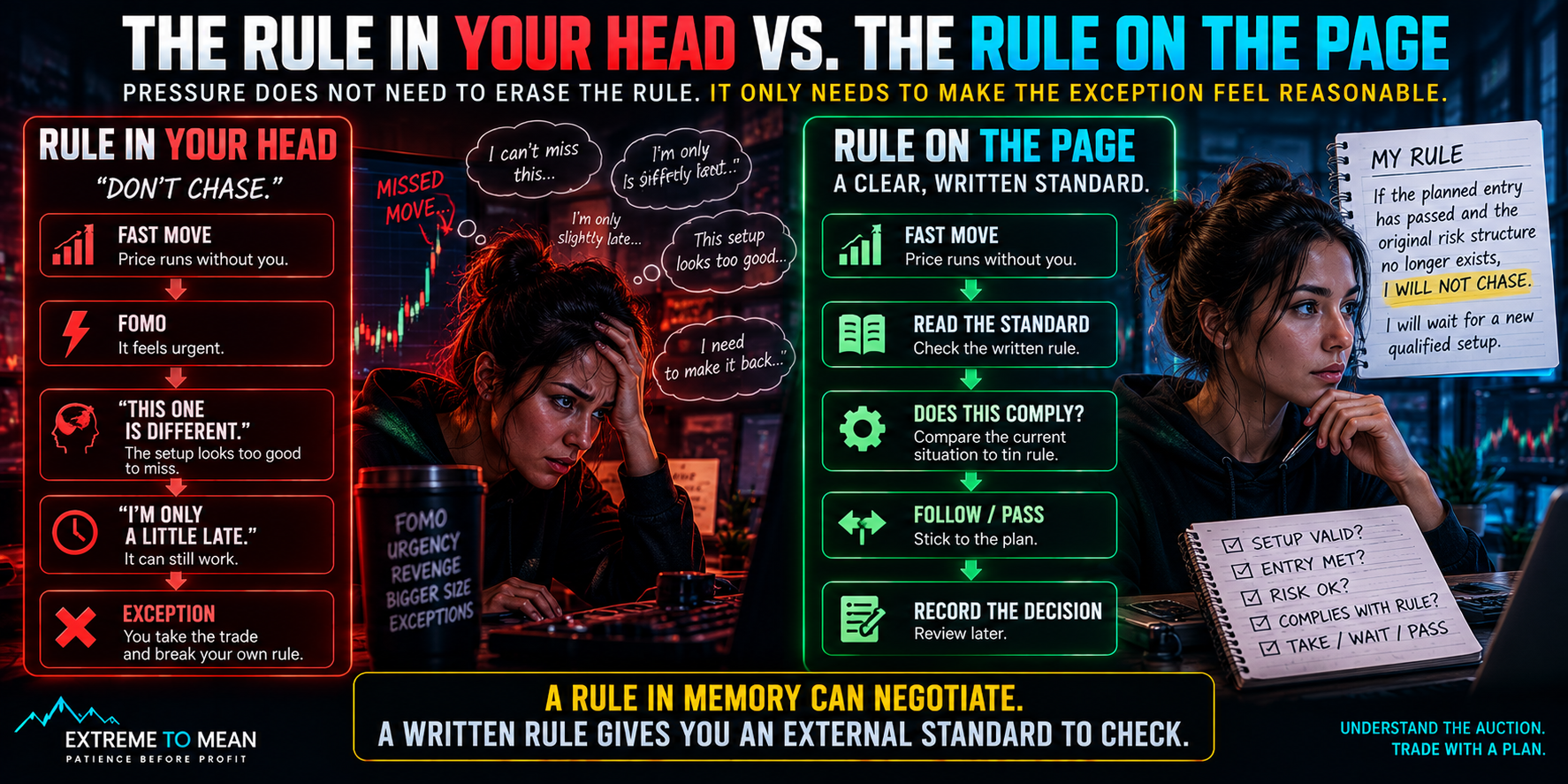
That is an important distinction. Written rules do not eliminate bad decisions, but they make planned behavior and actual behavior easier to compare. The page cannot stop you from breaking a rule; it can stop you from pretending there was no clear rule to break.
Turn Known Failure Points Into If-Then Responses
Some recurring trading problems become easier to manage when the response is decided before the pressure arrives. Instead of relying on a broad instruction like “do not chase,” the trader can define what happens when the known failure point appears. The purpose is to reduce the amount of live negotiation required.
An if-then structure can help: If situation X occurs, then I perform action Y. For example, if the planned entry has passed and the original risk structure no longer exists, then the trader waits for a new qualified setup rather than automatically following price. The exact rule depends on the trader’s process; the useful idea is that the response exists before the temptation.
Another example might involve a predefined stopping condition. If that condition is reached, then the session moves into review rather than another attempt. The value is not that this guarantees compliance; it makes the required response easier to identify when emotion starts suggesting alternatives.
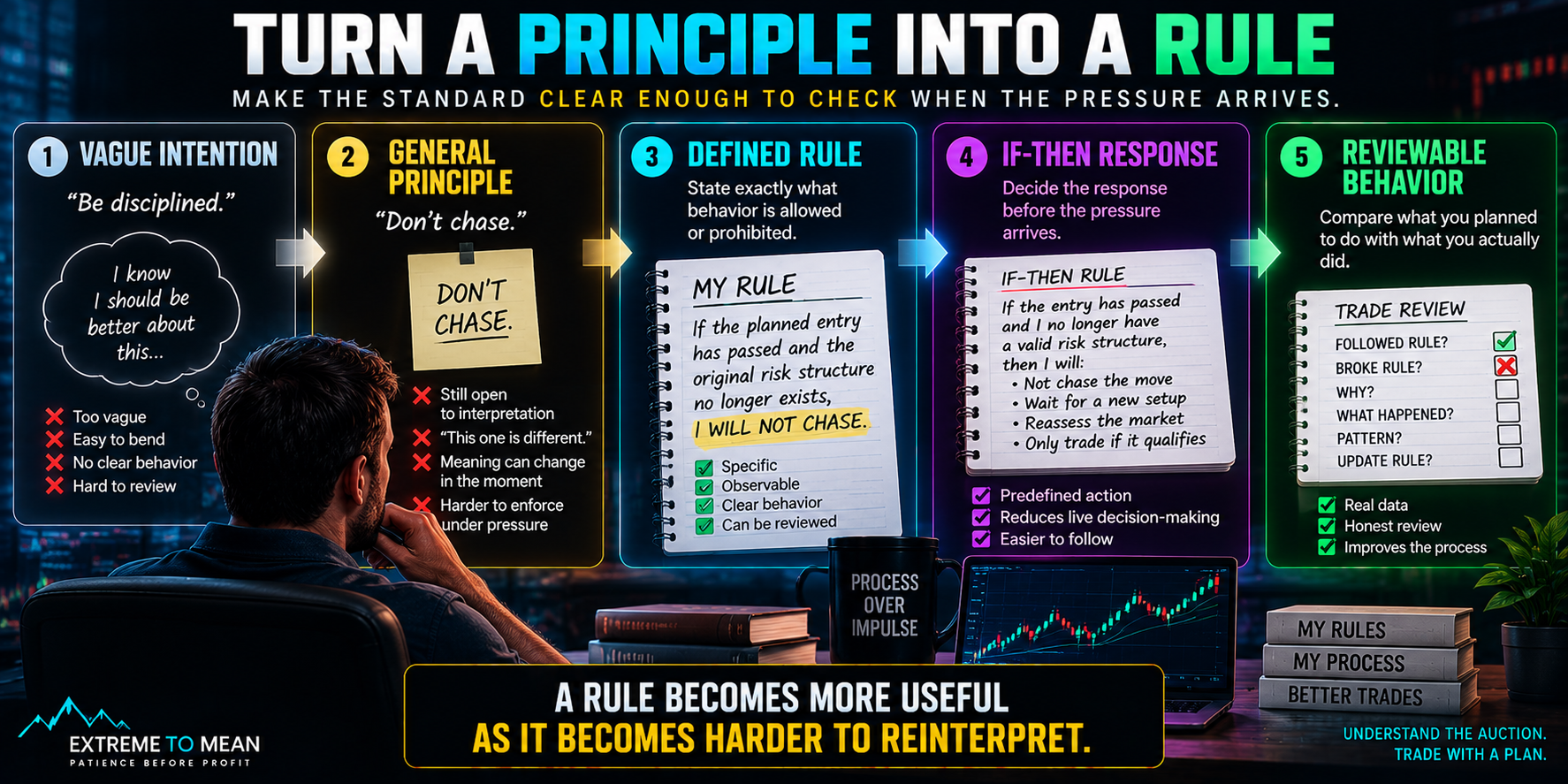
This also helps separate intention from something you can actually review. “I wanted to be disciplined” tells you very little after the session. “Condition X occurred, my written response was Y, and I did Z instead” gives you something concrete to examine.
Not Every Trading Decision Should Be Mechanical
Written rules should reduce unnecessary interpretation without pretending every trading decision can be reduced to a checkbox. Market context, setup quality, meaningful location, changing conditions, and other parts of trading may legitimately require judgment. Good process does not require turning the trader into a robot.
The danger is using “discretion” as a convenient name for every exception. Judgment should operate where the process genuinely allows judgment, not wherever the trader suddenly wants permission to do something different. A visible rule helps expose the difference.
That is also why a checklist should support judgment rather than replace it. Protecting your next decision still requires you to think about context and risk, but the behavioral boundaries around that decision can remain clear. Use judgment where judgment belongs; do not call every exception judgment.
Change Rules During Review, Not During Temptation
A written rule is not supposed to become sacred forever. Markets change, strategies develop, experience improves, and evidence can reveal that a rule needs revision. A good process must leave room for that evolution.
The important question is when the rule changes. Revising a rule during a scheduled review because repeated evidence supports the change is completely different from rewriting it at 10:17 a.m. because one particular trade suddenly feels too important to miss. Review is where the rule evolves; pressure is where the rule gets tested.
A useful question is, “Would I change this rule right now if there were no open P&L attached to the decision?” If the answer is no, the evidence probably has not changed—the emotional importance of the moment has. Change rules because the evidence changed, not because the trade became personally urgent.
Winning should not automatically excuse the exception either. If you break the written rule and the trade makes money, ask whether you would want to repeat that same behavior across many similar situations. A winning rule break can still reveal a process problem.
The ETM Written-Rules Framework
The process can be reduced to six steps:
- PRESSURE — Something creates emotional urgency.
- PAUSE — Do not let the feeling automatically become the action.
- READ — What does the written rule actually say?
- COMPARE — Does the behavior you want to take match the standard?
- ACT — Follow the rule, or consciously acknowledge that you are breaking it.
- RECORD — Review repeated conflicts later when the emotional moment has passed.
The purpose is not to remove thought from trading. It is to stop forcing your most emotional version of yourself to reconstruct standards that the calm version never bothered to make visible. The written rule becomes the bridge between intention and live behavior.
A few review questions can make that bridge stronger: What exact situation is making me want an exception? Did I define an exception beforehand, or am I inventing one now? Has the market actually changed, or has my emotional state changed?
The strongest question may be this: If I break this rule and the trade wins, would I want to repeat the behavior? That shifts the review away from outcome and back toward repeatability. If the answer is no, the profit did not make the decision cleaner.
When a trader repeatedly ignores written boundaries because another opportunity feels necessary, the issue may begin turning into chasing the trade. The written rule gives that behavior something concrete to collide with. What happens next can then be reviewed honestly instead of reconstructed from memory.
Final Thought
You do not need written rules because you are incapable of remembering what you believe. You need them because live trading can make a familiar exception feel more reasonable than it looked while you were calm. A visible standard preserves what you intended before the pressure arrived.
Write the rule while you are calm so you do not have to reconstruct it while you are tempted. Then let review—not urgency—decide whether the rule deserves to change. Do not ask your most emotional version of yourself to accurately remember, interpret, and enforce a standard your calm version never bothered to write down.
Educational content only. Trading involves substantial risk and is not suitable for everyone.