
For this lesson, the practical examples focus on U.S. equity-index futures such as ES, NQ, YM, RTY, and their Micro equivalents because the U.S. cash-equity session materially changes their intraday environment. Inside The Market, the useful question is not simply when futures are open, but what kind of market you are likely to be trading at that point in the session. “Best time to trade futures” is really “best time to trade this futures market with this strategy.”
That distinction matters because equity-index futures trade through most of the business day and overnight session, but participation is not constant. Global events can move them well before New York opens, while the U.S. cash open and close bring a different concentration of participants into the auction. Treasury, crude-oil, gold, agricultural, and currency futures can have different important windows, so the equity-index rhythm in this article should not be treated as universal. Open is a trading-hours fact; active is a market-condition fact.
Volume, Liquidity, Volatility, and Opportunity Are Different
Volume tells you how much actually traded, liquidity describes how easily participants can transact size without excessive price impact, and volatility describes how much and how quickly price is moving. A high-volume period can be liquid, a high-volatility event can temporarily thin displayed depth, and a quieter period can still be perfectly tradable for a small order. More volume, more liquidity, and more volatility are three different statements.
Opportunity is another variable because it depends on the strategy. A breakout trader may need expansion and acceptance, a mean-reversion trader may need extension followed by stabilization, and a scalper may care more about execution quality and frequent interaction. Activity creates movement; a setup determines whether that movement deserves risk.
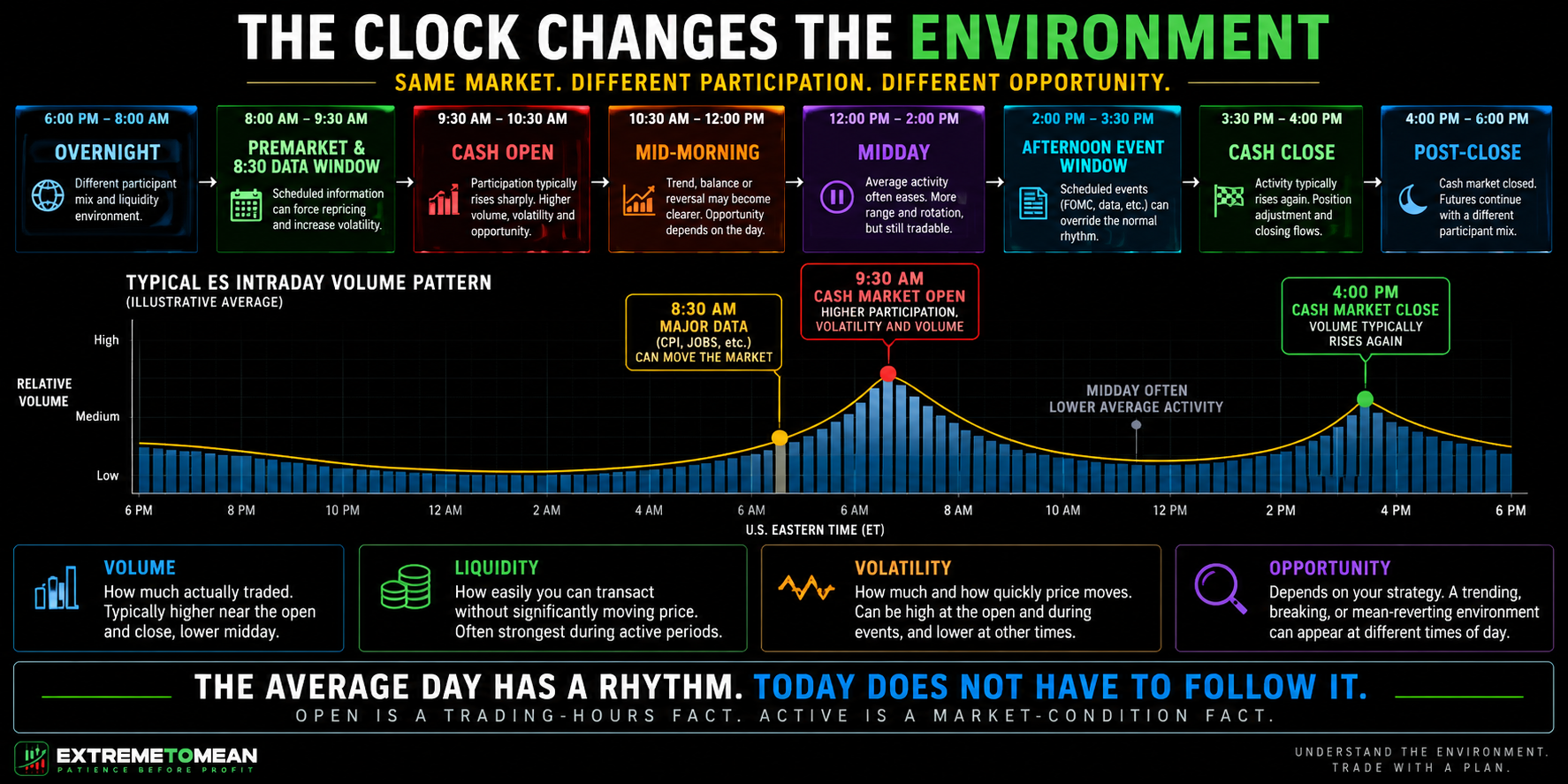
CME research on E-mini S&P 500 futures describes a U-shaped average intraday volume curve, with heavier activity around the 9:30 a.m. ET cash open and the 4:00 p.m. ET cash close and less activity through the middle of the day. That gives equity-index traders a useful baseline without turning the average into a schedule. The average trading day has a rhythm, but no individual trading day is required to follow the average. (cmegroup.com)
Overnight and Premarket Are Different, Not Dead
The overnight session should not be dismissed as inactive simply because the U.S. stock market is closed. Equity-index futures exist partly so participants can respond as global events unfold, and participation can change again as European markets become active and U.S. traders begin arriving. Overnight does not mean inactive; it means a different participant mix and liquidity environment.
The 8:30 a.m. ET window is especially important because major U.S. releases such as CPI and the Employment Situation are scheduled at that time. ES, NQ, and YM are already trading, so a report can create abrupt repricing, wider rotations, slippage, and fast changes in depth before the cash-equity session begins. A market moving farther does not mean the trade became easier. (bls.gov)
Why 9:30 Matters Even Though Futures Were Already Open
NYSE’s core cash-equity session runs from 9:30 a.m. to 4:00 p.m. ET, with the core opening auction beginning at 9:30 and the closing auction at 4:00. Equity-index futures have already been trading for hours, so 9:30 is not the futures open; it is the U.S. cash-equity open. 9:30 opens the stock market—not the futures contract. (nyse.com)
That transition brings the underlying stocks into core-session price discovery while overnight positioning, institutional orders, cash-index relationships, and normal cash-market internals become part of the live U.S. session. Volume and participation can increase sharply, but the same activity can create false breaks, whipsaw, gap reversals, and emotional urgency. The cash open adds participation—not certainty.
The first one-minute candle can look like the trade simply because it is the first dramatic thing the trader sees after waiting all morning. The lesson on the opening range explains why the early range is more useful as information than as an automatic signal. The opening bell starts the auction; it does not issue an entry signal.
Sometimes the Better Trade Comes After the Busiest Moment
The first 30–90 minutes often contain heavy participation, overnight repricing, and early session direction, but high activity does not tell you exactly when your strategy has an edge. Some traders may find a qualified setup during the opening drive, while others need the initial burst to create usable structure before they act. Sometimes the best trade comes after the busiest moment—not during it.
As the opening phase develops, the market may reveal trend, failed breakout, balance, or reversion more clearly, which is one reason the Initial Balance can be useful after the first hour. Activity often eases through the middle of the day relative to the open and close, yet trend days and scheduled events can keep midday active. Do not avoid midday because the clock says lunch; avoid weak conditions because the market says nothing useful is happening.
The Calendar Can Override the Clock
Time-of-day tendencies should always be read beside the scheduled calendar. BLS releases can occur at 10:00 a.m. ET as well as 8:30, while the Federal Reserve’s 2026 calendar schedules FOMC decisions at 2:00 p.m. and press conferences at 2:30 p.m. on meeting days. A normally quiet period can become the most volatile period of the day when the calendar says something important is coming. (federalreserve.gov)
That does not make scheduled news automatically attractive to trade. Event-driven volatility can increase range while spreads, depth, slippage, and structurally valid stop distances become less comfortable for the strategy. The calendar and the clock interact; neither creates a trade by itself.
Normal time-of-day assumptions can also weaken around holidays, early closes, unusual market closures, and futures rollover. Participation on a holiday-shortened session may look nothing like an ordinary Wednesday, while liquidity can migrate from an expiring futures contract into the next active contract during rollover. Before blaming the time of day for poor liquidity, make sure you are looking at a normal session and the active contract.
The Close Has Its Own Participation
Activity often rises again as the U.S. cash close approaches. CME’s ES volume research shows a notable increase around 4:00 p.m., and NYSE’s closing process concentrates auction activity into the end of the core session. The close is not simply the morning session in reverse; it has its own order-flow motives. (cmegroup.com)
The final hour is commonly called “Power Hour,” but greater activity does not make it automatically more predictable. Closing flows, benchmark execution, late breakouts, reversals, and end-of-day risk decisions can all influence price, which is why the Power Hour lesson treats the close as conditional context rather than a forecast. After 4:00, the cash market is closed while equity-index futures continue into a different participation environment.
Strategy Fit Matters More Than the Clock
Scalpers, breakout traders, trend traders, and mean-reversion traders can all prefer different conditions. Scalpers may value active two-sided interaction, breakout traders need expansion and acceptance, trend traders need organized directional structure, and mean-reversion traders need distance, location, stabilization, and a valid path back toward balance. For beginners, the most active period is not automatically the easiest period to manage. Mean reversion waits for distance and behavior—not a clock appointment.
The same time window can also behave differently across ES, NQ, and YM because the indexes do not move with identical volatility or leadership. The guide to choosing futures for day trading explains why contract selection should fit the strategy and risk rather than whichever ticker moved most recently. A fixed five-point ES stop or twenty-point NQ target can also represent very different conditions at 9:35 and 12:45 as volatility changes.
Rigid Trading Windows Can Create Urgency
A trader hears that the “best two hours” are 9:30 to 11:30, reaches 10:50 without a setup, and begins to feel the opportunity window disappearing. A mediocre trade suddenly looks more acceptable because a personal deadline is getting close. A good trading window should narrow when you pay attention; it should never become a deadline to participate.
The same problem appears when a trader misses the morning move, dismisses midday automatically, or treats 3:00 as one last chance to recover an earlier loss. Time-based rules that were supposed to reduce bad decisions can create chasing, forced trades, and recovery behavior when they are treated as appointments rather than context. The market does not owe you a setup just because you showed up during its busiest hour.
Build a Session Map Instead of a Trading Schedule
A useful session map creates expectations about participation and possible catalysts, then requires price to prove what kind of market actually developed. The clock should prepare you for conditions rather than make you assume them. Use the phases as questions rather than commands:
- Overnight: What happened while the U.S. cash market was closed?
- Premarket / data window: Is new information forcing repricing before the cash open?
- Cash open: Is U.S. participation confirming, rejecting, or changing the overnight move?
- Mid-morning: Did a usable trend, range, failure, or reversion structure develop?
- Midday: Is participation fading, or is a meaningful trend or event keeping the session active?
- Late session: Are closing flows producing continuation, reversal, or renewed volatility?
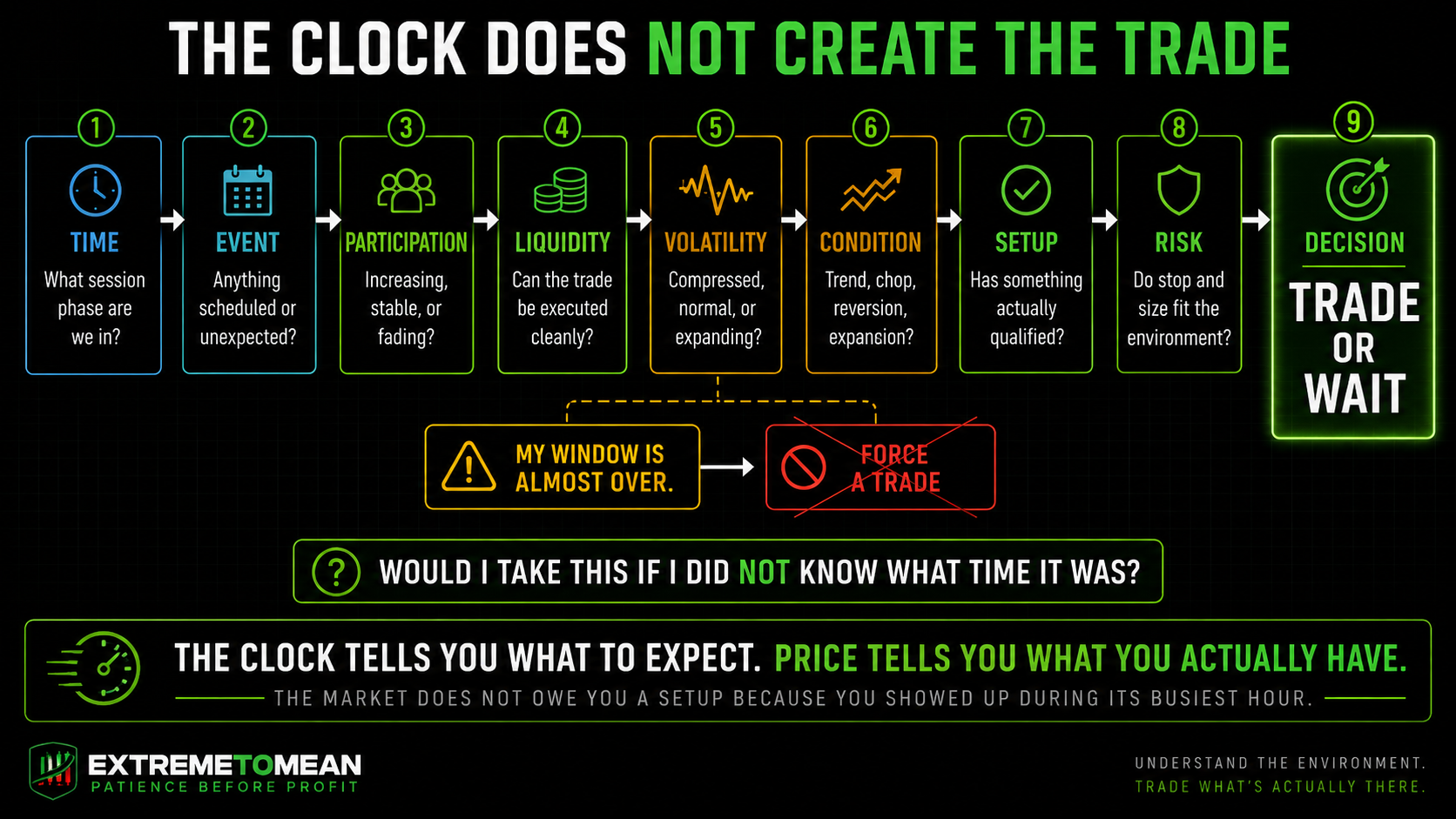
Before acting, ask whether current volume, liquidity, volatility, market state, and scheduled information fit the strategy you actually trade. One especially useful filter is: “Would I take this trade if I did not know what time it was?” The clock can change the quality of the environment, but the setup still has to stand on its own.
Use Time → Event → Participation → Liquidity → Volatility → Condition → Setup → Risk → Decision. This sequence turns time of day into context rather than a trigger and gives the trader a repeatable way to evaluate whether the current session phase actually belongs to the strategy. The clock tells you what environment to expect; price tells you what environment you actually have.
Final Thought
There is no universal best time to trade every futures market, and even within ES, NQ, or YM the same clock time can produce very different sessions. Overnight trade, 8:30 data, the 9:30 cash open, midday, scheduled afternoon events, and the cash close all change the mix of participants and information. Time matters because the environment changes—not because a timestamp possesses an edge.
The busiest market is not automatically the easiest market, and a quieter period is not automatically useless. One strategy may need the expansion of the open while another may prefer the structure that appears after the initial impulse has settled. Good time, bad trade—both can be true.
The goal is not to trade during somebody else’s “best hours.” Be available when your best setup meets a market environment that supports it, then require structure, location, and risk to justify the decision. That process-first approach is part of the broader market-reading discipline developed throughout Decode the Market.
Educational content only. Trading involves substantial risk and is not suitable for everyone.