
The market open can make traders feel as though a decision has to be made immediately. Price moves faster, overnight levels are tested, gaps are being accepted or rejected, and the first directional push can look like the beginning of the day's major move. That urgency makes the open easy to overtrade because every strong candle appears important before enough structure exists to judge it properly. A cleaner approach uses the first part of the session to gather evidence before turning movement into commitment.
This is why the opening range belongs inside The Market curriculum rather than being treated only as an entry technique. For this lesson, the opening range means the high and low established between 9:30 and 10:00 a.m. Eastern Time during the U.S. cash-equity session. Other traders may use shorter or longer windows, but the analytical principle is the same: define an early range and study how price behaves around it. The range describes what the market has done so far; it does not determine what the market must do next.
The Opening Range Is a Reference, Not a Signal
At the end of the first 30 minutes, the trader has at least two useful structural references: the opening-range high and opening-range low. Those boundaries show where the early auction has reached before the market has either accepted higher or lower prices or remained balanced between them. The opening price itself can provide another reference for how much of the early movement has persisted or been reversed. None of those levels carries an automatic instruction to enter a trade.
This distinction matters because it is easy to convert a visible line into a strategy without evaluating the behavior around it. A touch of the opening-range high does not automatically mean resistance, and a break above it does not automatically mean continuation. The same boundary can produce acceptance, rejection, repeated testing, or a false break depending on the session. The trader's job is to observe which behavior is developing instead of assigning the answer to the level in advance.
Why the Open Behaves Differently
The U.S. equity open brings together orders and information that accumulated while the primary cash market was closed. NYSE and Nasdaq both operate opening-auction processes around 9:30 a.m. ET that aggregate buying and selling interest and establish opening prices through price discovery. That makes the open a genuine liquidity event rather than an arbitrary timestamp on the chart. (nyse.com)
For an equity-index futures trader, this requires an important distinction. Futures may already have traded for many hours before 9:30, reacting to overseas markets, economic news, earnings, and other overnight information, but the underlying U.S. stock market is only then entering its regular session. CME itself provides products tied specifically to the official cash index open, reflecting the importance of that benchmark even in nearly 24-hour futures markets. (cmegroup.com) The broader guide to the best time to trade futures compares that opening window with pre-market, midday, and the close. The first 30 minutes therefore show how overnight positioning interacts with the new participation and price discovery arriving with the cash market.
Range Width Is Information
The size of the opening range can help describe how aggressively the market is searching for price. A relatively narrow range may indicate early balance, hesitation, or compression, while a broad range may reflect stronger disagreement, higher volatility, or an active repricing process. That comparison should be made against current conditions rather than a fixed number of points. A 100-point YM opening range can mean something very different in a quiet regime than during a major volatility expansion.
The important observation is not that wide is bullish or narrow is bearish. Range width says something about activity, not which side must eventually control the session. Academic research has long documented unusually high volatility around the market open, while the SEC has treated the earliest minutes as sufficiently unusual that some market-quality analysis excludes the first five minutes to avoid opening-specific effects. (academic.oup.com) Thinking in terms of the three market states helps the trader ask whether the initial movement is developing into direction, remaining rotational, or beginning a transition.
The Boundaries Become Decision Points
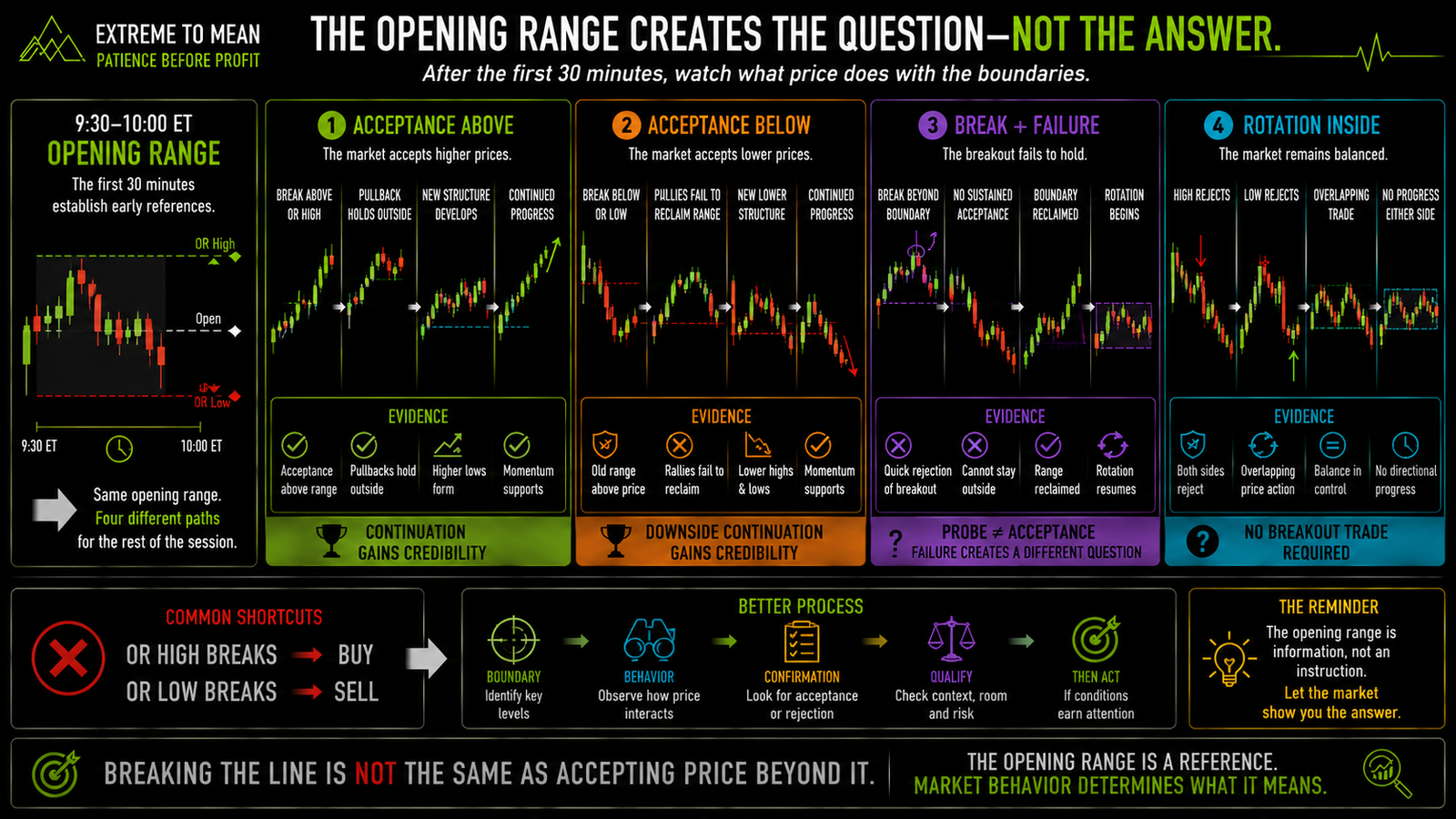
Once the range exists, its high and low become useful locations for observing acceptance and rejection. If price approaches the high and repeatedly fails to hold beyond it, the market is giving different information than it would if price breaks through, pulls back, holds above the boundary, and continues building structure there. The same logic applies at the opening-range low. The level creates the question; behavior around the level supplies the evidence.
Repeated tests can also change the meaning of the boundary. A range high that rejects price once may remain intact, while repeated tests with progressively smaller reactions can show that sellers are no longer producing the same response. Conversely, a quick break followed by an immediate return inside can indicate that the market did not accept the attempted expansion. This is another reason context comes before the candle: one breakout candle provides much less information than the sequence that develops around it.
A Breakout Still Needs Acceptance
Opening-range-breakout logic becomes dangerous when the trader assumes crossing the boundary is enough. Price can trade one tick or several points outside the range because stops trigger, short-term momentum accelerates, liquidity briefly thins, or participants probe for available interest. None of those possibilities guarantees that the market will sustain trade outside the range. Continuation becomes more credible when the market begins accepting the new area rather than merely visiting it.
Acceptance can appear through several forms of behavior without requiring one rigid pattern. Price may hold beyond the boundary, pullbacks may fail to reclaim the old range, directional attempts may continue making progress, or related equity indexes may broadly support the same move. The trader should still evaluate nearby structure, available room, volatility, and risk before treating that evidence as a qualified setup. The Opening Range Breakout strategy guide applies those questions without treating the first break as the trade.
Failed Breaks Matter Too
A failed opening-range break can be just as informative as a successful one. If price pushes above the range, cannot maintain acceptance, and returns decisively inside, the market has shown that the first attempt at higher prices was not sustained. That can create a reversion or rotation question, particularly when the range itself remains intact. It does not mean every failed upside break should automatically be sold.
The same logic applies to a failed break below the range. Price may probe lower, reject the new area, reclaim the range, and then begin rotating back through early structure, but the trader still needs to judge where the next obstacle sits and whether the broader environment agrees. A false break can be evidence without being an entry signal. The cleaner process evaluates the failure, the reclaim, the available path, and the risk before deciding what deserves attention.
The Opening Range Does Not Override the Larger Context
A beautifully defined opening range can still be secondary to stronger information elsewhere. A major overnight gap, scheduled economic release, higher-timeframe breakout, important support or resistance area, or unusually strong directional trend can change how the opening-range boundaries should be interpreted. A break above the range directly into major resistance is different from the same break with open space above it. The range belongs inside the market context rather than replacing it.
Scheduled information matters for the same reason. A range established before a major economic release can be rapidly repriced when new information arrives, which means the early boundaries may become less relevant than they appeared five minutes earlier. Checking the market calendar before the session helps identify whether known events could materially change the environment after the opening range forms.
The same principle appears in the broader lesson on how market conditions change the quality of a setup. The range must be interpreted inside the environment that produced it.
A Cleaner Opening-Range Process
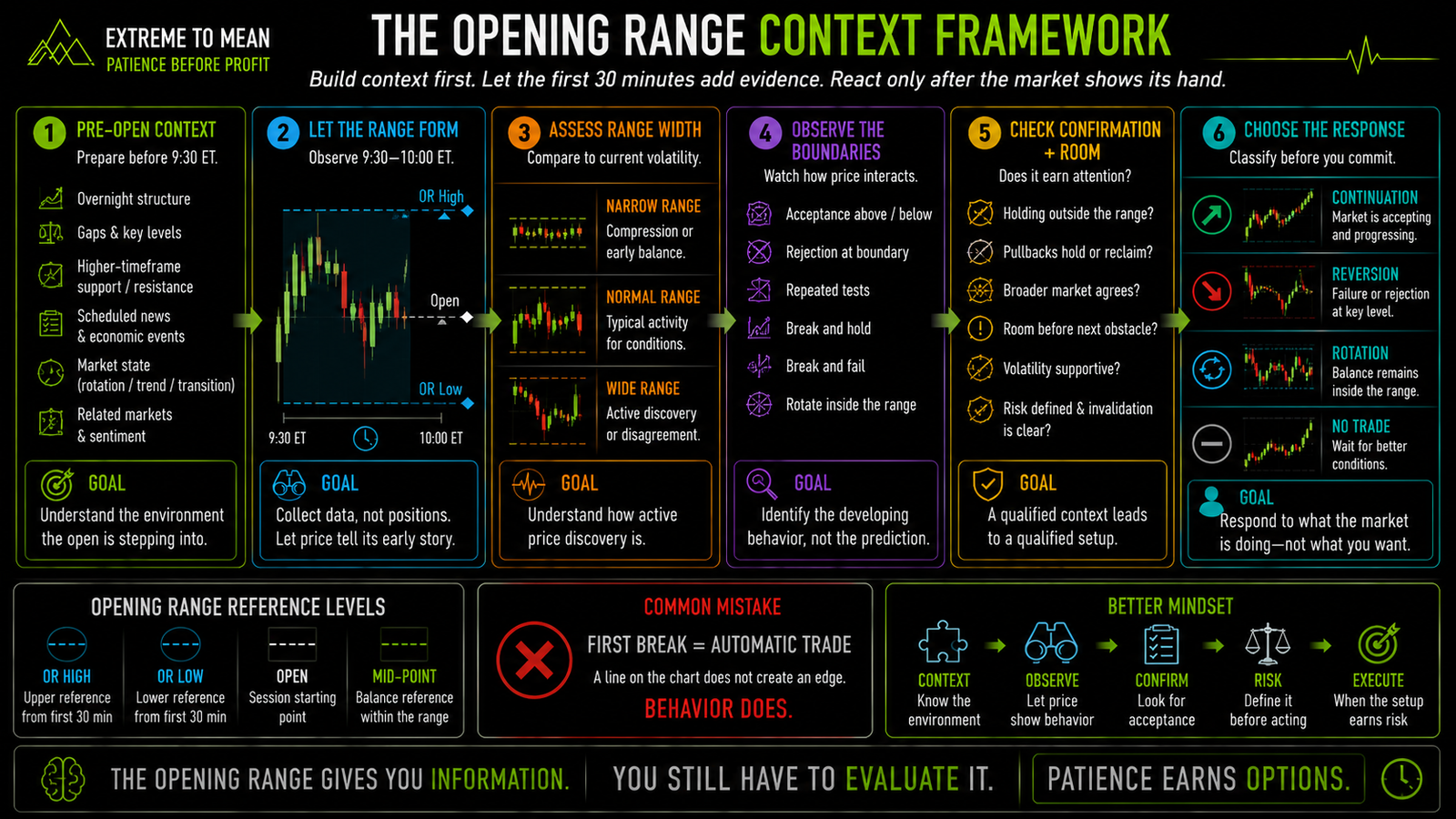
The cleaner process begins before 9:30 rather than at the moment the first candle moves. Identify the overnight structure, relevant higher-timeframe levels, gaps, scheduled information, and the broader market state, then allow the first 30 minutes to build additional evidence. At 10:00, mark the opening-range high and low and assess the range relative to current volatility. The goal is to describe what the market has established before deciding what behavior deserves a trade.
Then observe how price interacts with those boundaries rather than deciding in advance that one must break. Does price remain trapped inside, gain acceptance above, gain acceptance below, break and fail, or repeatedly test one side without making progress? Each path communicates something different about the developing session. Patience here is active observation: the trader is waiting for the market to clarify the branch rather than waiting passively for a favorite setup to appear.
Better Questions After the First 30 Minutes
A useful opening-range review should separate observation from prediction. The trader does not need to know at 10:00 whether the session will ultimately trend higher, trend lower, reverse, or remain balanced. The immediate job is to identify what the first 30 minutes established and what evidence would strengthen or weaken each possible interpretation. That makes the opening range a decision framework instead of a breakout command.
- How wide is the opening range relative to current volatility?
- Did the market spend the first 30 minutes progressing or rotating?
- Where are the opening-range high and low relative to larger structure?
- Is price accepting trade near one boundary or repeatedly rejecting it?
- If the range breaks, is price holding outside or quickly returning inside?
- Are pullbacks preserving the breakout or reclaiming the old range?
- Is the move supported by broader market behavior or isolated to one index?
- Is there useful room beyond the range before the next meaningful obstacle?
- Is scheduled news likely to change the environment?
- What would invalidate the interpretation I am considering?
- Is the market clear enough to act, or is remaining inside the range telling me to wait?
These questions also improve session review because the trader can record how the opening range actually behaved rather than simply whether a breakout won or lost. A failed trade might come from entering the first touch, chasing an already expanded move, ignoring higher-timeframe structure, or treating a temporary probe as acceptance. A profitable trade can still reflect a weak process if it was taken without confirmation. The useful review asks whether the trader read the early auction clearly and responded to evidence rather than urgency.
Final Thought
The first 30 minutes matter because they give the market time to begin revealing how overnight information, opening liquidity, volatility, and early directional pressure are being absorbed. The opening-range high and low can become valuable references for the rest of the session, but their value comes from what price does around them. A breakout that gains acceptance is different from a breakout that immediately fails, and a wide opening range communicates something different from a quiet rotational one. None of those observations guarantees the session's final direction.
The opening range should therefore make the trader more patient, not more reactive. Mark the boundaries, understand where they sit inside the larger structure, observe acceptance and rejection, and require the individual trade to earn risk through confirmation and location. The open can provide important information without demanding an immediate position. The trader's job is to evaluate the first 30 minutes, not obey them.
Educational content only. Trading involves substantial risk and is not suitable for everyone.