
ES, NQ, YM, and their Micro counterparts all provide exposure to major U.S. equity indexes, but they are not interchangeable trading experiences. They differ in index construction, contract multiplier, tick value, typical pace, liquidity, and position-sizing flexibility. Inside The Market, contract selection should be treated as a risk-and-process decision rather than a popularity contest.
Start With What You Are Actually Trading
ES tracks the S&P 500, giving exposure to a broad group of large U.S. companies. NQ tracks the Nasdaq-100, which is more concentrated in large non-financial Nasdaq-listed companies and has substantial technology and growth exposure. The direct ES-versus-NQ comparison explains how those differences affect pace, volatility, and risk. YM tracks the Dow Jones Industrial Average, a 30-company price-weighted index, so the same market headline can influence the three contracts differently.
That difference matters because related indexes can rally or sell off together without moving at the same speed or responding equally to the same sector. ES may reflect broad-market participation while NQ reacts more sharply to moves in dominant growth stocks, and YM can behave differently because of its narrower, price-weighted construction. ES, NQ, and YM can look correlated without being identical.
Contract Multiplier Matters More Than the Index Number
A beginner may look at ES near 6,500, NQ near 24,000, and YM near 46,000 and assume the highest index number creates the greatest dollar risk. That is the wrong framework because the index level tells you where the market is, while the contract multiplier tells you what each point of movement means to your account. For day trading, the combination of multiplier, stop distance, and position size is what converts price movement into actual dollar risk.
CME specifications put ES at $50 times the S&P 500 Index with a 0.25-point tick worth $12.50, NQ at $20 times the Nasdaq-100 with a 0.25-point tick worth $5, and YM at $5 times the DJIA with a one-point tick worth $5. That means a 20-point move in one ES is $1,000, while a 100-point move in one NQ is $2,000 and a 200-point move in one YM is $1,000. Those examples are arithmetic, not claims about typical daily ranges. (cmegroup.com)
| Contract | Index | Multiplier | Minimum Tick | Tick Value |
|---|---|---|---|---|
| ES | S&P 500 | $50 × index | 0.25 | $12.50 |
| MES | S&P 500 | $5 × index | 0.25 | $1.25 |
| NQ | Nasdaq-100 | $20 × index | 0.25 | $5.00 |
| MNQ | Nasdaq-100 | $2 × index | 0.25 | $0.50 |
| YM | DJIA | $5 × index | 1.00 | $5.00 |
| MYM | DJIA | $0.50 × index | 1.00 | $0.50 |
The index price tells you where the market is. The multiplier tells you what that movement means to your account.
Micro Futures Change the Size, Not the Market Idea
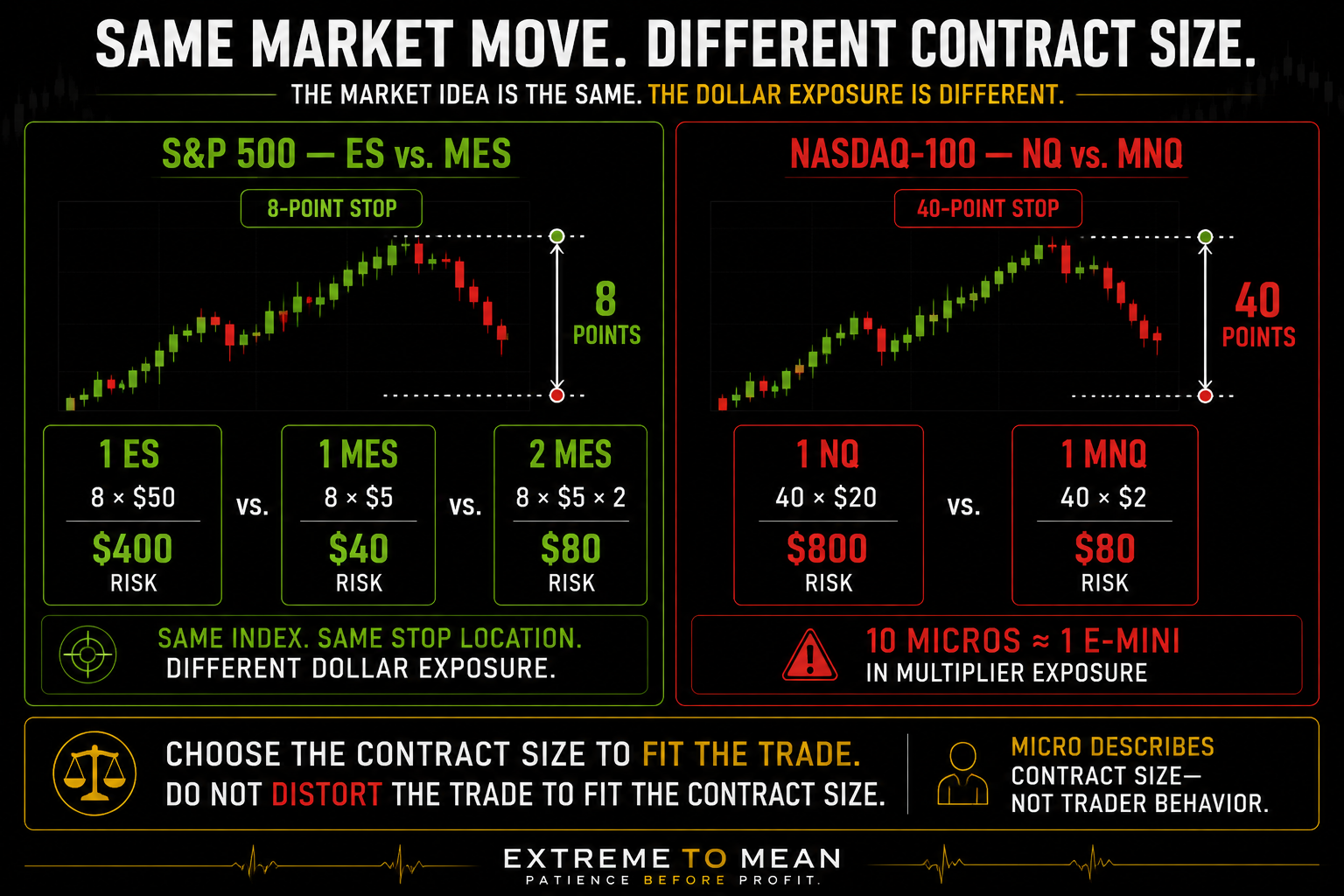
MES is not a different S&P 500 market from ES. It is a smaller contract built on the same underlying index exposure, just as MNQ is the Micro counterpart to NQ and MYM is the Micro counterpart to YM. CME's Micro E-mini specifications make those contracts one-tenth the multiplier of their E-mini counterparts. (cmegroup.com)
That smaller size can make position sizing more flexible. A 10-point move is $500 in one ES but $50 in one MES, while a 40-point move is $800 in one NQ but $80 in one MNQ. A smaller contract cannot make a bad decision good, but it can make the cost of learning smaller.
For a fuller explanation of how MES, MNQ, MYM, and M2K change exposure without changing the underlying market, see Micro Futures Trading Explained.
Micro does not mean low risk. Ten MES contracts create approximately the same multiplier exposure as one ES, ten MNQ approximately one NQ, and ten MYM approximately one YM. Micro describes contract size—not trader behavior.
CME also offers RTY and its Micro counterpart M2K for Russell 2000 exposure, but they do not need to turn this comparison into a complete contract directory. The important idea remains the same across the Micro family: smaller multipliers create finer sizing increments. CME currently lists MES, MNQ, MYM, and M2K among its Micro equity-index products. (cmegroup.com)
ES, NQ, and YM Offer Different Trading Experiences
ES is popular because it combines broad-market exposure with deep liquidity, but that does not make it a safe leveraged contract. NQ often attracts traders who want faster directional movement, yet that same movement can create wider rotations and greater pressure to chase. YM offers a different, price-weighted 30-stock exposure; none of the three should be permanently labeled safe, easy, fast, or slow.
The point is not to build another ranking. The same trader may find ES manageable in one regime and unusually fast in another, while NQ or YM can change character as participation and volatility shift. Contract identity matters, but current market behavior matters too.
Liquidity and Volatility Need Context
Day traders care about liquidity because deeper participation can support tighter spreads, more available counterparties, and cleaner execution. Liquidity is not constant, however, so comparing ES, NQ, and YM during the U.S. cash session can produce a different picture from comparing them in thinner overnight hours. The existing lesson on futures trading hours is important because market quality changes throughout the trading day.
Volatility also needs a better measurement than raw point count. If ES moves 50 points and NQ moves 200, that does not automatically make NQ four times more volatile because the indexes have different levels and multipliers. Volatility becomes risk only after position size and stop distance translate movement into dollars.
This is one reason “NQ moves more” is an incomplete reason to trade it. Larger point movement may come with larger normal pullbacks, wider structurally valid stops, and more dollar movement per trade. What matters is whether the movement can be used by the strategy without forcing the trader to abandon the intended risk.
Margin and Contract Cost Can Mislead You
Low intraday margin does not mean low trading risk. Margin is the capital required to hold the position under broker or exchange rules, while the trade's actual risk depends on movement, stop distance, and size. The amount required to open the trade and the amount you can lose are different numbers.
Micros also improve sizing precision without being cost-free. Because commissions and exchange fees are commonly charged per contract, using many Micros to recreate one E-mini can create more per-contract transaction cost. Define the trade first, then choose the size that fits it rather than tightening a valid stop just to afford the larger contract.
More Movement Does Not Mean More Edge
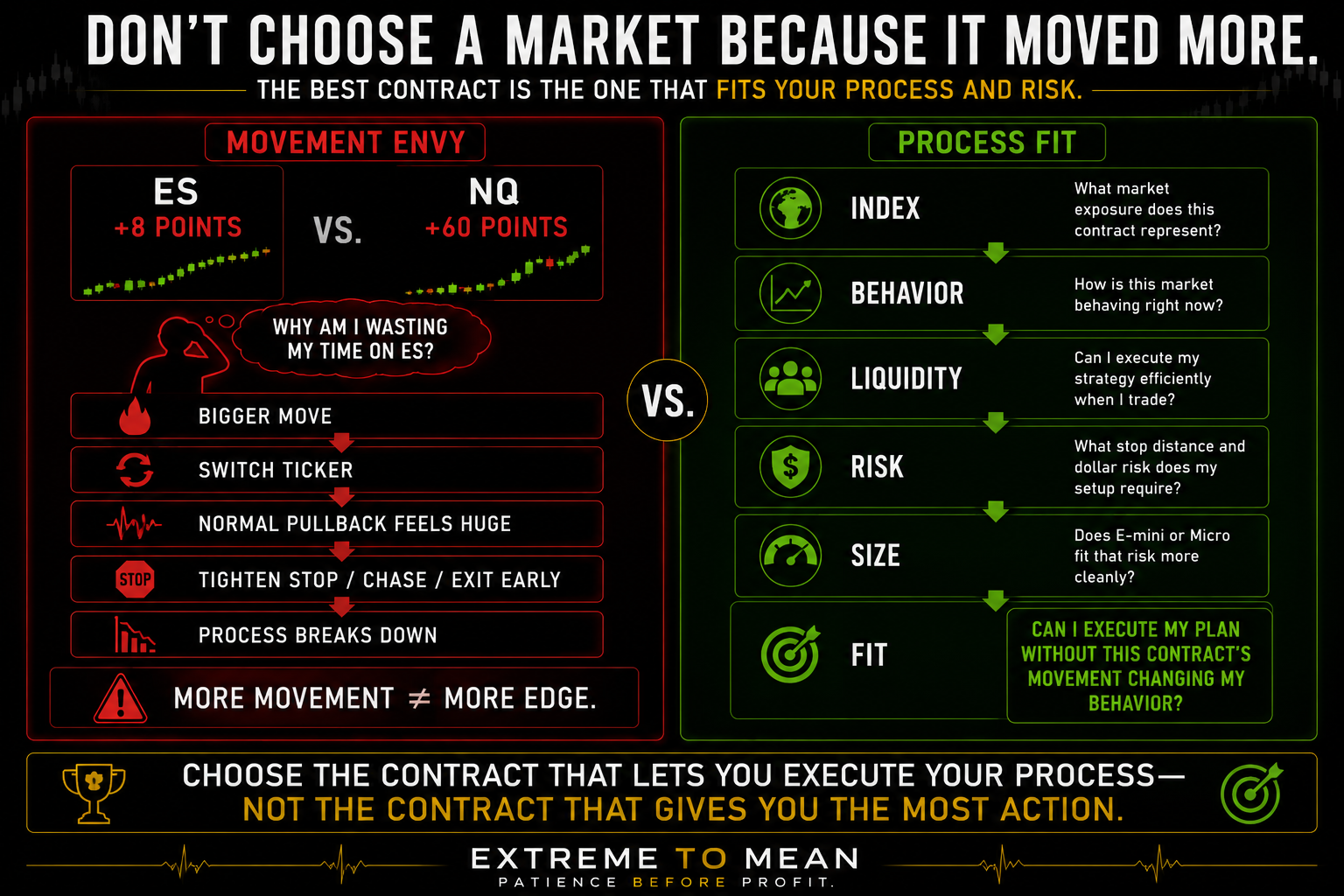
Movement envy is one of the easiest ways to choose the wrong contract. A trader watches ES gain eight points while NQ moves sixty and starts thinking the better opportunity must have been in NQ, even though they may not know whether their setup would have captured that move or survived the normal pullbacks. More movement does not automatically mean more edge.
The same mistake can lead to constant market switching. A trader jumps from ES to NQ to YM based on whichever chart moved most yesterday and never develops familiarity with one market's pace, rotations, and session behavior. What an edge actually is matters more than finding the ticker that produced the largest screenshot.
There is a learning cost to switching markets impulsively. Time spent observing one contract teaches what normal movement looks like, how it behaves around important levels, and how a specific strategy responds when volatility changes. A different ticker can look like a new opportunity when what the trader really needs is deeper familiarity.
Strategy and Market Condition Should Come Before the Ticker
There is no universal answer to which contract is best for mean reversion or trend trading. ES, NQ, and YM can all trend, chop, or revert, and the relevant condition changes over time. Reviewing the three market states is more useful than assigning a permanent strategy label to a symbol.
The same setup can also have different quality depending on volatility, location, liquidity, and room. That is why market conditions change the quality of a setup even when the contract itself is familiar. A strategy needs the right market condition more than it needs a favorite ticker.
A useful qualitative comparison is therefore about tendencies rather than rankings. These are not grades or promises. They are simply a way to organize differences without pretending one contract is universally better:
| Consideration | ES | NQ | YM |
|---|---|---|---|
| Underlying breadth | Broad | More concentrated | Narrow 30-stock index |
| Index weighting | Market-cap | Market-cap | Price-weighted |
| Liquidity | Very deep | Very active | Active |
| Intraday pace | Can be fast | Often especially fast | Regime-dependent |
| Micro equivalent | MES | MNQ | MYM |
These descriptions are context, not promises. NQ is not always the fastest, ES is not always the cleanest, and YM is not always slower than the others. Related markets can provide context without providing certainty.
A Practical Contract-Selection Framework
Use Index → Behavior → Liquidity → Risk → Size → Fit. The sequence starts with what the contract represents and ends with whether its movement allows the trader to execute the intended process without changing behavior. Choose the contract that lets you execute your process—not the contract that gives you the most action.
- Index: What market exposure does this contract represent?
- Behavior: What kind of movement is it producing in the current regime?
- Liquidity: Can the strategy be executed efficiently at the times you trade?
- Risk: What structural stop distance and dollar exposure does the setup require?
- Size: Does the E-mini or Micro version fit that risk more cleanly?
- Fit: Can you execute the plan without the contract's pace changing your decisions?
Consider a trader whose ES setup needs an eight-point structural stop while their risk plan allows $100. One ES would risk $400, but one MES at the same stop risks $40 and two MES risk $80. Choose the contract size to fit the trade; do not distort the trade to fit the contract size.
The better question is not “Which futures contract moves the most?” Ask, “Which underlying market do I understand, which movement can my strategy use, and which contract size lets me define risk without changing my behavior?” That question turns contract selection from a search for excitement into a repeatable trading decision.
Final Thought
The best futures for day trading are not determined by a universal ranking of ES, NQ, and YM. Each contract represents a different index, carries a different multiplier, and can produce a different combination of pace, liquidity, volatility, and dollar movement. Their Micro counterparts change the size of the exposure without changing the underlying market idea.
Smaller contracts can create more room for precise sizing, while E-minis may fit traders whose risk plans comfortably support larger increments. Neither contract size removes the need for structure, discipline, and market context. Smaller size creates room to learn; it does not remove the need to learn.
Before changing markets because another contract had the bigger move, ask whether that market actually fits the process you are trying to execute. You do not need the market that moved the most; you need a market you can trade correctly, which is part of the broader process developed throughout Decode the Market.
Educational content only. Trading involves substantial risk and is not suitable for everyone.