
Several choppy Mondays or losing Fridays can convince a trader the calendar is the problem. Skipping those days feels like risk control when the rule seems to explain frustrating results. But WEEKDAY ≠ MARKET CONDITION: Monday and Friday are labels, while liquidity, news, volatility, market structure, and trader behavior are the things that shape individual decisions.
The better question is whether a defined strategy performs differently after controlling for events, holidays, expiration, market regime, and costs. Inside The Market, study the environment instead of assigning personalities to weekdays. A calendar pattern is a hypothesis to test—not permission to stop asking questions.
Weekday Effects Are Real Research Questions, Not Trading Laws
Researchers have studied weekday anomalies for decades. A 2024 meta-analysis of 91 studies found lower average stock-market returns near the beginning of the week and stronger returns on Wednesdays and Fridays, while emphasizing the influence of time periods, outliers, and study design. It did not establish a comparable overall effect in futures, so stock-market averages cannot justify an ES day-trading rule.
The distinction also appears in older futures-specific work. A 1985 S&P 500 study identified a Monday pattern in the cash market but did not find the same pattern in index futures, while international research published in 2014 examined weekday effects across high- and low-volatility regimes. They do not rule out conditional effects; they challenge blanket claims that Mondays are bad.
There is another mismatch between academic research and the decision a day trader faces. Average daily returns measure direction, while a day trader needs to know whether a defined three-minute setup has Monday expectancy. DAILY RETURN EFFECT ≠ INTRADAY STRATEGY EDGE, because a market can fall on average and still offer valid long and short intraday opportunities.
Monday Begins With Weekend Information, Not a Guaranteed Gap Fill
Monday can feel unusual because information has accumulated while standard U.S. equity-index futures were closed over the weekend. Those contracts normally reopen Sunday evening, allowing global developments to affect prices well before the Monday 9:30 a.m. Eastern cash-stock opening. For a futures trader, Monday's cash open is therefore not necessarily the market's first reaction to weekend news.
Suppose ES reopens above Friday's prior trading area and remains elevated into Monday morning. Price might continue higher, return partway into the gap, fill it completely, or spend the session rotating near the new level. A gap only shows repricing; the overnight gap trading lesson explains how to evaluate structure and acceptance. MONDAY GAP ≠ GAP-FILL SIGNAL.
Friday Is Not One Market Condition
An ordinary Friday is not the same as a jobs-report, expiration, or holiday-shortened Friday. Yet all are routinely grouped under one calendar label, making averages misleading. The cause of unusual behavior matters more than the weekday.
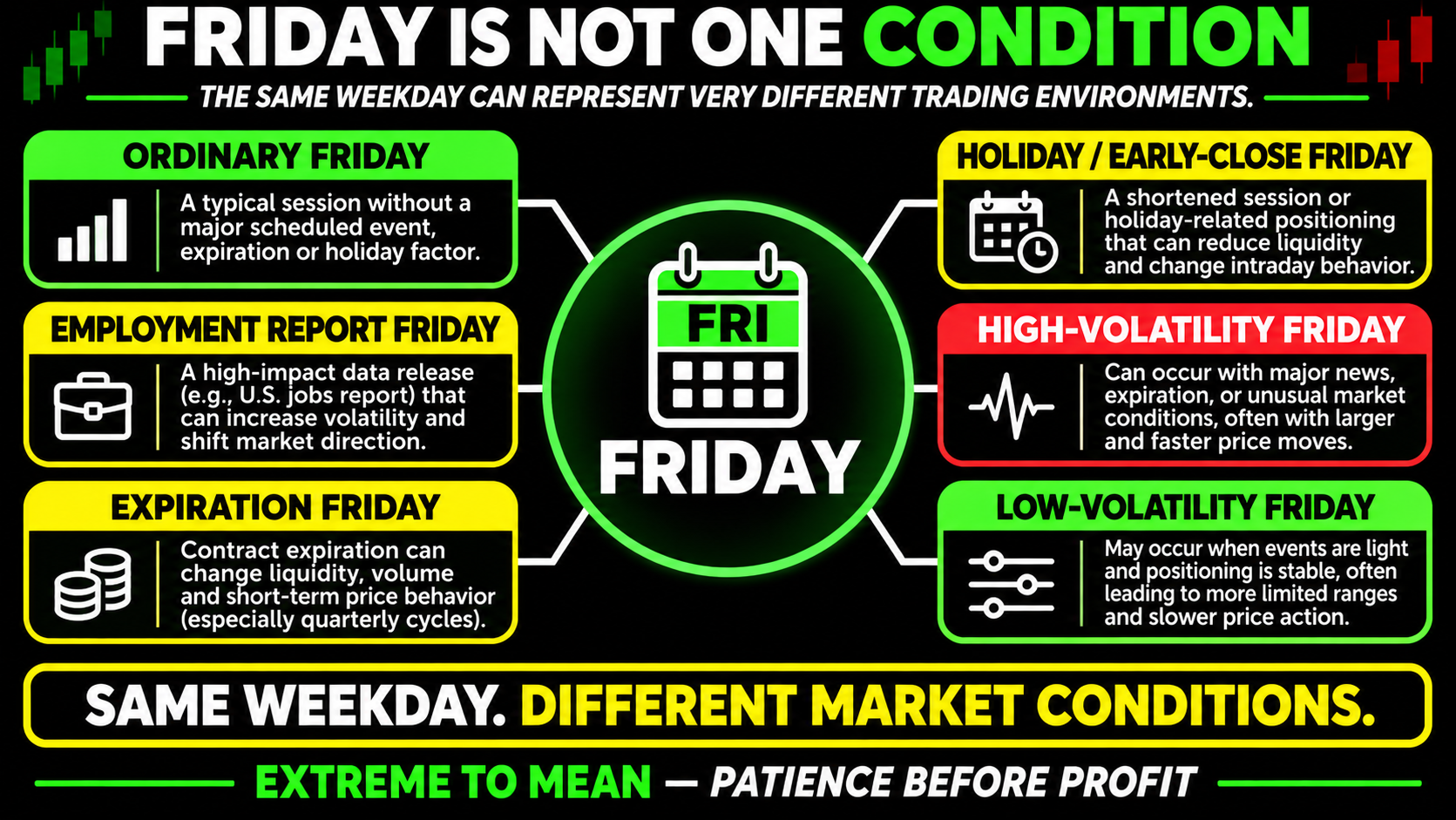
The U.S. Bureau of Labor Statistics commonly schedules its Employment Situation release for Friday at 8:30 a.m. Eastern, though dates can shift; the official release calendar is the authority for the specific day. A trader who groups jobs-report Fridays together with ordinary Fridays may think they have discovered a Friday volatility pattern when they have partly measured a scheduled news event. Sometimes the weekday effect is an event effect wearing a weekday label.
Quarterly expiration introduces a different distortion. CME's equity-index roll calendar shows March, June, September, and December expirations, with a customary roll date earlier in expiration week. Liquidity can migrate between contract months before expiration Friday, so the relevant context may span several days rather than one morning.
Holidays complicate both ends of the week through altered trading hours and participation. A Monday affected by a U.S. holiday should not be pooled casually with an ordinary Monday, just as an early-close Friday should not be treated as a normal full session. Other weekdays have scheduled events too, including Fed decisions and Wednesday petroleum data. The market event deserves a label of its own before the weekday takes credit or blame.
A Weekday Average Can Hide the Actual Trading Window
Friday morning and afternoon need not resemble each other. The open may feature price discovery while later hours may bring position adjustments or a directional move. The best time to trade futures lesson covers this session-level distinction; the day-of-week question must hold the trading window constant before making comparisons.
Market regime creates another problem. A high-volatility trend week, a narrow range week, and an expiration week can produce very different outcomes for the same setup. An apparent Friday weakness may disappear once those environments are separated, or it may persist only in one clearly defined condition. A conditional pattern is not a permanent calendar rule.
Small Samples Make Weekday Folklore Look Convincing
Imagine reviewing fifty trades spread across five weekdays, leaving roughly ten observations per weekday. Monday shows a loss of three units of planned risk, or −3R, while Friday shows −2R, and both immediately appear worse than Wednesday. Those numbers may reflect a few large outcomes, an uneven mix of setups, or ordinary randomness rather than a repeatable disadvantage.
Now imagine splitting the same sample again by opening session versus afternoon, news versus no news, and trend versus range. A supposedly precise category may contain only six trades. Five weekday buckets can turn an already-small sample into five tiny ones, and every extra filter may make the explanation sound more specific while weakening the evidence behind it.
There is also a search problem: if we compare enough days, hours, setups, and parameter combinations, some will look unusually good or bad by chance. We might discover that eliminating Mondays makes last year's backtest look excellent, only to find that the rule fails in a later period. The ETM lesson on overfitting explains why retrospectively selected rules need careful testing. BACKTEST IMPROVEMENT ≠ ROBUST FILTER.
Test the Setup, Not the Reputation of the Day
A workable test starts with a fully defined strategy and an exact window, such as an ES opening-range setup from 9:30 to 11:00 a.m. Eastern. Record every qualifying opportunity, not just memorable trades. Then compare weekdays using expectancy per trade, average win and loss, drawdown, sample size, rule adherence, and costs—not total P&L or win rate alone.
Suppose a hypothetical trader records forty Friday trades totaling −8R, then notices that four Employment Situation sessions account for −6R. That observation does not prove employment Fridays are untradeable, but it changes the question from “Should I skip Friday?” to “Does my exact setup perform poorly around this release?” A specific event-window hypothesis can be evaluated without throwing away every ordinary Friday.
Every skip rule also has an opportunity cost. Removing a weekday removes its winners along with its losers, and a low win rate can still coexist with positive expectancy when average winners are sufficiently large. Test whether excluding the day improves later results after costs and lost opportunities—not just historical losses.
Sometimes the Weekday Effect Belongs to the Trader
Not every recurring weekday problem begins in the market. A trader may arrive unprepared on Monday, feel exhausted on Friday, or become desperate to recover a losing week before the weekend. The strategy may stay unchanged while their entries, sizing, and patience worsen.
That is worth tracking separately from market behavior. Log preparation, fatigue, interruptions, emotional state, and rule violations alongside the market's event calendar and condition. The futures trading journal lesson provides the review framework for separating market behavior from execution behavior. A personal weekday filter can be justified without claiming a universal weekday anomaly.
Before You Skip a Weekday
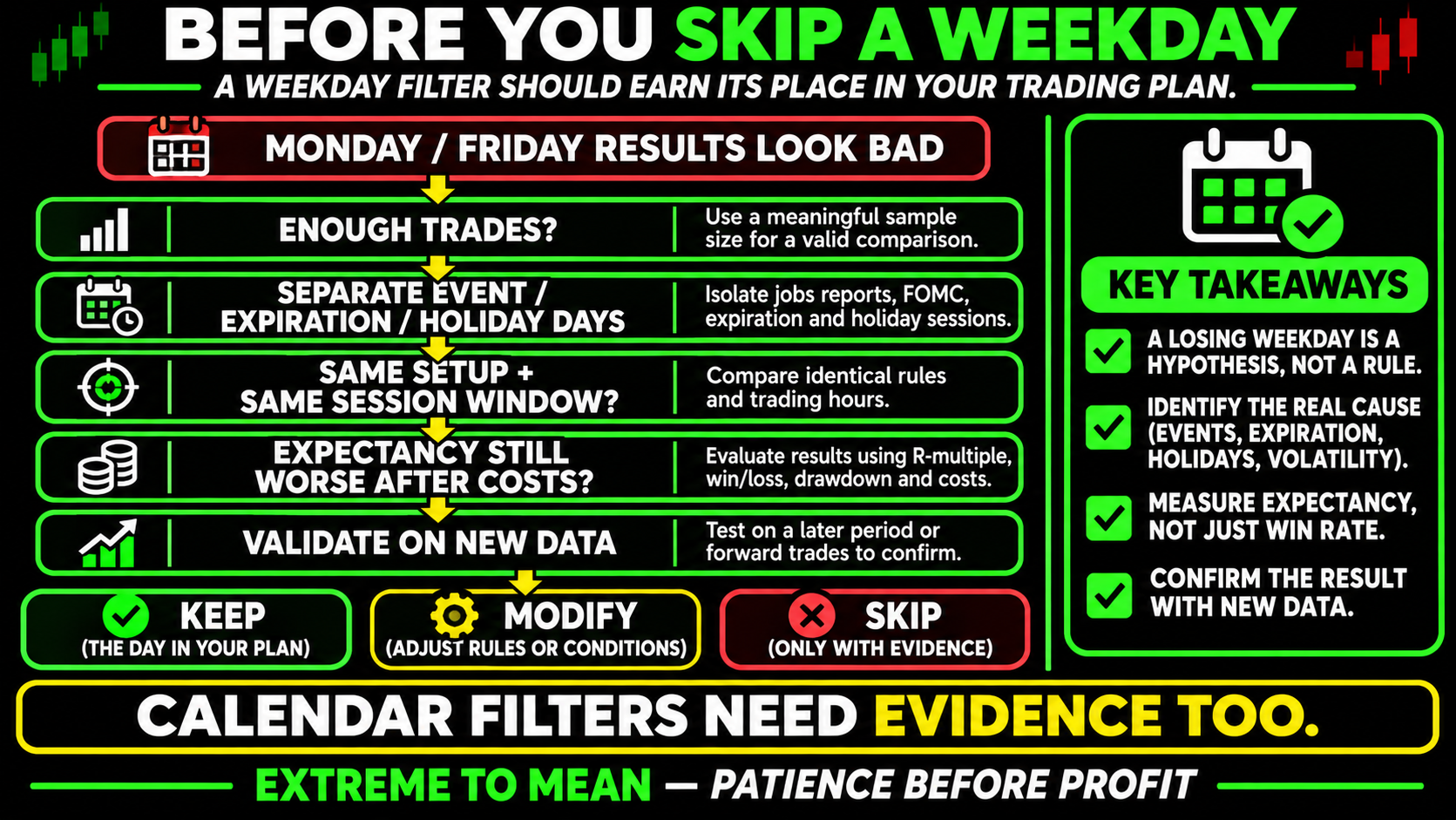
A weekday filter needs the same scrutiny as any other rule. Separate its calendar label from the conditions underneath it before excluding a trading day. Use these questions before promoting a recent losing streak to a permanent restriction.
- Do we have enough qualifying trades for this weekday to draw a useful conclusion?
- Are we measuring our exact setup and trading window rather than the market's average daily return?
- Have we separated employment releases, FOMC decisions, other scheduled events, expiration/roll sessions, and holidays?
- Are we comparing reasonably similar volatility and market-structure conditions?
- Does expectancy still differ after realistic transaction costs and slippage?
- Have we reviewed payoff, drawdown, opportunity count, and rule adherence—not just win rate?
- Was this filter designed after looking at the same history used to judge it?
- Does the result survive later out-of-sample or forward observations?
- Could sleep, preparation, or emotional pressure explain part of the difference?
- What evidence would cause us to keep, modify, or remove the filter?
The ETM Day → Context → Strategy → Sample → Verify Framework
Use DAY → CONTEXT → STRATEGY → SAMPLE → VERIFY to evaluate any proposed weekday rule. DAY identifies the calendar label; CONTEXT records news, expiration, holidays, and market regime; STRATEGY defines the exact setup and session window. SAMPLE checks whether there is enough comparable evidence, while VERIFY asks whether the conclusion survives new observations rather than relying on the history that inspired it.
The result is TRADE / MODIFY / SKIP, but never automatically. A trader might discover a repeatable problem during a particular release window and change that portion of the plan, while leaving ordinary Fridays available for qualified setups. The ETM free tools can help organize preparation, but the purpose of the framework is to require evidence before a calendar preference becomes a trading restriction.
Final Thought
No evidence justifies telling every futures trader to avoid Mondays or Fridays. Research suggests some weekday patterns have appeared in historical stock-market returns, while futures-specific results are less consistent and can depend on the period and market regime. More importantly, those findings do not tell us whether one trader's defined setup earns or loses expectancy during a particular intraday window.
Monday may begin with weekend repricing, while Friday may feature employment data, expiration, a holiday, or an ordinary session. Sample size, transaction costs, current market condition, and our own execution habits can matter more than the weekday printed at the top of the chart. Do not skip the day merely because the day has a reputation; skip the conditions your evidence shows do not fit your process.
Educational content only. Trading involves substantial risk and is not suitable for everyone.