
Mean reversion is easy to understand and easy to misuse. Price moves far from an average, looks stretched, and the trader assumes the distance itself creates an opportunity in the opposite direction. Sometimes price does return toward balance, which reinforces that intuition. Other times it keeps extending because The Market is repricing and the old reference no longer describes the environment.
Research gives good reason to take the idea seriously without treating it as a law. Poterba and Summers found evidence of longer-horizon negative serial correlation in stock returns, while Kim, Nelson, and Startz later found that U.S. evidence varied substantially across historical periods. De Bondt and Thaler also reviewed evidence of longer-horizon reversal after extreme stock performance. Mean reversion can exist, but its strength depends on the market, sample, horizon, and variable being studied. (nber.org)
What Mean Reversion Actually Means
Mean reversion describes a tendency for a variable that has moved away from some reference level or relationship to later move back toward it. That variable might be price, returns, volatility, valuation, or the spread between related instruments. The “mean” may be a statistical average, but it can also be a changing equilibrium or relationship rather than one fixed line. Understanding what the mean really is matters because a poor reference can make ordinary movement look extreme.
Statistical arbitrage and pairs trading apply the same idea to the relationship between instruments rather than one price alone.
The concept is therefore broader than buying below a moving average and selling above it. Gatev, Goetzmann, and Rouwenhorst, for example, studied pairs of historically related stocks and whether temporary divergence between them later narrowed. That application differs from an index returning toward an intraday reference, but both depend on a relationship moving away from a recent norm and later normalizing. The reference must be defined before the deviation can mean anything. (academic.oup.com)
A Deviation Is Not Automatically a Mispricing
The word “extreme” can quietly smuggle a conclusion into the analysis. A trader may see price far above a mean and call it overbought or unsustainable before there is evidence that the move is actually mispriced. Yet a large deviation can reflect new information, volatility expansion, a structural breakout, or the start of sustained repricing. Distance tells you that price moved; it does not tell you why.
That is why what Extreme to Mean really means is not simply “far away equals fade.” A stronger question is whether the deviation exists inside an environment where movement back toward balance is becoming more plausible. Location, structure, volatility, acceptance, and market state all help answer that question. Mean reversion becomes a better hypothesis when those elements support it instead of distance acting alone.
Why Mean Reversion Can Appear
Temporary overreaction is one possible mechanism. Participants can respond aggressively to information, chase movement, hedge urgently, or create short-lived order imbalances that push price beyond an area the market later struggles to accept. Noise-trader research has also modeled how prices can diverge from longer-run values and later move back. These mechanisms make reversion plausible without implying that every large move is irrational. (nber.org)
Market structure can produce similar behavior without requiring an emotional story. Liquidity imbalances can fade, forced flows can end, related instruments can reconverge, and balanced markets can repeatedly rotate around accepted areas. This is why one mean-reversion explanation should not be pasted onto every chart. The cleaner process identifies what may have created the deviation and whether that pressure is actually weakening.
Time Horizon and Volatility Change the Interpretation
Mean reversion can appear on one horizon while momentum dominates another. Cutler, Poterba, and Summers documented a broader pattern of positive serial correlation at higher frequencies and negative serial correlation over longer horizons across several speculative markets. That does not establish a universal timing rule, but it shows why “does this market mean revert?” is incomplete. The better question is “mean revert relative to what, and over what horizon?” (nber.org)
Volatility changes the same calculation. A distance that looks extreme during quiet conditions may be ordinary after ranges expand or new information changes the market’s pricing process. An intraday pullback can revert toward a session reference while a higher-timeframe trend remains intact, and a fixed point distance can mean very different things across regimes. The reference and the deviation both need to be judged in the context of the timeframe and current volatility.

Reversion Is Not Reversal—and Market State Matters
A market does not need to reverse its larger trend to move meaningfully back toward a mean. An uptrend can pull back toward balance and then resume higher, while a downtrend can rally toward a reference without becoming bullish. That distinction is central to Reversion Is Not Reversal. Reversion describes movement toward balance; reversal requires stronger evidence that the larger directional structure has changed.
Mean reversion also tends to fit rotation differently from strong directional repricing. When a market repeatedly rejects expansion and returns toward an accepted area, reversion has more structural support; when price is gaining acceptance away from old balance, the same distance can behave very differently. This is where the three market states become practical. A reversion setup should fit the state instead of being imposed on it.
The Mean Can Move—or Become Invalid
The mean itself is not sacred. Moving averages update, volume-weighted references change, valuation anchors shift, and relationships between securities can break when fundamentals diverge. After major information, a volatility regime change, or a genuine breakout, the old reference may describe where the market used to trade rather than where it should trade now. Mean reversion is a relationship, not a gravitational law.
This is one of the hardest ideas for traders who have been rewarded for fading the same reference repeatedly. A market may revert several times and then transition into sustained directional acceptance, leaving the next familiar fade exposed to a different environment. The trader has to be willing to invalidate the reference when the conditions supporting it change. Flexibility means updating the model from evidence, not defending the old mean because it worked earlier.
A Cleaner Mean-Reversion Evaluation Process
Start with the reference, not the trade. Define what the mean represents, why it matters on the chosen horizon, and whether the current market is still interacting with it in a useful way. Then evaluate the deviation relative to current volatility and ask what caused price to move away. This prevents “too far” from becoming the conclusion before the analysis begins.
Next, require evidence that movement away from balance is losing acceptance. That may include failed continuation, rejection at meaningful location, weakening directional efficiency, structural reclaim, or another form of confirmation appropriate to the market. Then check whether there is room to revert before the next obstacle and whether invalidation can be defined clearly. The setup earns attention only after the market begins supporting the return-to-balance thesis.
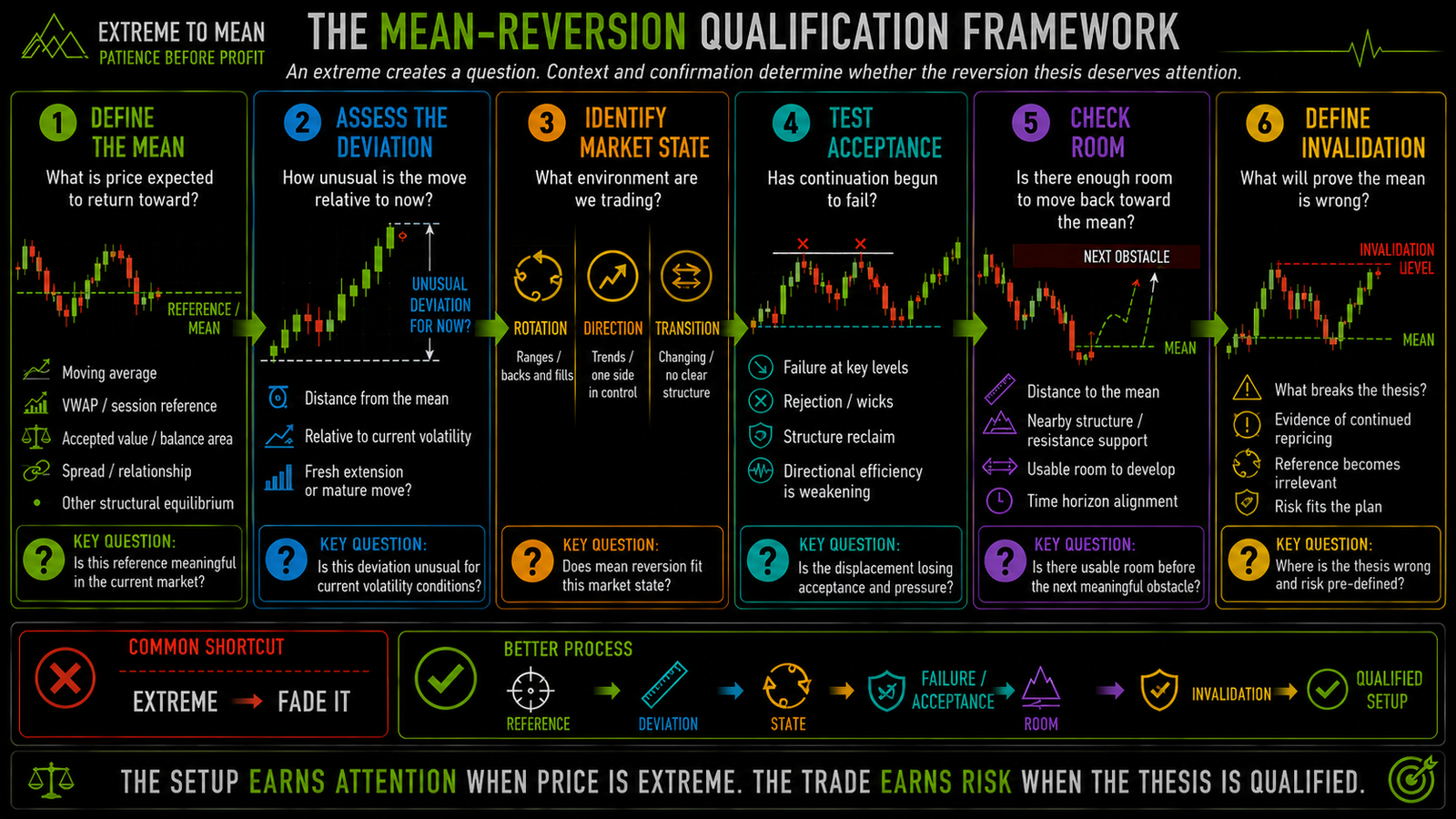
Better Questions Before Expecting Reversion
A research-grounded process should make the trader more selective, not more willing to fade anything extended. The questions should separate a market tendency from a live trade and force the trader to define the reference, horizon, regime, and invalidation. They should also allow the conclusion that the market is repricing and the old mean no longer deserves much weight. The better question is not “How far is price from the mean?” but “Why should this mean still matter here?”
- What exactly is the reference or “mean”?
- Why is that reference relevant on this timeframe?
- Is the deviation unusual relative to current volatility?
- Is price temporarily displaced, or establishing new acceptance?
- What market state am I trading?
- Has continuation actually begun to fail?
- Am I expecting reversion or claiming a full reversal?
- Is there enough room to move back toward balance?
- What would invalidate the reference or reversion thesis?
- Am I fading evidence, or only fading distance?
These questions improve review because they separate the quality of the process from the outcome. A qualified reversion trade can still lose, while a poorly justified fade can win despite relying only on distance. Recording the reference, market state, volatility, acceptance, and invalidation creates a clearer decision record. The guide to backtesting mean reversion without hindsight turns those observations into predefined, testable rules. The goal is to identify where mean reversion is relevant enough to guide evaluation, not to prove that it works everywhere.
Final Thought
Mean reversion is a real and extensively studied market behavior, but research does not support treating it as a universal law. Evidence varies across markets, periods, variables, and time horizons, and reversion in a spread or return series is not automatically the same thing as price returning to a moving average. “Far from the mean” is an observation, not a complete trade thesis. The relationship has to be defined before the deviation deserves interpretation.
A cleaner approach asks what the mean represents, why price moved away from it, whether current structure still supports that reference, and what evidence shows the displacement is beginning to normalize. That is the foundation readers need before moving into practical return-to-mean setups and the broader Extreme to Mean approach. Mean reversion can organize a useful trading idea, but the market still has to earn the decision through context, location, structure, and risk. The trader’s job remains to evaluate, not react.
Educational content only. Trading involves substantial risk and is not suitable for everyone.