
For U.S. equity-index futures traders, the Opening Range is commonly anchored to the 9:30 a.m. ET cash-equity open, even though ES and NQ have already been trading overnight. CME notes that U.S. equity-index futures trade nearly around the clock, while the NYSE Core Trading Session begins at 9:30 a.m. ET. Inside The Setup, the goal is to evaluate the escape from the range rather than react to the first tick outside it.
What an Opening Range Breakout Actually Is
An Opening Range Breakout occurs when price moves above the Opening Range high or below its low after a predefined opening period has been established. A bullish ORB moves above the range high, while a bearish ORB moves below the range low. Crossing the boundary creates the breakout event; it does not automatically create a trade.
If you need the foundation first, start with understanding the Opening Range itself. Extreme to Mean’s existing lesson uses the first 30 minutes, but other traders may define different windows as part of their own strategy. The important point is to choose the period before interpreting the breakout rather than deciding afterward which range best fits the move.
If the chosen range is 9:30–10:00 ET, the final high and low are not known at 9:42. Trading a developing high before the range finishes is therefore a different strategy from trading the completed range. Define the box before trading the escape from the box.
Range Width Changes the Opportunity
Opening Range width affects how usable a breakout may be, but it should not become a fixed point threshold. A narrow range can leave nearby invalidation yet make small probes look meaningful in compressed trade, while a wide range may leave less room or require wider risk. Width has to be judged relative to volatility and context.
This is one reason a setup is not a signal even when the chart gives you a clean boundary. The range high and low create references, but the breakout still needs location, structure, room, and logical risk. A neat rectangle does not make those questions disappear.
The Break Matters Less Than What Happens After It
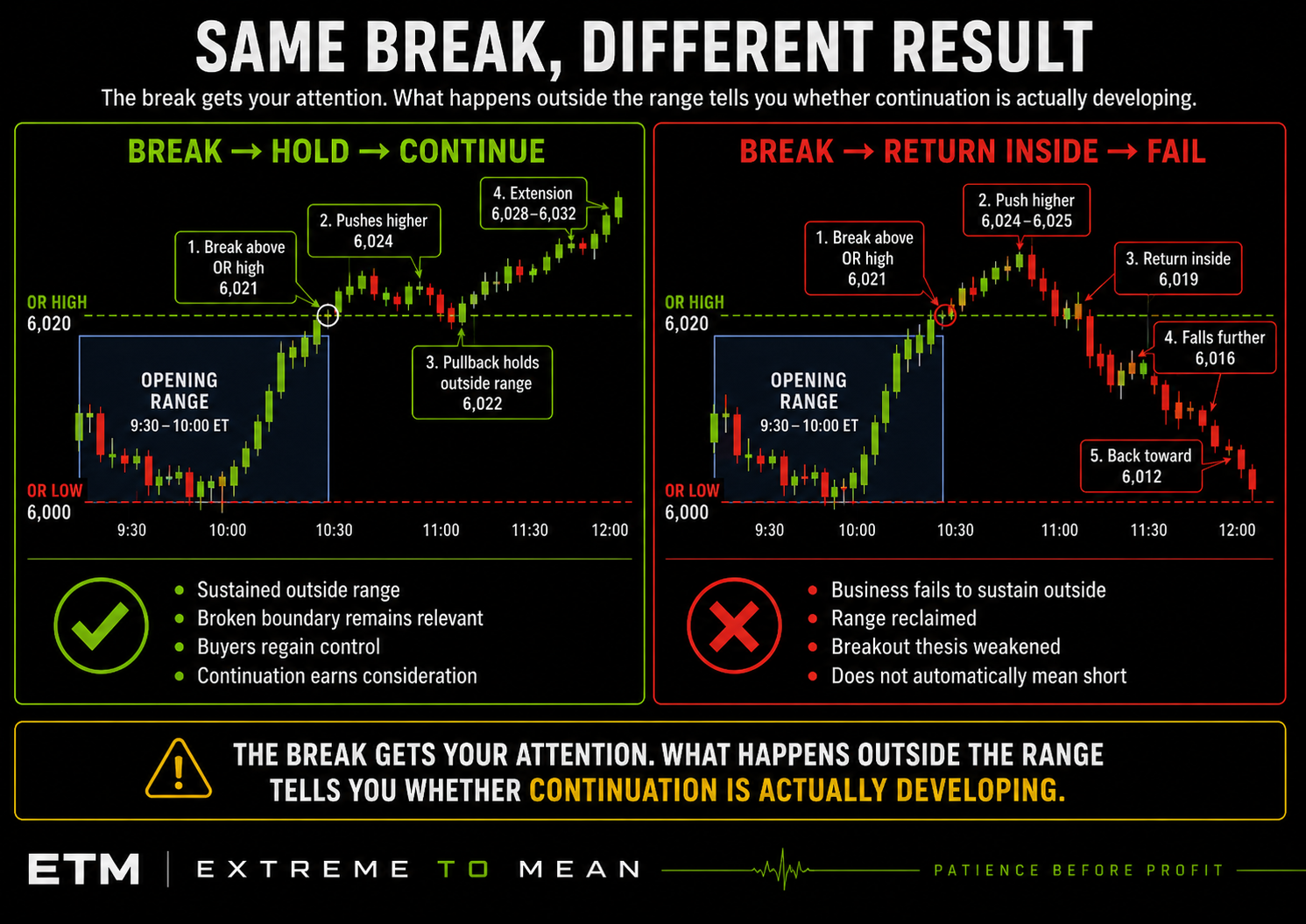
Suppose the Opening Range high is 6,020 and ES trades 6,022 before immediately falling back inside. Price technically traded above the range, but the market has not necessarily shown that it can sustain business at higher prices. A wick through the boundary is information, not automatic confirmation and not automatic failure.
The better question is what happens next. Sustained trade outside the range, follow-through, pullbacks that remain near or outside the broken level, and new structure developing beyond it can all contribute to evidence of acceptance. None of those observations needs to become a universal rule such as two closes, three minutes, or one volume threshold.
A failed ORB is new information too. If price trades 6,021, 6,024, and 6,025 before rapidly returning through 6,019, 6,016, and 6,012, the auction is behaving differently from one that holds and extends. That failure tells the trader to reassess, not automatically reverse direction.
Context and Room Come Before the Entry
The same ORB shape can mean something different across the three market states. Before trading the break, consider whether the session is trending or rotating, whether a meaningful overnight gap exists, where price sits relative to the previous day, and whether volatility or higher-timeframe structure changes the trade. Context should narrow the interpretation rather than add a dozen mandatory indicators.
The overnight session matters especially for ES and NQ because the 9:30 cash-equity open occurs after hours of futures trading. Overnight high and low, prior close, previous-day high and low, and major higher-timeframe references can all affect the space available beyond the Opening Range. An upside ORB with an overnight high three points above it is not the same trade as the same breakout with 30 points of clear space.
Suppose the range high is 6,020, a potential long entry is 6,023, and major resistance sits at 6,026. Even if the breakout looks clean, there may be only three points of room before a meaningful opposing reference. A breakout can be correct directionally and still offer a poor trade.
Risk and Retest Decisions Still Need a Plan
Risk should not be manufactured after the trader decides they want the breakout. Stops placed mechanically at the opposite side of the range can be too wide, while stops tucked just inside the boundary can sit inside normal noise. Invalidation belongs where the continuation thesis is actually wrong under the strategy being traded.
Immediate breakout entries and retest entries involve different tradeoffs. The initial break may never return, while a retest can provide more information and sometimes better location but may never occur. Waiting for a retest is a tradeoff, not universally superior execution.
Do Not Chase a Breakout That Already Left You
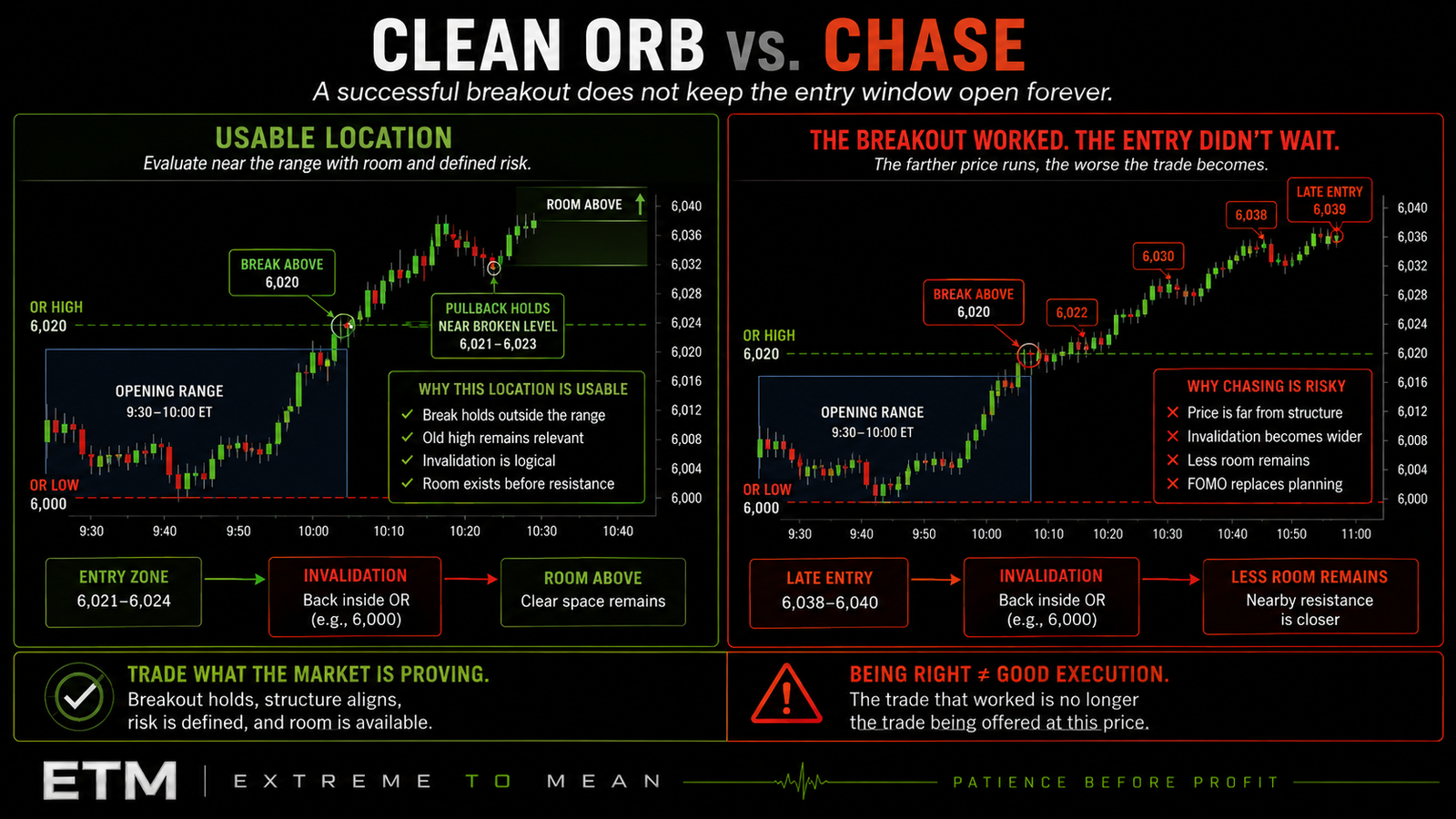
The ORB often becomes emotionally difficult precisely when it works. If the range high is 6,020 and price runs 6,022 → 6,030 → 6,038, the trader can suddenly feel punished for waiting and start buying because the original breakout thesis was correct. That is where confirmation can quietly turn into FOMO.
The trade being offered at 6,038 is not the same trade that existed near the boundary. Invalidation may be farther away, available upside room may be smaller, and the trader is paying a worse price for the same directional idea. A successful breakout does not keep the entry window open forever.
This is where where you enter matters more than what you predict. Being right about direction does not guarantee good execution after price has already expanded, and “I knew it was going higher” is not a risk argument. If the clean ORB is gone, it can simply be gone.
A Bullish ES Example
Assume a hypothetical 30-minute Opening Range from 9:30 to 10:00 ET with an OR high at 6,020 and an OR low at 6,000. At 10:05, ES prints 6,022, which earns attention because the range high has been crossed. What happens next determines whether the break becomes useful.
In Scenario A, price moves 6,022 → 6,025, pulls back to 6,021, and then advances to 6,028. The old boundary remains relevant and buyers regain control after the pullback. That can earn continuation consideration if room and invalidation still make sense.
In Scenario B, price moves 6,022 → 6,024 and then falls through 6,018 to 6,014. The market cannot sustain business outside the range, so the bullish thesis needs reassessment. That does not automatically create a short.
In Scenario C, price runs 6,022 → 6,032 → 6,040 and the trader finally buys at 6,039 because the breakout “worked.” The directional analysis may still be correct, but location and risk can now be unacceptable relative to the earlier setup. Good analysis and good execution are separate things.
A Practical ORB Qualification Sequence
Use Range → Break → Hold or Fail → Confirm → Room → Risk as the core sequence. The process begins before the breakout because range definition, session context, and nearby structure already shape the opportunity. It ends with entry quality because a valid market read can still become a poor trade after price travels too far.
- Define the range: Know the exact opening window before the session.
- Let it complete: Do not redefine the range based on what price does later.
- Mark the boundaries: OR high and OR low become references.
- Observe the break: Price leaves one side of the completed range.
- Evaluate hold or failure: Can the market sustain trade outside?
- Check context: Does the surrounding environment support continuation?
- Check room: What meaningful obstacle lies ahead?
- Define invalidation: Where is the breakout thesis actually wrong?
- Evaluate entry quality: Has price already traveled too far?
- Decide: Only now ask whether the ORB deserves risk.
| Question | Qualified ORB Candidate | Weak / Failed ORB |
|---|---|---|
| Opening Range | Clearly defined before breakout | Range definition changing after the fact |
| Break | Price leaves boundary | Brief probe only |
| Outside-range behavior | Sustained / constructive | Immediate return |
| Follow-through | Developing | Missing or reversing |
| Room | Clear space exists | Major obstacle immediately ahead |
| Risk | Logical invalidation available | Stop arbitrary or excessively wide |
| Entry | Near usable structure | Chasing extended move |
| Context | Supports continuation | Conflicting / choppy |
| Trader response | Evaluate risk | Wait / reassess |
These are qualification questions, not a mechanical probability model. Instead of asking “Did the Opening Range break?”, ask “Did price leave the Opening Range in a way that is gaining acceptance, preserving usable location, and leaving enough room to justify risk?” Then ask: “If I had not seen the original breakout happen, would I still consider this a good entry at the price being offered now?”
Final Thought
An Opening Range Breakout is not tradable simply because price crossed the range high or low. The range creates the reference, the breakout creates the test, and the market’s behavior outside that range tells you whether continuation is developing. Room, context, invalidation, and entry quality decide whether that development deserves risk.
Patience here is not waiting for a perfect candle or requiring every breakout to retest. It is refusing to convert the first move outside the range into an automatic order and refusing to chase after the clean location is gone. The trader’s job is to evaluate what the market is proving, not react to the fact that a line broke.
When price leaves the Opening Range, ask whether you are trading because the boundary was crossed or because the market has shown enough acceptance, context, room, and risk clarity to make the breakout usable. Readers who want to build the broader market-reading skills behind that decision can continue with Decode the Market. The ORB becomes more useful when it is placed inside the session rather than treated as an isolated signal.
Educational content only. Trading involves substantial risk and is not suitable for everyone.