
New traders often give most of their attention to the entry because it feels like the decision that creates the trade. They search for the right candle, level, signal, or moment to press Buy or Sell, then treat everything that happens afterward as management. In reality, the entry is only the beginning of a sequence that remains incomplete until the position is closed.
A trader can enter at a reasonable price and still produce a poor result by using too much size, exiting without a plan, or misunderstanding how the position makes and loses money. A less-than-perfect entry can sometimes remain manageable when the exposure and exit logic are clearly defined. The quality of the trade therefore depends on the relationship among the entry, direction, size, risk, and exit rather than on the entry price by itself.
This lesson does not teach a particular setup or strategy. It explains the structure shared by every completed trade: a position opens, price moves, and the position closes. The difference between the opening and closing prices becomes financially meaningful only after the direction and size of the position are included.
This concept belongs in the broader Basics learning path because later lessons on orders, stops, targets, leverage, costs, and position sizing all depend on understanding how a trade’s result is created. Before a trader can evaluate whether a plan is good, they need to understand what the basic numbers actually represent.
The Entry Price Begins the Position
The entry price is the price at which the trader opens a position. In a long trade, the trader buys first because they expect to sell later at a higher price. In a short trade, the trader sells first and plans to buy the position back later at a lower price.
Once the order is filled, the entry becomes the starting reference for measuring subsequent movement. Suppose a trader buys 10 shares at $50.00, creating a position with $500 of market value. If price rises to $51.00, the position has moved $1.00 per share in the trader’s favor; if price declines to $49.00, it has moved $1.00 per share against the trader.
While the position remains open, that movement may appear as unrealized profit or loss on the trading platform. The number continues changing because the trader has not yet exited. The entry tells the trader where the position began, but it does not reveal whether the trade was well planned, appropriately sized, or ultimately profitable.
The Exit Price Completes the Trade
The exit price is the price at which the trader closes the position. A long position is closed by selling what was previously bought, while a short position is closed by buying back what was previously sold. Once the exit occurs, the trade has both a beginning and an end, allowing its price-based result to be calculated.
Suppose the trader who bought 10 shares at $50.00 later sells them at $52.00. The market moved $2.00 per share in the trader’s favor, producing the following calculation:
$52.00 exit price − $50.00 entry price = $2.00 gain per share
With 10 shares:
$2.00 × 10 shares = $20.00 gross gain
The word gross matters because commissions, fees, spread, and slippage may reduce the amount ultimately recorded in the account. The price calculation shows how the position performed before those costs are included. If the same trader instead sells at $48.50, the market has moved $1.50 per share against the position:
$48.50 exit price − $50.00 entry price = −$1.50 per share
With 10 shares:
−$1.50 × 10 shares = −$15.00 gross loss
The exit does more than stop the position from moving. It converts a changing open result into a completed result for the shares or contracts that were closed. Until that point, the outcome remains exposed to further market movement.
Long and Short Trades Use Opposite Directional Logic
A long position benefits when price rises after the entry, while a short position benefits when price falls. The entry and exit prices may be identical in two examples, but the result can reverse completely depending on which direction was traded. Direction therefore determines how the distance between the two prices should be interpreted.
For a long trade, the basic calculation is:
Exit price − entry price = gain or loss per unit
A trader who buys at $100 and sells at $104 gains $4 per share. A trader who buys at $100 and sells at $96 loses $4 per share because the exit occurred below the entry.
For a short trade, the basic calculation is reversed:
Entry price − exit price = gain or loss per unit
A trader who sells short at $100 and buys the position back at $96 gains $4 per share because the repurchase occurred at a lower price. If the trader instead buys it back at $104, the $4 rise creates a $4 loss per share. Readers who need a fuller explanation can review how long and short trades work.
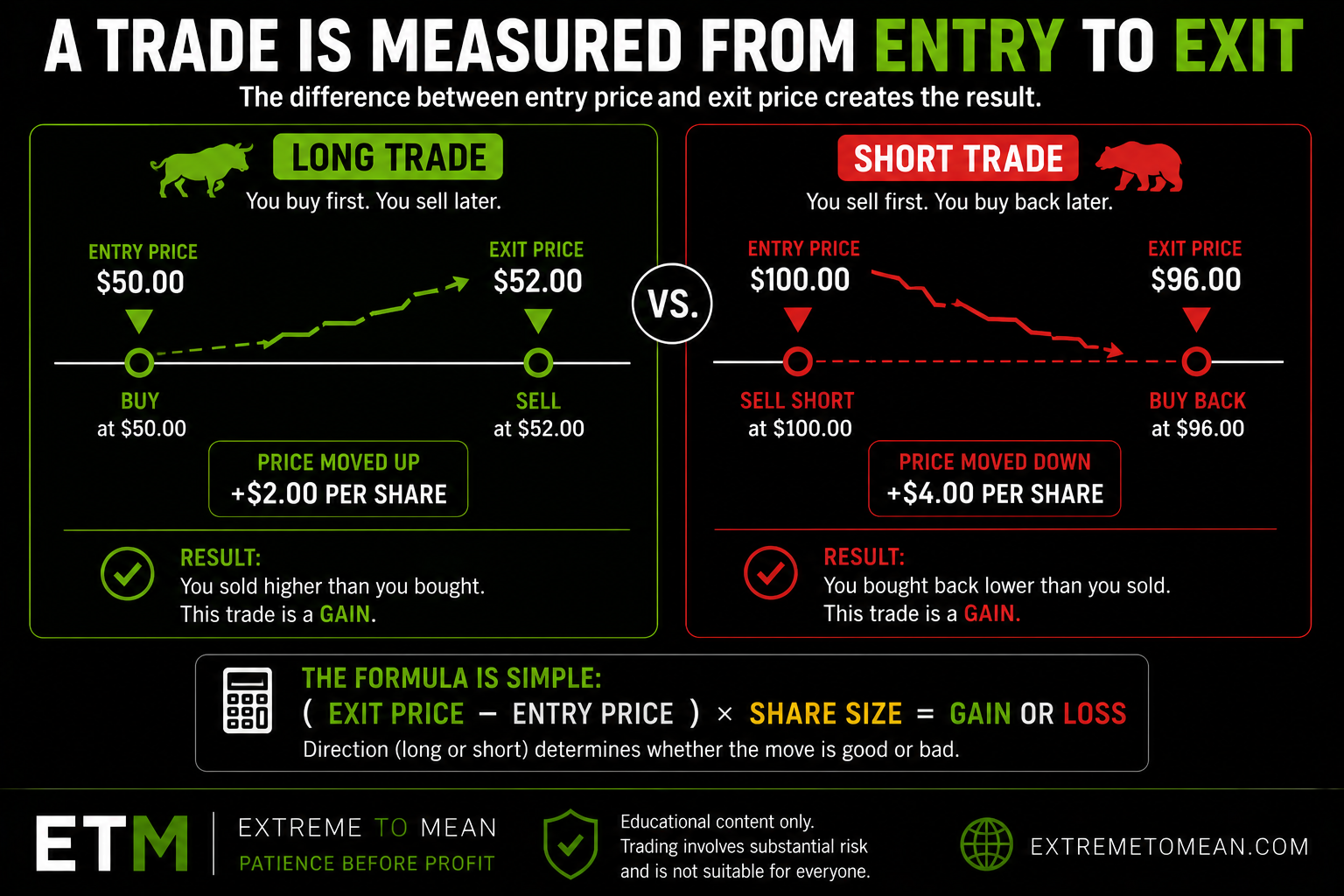
The entry and exit prices show the distance traveled during the position. Direction determines whether that movement helped or hurt the trade. Position size then determines how strongly the movement affected the account.
Position Size Changes the Dollar Result
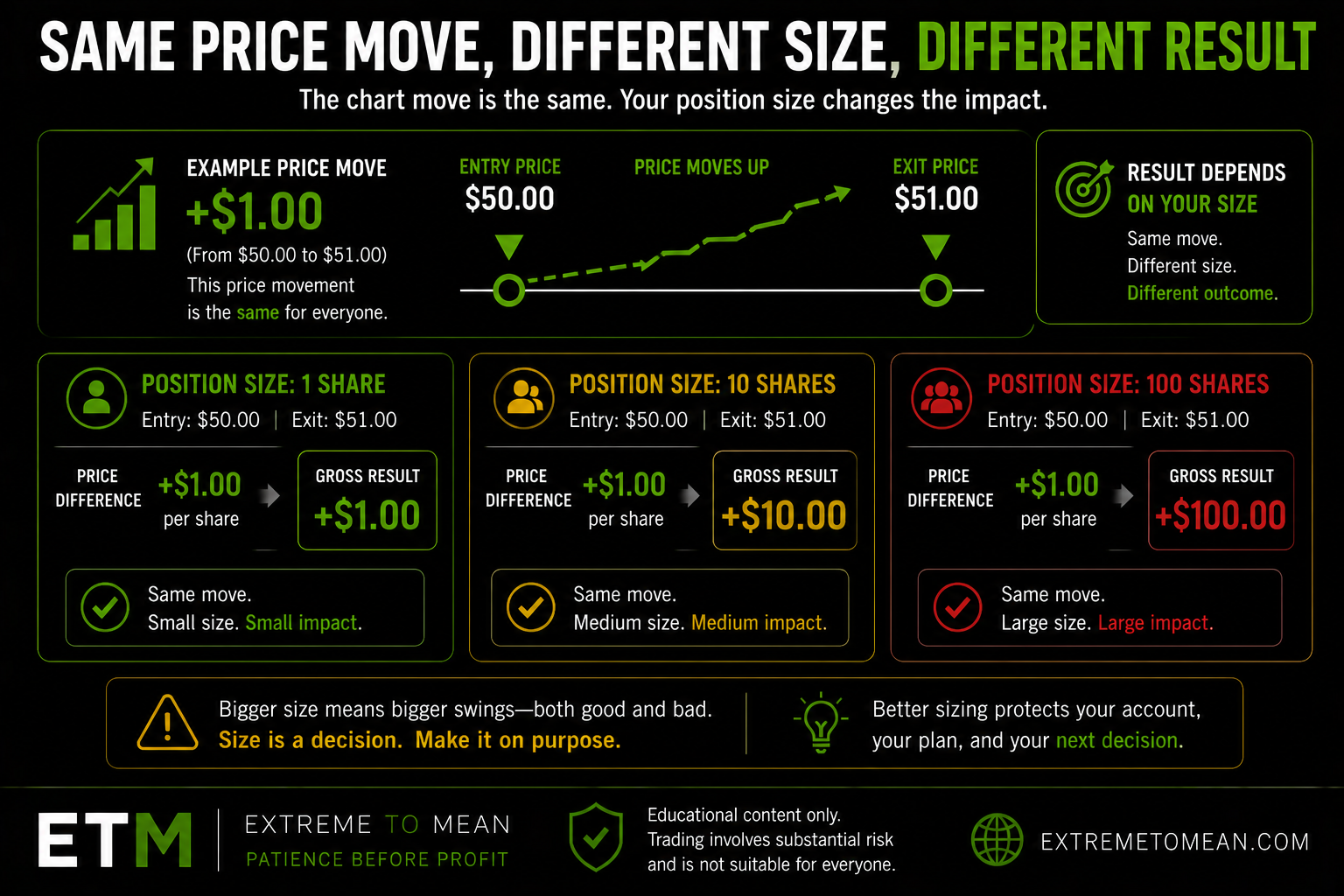
The difference between entry and exit shows how much was gained or lost per share, contract, or other unit. Position size determines how many times that amount is applied. Two traders can participate in the same movement and experience very different financial results because they accepted different levels of exposure.
Suppose two traders both buy at $50 and sell at $51. The market moved $1 per share in both positions, but the first trader held 10 shares and earned a gross gain of $10, while the second held 100 shares and earned a gross gain of $100. The price movement was identical, but the account impact was not.
The same relationship applies when the trade loses. If both traders buy at $50 and exit at $49, the first loses $10 while the second loses $100 before applicable costs. Position size does not merely increase the result when the market moves favorably; it also increases the damage when the market moves against the position.
This is why an entry should never be evaluated without considering size. A one-dollar move on the chart can represent a minor fluctuation for one account and a serious loss for another. The related lesson on position size versus account size explains why the same number of shares or contracts can create very different levels of risk for different traders.
Open Profit and Loss Is Still Changing
While a position remains active, the trading platform may display unrealized profit or loss. Unrealized means the position has not yet been closed, so the displayed number is an estimate based on the price currently available in the market. It may change from one moment to the next as price moves.
Suppose a trader buys 20 shares at $40.00. If price rises to $41.00, the platform may show an unrealized gain of approximately $20 before costs. If price later falls to $39.50 while the trade remains open, the display may change to an unrealized loss of approximately $10.
The trader did not first complete a $20 gain and then complete a $10 loss. The position remained open during the entire move, and its current value changed as the market changed. No final result existed because no exit had occurred.
This distinction often creates emotional problems. A trader may begin treating an open gain as money already owned, then react impulsively when normal movement causes part of it to disappear. Another trader may treat an open loss as less serious because it does not feel final, even though the position remains exposed and the loss can continue growing.
Unrealized does not mean unimportant or imaginary. It means the result remains unfinished. The trader still needs a defined reason for continuing to hold, reducing the position, or closing it.
Realized Profit and Loss Is the Completed Result
Profit or loss becomes realized when all or part of the position is closed. If the entire position is exited, the trade’s price-based result is complete. If only part is closed, the realized result applies to that portion while the remaining shares or contracts continue carrying unrealized profit or loss.
Suppose a trader buys 100 shares at $25.00 and price later rises to $27.00. If the trader sells 50 shares, those shares create a realized gross gain of $100:
$2.00 gain per share × 50 shares = $100 realized gross gain
The remaining 50 shares are still open, so their result continues changing with the market. A platform may therefore display realized and unrealized profit or loss at the same time because one portion of the position has ended while another remains active.
A completed result should eventually include more than the difference between entry and exit. Commissions, regulatory or exchange fees, spread, and slippage can separate the gross price result from the net amount recorded in the account. The lesson on the real cost of a trade explains why a position can move in the expected direction and still produce less than the basic calculation suggests.
A Trade Is a Complete Sequence
Beginners sometimes think about a trade as though they are simply purchasing something at one price. Trading is different because the decision continues after the entry, the value of the position changes with the market, and the exposure does not end until the position is closed. Pressing Buy or Sell opens the process rather than completing it.
After entering, the trader must determine whether the original reason for participating remains valid. They may need to follow a planned stop, target, time limit, partial exit, or another management rule. Those decisions should come from the trade plan and the market’s behavior rather than being invented in response to hope, fear, or discomfort.
A complete trade can be understood as the following sequence:
- Entry: The position opens at a defined price or area.
- Price movement: The market moves for or against the position.
- Risk and trade management: The trader follows the rules governing the open exposure.
- Exit: All or part of the position is closed.
- Final result: Direction, movement, size, and costs determine the effect on the account.
A trader who focuses only on buying or selling may enter without understanding where the position should be closed if the idea succeeds or where it must be closed if the idea fails. The entry opens the risk, but the full sequence determines the outcome.
The same price movement can create very different results depending on position size, direction, and execution. The trade is therefore not one button press or one chart level. It is the complete decision from entry through exit.
Correct Direction Does Not Guarantee a Good Trade
A trader can correctly predict that price will rise and still create a disappointing or negative result. They may enter after most of the move has already occurred, leaving little room before resistance, or use so much size that normal movement becomes emotionally difficult to tolerate. They may also exit too early during a minor pullback or continue holding after the original idea has failed.
Execution costs can further reduce the result, especially when the expected move is small. A trader might correctly anticipate a short upward move but surrender much of that movement through spread, commission, or slippage. Direction was correct, yet the complete trade was still poorly constructed.
The opposite can also occur. A trader can ignore the plan, use excessive size, or enter without defined risk and still receive a favorable result because the market happened to move in the chosen direction. That gain does not prove the process was sound; it only proves that the outcome was favorable on that occasion.
Decision quality should therefore be reviewed separately from the result of a single position. One loss does not automatically make a disciplined trade poor, and one gain does not make an uncontrolled trade good. The relevant question is whether the trader defined and followed a process that can be evaluated.
Why the Entry Receives Too Much Attention
The entry receives attention because it creates the immediate possibility of reward. It is the moment when analysis becomes action and profit and loss begin moving on the screen. Finding an entry can also feel like solving the market, which makes it more exciting than planning the less comfortable parts of the decision.
The exit requires the trader to accept an outcome. Closing a gain may create concern that more movement will be missed, while closing a loss requires acknowledging that the position did not develop as expected. Because those decisions are emotionally harder, traders may spend hours studying entries while giving only seconds to the rules that complete the trade.
A cleaner process gives the entry and exit separate jobs. The entry begins exposure only when the required conditions are present. The exit ends that exposure according to a target, invalidation point, time condition, or another rule defined before the position begins influencing the trader’s emotions.
The entry cannot solve decisions that were never planned. Even a precise entry becomes difficult to manage when the trader has not defined the size, risk, exit logic, or expected destination. The complete plan must exist before the order is placed.
Define the Complete Trade Before Entering
Before opening a position, the trader should be able to explain where participation begins, which direction is being traded, how much size will be used, and what behavior would require an exit. The trader should also understand the target or management approach and the realistic amount of movement available. The market is not required to follow that plan, but the trader should know what decision they are accepting.
Consider a trader planning to buy 20 shares near $50 because price is responding at a meaningful location. The idea becomes invalid below $48.50, while the next reasonable target area sits near $53. The planned price risk is therefore $1.50 per share, or $30 across the 20-share position before possible slippage and other costs.
The potential movement from $50 to $53 is $3 per share, or $60 across the position before costs. Those numbers do not guarantee that the trade will reach the target or exit at the exact stop price. They give the trader enough information to decide whether the location, exposure, and available room justify participation.
Before entering, the trader should be able to answer four practical questions:
- Where does the position begin?
- What market behavior ends the idea?
- How much total exposure does the chosen size create?
- What result would the planned target or invalidation produce before costs?
This review may reveal that the location is unclear, the stop is too far away, the position is too large, or the available room is insufficient. Discovering that before entry is useful because the trader can adjust the size, wait for a better location, or reject the trade without open profit and loss influencing the decision.
The free trading tools and checklists can help organize the entry, exit, size, invalidation, and expected movement before a position is opened. The objective is not to predict the exact outcome. It is to understand what the trade could reasonably do to the account before accepting the exposure.
Final Thought
Every completed trade has an entry price and an exit price, but those two numbers do not tell the entire story by themselves. Their difference shows how far the market moved while the position was open. Direction determines whether the movement produced a gain or loss, while position size and trading costs determine the final account impact.
An entry does not create a complete trade. The position remains exposed until it is closed, and its unrealized result may continue changing throughout that period. A well-defined decision therefore includes the entry, direction, size, invalidation, exit logic, and expected destination before capital is placed at risk.
Understand the full sequence before acting. The trade is not merely where the trader gets in; it is everything that happens from entry to exit and what that complete process does to the account.
Educational content only. Trading involves substantial risk and is not suitable for everyone.