
Many beginners start with statements such as "trade with the trend," "wait for confirmation," or "control risk." Those ideas sound sensible, but they do not explain which market to trade, when to participate, what qualifies as confirmation, or how much exposure is acceptable. The missing details are usually filled in while price is already moving. That is when urgency and emotion gain influence over decisions that should have been prepared earlier.
The lessons in The Trader category emphasize that the trader's job is to evaluate rather than react. A complete plan supports that job by defining the boundaries of acceptable participation before the session creates pressure. It does not predict which trades will work or require the trader to take action. It creates a stable reference for deciding whether the setup earns attention and whether it eventually earns risk.
A Trading Plan Is a Decision Manual
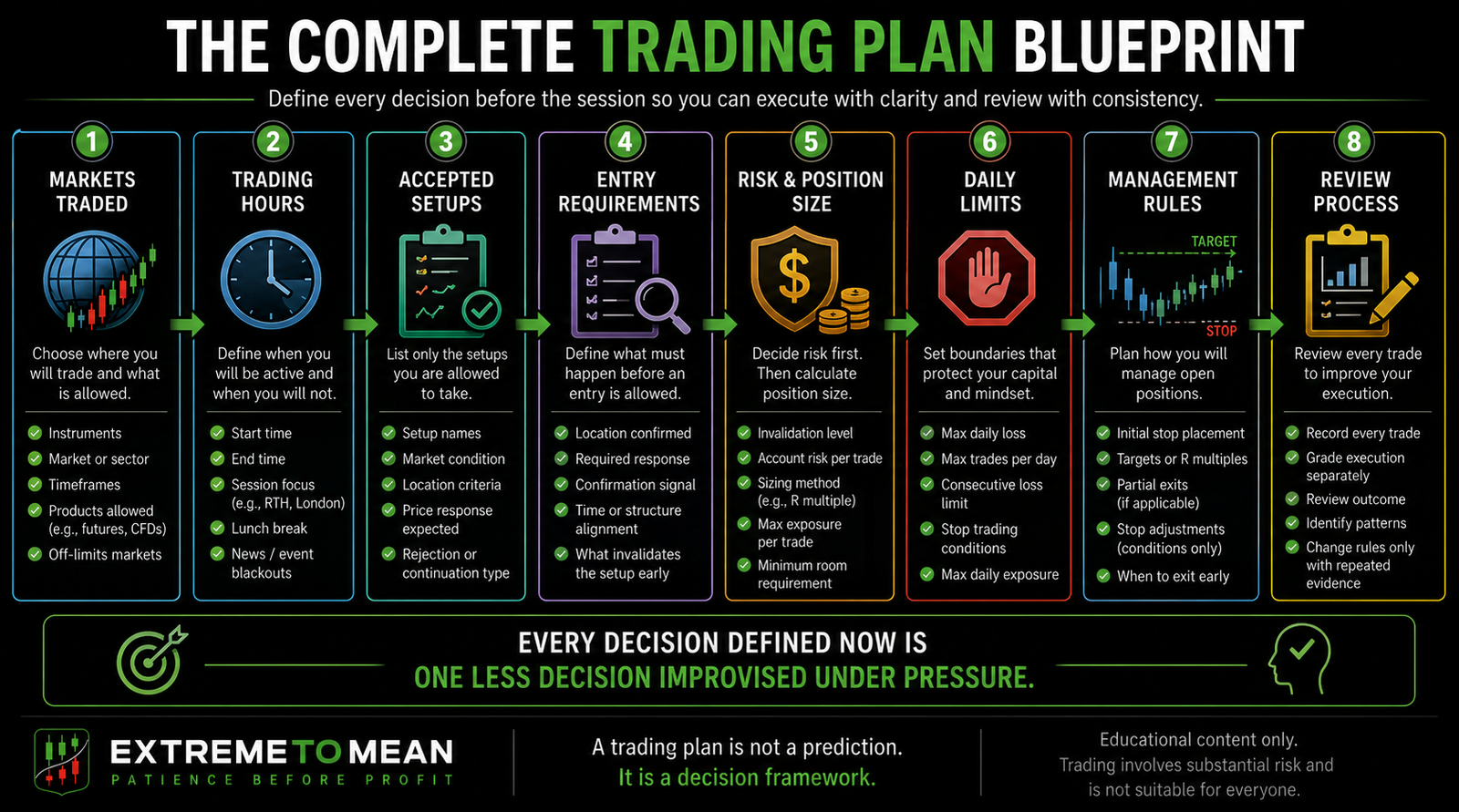
A trading plan is not a market forecast, a list of goals, or a promise that every session will produce an opportunity. It is a decision manual that tells the trader what is allowed, what is required, and what should cause the trader to stand aside. The plan should reduce the number of important choices that must be invented in real time. It should also make the trader's actions understandable during review.
The lesson that a trading plan is a promise made before the open explains why the document matters. The trader creates the plan while thinking is calmer, then uses it when movement and uncertainty make improvisation more tempting. A useful promise must be specific enough to recognize when it has been kept or broken. "Be disciplined" is not specific, but "trade only these setups during these hours with defined risk" can be evaluated.
Start With the Boundaries
The first part of the plan should define the markets, instruments, and trading hours the trader is permitted to use. Limiting the list makes preparation more focused and prevents frustration in one market from becoming an impulsive search for action somewhere else. Time boundaries may define the session, opening period, stopping time, or scheduled events that do not fit the method. These choices should reflect the strategy, personal schedule, and ability to remain attentive. The goal is not to find perfect conditions but to define the environment in which the plan is intended to operate.
Define the Setups You Will Accept
A plan should name the setups the trader is allowed to consider and describe the basic logic behind each one. The description should include the market condition, location, and type of price response that make the setup relevant. A setup is not simply a pattern that looks familiar on the chart. It is a group of conditions that explains why the location deserves attention and what behavior must appear before participation is considered.
This is where why simple trading is not easy trading becomes practical. A short list of accepted setups gives the trader fewer decisions, but it also removes many excuses for acting outside the rules. If the live idea does not match one of the written setups, the plan should not be stretched to include it. New setups can be researched separately without being added during an emotional session.
Write the Entry Requirements
Each accepted setup needs entry requirements that can be observed rather than felt. The plan should define what price must do at the location, what confirmation is required, and what conditions would make the entry too early or too late. Words such as "strength," "weakness," and "clean reaction" should be explained in the trader's own method. If two reasonable people could interpret the instruction in opposite ways, it probably needs more detail.
The entry section should also separate setup recognition from trade qualification. Price reaching an important level may earn attention, but arrival alone should not automatically create an order. The trader still needs to evaluate context, structure, confirmation, room, and risk. This separation prevents a prepared area from becoming a prediction that price must reverse or continue.
Build Risk and Position-Sizing Rules
Risk rules should be written before any position size is calculated. The plan needs to define where the idea becomes invalid, how much account exposure is permitted, and whether the available room justifies considering the trade. Position size should come from the planned risk and the distance to invalidation, not from confidence or recent results. The same setup should not receive more exposure merely because the trader strongly wants it to work.
The principle that the trade is not ready until the risk is clear belongs inside every trading plan. If the invalidation point cannot be placed logically, the position cannot be sized honestly. If the required size does not fit the trader's limits, the trade does not earn risk. The plan should make that conclusion available before the trader becomes attached to the opportunity.
Set Daily Limits Before the Session
A complete plan needs limits for daily exposure, trade count, and conditions that end participation. The trader may use a maximum daily loss, a maximum number of attempts, a consecutive-loss rule, or another boundary suited to the method. Limits should also address positive emotional pressure because a strong start can create overconfidence, larger size, or unnecessary trades. The plan may define when to reduce activity, stop after the intended work is complete, or refuse to increase risk because of earlier results. These boundaries protect decision quality when the session is no longer being traded as planned.
Decide How Trades Will Be Managed
Entry rules are incomplete without management rules. The plan should explain whether stops remain fixed, when they may be adjusted, how targets are selected, and whether partial exits are part of a defined scale-out method. It should also identify what new information would justify a legitimate change after entry. Flexibility may respond to changing volatility, new structure, or a planned management trigger, but it should not become permission to rewrite the trade. Management decisions should follow evidence and written rules rather than the desire to avoid being wrong.
Make Review Part of the Plan
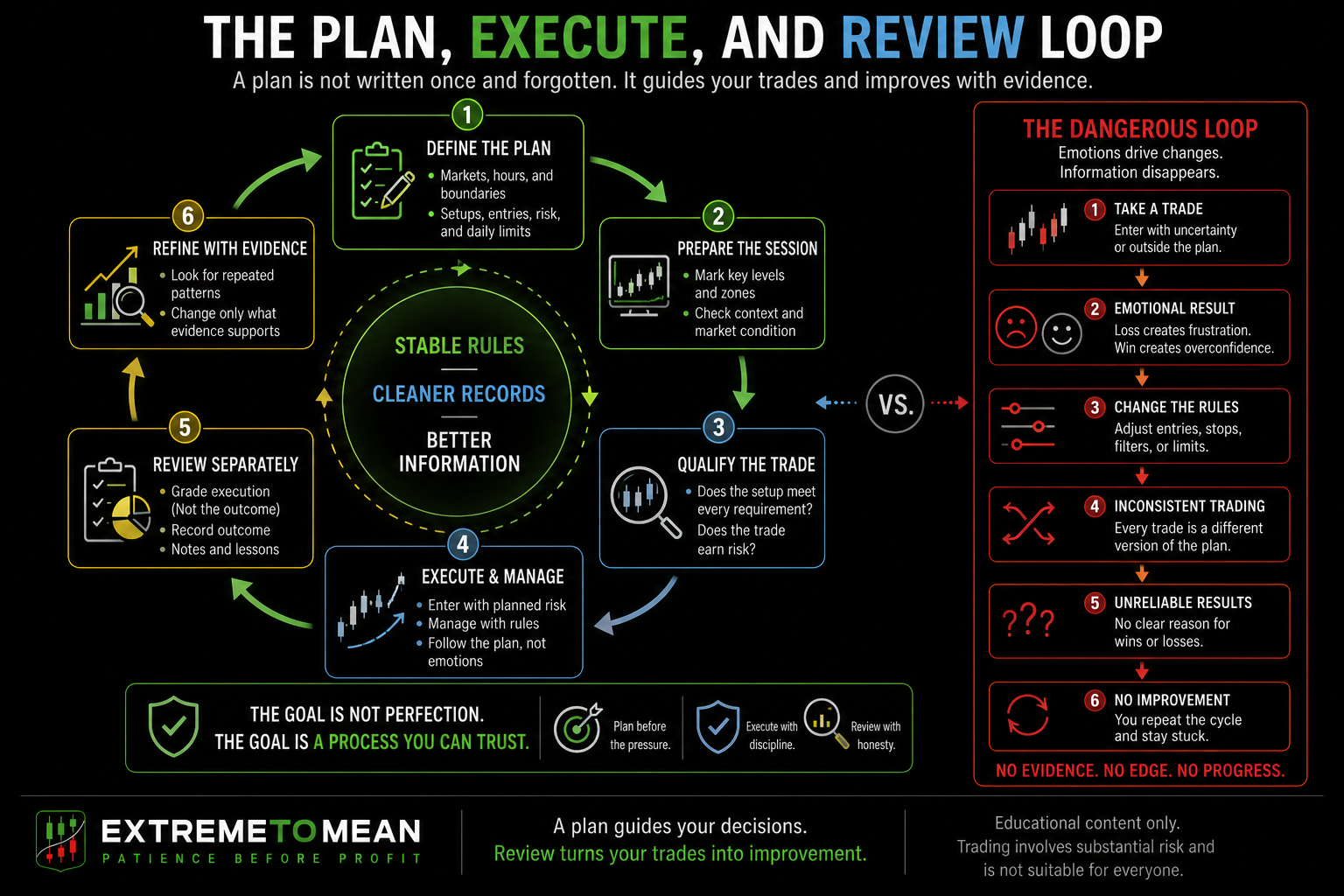
A trading plan should explain how each decision will be reviewed after the session. The record should include the setup, context, location, entry requirements, planned risk, management, and whether each rule was followed. Outcome should be recorded, but it should not replace execution quality as the main subject of review. A favorable result can come from a poor decision, and an unfavorable result can follow clean execution.
The purpose of review is to protect your next decision by turning the previous trade into useful information rather than emotional residue. Repeated rule breaks may reveal that a rule is vague, unrealistic, or not being respected under pressure. Repeated clean execution may reveal a genuine method issue that deserves further study. The plan should be changed only after a consistent pattern is visible, not after every individual result.
Assemble the First Version
The first trading plan does not need to be long, elegant, or complete in every possible situation. It needs to cover the decisions that repeatedly create confusion during preparation and execution. The trader should begin with a version that can be read quickly before the session and checked easily during review. A plan that is too complicated to use will become another document the trader ignores.
A beginner-friendly first version should answer the following questions. The plan should answer each one in plain language. If an answer cannot be stated clearly, the rule needs more work.
- Which markets or instruments may I trade?
- During which hours may I participate?
- Which setups are accepted?
- What market condition and location does each setup require?
- What must happen before entry?
- Where is the idea invalid?
- How is position size calculated?
- What are the daily loss, trade-count, and stop-trading limits?
- How will an open trade be managed?
- What must be recorded and reviewed afterward?
After writing the first version, the trader should test it for clarity rather than profitability. The better question is, "What important decision am I still leaving for my most emotional moment?" Any answer that depends on improvisation should be considered for inclusion in the plan. The goal is not to remove judgment but to prepare the decisions most likely to become distorted under pressure.
The plan should remain accessible while the trader is working. A one-page summary, checklist, or worksheet can make the core rules easier to use than a long document hidden in a folder, but it helps to keep the difference between a checklist and a trading plan in mind so the shorter format never replaces the plan itself.
The free trading tools can provide a practical starting point for organizing preparation and review. Whatever format is used, the trader should be able to compare the live decision with the written standard before placing risk.
Final Thought
Building a trading plan from scratch means deciding how the work will be done before the market begins demanding answers. The plan defines the markets, hours, setups, entry requirements, risk, daily limits, management, and review process that shape participation. It cannot make uncertainty disappear or guarantee that a qualified trade will work. It can make the trader's choices clearer and easier to evaluate.
The first plan will not be perfect, and it should improve as the trader collects reliable evidence. Changes should come from repeated observations, not from one loss, one missed move, or one emotional session. A useful plan becomes a stable bridge between strategy and execution. It tells the trader what must happen before the setup earns risk and what must be reviewed after the decision is complete.
The review portion becomes more concrete when the plan is paired with a futures trading journal built around process and outcome.
That record also helps distinguish normal variance from the execution problems discussed in the guide to strategy hopping.
Educational content only. Trading involves substantial risk and is not suitable for everyone.