
An unexpected political statement, policy announcement, or geopolitical development can arrive while an ES or NQ position is already open. Price may jump before the first report is verified, then change direction as more information arrives. The temptation is to follow the spike, fade an apparent overreaction, or search for a story that makes one of those decisions feel certain.
That reverses the proper order of evaluation. Within The Market, headline risk is primarily a question of information uncertainty, market response, and execution—not merely whether a news item sounds bullish or bearish. HEADLINE EXPLANATION ≠ TRADE QUALIFICATION.
Scheduled News Gives Us a Clock; Headlines Do Not
A scheduled inflation report, employment release, or central-bank decision gives traders a known event time and some idea of the subject. We cannot know the result in advance, but we can decide how much exposure to carry through its release. The existing lesson on how news and economic data change market behavior explains that scheduled-event context in more detail.
An unscheduled headline removes much of that preparation window. We may not know when it is coming, whether the first account is accurate, or what important detail a follow-up report will add. Scheduled news gives us a clock; headline risk removes the clock. The goal cannot be to avoid every surprise, because surprises are precisely the events we could not place on a calendar.
Price Can Reprice Faster Than a Story Can Be Verified
Index futures are used to express and hedge changing expectations about U.S. equities, so bids, offers, and positions can adjust rapidly when important information appears. An initial headline might sound negative, yet the market may rally if traders feared something worse or had already positioned defensively. Markets respond to changes in expectations, not just to the emotional tone of the words.
The first report also may be incomplete. A later clarification can soften its implications, confirm them, or introduce a different uncertainty entirely. As the article on why price moves before the news makes sense explains, price can register changing participation before a tidy public explanation exists. The first spike may be the beginning of the information process, not the end.
That makes a large first candle useful evidence of urgency but weak evidence of final direction. A sudden selloff can continue if additional information reinforces the original concern, or it can reverse if the market rejects the initial interpretation. Neither outcome follows automatically from the size of the move. FAST MOVE ≠ OVERREACTION, and FIRST MOVE ≠ FINAL DIRECTION.
Execution Quality Can Change Along With Price
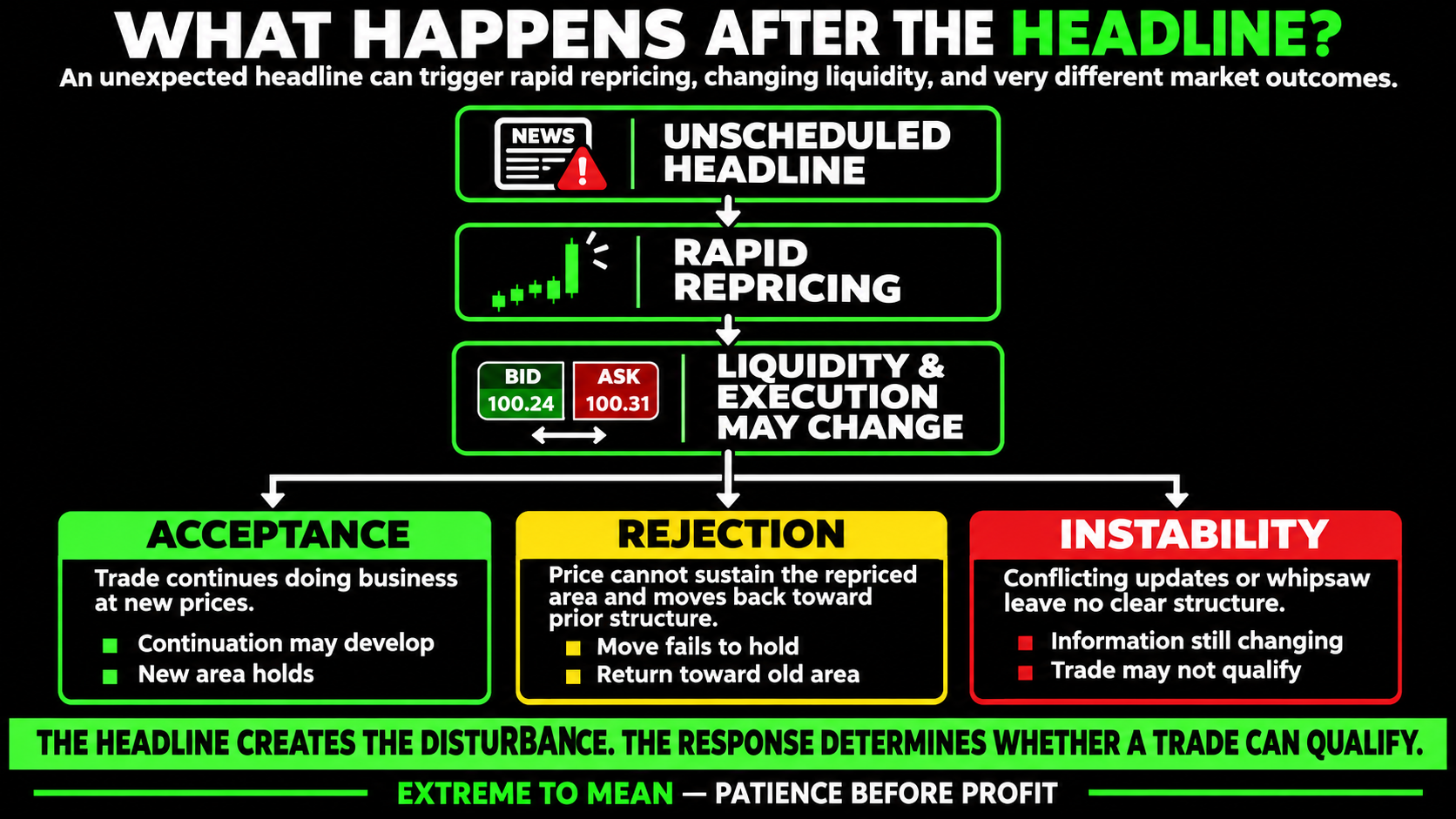
A normal setup assumes some relationship between the displayed market, the entry, the stop, and the price available for execution. During an information shock, order-book depth can change quickly and bid-ask spreads may widen as liquidity providers reconsider their quotes. Even if our directional read proves correct, a worse entry or exit can change the trade's risk and reward.
Order type matters in this environment. A market-oriented order emphasizes getting executed, subject to the exchange's applicable protections, while a limit order specifies an acceptable price but may not fill at all. A stop order is also not a guarantee that we will exit at the trigger price; a stop-limit can remain unfilled, while other protected stop mechanisms have their own execution boundaries. The stop defines the planned exit condition; available liquidity and order rules determine the fill.
A trader might have planned one unit of risk, or 1R, at the stop under normal conditions. If the market jumps through that area, the realized loss can exceed the estimate even though the stop was placed correctly. Exchange price limits and circuit breakers can constrain or pause trading during extreme moves, but they are not personal stop-loss insurance. A pause in trading does not stop new information from arriving or erase the open position.
Verify the Source Without Trying to Win a Speed Race
An unsourced screenshot, a social repost, and an official announcement should not carry equal evidentiary weight. A practical hierarchy begins with the original official statement, then established reporting that independently verifies it, followed by analysis and commentary, and finally unattributed claims. Source quality matters especially when a second message could contradict the first.
Verification does not mean waiting for perfect certainty before looking at the chart. By the time the event is fully explained, the market may already have adjusted, and that is not a failure of the trader's process. If our supposed advantage requires beating professional participants to the very first headline, we are competing in an information-speed race rather than evaluating a structured setup. A faster headline feed does not tell us how the market will interpret the news.
The Market's Response Matters More Than the First Spike
Once the initial shock has occurred, watch what price actually does near the new trading area. Acceptance means that trade continues to develop around or beyond repriced levels; rejection means price cannot sustain that area and moves back toward earlier structure. A third outcome is instability, when repeated updates and violent reversals leave no dependable reference for a normal setup.
None of these observations is an automatic entry signal. Acceptance may strengthen a continuation thesis without defining a sensible entry or invalidation, while rejection may weaken the initial move without proving a full reversal. The right first question is not “Do I fade it or follow it?” but “Has this market become tradable for my process again?”
Managing an Open Trade Is Different From Opening a New One
A trader who is already exposed cannot simply pretend the shock did not happen. The relevant questions are whether the original thesis still holds, what risk remains, and whether existing orders still match the plan. Removing a protective stop because the move feels like “news noise” turns uncertainty into potentially undefined exposure, even though the stop itself cannot promise an exact fill.
A flat trader has another option: not entering. If spreads are unstable, the report is unverified, or the original price structure has broken down, the process may have no qualified trade to offer. The lesson on market conditions not worth trading applies here: standing aside can be an evidence-based decision rather than a reaction to scary candles.
Reduced size may be appropriate when a properly tested setup remains valid but risk distance has changed. It cannot repair a missing setup, and simply widening a stop to make a violent move feel manageable changes the risk calculation. The futures position-sizing lesson starts with invalidation and dollar exposure rather than the number of contracts we hope to trade. After the headline, rebuild the trade from what is still true.
Two Similar Spikes Can Demand Different Decisions
Imagine NQ drops sharply after an unexpected announcement and briefly bounces. A trader calls the decline an overreaction, buys immediately, and then learns that a later verified report strengthens the original concern. Price makes new lows, exposing the weakness of a trade based only on the idea that the first move had gone “too far.”
Now imagine ES sells on a preliminary report, but clarification arrives and price moves back inside its previous range. The subsequent failure to sustain lower prices becomes meaningful context; it still does not automatically qualify a long trade. In a third version, conflicting updates produce alternating spikes with unstable spreads and no coherent invalidation, making PASS a legitimate result of the same review process.
The Headline-Risk Decision Filter
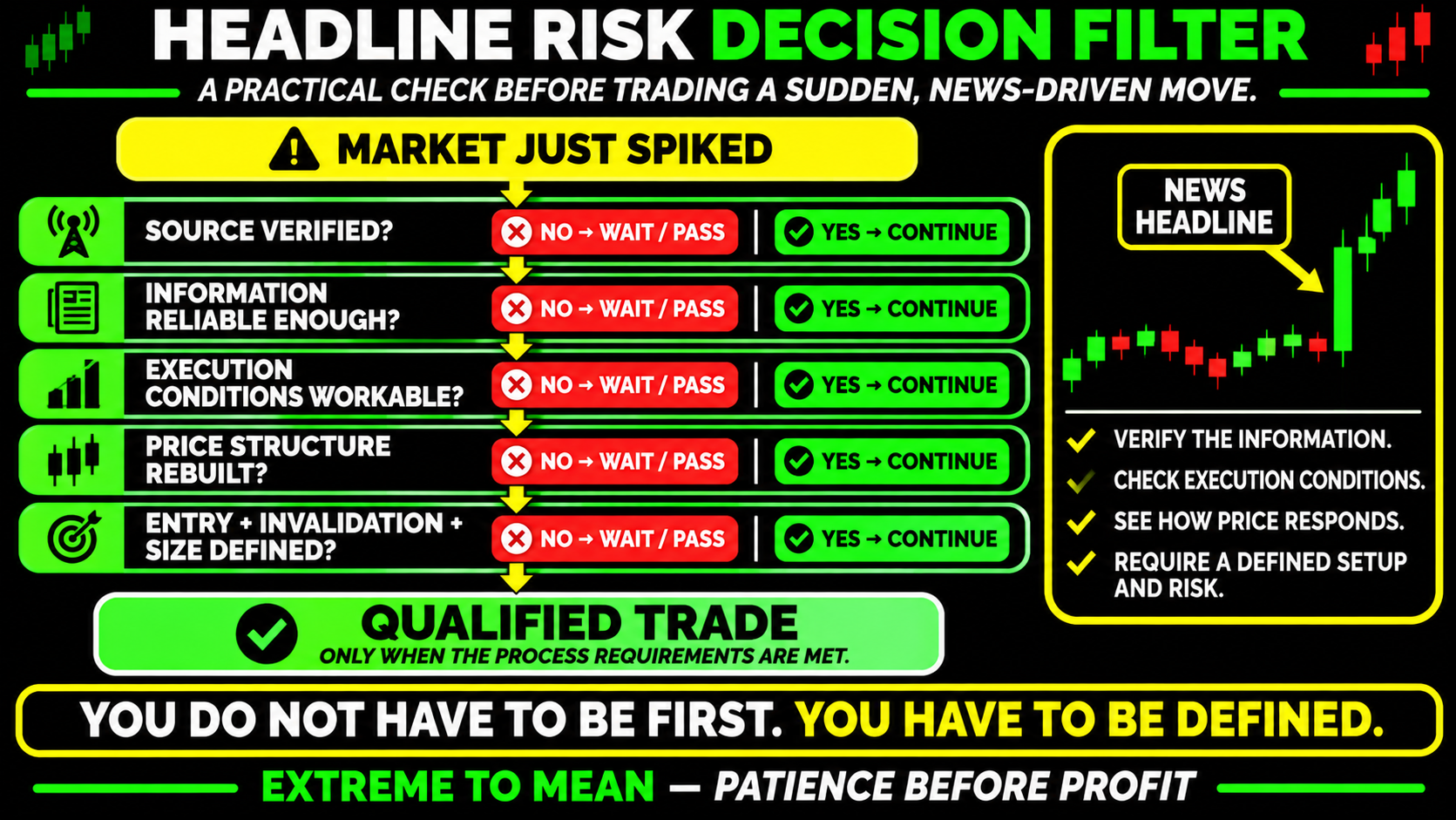
When an unscheduled move interrupts the session, separate information verification from price interpretation and trade qualification. The questions should be asked before the size of the candle or the urgency of a news alert becomes the reason for an order. A useful review is:
- Source: Do we know what actually happened, and is the information verified or still a rumor?
- Newness: Is this genuinely new information or an old story being repeated?
- Exposure: Are we managing an existing position or deciding whether to enter a new one?
- Repricing: How much has price already moved, and what previous structure survived?
- Execution: Are spreads, available depth, and order behavior suitable for our normal process?
- Response: Is price accepting new levels, rejecting them, or becoming unstable?
- Qualification: Can we specify an entry, invalidation, and size without inventing rules after the shock?
- Behavior: Are we fading because the move looks excessive or chasing because we fear missing it?
- Final test: Would the setup still deserve consideration if we did not know the headline's story?
The ETM Headline → Reprice → Liquidity → Response → Qualify Framework
Use HEADLINE → REPRICE → LIQUIDITY → RESPONSE → QUALIFY. HEADLINE asks what information arrived and how credible it is; REPRICE identifies what changed in the market; LIQUIDITY tests whether execution remains workable. RESPONSE watches continuation, rejection, or instability, while QUALIFY requires the ordinary entry, invalidation, and risk standards to be met before a new position is considered.
The result can be to manage an existing position, reduce exposure under an established plan, wait for structure, take a qualified setup, or pass entirely. None requires us to declare that the news itself predicts the next move. The ETM free trading tools can support preparation and post-trade review, but they cannot turn an unverified story into a trade plan. The headline explains urgency; the price response helps determine whether a trade can be qualified.
Final Thought
Unscheduled political and geopolitical headlines create a different problem from scheduled data releases because the timing, completeness, and reliability of the initial information may all be unknown. Price can adjust before a clear narrative exists, while available liquidity and order execution change at the same time. A large move can continue, reverse, or become a disorderly series of reactions, so neither “fade the spike” nor “follow the first move” works as a universal rule.
We do not have to be first to the information to make a disciplined decision about our own exposure. Verify what can be verified, observe the market's response, reassess the structure and execution conditions, and require the next setup to earn risk on its own terms. If no clear entry, invalidation, and acceptable size exist, waiting or passing is part of the process. You do not have to be first. You have to be defined.
Educational content only. Trading involves substantial risk and is not suitable for everyone.