
Traders often approach every session with the same technical expectations. They mark support, resistance, trends, and potential setups, then assume price should behave around those areas in a familiar way. That process can work when participation is orderly and information is already understood. It becomes less dependable when a major event causes participants to change their expectations and exposure at the same time.
The lessons in The Market category emphasize that context comes before the setup. An economic release, earnings report, central-bank decision, or geopolitical headline can become part of that context because it changes who is participating and how urgently they need to act. The trader does not need to predict the information or the reaction. The job is to recognize when the market is behaving differently enough that the normal decision process needs more caution.
Information Can Change the Environment
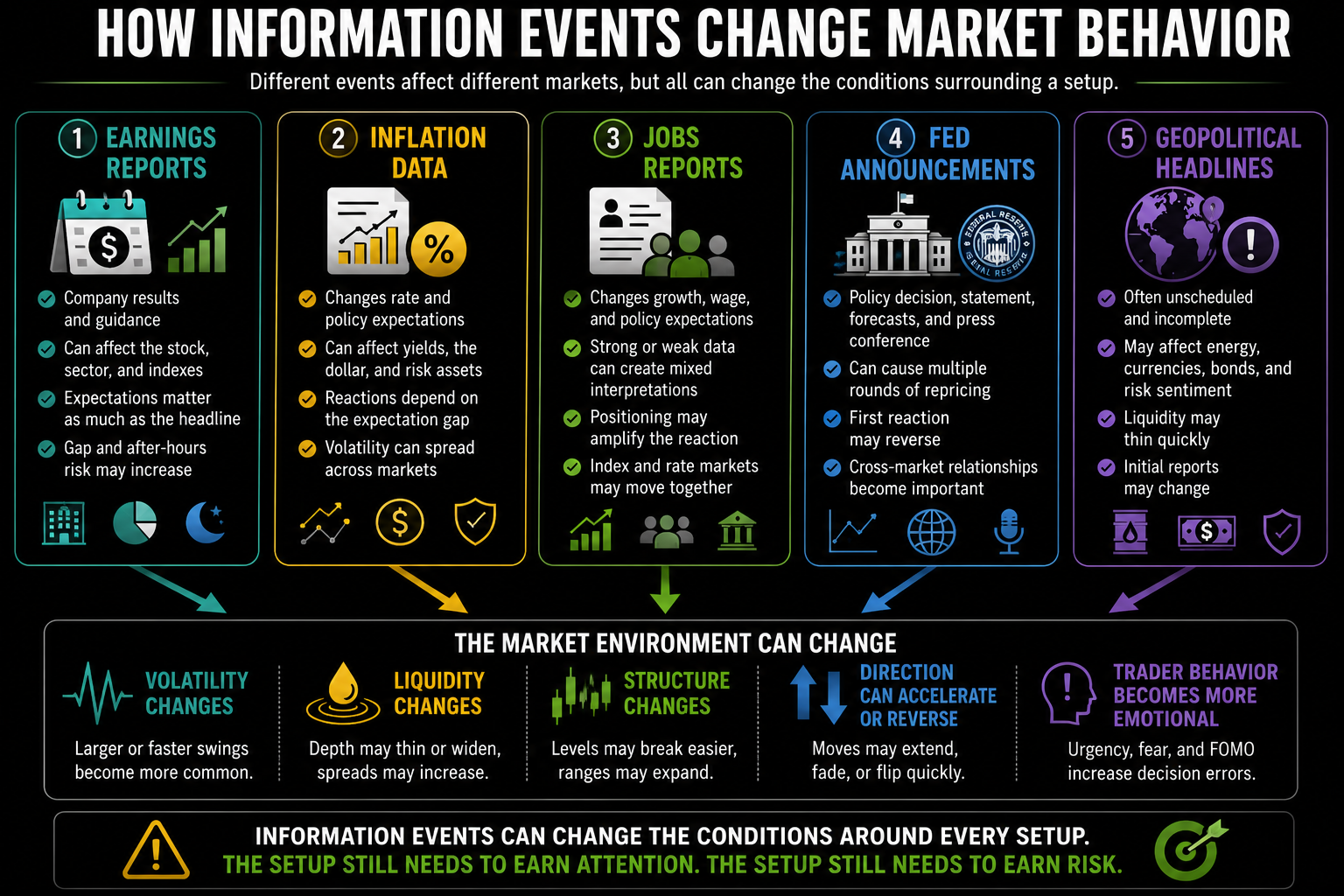
A market event does more than create one large candle. It can change the speed of movement, available liquidity, size of price swings, relationship between markets, and willingness of participants to hold risk. Conditions that looked balanced before the event may become directional within seconds. A clean trend can also break into unstable two-way movement as traders interpret the information differently.
This is why the framework behind three market states remains useful around news. The market may move from rotational to directional, from directional to conflicted, or from calm to highly unstable without giving the trader much warning. The visual setup may still resemble something familiar, but its surrounding environment has changed. A setup should be evaluated under the market state that exists now, not the one that existed before the release.
Scheduled and Unscheduled Events Are Different
Scheduled events give traders time to prepare even though the outcome remains unknown. Earnings dates, inflation reports, jobs data, and Fed announcements are usually known in advance, allowing the trader to identify when liquidity and volatility may change. Preparation can include reducing exposure, avoiding new entries near the release, or waiting until the first reaction becomes more organized. Knowing the event time does not reveal the direction, but it removes the excuse of being surprised by the timing.
Unscheduled events create a different problem because they can arrive while a trade or setup is already developing. Geopolitical headlines, unexpected company announcements, policy remarks, and breaking news may cause price to move before the trader understands what happened. The first reaction can be fast, incomplete, or based on limited information. In that environment, protecting decision quality matters more than finding an immediate explanation.
Earnings Can Reprice More Than One Stock
An earnings report can change how participants value a company based on revenue, profit, guidance, margins, demand, or management commentary. The market reaction depends not only on the reported numbers but also on what investors expected beforehand. A company can exceed past results and still fall if the market expected more. It can also miss one headline estimate and rise if guidance or another important detail reduces a larger concern.
Large companies can influence related sectors, indexes, suppliers, competitors, and broader market sentiment. A major technology company’s report may affect index futures because of its weight, while a bank’s earnings may influence expectations for credit or economic activity. The movement may therefore spread beyond the company that released the information. Traders should avoid assuming that an unrelated chart is isolated when a major component is changing the broader auction.
Inflation and Jobs Data Can Change Rate Expectations
Inflation data matters because it can change expectations for interest rates, central-bank policy, consumer pressure, and corporate costs — and it is worth distinguishing from the separate question of inflation versus currency debasement. Jobs reports can influence expectations for economic strength, wage growth, demand, and the ability of the economy to tolerate tighter policy. The numbers themselves are important, but the difference between the result and the market’s expectation often shapes the initial reaction. Positioning before the release can then amplify or reverse that response.
The article on why price moves before the news makes sense explains why the first move may not match a simple good-news or bad-news label. Strong employment data can support growth expectations while also raising concern about interest rates. Softer inflation can support risk assets, but a market already positioned for a large decline may respond weakly if the improvement is smaller than expected. The trader should study the reaction instead of assuming the headline determines one required direction.
Fed Announcements Can Affect Several Markets at Once
Federal Reserve announcements can influence interest rates, bond yields, the dollar, equities, commodities, and other risk-sensitive markets. The policy decision is only one part of the event because traders also evaluate the statement, forecasts, voting details, and press conference. A decision that appears unchanged can still cause repricing when the language shifts expectations about future policy. The MOVE Index can show whether that repricing is widening expected volatility in the rates market itself. Multiple markets may react together as participants adjust connected exposures.
The first move after a Fed announcement is not always the final interpretation. Algorithms may respond to the initial text, followed by additional movement as traders process details or listen to the press conference. Price can reverse, accelerate, or become highly unstable as different expectations compete. Waiting for the market to show acceptance or rejection can provide more useful information than reacting to the first candle.
Geopolitical Headlines Create a Different Kind of Uncertainty
Geopolitical news may affect energy, currencies, bonds, equities, and volatility depending on the location and possible economic consequences. The market may respond to concerns about supply, trade, security, sanctions, or broader risk appetite. Early reports can be incomplete or contradicted as more information becomes available. That makes the first interpretation especially uncertain. These are the same underlying forces described in why traders should understand the changing money system, since policy, debt, and currency pressure rarely move in isolation from one another.
The weaker response is to chase a sudden move while trying to build a confident story from limited facts. That impulse feels reasonable because the market is moving and the trader fears being left behind. The problem is that wide spreads, thin liquidity, and rapid reversals can make risk difficult to define. A dramatic event may earn attention, but it does not automatically create a qualified trade.
Volatility and Liquidity Change the Technical Picture
Higher volatility increases the distance price may travel during normal short-term movement. Stops that made sense during calmer conditions may become too close, while wider stops may require a smaller position or make the trade unacceptable. Candles can move through familiar levels without producing the controlled response the trader expected. The location may still matter, but the way price interacts with it has changed. The VIX Index is one way to see that expected volatility shift before it shows up in every candle.
Liquidity can also disappear near important releases as participants reduce quotes or wait for information. When less opposing interest is available, price may travel farther to complete the same amount of business. The auction can jump through levels that normally attract more trade. This does not mean technical structure has become useless; it means the trader must interpret it within the new liquidity environment.
A Familiar Setup May No Longer Be the Same Trade
A pattern can look identical before and after a major release while carrying a completely different level of uncertainty. Before the event, the setup may depend on orderly movement and a stable invalidation point. During the release, the same pattern may be overwhelmed by repricing, widening spreads, and changing expectations. The picture remains familiar, but the conditions that gave it meaning may no longer be present.
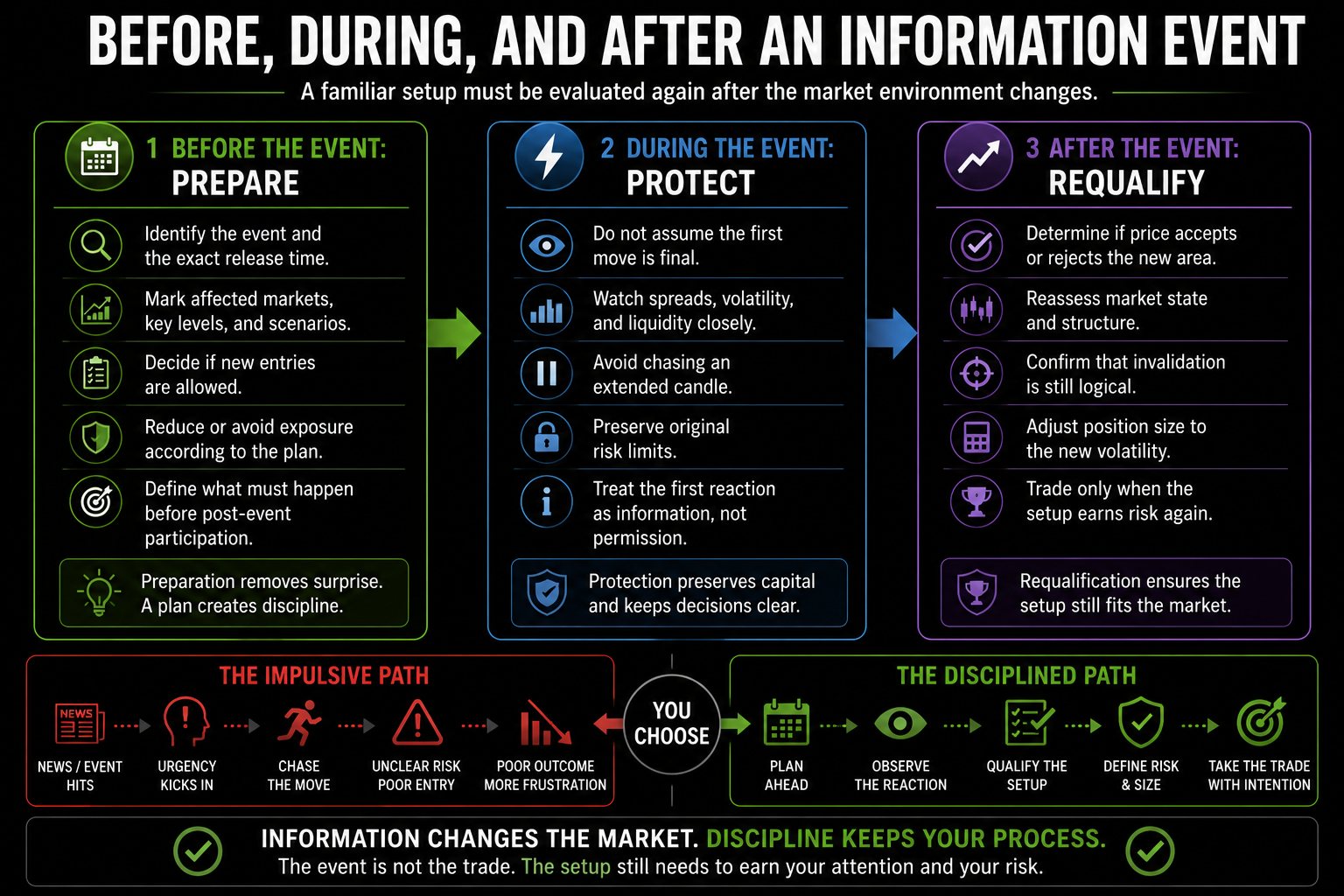
This distinction protects the trader from confusing setup recognition with trade qualification. Recognizing a pattern only tells the trader that something familiar is visible. Qualification asks whether context, location, response, room, liquidity, and risk still support participation. When the information environment changes those conditions, the setup must earn risk again under the new market state.
The Cleaner Process Begins Before the Event
Preparation starts by identifying scheduled information events before the session. The market calendar can help traders see when inflation data, employment reports, Fed decisions, and other known releases are expected. The plan should define whether the trader will avoid new entries, reduce size, exit before the event, or wait for a post-release structure. These rules should be written before price movement makes participation feel urgent.
Preparation should also consider the markets most likely to be affected. A report may have a direct influence on one product and an indirect influence on another through yields, currencies, sector weight, or risk sentiment. The trader does not need to map every possible relationship. It is enough to recognize that correlated markets can change the context of the chart being traded.
The First Reaction Is Information, Not Permission
The first move after an event shows that participants are responding, but it does not tell the trader that the move is complete or safe to chase. Price may continue because the information caused genuine repricing, or it may reverse because positioning was crowded and the first reaction exhausted available orders. The trader should observe whether price accepts the new area, returns through the move, or becomes unstable. That behavior offers more information than the candle size alone.
Patience in this environment is active rather than passive. The trader can update important levels, watch liquidity and volatility, and determine whether risk can be defined under the new conditions. Waiting does not mean ignoring the event. It means allowing the auction to reveal whether the move is becoming structured enough to evaluate.
A Better Question Around Information Events
The question “Which direction will the news move the market?” encourages prediction before the event and reaction afterward. A better question is, “How could this event change volatility, liquidity, structure, and the risk required for my setup?” That question keeps the trader focused on conditions that can be observed and managed. It also allows the correct conclusion to be that no trade is available yet.
Before participating around a major information event, review the following:
- Is the event scheduled or unexpected?
- Which markets and sectors are most likely to respond?
- Has positioning already produced a large move before the event?
- Did volatility and spreads expand after the information arrived?
- Is price accepting a new area or rapidly moving back through it?
- Does the setup still have a logical invalidation point?
- Can position size be adjusted to fit the changed risk?
- Am I evaluating a qualified setup or reacting to movement and headlines?
The filter does not eliminate uncertainty or guarantee that waiting will produce a cleaner trade. It gives the trader a structured way to decide whether the information environment still supports the original plan. When the answers are unclear, the trader can preserve capital and attention rather than forcing a technical interpretation onto unstable behavior. The setup earns risk only after the changed conditions can be evaluated.
Review the Event and the Decision Separately
Post-session review should distinguish the information event from the trader’s response to it. The trader can record what was scheduled, what happened to volatility and liquidity, how structure changed, and whether the planned event rules were followed. This prevents the outcome alone from determining whether the decision was good. A favorable chase can still be a poor process, while a disciplined stand-aside decision can remain correct even if price later moves cleanly.
The review should also identify whether the event created a recurring market behavior worth preparing for in the future. Repeated observations may show that certain releases regularly produce spreads or volatility that do not fit the trader’s method. They may also show that useful structure often appears only after a waiting period. Evidence from several events is more valuable than rewriting the plan after one dramatic session.
Final Thought
News, earnings, economic data, and geopolitical developments can change more than price direction. They can alter participation, liquidity, volatility, structure, and the amount of uncertainty attached to every decision. A setup that was clear before an event may become difficult to qualify afterward. The trader must evaluate the market that exists now rather than the market that existed before the information arrived.
The goal is not to predict every announcement or avoid every active session. It is to recognize when information is driving repricing strongly enough that normal technical expectations need to be adjusted. Preparation identifies the risk window, observation reveals the new behavior, and discipline prevents movement from becoming automatic permission. Better decisions come from respecting how information changes the auction before asking a setup to earn risk.
Inflation releases become easier to compare after separating what CPI and PPI measure for traders.
The direct futures-market transmission is covered in the guide to how CPI moves stock futures.
Employment data has its own transmission path through rates, the dollar, and growth expectations, explained in how the jobs report moves stock futures.
Because the reaction depends on expectations and policy implications, it also helps to understand why stocks can rise after a bad jobs report.
Educational content only. Trading involves substantial risk and is not suitable for everyone.