
Traders often search for a headline immediately after a sudden move. They assume that price must have reacted to one identifiable event and that finding the event will make the movement understandable. Sometimes a clear catalyst exists, but the explanation may appear only after the market has already begun adjusting. In other cases, the move reflects several smaller changes rather than one dramatic piece of news.
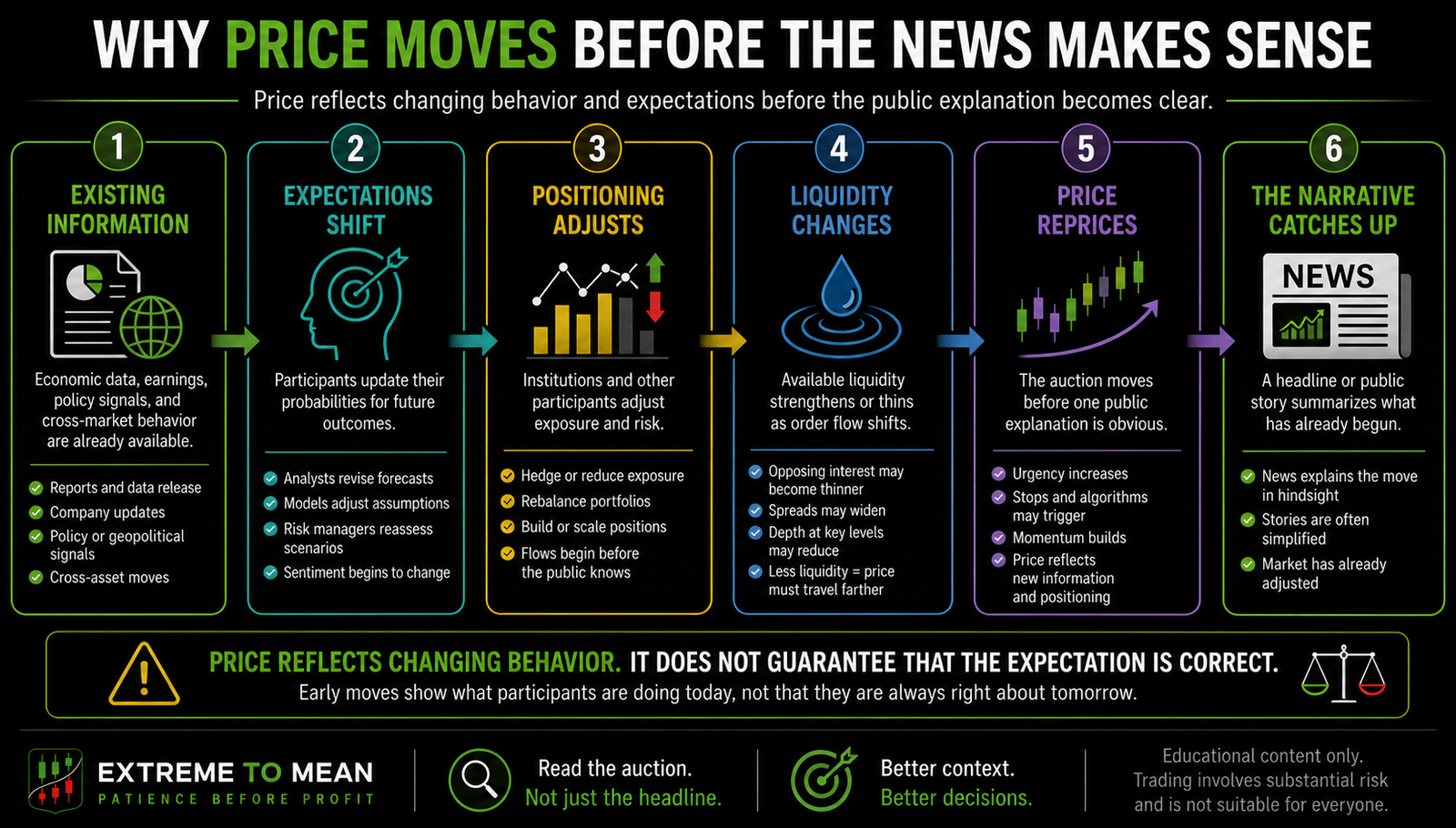
The lessons in The Market category emphasize that price should be evaluated in context rather than explained through the first available story. The market does not wait for every participant to receive the same headline at the same time. Expectations can shift gradually as economic data, company information, policy signals, and cross-market behavior are interpreted. Price records the resulting decisions even when the public explanation remains incomplete.
The Headline Is Often Not the Starting Point
A public headline may look like the beginning of a market move because it is the first clear explanation most people see. Market participants, however, may have been evaluating the underlying issue for days or weeks. Analysts may revise assumptions, funds may adjust exposure, and risk managers may reduce positions before one story becomes widely discussed. By the time the headline appears, part of the adjustment may already be visible in price.
The article on how the stock market actually moves through auction, liquidity, and emotion provides the foundation for this process. Price changes when participants become willing to transact at different levels, not when a news service officially declares that conditions have changed. An explanation can help people understand the auction afterward, but it does not create every order inside it. The orders themselves are what move the market.
Markets Price Expectations, Not Just Facts
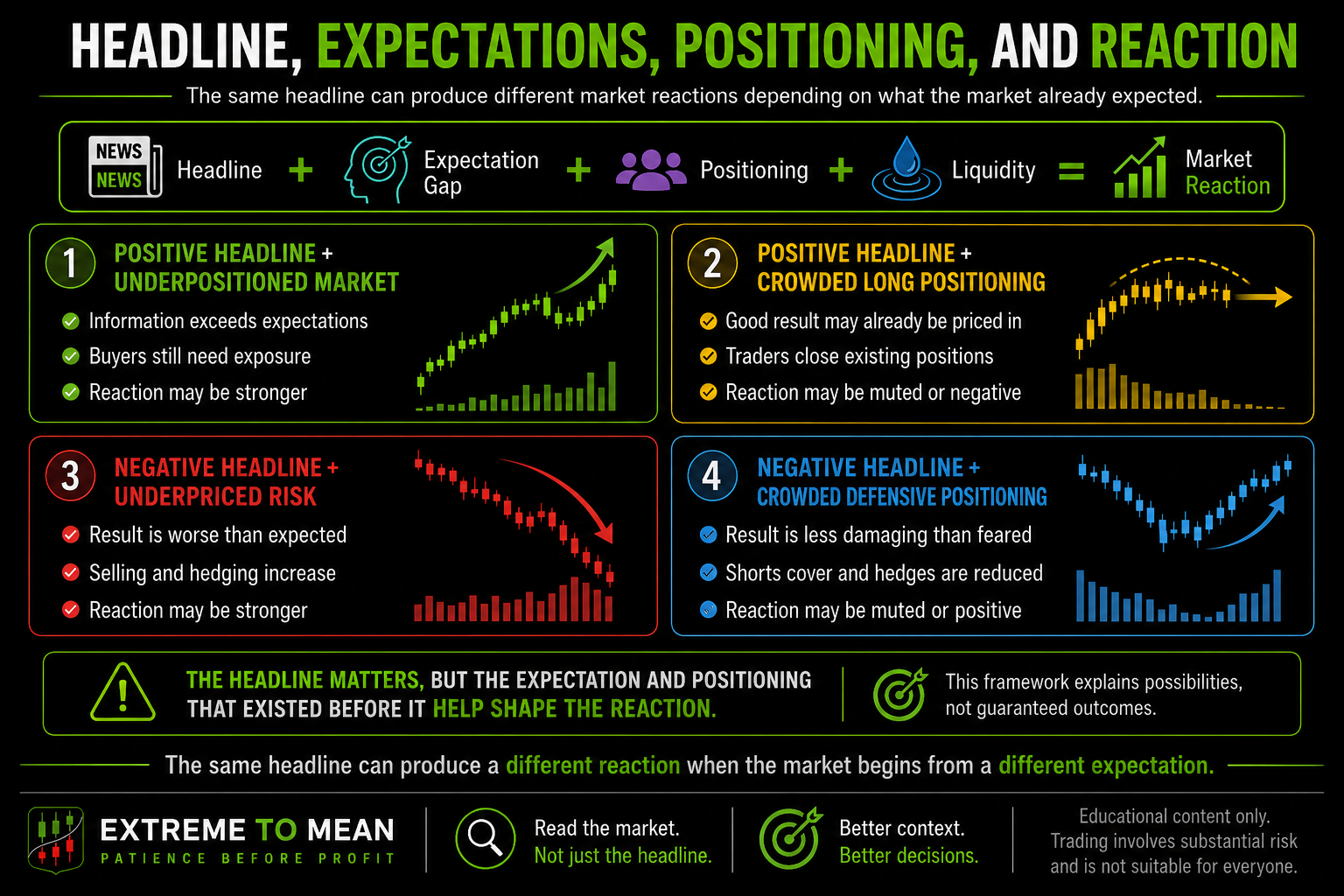
Markets respond to the difference between what participants expected and what they now believe. A report can look positive in isolation but still disappoint if traders expected something stronger. A weak number can produce a rally when it is less damaging than feared. The factual headline matters, but the expectation already reflected in positioning can matter just as much.
Expectations do not need to be unanimous or correct. Different participants assign different probabilities to future growth, inflation, earnings, interest rates, and policy decisions. As those probabilities change, some traders reduce risk while others add exposure. Price moves as those competing decisions meet in the auction. Those same competing expectations are why understanding the changing money system helps explain shifts in risk appetite before a single headline ties them together.
Positioning Changes the Meaning of the News
Positioning describes how participants are already exposed before new information arrives. When many traders hold similar positions, a small change in expectations can force a larger response because numerous participants may try to adjust at once. A crowded long position can become vulnerable even to mildly disappointing information. A heavily defensive market can rally sharply when the news is merely less negative than expected.
The different groups described in Who Participates in the Market? may also react for different reasons. An institution may rebalance, an algorithm may respond to momentum, and a short-term trader may exit because the move has already extended. Those decisions can occur together without one group controlling the market. The chart displays their combined behavior rather than the private motive behind each order.
Institutional Flows Can Arrive Before the Explanation
Large institutions do not need to wait for a television headline before adjusting a portfolio. They may respond to internal research, changing correlations, risk limits, scheduled rebalancing, client flows, or a gradual shift in economic expectations. A fund may reduce exposure because several small signals have changed the balance of risk. The public may not receive one simple explanation because the decision did not come from one simple event. Bitcoin shows this clearly: large ETF-driven flows can move its price well before any headline explains why, a dynamic examined in why Bitcoin's correlation with stocks keeps shifting.
This does not require assuming that every early move comes from secret information. Large participants often act on the same public information available to everyone but process it through different models, mandates, and time horizons. Their order size may require execution across many prices rather than one immediate transaction. That gradual activity can influence market behavior before the reason becomes obvious to a wider audience.
Liquidity Determines How Far Price Must Move
The same amount of buying or selling can produce very different price movement depending on available liquidity. When many orders are waiting nearby, business can be completed without price traveling far. When opposing interest is thin, participants must reach farther to find someone willing to take the other side. Price can then move quickly even without one extraordinary headline.
Fast movement can also trigger additional behavior. Stops may activate, algorithms may respond to volatility, and traders who missed the first move may begin chasing it. These secondary orders can extend the original adjustment beyond what the initial flow might have created alone. The final move may therefore look much larger than the information that first changed expectations.
Why Good News Can Produce Selling
A positive headline does not guarantee a positive market reaction. If traders already expected the news and positioned for it, the release may provide no new reason to keep buying. Some participants may use the event to close positions, while others may decide that the actual result did not justify the earlier optimism. The market can fall even though the headline appears favorable.
The opposite can happen after negative news. A market that has already declined may have priced in an outcome worse than the one eventually reported. Short sellers may cover, defensive positions may be reduced, and buyers may respond to the smaller-than-expected disappointment. The reaction can look backward only because the public headline is being compared with the wrong starting expectation.
Price Can Lead Without Knowing the Future
Price moving before a clear explanation does not mean the market always knows what will happen next. Participants can misread information, become too confident, or push price beyond what later evidence supports. Early positioning can reverse when the expected event does not occur. Price is a record of current behavior, not an all-knowing forecast.
This is another reason context comes before the candle. A sudden move may reflect genuine repricing, thin liquidity, temporary urgency, or an unstable combination of all three. The trader should examine where the move began, what structure it changed, and whether the new area is accepted. The candle alone cannot prove that the market has correctly predicted future news.
The Reaction Often Matters More Than the Headline
A trader can learn more by studying how price responds to information than by classifying the headline as simply good or bad. The reaction shows whether the market was surprised, already positioned, or unable to continue despite the apparent catalyst. A strong headline that cannot lift price may reveal that buyers have already acted. A weak headline that cannot push price lower may show that selling pressure is becoming less effective.
The principle that the market comes first keeps this evaluation grounded. The trader does not need to argue with the news or pretend the headline is irrelevant. The cleaner process is to compare the information with the existing trend, location, volatility, and positioning visible through price behavior. What the market does with the information is part of the context.
A Better Question After a Sudden Move
The question “What news caused this?” can be useful, but it is often too narrow as the first response. A better question is, “What changed in expectations, positioning, or liquidity, and how is price responding?” That question leaves room for more than one cause and keeps the trader focused on observable behavior. It also reduces the urge to force a trade merely because a headline has been found.
Before acting after a news-related move, review the following:
- Was the event scheduled, expected, or genuinely surprising?
- How had price behaved before the headline appeared?
- Was the market already positioned heavily in one direction?
- Did the move begin at a meaningful location or in the middle of noise?
- Did liquidity appear thin as price accelerated?
- Is price accepting the new area, rejecting it, or becoming unstable?
- Is the setup qualified, or am I reacting to the size of the candle?
- Can the risk still be defined without chasing the move?
This review does not require the trader to discover the exact reason behind every order. Its purpose is to separate useful context from a convenient story created after price has moved. The setup still needs an appropriate location, observable qualification, and clear invalidation. A headline may earn attention, but it does not automatically make the trade ready.
Scheduled events should be identified before the session whenever possible. The market calendar can help traders recognize when economic reports, policy decisions, and other known events may affect expectations and liquidity. Preparation does not reveal the outcome or guarantee a sensible reaction. It prevents a scheduled release from being mistaken for an unexplained market event.
The same questions should be used during trade review. The trader can record what was known before the move, what explanation appeared afterward, and whether the decision was based on price behavior or a rushed headline story. Over time, this may reveal recurring mistakes such as chasing releases, ignoring positioning, or assuming positive news must produce higher prices. The goal is to improve the quality of the evaluation rather than become better at inventing explanations.
Final Thought
Price often moves before the news makes sense because markets continuously adjust to changing expectations, positioning, institutional flows, and liquidity. The public explanation may arrive later, simplify several forces into one story, or describe information that was already partly reflected in price. That does not mean every early move is correct or based on hidden knowledge. It means the auction is active before the narrative becomes complete.
The trader’s job is not to explain every candle with certainty. It is to observe what changed, where the move occurred, how the market responded, and whether the setup still offers clear risk. Headlines can provide context, but price shows how participants are acting on that context. Better decisions begin when the trader stops demanding an immediate story and starts evaluating the behavior already visible in the market.
A focused example appears in how the jobs report moves stock futures through expectations, rates, the dollar, and growth.
The same expectation gap can produce the counterintuitive reaction explained in why stocks can rise after a bad jobs report.
Educational content only. Trading involves substantial risk and is not suitable for everyone.