
U.S. equity-index futures are available for most of the trading week, so a trader can hold ES or NQ beyond the cash close or deliberately trade while Asia and Europe are active. That access is useful, but availability and suitability are not the same thing.
The ability to hold a position overnight is not the same thing as having a reason to hold it overnight.
Nearly around-the-clock futures trading solves an access problem, not a decision problem. It does not automatically solve liquidity, margin, execution, news risk, trader attention, sleep, or whether a strategy has an edge in that part of the day. Inside The Market, the better question is: “Does this position, this session, and this trader belong here?”
Two decisions often get mixed together: carrying an existing U.S.-session trade into later hours and deliberately opening new trades during Asia or Europe. The first asks whether existing exposure should remain; the second asks whether the strategy has evidence in that session. HOLDING OVERNIGHT ≠ TRADING THE OVERNIGHT SESSION.
One Contract, Different Market Environments
“Asia session,” “London session,” and “New York session” are useful shorthand, but they are not separate versions of ES or NQ. The contract remains the same while participants, regional markets, catalysts, liquidity, and volatility change around it. The contract stays the same. The market environment around it changes.
Current CME equity-index hours run broadly from Sunday evening through Friday afternoon with a daily maintenance break. Asia and London are participation windows inside the larger Globex day, not new contract opens. For an Eastern Time trader, exact regional conversions can shift around daylight-saving changes, so avoid rigid “London always opens at X” rules.
Holding Overnight Starts With the Original Thesis
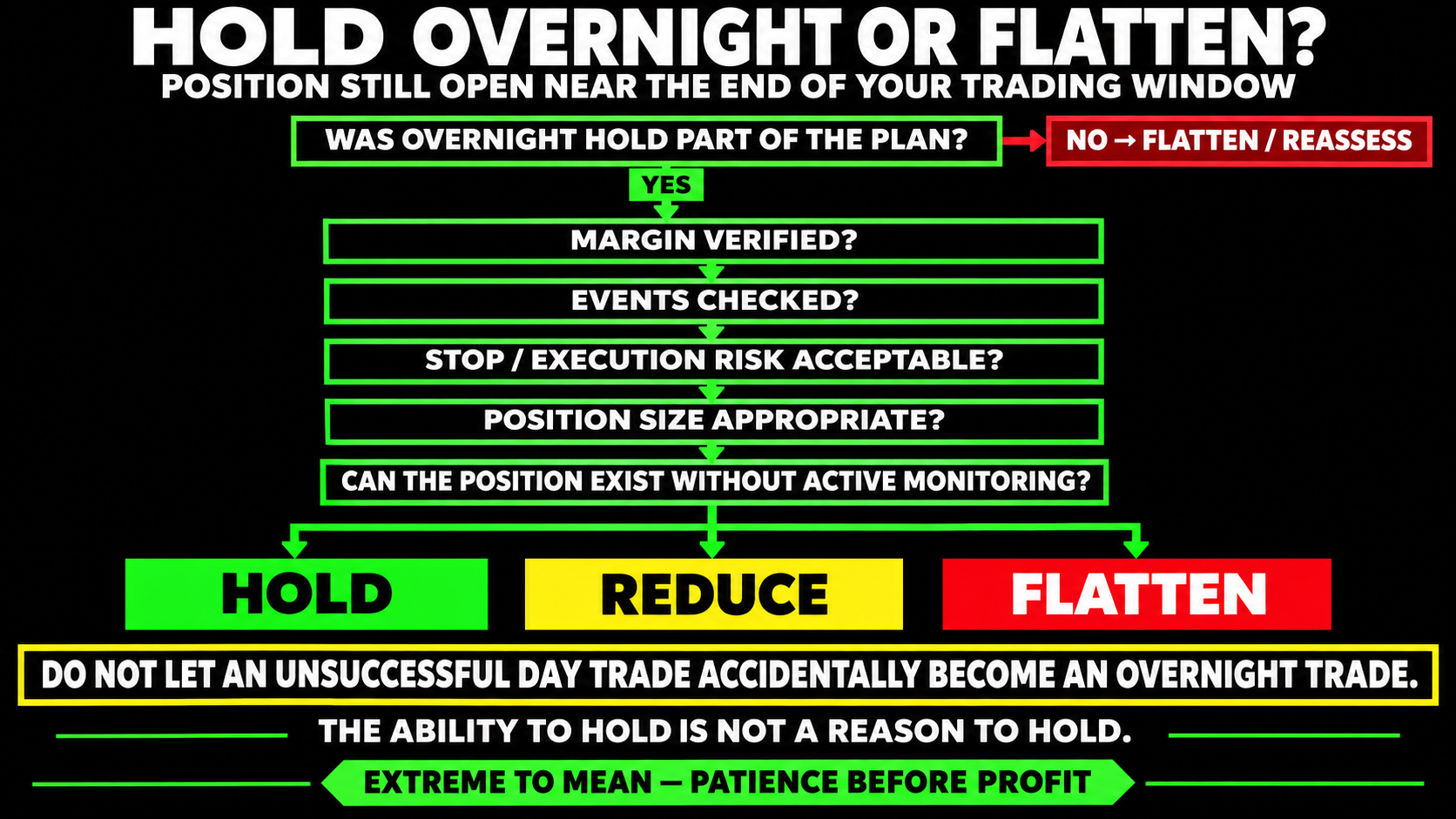
If a position is still open near the end of your trading window, start with the thesis before margin or news. Was the setup designed for multiple sessions, is the target still valid, and did the plan allow an overnight hold? If the answer is simply, “I do not want to take the loss yet,” the holding decision came from discomfort rather than the strategy.
A day trade that disappoints should not quietly become a swing trade. Changing the holding period after the trade fails to resolve as expected changes the trade thesis after the fact, while opening a fresh Asia or European trade is a separate decision that needs its own evidence. Overnight should be part of the trade plan—not a place a failed day trade goes to avoid being closed.
Overnight Margin Can Change the Decision
Reduced intraday futures margin may not apply to positions carried overnight. Brokers can require higher overnight margin, add house requirements, change permissions, or impose their own cutoff for positions using reduced day-trading margin. The margin that lets you open the trade may not be the margin required to keep it open overnight.
That is why futures margin requirements matter before the holding decision. INTRADAY MARGIN ≠ OVERNIGHT CARRYING REQUIREMENT, and there is no universal ES or NQ overnight-margin number worth memorizing. Margin also does not cap loss; it tells you what capital is required to carry the position, not what the market can ultimately cost you.
Near-24-Hour Trading Does Not Remove Gap or Stop Risk
Nearly continuous trading reduces closed-market time, but it does not create continuous executable liquidity. Daily maintenance, weekends, holidays, price limits, or abrupt news can produce a next available trade away from the price a trader expected. NEAR-24-HOUR TRADING ≠ ZERO GAP RISK.
A protective stop is important, but it is not a guaranteed fill at the trigger price. In a fast or discontinuous move, an activated stop can execute at a worse available price, so planned risk and realized loss can diverge. The overnight-gap lesson treats gaps as setups; here the point is that gap-like movement can also be holding risk.
Weekend exposure deserves separate treatment because standard U.S. equity-index futures stop Friday afternoon and resume Sunday evening. That longer closure gives information more time to accumulate without continuous Globex price discovery. A weekend is not simply a longer overnight session.
News Keeps Arriving While the Trader Sleeps
ES and NQ can reprice because of foreign central-bank decisions, Asian or European data, geopolitical developments, rates, currencies, major corporate developments, or unexpected headlines while U.S. cash equities are closed. Price discovery does not wait for New York to wake up. Your sleep schedule is not part of the market's news calendar.
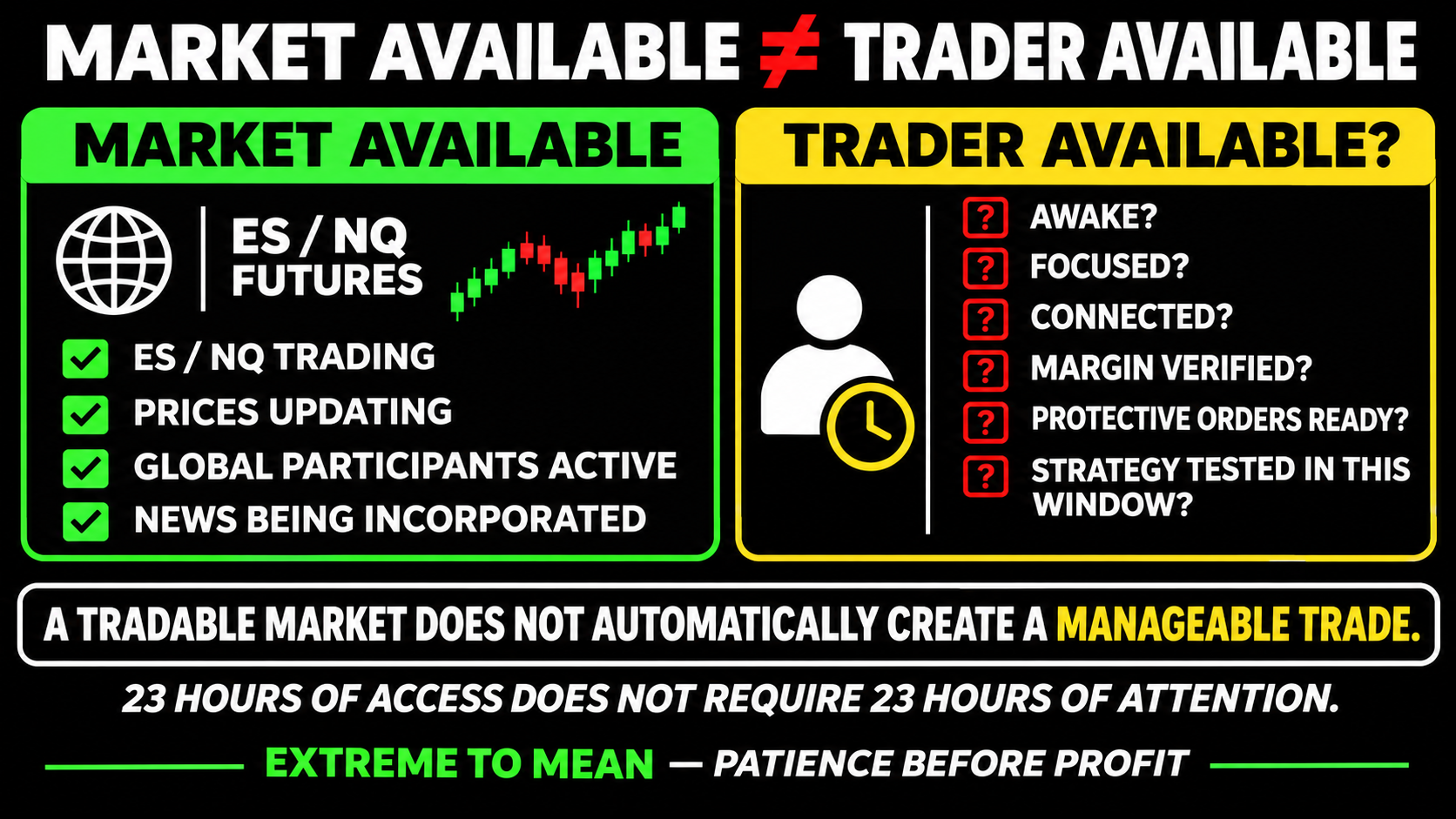
An overnight position may exist for hours without active supervision, so its size and protective orders need to make sense without immediate intervention. If the plan depends on waking up later to create the exit, the trade contains an obvious availability risk, and an alert is information rather than guaranteed risk control. MARKET AVAILABLE ≠ TRADER AVAILABLE.
Liquidity Changes Through the Global Day
It is too simplistic to say overnight futures are always illiquid. Non-U.S. participation can be substantial, but volume, depth, spread, slippage, and range still change through the global day. Nearly continuous trading does not mean continuously identical market quality.
The better question is not, “Is overnight liquid?” but “Is this contract liquid enough for this strategy in this window right now?” Quiet also does not mean safe: a narrow evening range can coexist with shallower depth and a sharp reaction to news. QUIETER SESSION ≠ LOWER RISK.
Trading Asia or London From a U.S. Time Zone
The practical appeal is obvious: someone working normal U.S. daytime hours may be free in the evening, while another trader may prefer the pre-dawn European window. Convenience can make a schedule possible, but CONVENIENT SESSION ≠ VALIDATED SESSION. The best session for your calendar is not automatically the best session for your strategy.
The best-time-to-trade-futures lesson makes the broader point that time changes the environment, not the need for evidence. If you want to trade Asia or London, isolate the exact window and measure range, spread, depth, slippage, trade frequency, and strategy results separately from New York. Do not lump everything before 9:30 a.m. into one “overnight” bucket because Asia, Europe, and the U.S. premarket can contain different participants and catalysts.
Market Available Does Not Mean Trader Available
A U.S. trader can wake before dawn to trade Europe and still stay for the New York open, but that does not make the schedule sustainable. If the added session degrades sleep, attention, or later decision quality, the trader has created another form of execution risk. Twenty-three hours of market access does not require twenty-three hours of trader attention.
The Hold-or-Flatten Overnight Checklist
Before keeping a futures position open overnight, ask:
- Was this trade designed to be held overnight?
- Is the original thesis still valid?
- Does the account meet the broker's current overnight margin requirement?
- What events can occur before I return?
- Will I be awake and able to manage the position if needed?
- Does a protective order already exist?
- What happens if price moves through the stop during a fast or discontinuous move?
- Is the size appropriate for the longer exposure window?
- Am I holding because the plan says hold—or because I do not want to realize a loss?
- Would flattening, reducing, or hedging be cleaner?
The last question matters because there is more than one way to change overnight exposure. The lesson on hedging futures with Micros shows how a hedge can reduce directional sensitivity while adding costs, margin questions, and another exit decision. Hedging changes the exposure; it does not remove the overnight decision.
The Asia/London Session Checklist
Before deliberately trading non-U.S. hours, ask:
- What exact window am I trading?
- Why does this window fit the strategy rather than merely my schedule?
- Has the setup been tested in this window?
- What are volume, spread, depth, and slippage like for this contract?
- Which regional economic events occur during it?
- Does the setup behave differently from New York?
- Does the broker apply different margin or risk rules?
- What time do I stop trading?
- Will this session damage my sleep or later decision quality?
- Am I adding a proven opportunity—or simply more screen time?
A global market still deserves a local trading window. Define when the session begins for your process, when it ends, what setups qualify, and which events exclude participation. The market can remain open after your window closes; your trading plan does not have to.
The ETM Session → Capital → Liquidity → Catalyst → Capacity → Decide Framework
Use SESSION → CAPITAL → LIQUIDITY → CATALYST → CAPACITY → DECIDE. SESSION identifies the global window; CAPITAL asks whether the account can carry the position; LIQUIDITY tests execution conditions. CATALYST asks what can move the market, CAPACITY asks whether the trader can manage the exposure, and DECIDE chooses among HOLD / REDUCE / FLATTEN / TRADE / PASS.
The market being open answers only whether trading is available. It does not answer whether the strategy is valid, the account can carry the position, or the trader should be there. The ETM free tools can help organize preparation, but the process still has to decide whether access should become action.
Final Thought
U.S. equity-index futures trading nearly around the clock means ES, NQ, and their Micro counterparts can react to Asia, Europe, global news, and U.S. premarket information before the stock-market bell. That access is valuable, but MARKET OPEN ≠ STRATEGY OPPORTUNITY. The same contract can exist through very different liquidity, catalyst, and participation environments.
Holding an existing trade overnight requires a reason for the trade to remain open. Intentionally trading Asia or London is a separate decision that requires evidence in that exact window, and neither choice should be justified simply because the platform is available. Longer holding periods are not inherently worse; accidental holding periods are.
The correct question is not simply, “Can I hold or trade futures overnight?” Ask whether the position, account, liquidity, event calendar, strategy, and trader are all designed to be there. A tradable market does not automatically create a manageable trade.
Educational content only. Trading involves substantial risk and is not suitable for everyone.