
Many traders begin the morning by gathering as much information as possible. They review overnight prices, economic headlines, social-media opinions, earnings reports, and several charts in the hope that more information will create confidence. The routine feels productive because the trader is busy and engaged. The problem is that information without a decision framework can leave the trader more reactive rather than better prepared.
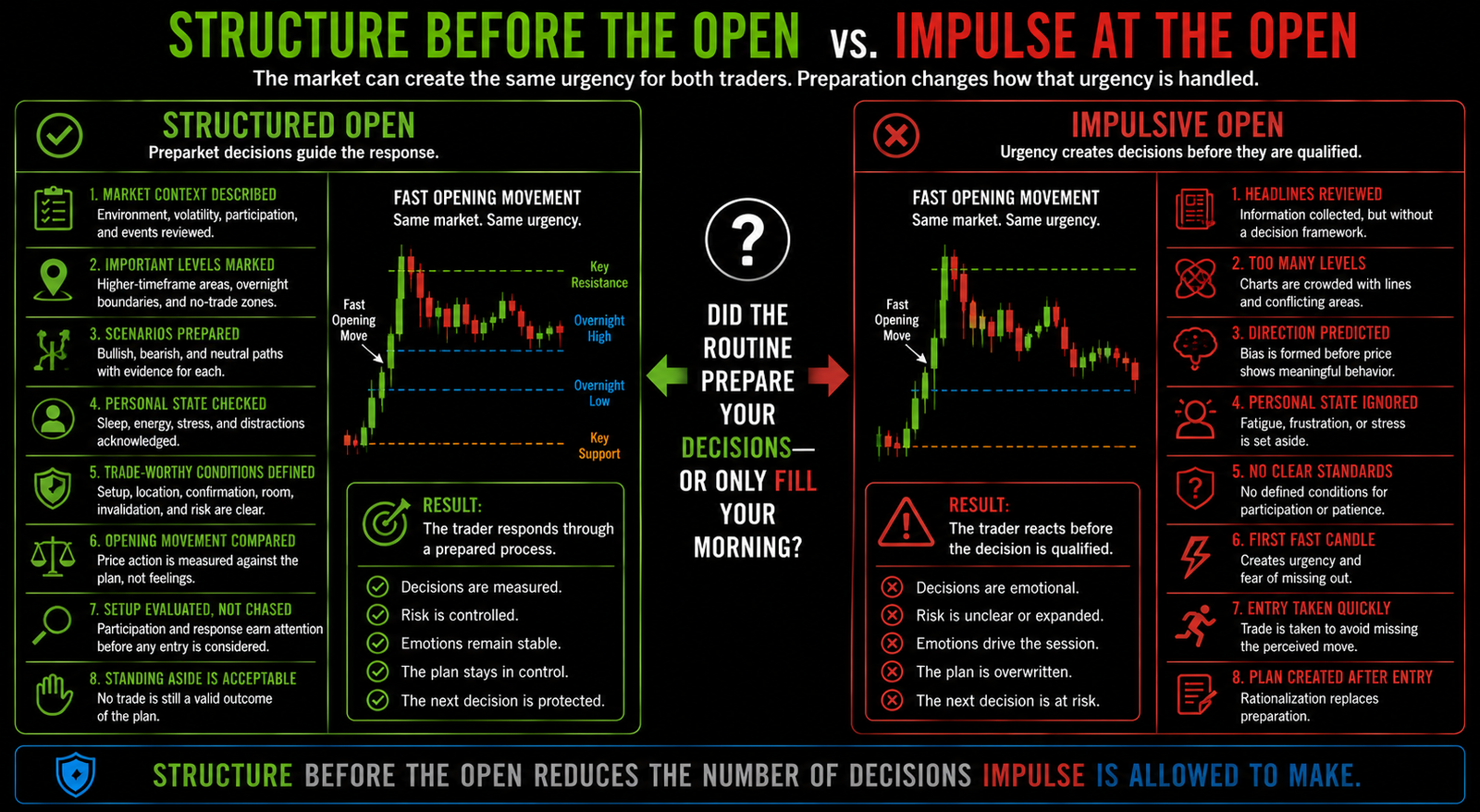
The lessons in The Trader category emphasize that discipline should be supported by a process rather than demanded through willpower alone. Once the market opens, movement becomes faster, missed opportunities feel more important, and uncertainty can create urgency. A pre-market routine reduces the number of decisions that must be invented under that pressure. It gives the trader a prepared structure for evaluating what the market actually offers.
The Routine’s Job Is to Prepare Decisions
A pre-market routine is not meant to predict the entire session. It should organize the evidence currently available and identify what would matter if conditions change. The trader is preparing a way to respond rather than trying to know every move in advance. That distinction keeps preparation connected to evaluation instead of prediction.
Without that structure, the trader can enter the session with several observations but no clear standards. A level may be marked, but the trader has not defined what response would make it meaningful. A bullish opinion may be present, but the conditions supporting it have not been written down. When price begins moving, impulse fills the gaps left by incomplete preparation.
Begin With the Market, Not the Trade
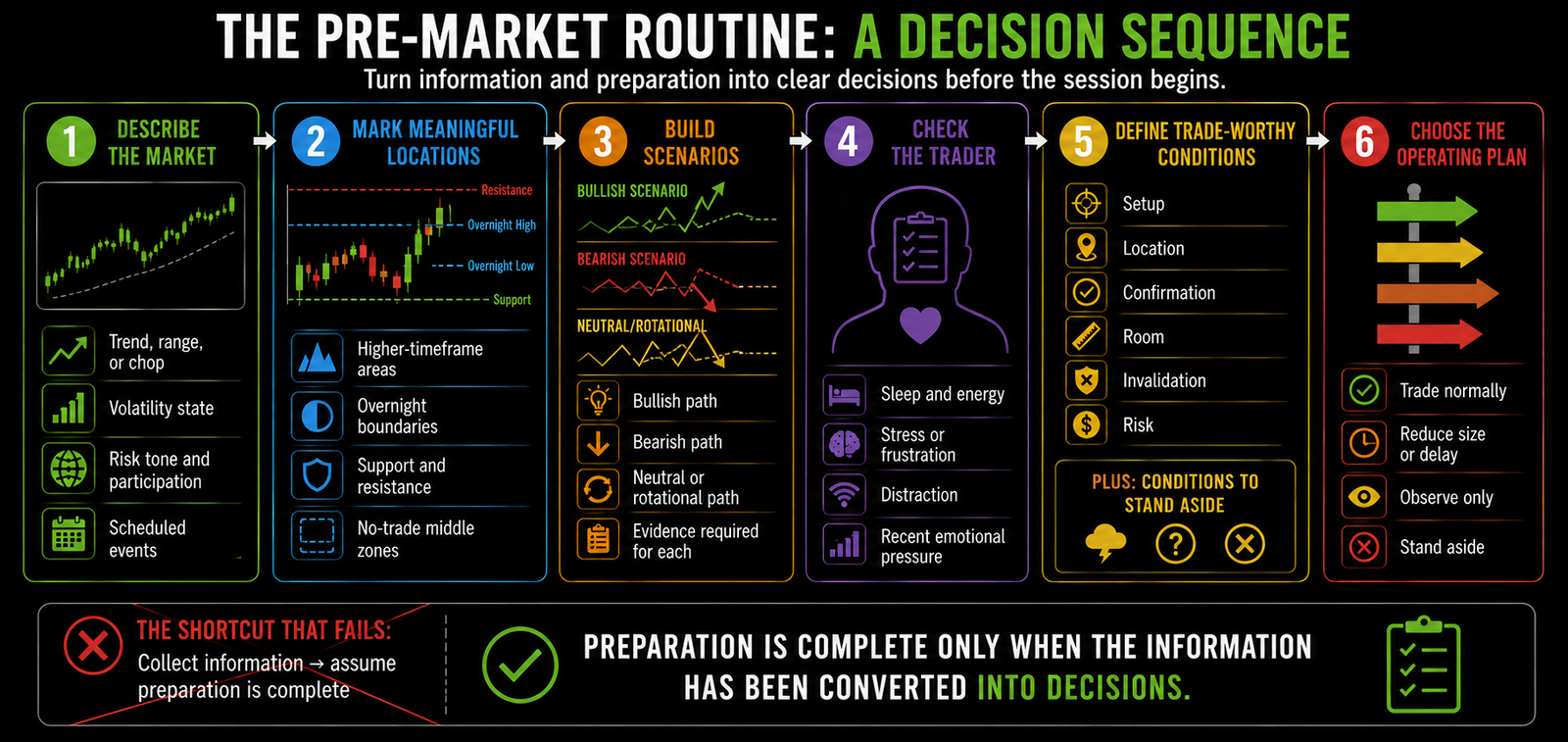
The first part of the routine should describe the broader market environment. The trader can review overnight direction, market state, volatility, participation, major scheduled events, and the relationship between important indexes or sectors. The goal is not to produce one dramatic conclusion. It is to understand what kind of market the trader may be operating inside.
This follows the principle that the market comes first. A setup should not be evaluated as though it exists separately from trend, range, chop, expansion, contraction, or broader risk conditions. The trader should identify whether the environment appears supportive, restrictive, mixed, or unclear. That description provides context for every later decision.
The routine should remain brief enough to be usable. A trader who studies every market, headline, indicator, and opinion may create more conflict than clarity. Preparation should focus on information that can materially affect the planned session. The goal is a working description that guides attention, not an encyclopedia of everything that happened overnight.
Mark Locations That Can Change the Decision
After the environment is described, the trader can identify the locations that may matter during the session. These may include prior highs and lows, overnight boundaries, support and resistance, higher-timeframe areas, gaps, value areas, or other locations used by the trading plan. The purpose is not to cover the chart with lines. It is to know where market behavior may become more meaningful.
A level becomes useful only when the trader knows what to observe there. Price may reject the area, accept beyond it, stall, accelerate, or move through it without meaningful response. Each behavior can carry a different message. Marking the location without defining the required response still leaves the decision unfinished.
Not every marked area deserves a trade. Some locations may be too close together, trapped in the middle of a range, or surrounded by conflicting structure. The routine should identify where the trader is interested and where participation would likely be forced. A no-trade area can be as valuable as a potential entry area because it removes decisions before urgency appears.
Prepare Scenarios Instead of Predictions
Scenario planning helps the trader think in conditions rather than certainty. A scenario explains what the market may do, what evidence would support that path, and how the trader would respond if it develops. The trader is not claiming that one scenario must occur. The purpose is to reduce surprise when one of several reasonable paths begins taking shape.
A useful scenario connects context, location, behavior, and action. The trader might write that a move above the overnight high matters only if price holds, participation improves, and pullbacks remain controlled. Another scenario may explain that rejection from the same area would support patience until price returns to a more meaningful location. Each scenario should define evidence rather than merely state a preferred direction.
This is where your trading plan becomes a promise made before the open. The plan should explain what qualifies the trade, what invalidates the idea, and what conditions require the trader to stand aside. Those conclusions are easier to respect when they are created before money and emotion are involved. Scenario planning turns preparation into a set of conditional decisions.
Check the Trader Before Checking the Trigger
The market is not the only source of risk during the session. Fatigue, frustration, financial pressure, recent losses, overconfidence, distraction, and the need to recover can all influence how evidence is interpreted. A setup may look more urgent when the trader feels behind or more convincing after a recent winning streak. The routine should therefore include an honest personal check before participation is considered.
A trader who is emotionally unsettled may still be able to observe the session. The decision does not have to be limited to trading normally or abandoning the day completely. Size can be reduced, the opening period can be avoided, or stricter confirmation can be required. The adjustment should be planned rather than invented after an impulsive entry.
Physical readiness also matters because attention and patience are not unlimited. Poor sleep, illness, hunger, interruptions, or time pressure can reduce the trader’s ability to follow a detailed plan. Recognizing that condition is not weakness or an excuse. It is part of evaluating whether the trader can execute the process responsibly.
Decide What Would Make Trading Worth It
A pre-market routine should define the conditions that make participation worthwhile. The trader can identify the market state, location, response, available room, invalidation, and risk clarity required before the setup earns more than attention. This prevents the appearance of a familiar pattern from becoming automatic permission. The decision standard exists before the opportunity begins to feel urgent.
The routine should also define what makes the day unsuitable. Heavy overlap, poor follow-through, conflicting signals, major event risk, unclear location, or personal distraction may justify observation instead of action. The trader is not required to extract a trade from every session. Some mornings provide information without providing an acceptable opportunity.
This connects directly to the principle of protecting your next decision. Passing on one weak opportunity preserves attention, emotional stability, and risk capacity for the next evaluation. Taking a forced trade can affect more than the position itself because frustration often changes the decisions that follow. The pre-market routine should protect the complete sequence of decisions, not merely the first entry.
Convert Preparation Into Simple If-Then Rules
The cleanest routine produces a small number of clear conditions. If price reaches a meaningful area and produces the required response, then the trader evaluates the setup. If price remains in the middle of poor structure, then the trader waits. If volatility expands beyond what the plan can manage, then size or participation must change.
These rules should guide the process without pretending every situation can be scripted perfectly. Markets change, and unexpected information may require the trader to reassess the original description. Flexibility remains disciplined when the reason for changing the plan comes from new evidence. It becomes impulsive when the rules are changed only to justify immediate participation.
A useful routine should be short enough to complete consistently. A complicated document that takes an hour to prepare may eventually be rushed or abandoned. The trader should focus on the few observations that directly affect trade approval. Consistency matters more than creating an impressive morning report that cannot be used once the market opens. It also helps to keep the routine and the plan itself distinct, since a checklist and a trading plan solve different problems: the routine is the checklist that applies the plan each morning, not a substitute for the plan itself.
A Practical Pre-Market Routine
Before the session, the trader can move through one connected decision sequence. The answers should be written briefly enough to review during the day. When several answers remain unclear, the routine should produce caution rather than force a directional conclusion. The goal is to begin the session knowing what deserves attention and what does not:
- What market environment is present: trend, range, chop, expansion, contraction, risk-on, risk-off, or mixed?
- Which scheduled events could materially change volatility or participation?
- What higher-timeframe and overnight locations matter today?
- Where is price likely to be trapped in the middle or too close to opposition?
- What bullish, bearish, and neutral scenarios are reasonable?
- What specific behavior would confirm each scenario?
- What conditions would invalidate the working market read?
- What setup, location, room, and risk requirements must be present before entry?
- What conditions would make standing aside the better decision?
- What is my current emotional and physical state?
- Do size, timing, or expectations need to be adjusted?
- What is the maximum number of decisions or trades allowed by the plan today?
The better question is not, “What can I trade this morning?” It is, “What conditions would make trading worth the risk, and what conditions would tell me to wait?” That question changes the routine from a search for action into a process for qualification. It also makes patience an explicit decision rather than something the trader hopes to remember later.
The principle that doing nothing is still a trading decision belongs inside the routine. A trader who defines acceptable conditions before the open has a legitimate reason to remain inactive when those conditions do not appear. Standing aside is not a failure to follow the plan. It may be the clearest evidence that the plan is controlling the session instead of urgency.
Review Whether the Routine Changed the Decisions
After the session, the trader should review whether the morning description matched the environment that developed. The purpose is not to criticize every incorrect expectation because scenarios are not predictions. The review should identify which observations were useful, which assumptions were weak, and when the market provided evidence that required an update. This improves the routine without demanding certainty from it.
The trader should also review whether impulse appeared despite the preparation. If the plan said to avoid the middle but the trader entered there, the problem was not a missing level. If the routine identified poor personal readiness but normal size was still used, the self-check had no operational effect. Traders who repeatedly override their own preparation may need to examine the broader problem of trading too much.
Final Thought
A pre-market routine is valuable because it creates structure before the market creates urgency. It describes the environment, identifies meaningful locations, prepares scenarios, checks the trader’s readiness, and defines the conditions required for participation. The routine cannot guarantee that the market will behave as expected. It can give the trader a clearer process for responding when it does not.
The goal is not to begin every morning with a confident prediction or a list of trades that must happen. It is to start with decisions already protected from the first wave of emotion. Some sessions will earn participation, while others will earn observation or patience. A strong routine helps the trader recognize the difference before impulse decides for them.
Educational content only. Trading involves substantial risk and is not suitable for everyone.