
Inside The Setup, the distinction is not simply whether the second entry occurs above or below the first one. A trader can plan multiple entries through one structural zone, or make a poor decision while adding to a position that is already profitable. The cleaner question is whether every tranche was authorized by the original plan and still fits the total risk allowed for the complete trade.
What Scaling Into a Trade Actually Means
Scaling in means building an intended position through multiple entries rather than entering the entire position at once. A trader whose maximum planned size is four contracts might begin with two and later add one plus one, or begin with two and add another two. The division itself depends on the strategy rather than a universal formula.
The important part is that the trader knows before Entry #1 that the position is allowed to become four contracts. Maximum size, maximum trade risk, invalidation, and conditions for future adds should already exist. Brooks describes scaling into a trade as entering again after a position already exists and notes that traders may scale as price moves either for or against them, while also warning that some forms of scaling can be especially risky. (onlinelibrary.wiley.com)
The Risk Budget Belongs to the Whole Trade
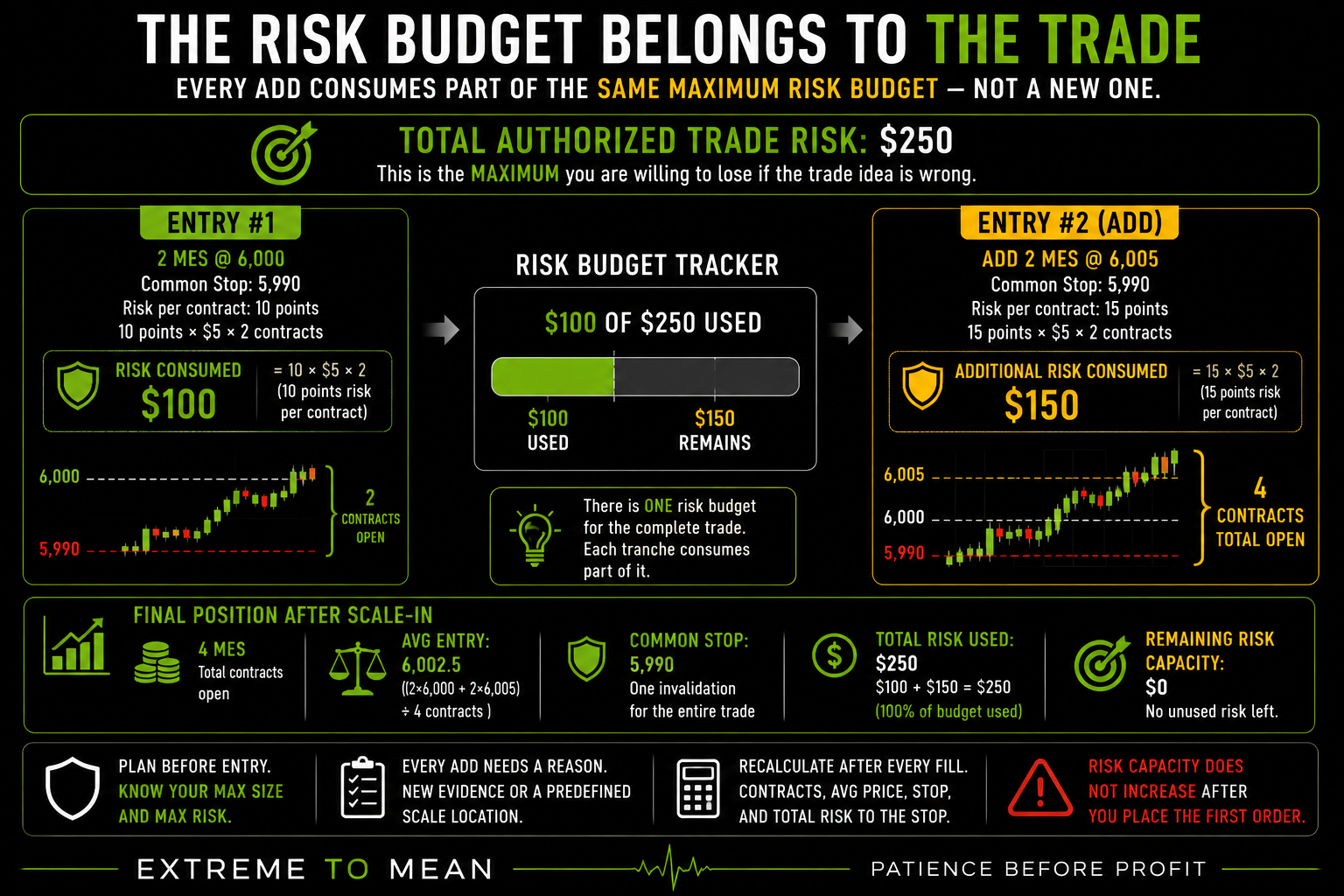
Suppose the maximum acceptable gross risk for one trade idea is $250. That does not mean the first order receives $250 of risk, followed by another $250 for the second order and another $250 for a third. Each tranche consumes part of the same authorized risk budget unless the strategy explicitly defines a different structure.
This connects directly to risk-first trading: total exposure should be known before the position begins growing. CME notes that increasing the number of futures contracts increases market exposure and recommends sizing the number of contracts according to the actual risk scenario rather than simply trading whatever maximum margin permits. (cmegroup.com) A new order changes exposure; it does not create new risk capacity.
A Concrete MES Scale-In Example
Consider a hypothetical long trade using Micro E-mini S&P 500 futures, or MES. CME currently specifies MES at $5 × the S&P 500 Index, so a one-point price move equals $5 per contract, with a 0.25-point minimum tick. (cmegroup.com)
Assume the structural entry area is around 6,000, invalidation is 5,990, maximum position size is four MES contracts, and maximum planned gross risk is $250. Entry #1 buys two MES at 6,000, creating 10 points of risk per contract to the common stop. The calculation is 10 × $5 × 2 = $100, leaving $150 of the original risk budget unused.
Later, price strengthens and a predefined confirmation condition triggers an add of two MES at 6,005. Those contracts sit 15 points above the common 5,990 invalidation, so their gross risk is 15 × $5 × 2 = $150; total planned risk is now $100 + $150 = $250. The weighted average entry becomes (2 × 6,000 + 2 × 6,005) ÷ 4 = 6,002.5.
| Tranche | Contracts | Entry | Stop | Risk per Contract | Total Tranche Risk |
|---|---|---|---|---|---|
| Entry 1 | 2 | 6,000 | 5,990 | $50 | $100 |
| Add 1 | 2 | 6,005 | 5,990 | $75 | $150 |
| Full position | 4 | Avg. 6,002.5 | 5,990 | — | $250 |
Equal Contract Adds Do Not Mean Equal Risk Adds
Both entries in the example contain two contracts, yet the first tranche risks $100 while the second risks $150. The difference comes from each entry’s distance to the common invalidation point. Contract count alone therefore does not tell the trader how much risk an add creates.
This is why maximum position size and maximum trade risk need to be treated as related but different constraints. “I started with two, so I can add another two” is incomplete reasoning until the new stop distance is calculated. The better question is, “What will another two contracts do to the complete position’s risk from here?”
A Better Average Price Is Not the Goal
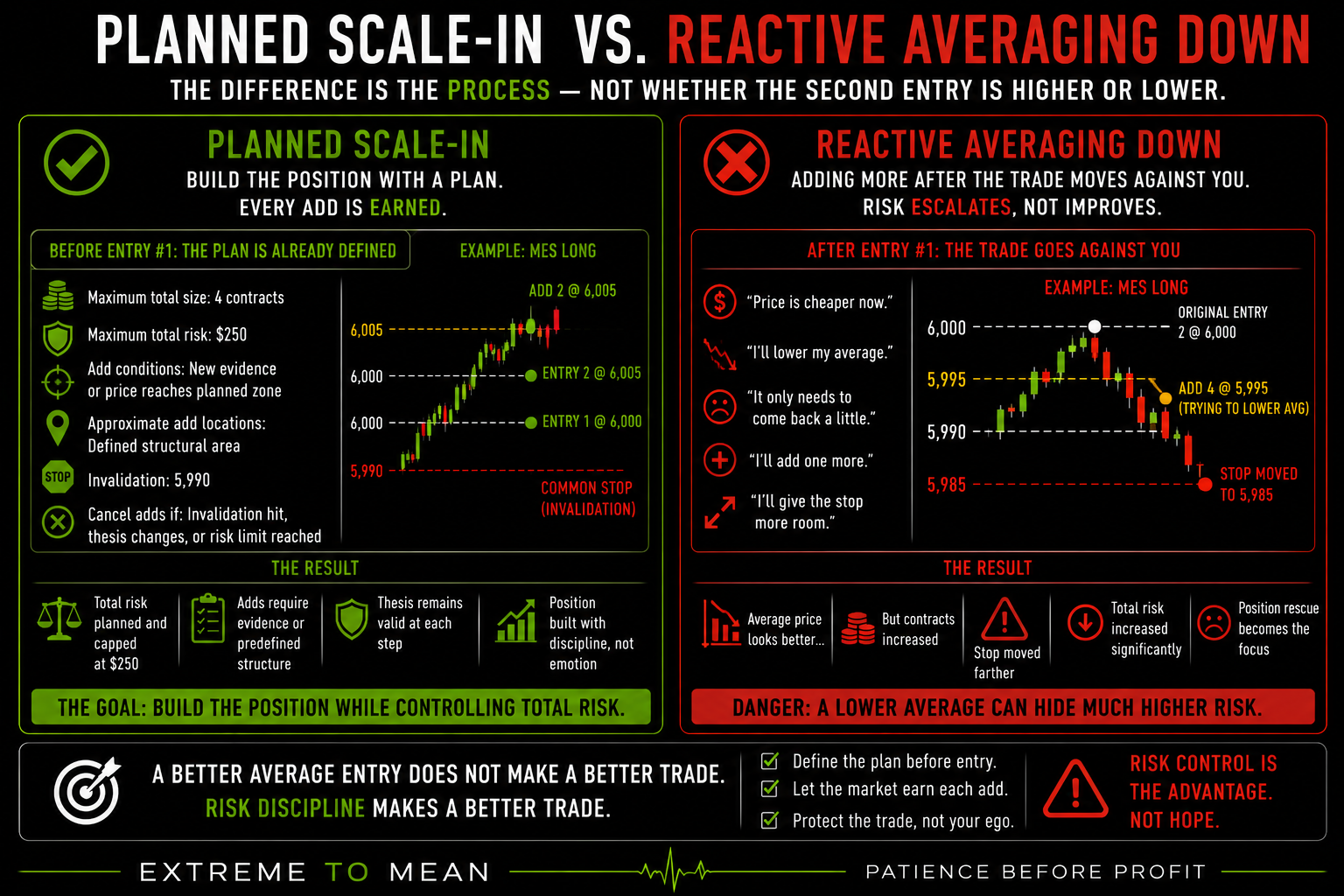
Suppose a trader is long at 6,000 and price falls to 5,995. Buying additional contracts will mathematically lower the displayed average entry, but it says nothing about whether the original thesis is still valid, whether the position remains within its risk budget, or whether additional exposure has been earned. Lowering average price is an arithmetic result, not a reason to trade.
The reverse is equally important: adding at 6,005 in the MES example made the average entry worse, moving it from 6,000 to 6,002.5. Yet if that add followed new confirmation while total risk remained capped, the market evidence may have become stronger even though the average price became less favorable. A lower average is therefore not automatically better management, and a higher average is not automatically worse.
Planned Scaling vs. Reactive Averaging Down
Planned scaling begins before Entry #1, with maximum size, total risk, invalidation, add conditions, and cancellation conditions already defined. Reactive averaging typically begins after the position becomes uncomfortable and the trader decides that a lower price provides a reason to buy more. Fidelity specifically identifies averaging down into losing stock positions as a behavior investors should be cautious about, although that does not establish that every lower-priced add inside a preplanned trading structure is automatically wrong. (fidelity.com)
| Question | Planned Scaling | Reactive Averaging Down |
|---|---|---|
| Planned before Entry #1? | Yes | Usually no |
| Maximum size defined? | Yes | Often expands |
| Total risk defined? | Yes | Often recalculated afterward |
| Reason for add | New evidence or planned zone | Price is cheaper / position is losing |
| Invalidation | Defined by setup | Often moved or ignored |
| Objective | Build planned exposure | Repair entry / reach breakeven |
| Remaining adds can be canceled? | Yes | Trader often feels committed |
| Average price | Consequence | Becomes the goal |
A lower second entry can still belong in the planned column. A trader might define a 6,000–5,995 entry zone before the trade, authorize two contracts near each location, cap total size at four, and use 5,990 as the common invalidation. The key distinction is not whether Entry #2 is cheaper; it is whether the lower entry existed before the first position began influencing the next decision.
This also differs from dollar-cost averaging in long-term investing. Fidelity defines dollar-cost averaging as investing similar amounts at regular intervals regardless of short-term price direction and notes that the approach does not prevent losses. (fidelity.com) An active trade scale-in instead revolves around one finite thesis, one invalidation structure, defined market conditions, and a capped position.
Every Add Needs a Reason of Its Own
For a straightforward beginner model, starting smaller and adding only after the market provides new supporting evidence is easier to control. That evidence might involve successful breakout acceptance, a controlled continuation pullback, a new higher low or lower high, improving timeframe alignment, or another independently qualified setup within the same thesis. No single trigger is mandatory; the principle is that additional risk should require additional evidence.
A starter position does not excuse entering an unfinished setup. The initial tranche should still have valid location, defined risk, a reasonable thesis, and clear invalidation before any future add is considered. A small bad trade is still a bad trade, and scaling should not become a workaround for impatience.
Adding to a winner is not automatically intelligent either. If price is already extended, the next target is close, volatility has expanded, or the new stop distance makes the complete position unattractive, an add can turn a strong original entry into weak new exposure. This is where where you enter matters more than what you predict, even when the initial tranche is already profitable.
Never Let an Add Rewrite Invalidation
Unused scale-in capacity disappears when the trade thesis becomes invalid. The trader should not add because price is now cheaper, widen the stop, invent a deeper support level, switch timeframes, or convert an intraday trade into something else merely to preserve the position. Knowing where the trade is wrong matters more after Entry #1, not less.
The danger becomes obvious when adding size and widening the stop happen together. Two MES bought at 6,000 with a 5,990 stop carry $100 of gross risk, but if the trader reacts to a decline by buying four more at 5,995 and moving the stop to 5,985, the original two now risk $150 and the four new contracts risk another $200. Total gross risk has expanded to $350, even though the larger lower-priced entry improved the position’s weighted average price.
That contrast is one of the most useful scaling lessons. The displayed average entry can improve at exactly the same time that contract count, stop distance, and total downside become substantially worse. Average price is information about the combined fills; it is not risk management.
Maximum Size and Add Conditions Must Exist Before Entry #1
Every scale plan should establish the largest position it is allowed to become. That number might be two contracts, four contracts, or another strategy-appropriate size, but once it is reached there is no additional tranche available simply because another level looks attractive. A finite maximum prevents position construction from turning into an open-ended rescue operation.
The plan should also define what makes each add eligible and what cancels every unused add. New confirmation, continued structural validity, enough room to the objective, acceptable total risk, and a compatible market environment can all matter. Invalidation, a structural change, disappearance of available room, or exhaustion of the risk budget should cancel future additions.
After every fill, recalculate current contracts, weighted average entry, stop location, dollar risk to the stop, maximum loss under the plan, and remaining room to a realistic objective. Do not mentally treat every contract as though it inherited the original entry price simply because they belong to one position. The platform’s combined average reflects the actual position, but each new tranche still needs to be understood as real additional exposure.
Scaling Adds Flexibility—and Complexity
Scaling can reduce the need to commit an entire intended position at one exact moment, which may be useful for strategies built around zones or confirmation. It also adds orders, fills, transaction costs, potential slippage, multiple entry prices, more bookkeeping, and additional opportunities to make emotional management changes. Scaling should therefore solve a real problem for the strategy rather than being used because multiple entries appear more sophisticated.
Do not treat the initial tranche’s open profit as “house money” for the next add. Unrealized P&L can disappear, and newly added contracts remain genuine market exposure that must fit the trade’s risk plan. Phrases such as “free contracts” or “risk-free add” can obscure what the combined position can actually lose.
Review scaling across a meaningful trade sample rather than judging it by one memorable winner. Track each tranche, risk added, weighted average entry, maximum favorable excursion, maximum adverse excursion, execution costs, the initial tranche’s result by itself, and the final result with scaling. The useful question is whether the add process improved the strategy’s behavior after costs and complexity, not whether one particular add happened to work.
A Practical Scale-In Framework
Use Plan → Starter → Evidence → Add → Recalculate → Stop. The purpose of the sequence is to prevent the current position from authorizing its own additional risk. Each stage should be understandable before the trader moves to the next one.
- Plan: Define maximum size, maximum total risk, invalidation, and permitted add conditions.
- Starter: Enter only if the initial tranche independently qualifies.
- Evidence: Require something new or reach a predefined scale zone before increasing exposure.
- Add: Execute only the size already authorized by the plan.
- Recalculate: Know the new weighted average, contract count, stop, and total dollar risk immediately.
- Stop: Cancel all future adds when invalidation, maximum size, or maximum risk is reached.
The better question is not, “Should I add because the price is better now?” Ask: “Was this additional exposure part of the original plan, what new evidence justifies it, and what will my total risk become if I add here?” A second filter is even harder to rationalize around: “If I were flat right now, would this additional tranche independently deserve risk?”
Final Thought
Scaling into a trade is not permission to keep adding until the position works. It is a predefined method for constructing a finite position while keeping every tranche inside one known risk budget. The market still has to earn each increase in exposure.
The key is to stop treating average price as the objective. Maximum size, total risk, structural invalidation, new evidence, and the conditions that cancel future adds are more important than making the entry displayed on the platform look better. One of the harder forms of patience is refusing to add simply because an existing position has become uncomfortable, a broader decision problem explored in The Patience Principle.
Educational content only. Trading involves substantial risk and is not suitable for everyone.