
Many beginners think risk begins with whether a trade is right or wrong. They focus on the chart, the setup, the entry, and the expected direction because those are the most visible parts of the decision. While each of those matters, none tells the trader how strongly the outcome will affect the account.
Risk also comes from size. A small price move can be manageable with one position and emotionally overwhelming with another, while the same dollar loss can be minor for a larger account and serious for a smaller one. That is why position size and account size must be understood together rather than treated as separate ideas.
At Extreme to Mean, this belongs in The Basics lesson library because traders need this math before moving deeper into risk management, drawdowns, and decision quality. Position size is not merely a number entered into an order ticket. It is the link between what happens in the market and what happens to the account.
Account Size Is the Base You Are Trading From
Account size is the amount of capital available in the trading account. Two traders can study the same chart, choose the same entry, and take the same directional idea while experiencing completely different financial consequences. The difference comes from the amount of capital supporting the decision.
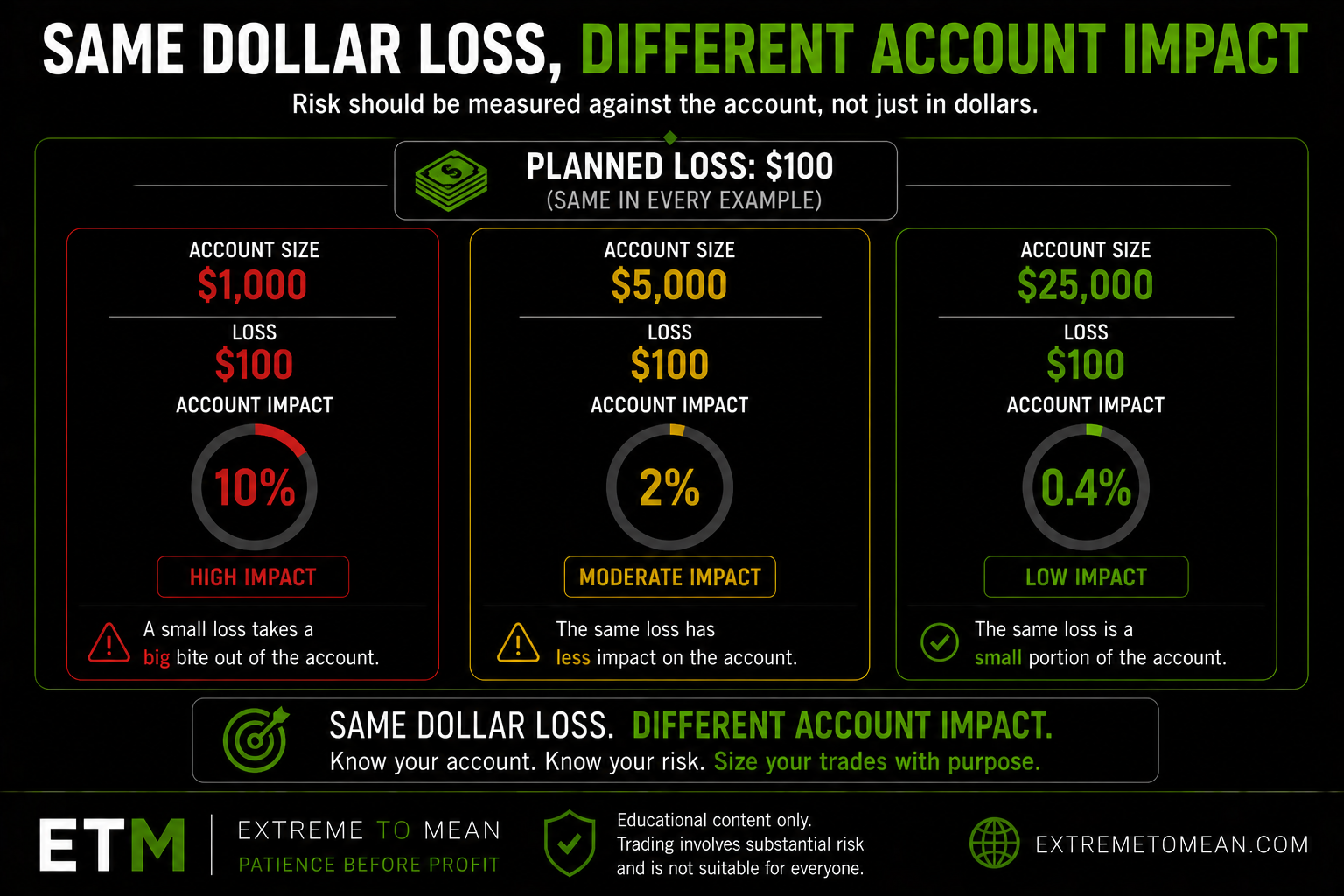
Consider a $100 loss. That loss represents 10% of a $1,000 account but only 0.2% of a $50,000 account. The dollar result is identical, yet the effect on the two accounts is dramatically different.
This is one of the most important lessons for a beginner because risk should not be viewed only in dollars. It should also be measured as a percentage of the account. The percentage shows how much of the trader’s available capital is being affected by one decision.
A $50 loss represents 5% of a $1,000 account, 1% of a $5,000 account, and 0.2% of a $25,000 account. Nothing about the dollar loss changed; only the base against which it was measured changed. A beginner who thinks, “It is only $50,” may be underestimating the decision if that amount represents a meaningful portion of the account.
Position Size Turns Price Movement Into Account Movement
Position size describes how much of a market the trader controls. In stocks, it may be the number of shares; in futures, it may be the number of contracts; and in options, it may involve the number of contracts combined with how the option responds to price movement. For futures specifically, the ATR lesson shows how volatility and contract value interact with size. The product mechanics differ, but the central idea remains the same: position size determines how strongly a market move affects the account.
This connects directly to the earlier lesson on entry price, exit price, profit, and loss. The difference between the entry and exit prices determines how far the trade moved, but position size determines how large that movement becomes in dollar terms. The market supplies the price change, while the position converts that change into an account result.
If a stock moves $1, a trader holding one share gains or loses $1, while a trader holding 10 shares gains or loses $10. A position of 100 shares turns that same market move into a $100 result. The chart movement is identical in every case, but the account impact changes with the size.
This is where beginners can run into trouble. They may study whether a stock can move $1 without fully considering what that move means for the position they intend to take. The market does not adjust its movement because a trader selected a size that is uncomfortable or inappropriate; the account simply absorbs the result.
Position size is therefore not only a way to make more when a trade works. It also increases the loss when the trade fails. Larger size magnifies both outcomes, which is why it must be selected from the risk plan rather than from excitement about the potential reward.
The Same Setup Can Carry Different Risk
Two traders can take the same setup and still accept completely different amounts of risk. Suppose both traders buy at $50 with a planned exit at $49 if the idea fails. Their price risk is $1 per share, but that does not yet reveal the total account exposure.
A trader buying 10 shares has $10 of planned risk if the stop is reached, while another trader buying 500 shares has $500 of planned risk. The entry, invalidation level, and chart structure are identical. The difference in position size transforms the same setup into two very different account decisions.
This is why a trade is not fully defined by the setup alone. It is defined by the setup, the distance to invalidation, and the amount of size attached to that distance. The futures position-sizing guide turns those inputs into a contract-count calculation. Until those elements are connected, the trader does not know what the trade actually means for the account.
Beginners often skip this step because the chart appears to be the important part. A clean setup may feel reasonable simply because the location and entry look attractive, but a good setup can still become a poor decision when it is oversized. Good analysis cannot make excessive exposure appropriate.
Size therefore belongs in the planning process before the order is placed. For futures, the trader must calculate the dollar value of each point before choosing size. The trader should know the entry area, the invalidation area, the distance between them, and the resulting account impact before clicking the order button.
A stop may help define where the trade should exit if the idea fails, but the stop level alone is not enough. A ten-point stop attached to one contract creates a different exposure than the same stop attached to five contracts. The risk only becomes clear after both distance and size are known. The same total-risk logic applies when deciding how to scale into a trade without averaging down.
Why Small Accounts Feel Pressure Faster
Smaller accounts often experience emotional pressure more quickly because each dollar can represent a larger percentage of the available capital. A $100 loss may be relatively small in a large account but significant in a smaller one. That difference can make ordinary market movement feel more urgent than it would with more appropriate exposure.
The emotional response is not simply a matter of discipline or toughness. The math is tighter because there is less room for oversized decisions. A few large losses can change a small account quickly, and even a normal pullback can feel severe when the position is too large relative to the capital behind it.
That pressure can affect the next decision as well as the current one. A trader may move a stop, exit too early, revenge trade, increase size to recover quickly, or take a setup that does not meet the plan. The account impact creates urgency, and urgency begins replacing process.
This is why beginners should avoid copying another trader’s position size. That trader may have a different account balance, product, timeframe, strategy, risk tolerance, or loss limit. Their number of shares or contracts may have no useful connection to what is appropriate for someone else.
The better question is not, “What size is that trader using?” It is, “What would this size mean for my account if the trade does not work?” Available margin should not determine position size, because being permitted to control a position does not mean the account can responsibly absorb its risk.
Size Affects Decision Quality
Position size affects more than the account balance; it also affects the trader’s ability to think clearly. When the size is too large, a normal pullback can feel like a crisis, a small unrealized loss can feel personal, and a modest open profit can become difficult to let go. The trader may stop managing the setup and begin managing the emotional reaction created by the position.
That is why risk management and trading psychology cannot be completely separated. The size of the trade changes the emotional environment in which every later decision is made. An otherwise reasonable plan becomes harder to follow when each tick or point feels too important.
A smaller and more appropriate position does not make trading safe or predictable. It can, however, make normal market movement easier to tolerate because the account impact was considered before the trade began. The trader is less likely to be surprised by what a routine pullback means in dollars.
This is where Patience Before Profit becomes practical. Patience is not limited to waiting for the setup; it also means waiting until the trade can be sized in a way that supports disciplined execution. A setup may earn attention, but the size helps determine whether it has earned risk.
An oversized trader is often no longer trading the chart. They are trading their fear of what the chart could do to the account. Once that happens, decisions are driven by financial pressure rather than by the structure of the original plan.
A Simple Way to Think About Risk Percentage
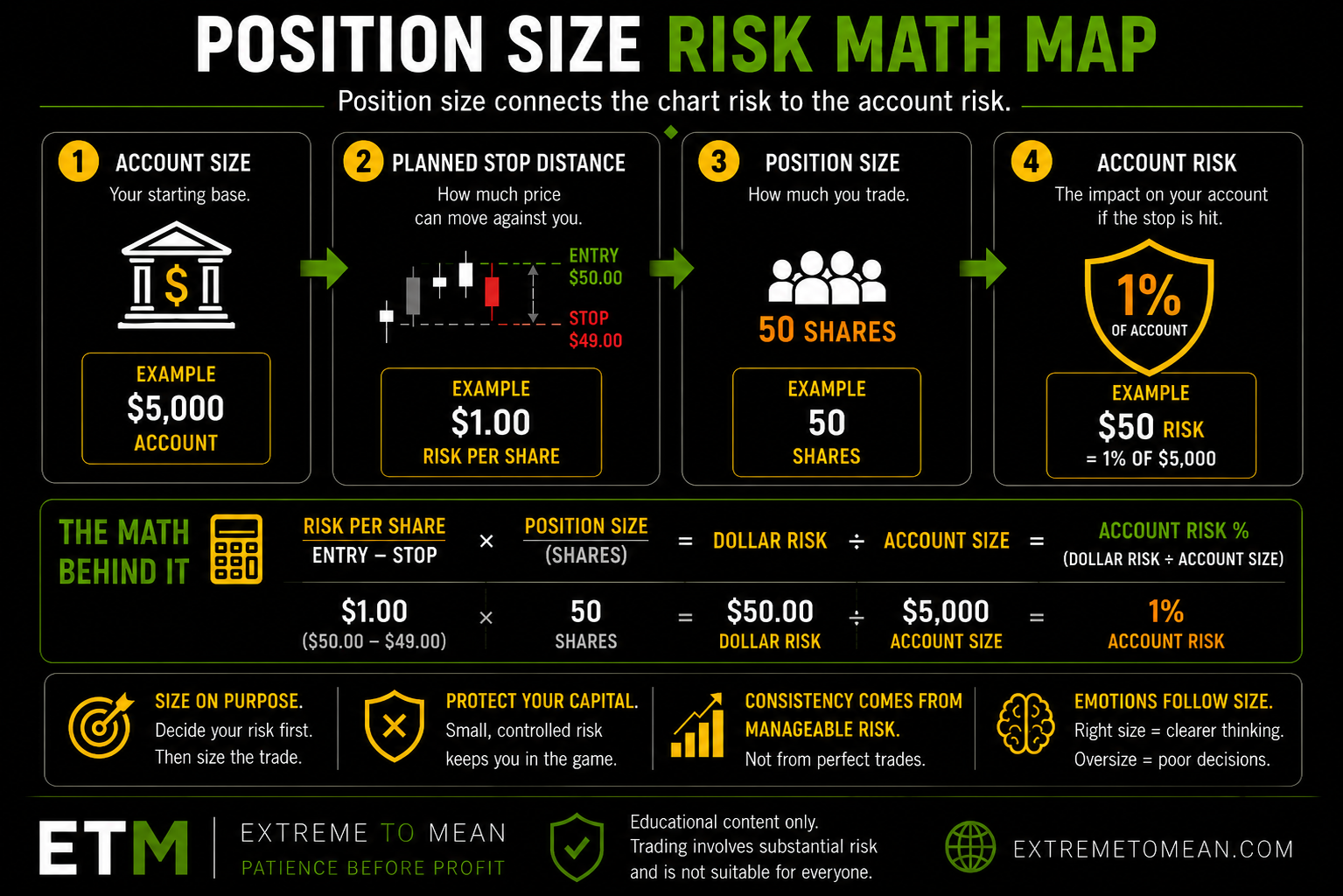
Beginners do not need complicated formulas to understand the basic relationship between account size and risk. They need to answer one clear question: if the trade loses the planned amount, what percentage of the account will be affected? That percentage provides a common way to compare decisions across accounts of different sizes.
The basic relationship is:
Planned dollar risk ÷ account size = account risk percentage
A trader with a $5,000 account who risks $50 on a trade is exposing 1% of the account. Risking $250 represents 5%, while risking $500 represents 10%. The account balance stayed the same, but the size of the decision changed dramatically.
This does not mean every trader or strategy must use one universal risk percentage. Products, approaches, experience levels, and account rules can differ. The beginner lesson is simply that every trade has an account impact, and that impact should be understood before entry.
A trader who knows the percentage is less likely to dismiss risk casually. A trader who does not know it may be accepting a much larger decision than they realize. Dollar risk explains how much can be lost, while percentage risk explains what that loss means relative to the account.
This connects to the broader Extreme to Mean principle that a trade is not ready until its risk is clear. Risk is not clear when the trader knows only the entry or even the entry and stop. It becomes clearer when the trader also understands the position size and the percentage of the account exposed to the outcome, which is the sequence covered in defining risk before the entry.
A Simple Position Size and Account Size Filter
Before placing a trade, the trader should be able to explain the size decision in plain English. The purpose is not to make every trade mathematically complicated, but to ensure that the account impact is visible before the uncertainty begins.
A useful position-size filter includes the following questions:
- What is my current account size? The account balance provides the base against which the planned loss should be measured.
- What is my planned entry, and where is the trade invalidated? Those two levels determine the price distance at risk.
- How much could the position lose if price reaches that level? The trader should convert the market movement into a dollar amount.
- What percentage of the account would that loss represent? The percentage shows how meaningful the decision is relative to the available capital.
- How much size am I using? Shares or contracts should be selected deliberately rather than guessed.
- What would a normal price move mean for this position? The trader should understand how routine movement may affect both the account and their emotions.
- Would I still follow the plan if the trade moved against me? If the size would make normal execution difficult, it may be too large.
- Does the trade still make sense after the account impact is calculated? A setup that appears attractive may no longer qualify after the real exposure becomes visible.
These questions do not make the trade safe because trading always involves uncertainty and loss risk. Their purpose is to make that risk visible before the trader acts. A known exposure can be evaluated, while an unknown exposure is usually discovered only after the position begins creating pressure.
The better question is not simply, “How much can I make if this works?” It is, “What will this decision cost my account if it does not work?” That shift keeps position size from being chosen through excitement, fear, or comparison with another trader.
For newer readers, the best next step is to start with the beginner trading path before moving deeper into risk per trade, drawdowns, and trade review. The calculations become more useful when they are connected to a complete process rather than treated as isolated numbers.
Final Thought
Position size and account size must be understood together. Position size determines how strongly price movement affects the trade, while account size determines how significant that result is relative to the trader’s capital. The same dollar loss can be manageable for one account and damaging for another.
Beginners often skip this math because entries and setups appear more exciting. Yet this is the math that determines whether the trade is manageable before the outcome is known. A strong setup cannot protect an account from a position that was too large from the beginning.
The better trader does not ask only, “Can this trade work?” They also ask, “If it does not work, what will the loss mean for my account, and can I accept that before entering?” That question turns position size into part of the decision rather than an afterthought.
That is how sizing becomes part of a cleaner trading process. The next risk lesson explains how leverage changes account exposure and why controlling more market value can magnify both opportunity and risk.
A small account can make normal risk feel urgent and expose weak sizing or recovery habits. How small accounts expose big discipline problems shows why that pressure deserves attention before it becomes behavior.
Educational content only. Trading involves substantial risk and is not suitable for everyone.