
Many traders begin planning with the target. They see a possible move toward a prior high, the mean, a gap, or another area of interest and begin calculating what the trade could produce. The potential destination makes the setup feel attractive before the trader has identified what would make the idea wrong. That order of thinking creates attachment to the opportunity before the risk has been defined.
The lessons in The Setup category emphasize that a pattern must be qualified through context, location, structure, and risk. A familiar setup may earn attention, but it does not earn participation merely because a possible destination is visible. The trader must know what market behavior supports the idea and what behavior would invalidate it. Without that boundary, the trade remains a prediction rather than a complete decision.
Invalidation Is the Point Where the Idea Fails
A trade idea is built on an expectation about market behavior. A long setup may depend on buyers defending a meaningful area, while a short setup may depend on sellers rejecting higher prices. The invalidation point is where the evidence required by that idea is no longer present. It answers what price must do for the trader to admit that the original reasoning no longer applies.
A stop order is the execution tool used to limit exposure when invalidation occurs. The stop and invalidation are connected, but they are not the same concept. Invalidation explains why the trade is wrong, while the stop defines where the trader will exit when that condition is met. Placing a stop without first defining invalidation turns risk management into guesswork.
Start With the Logic of the Setup
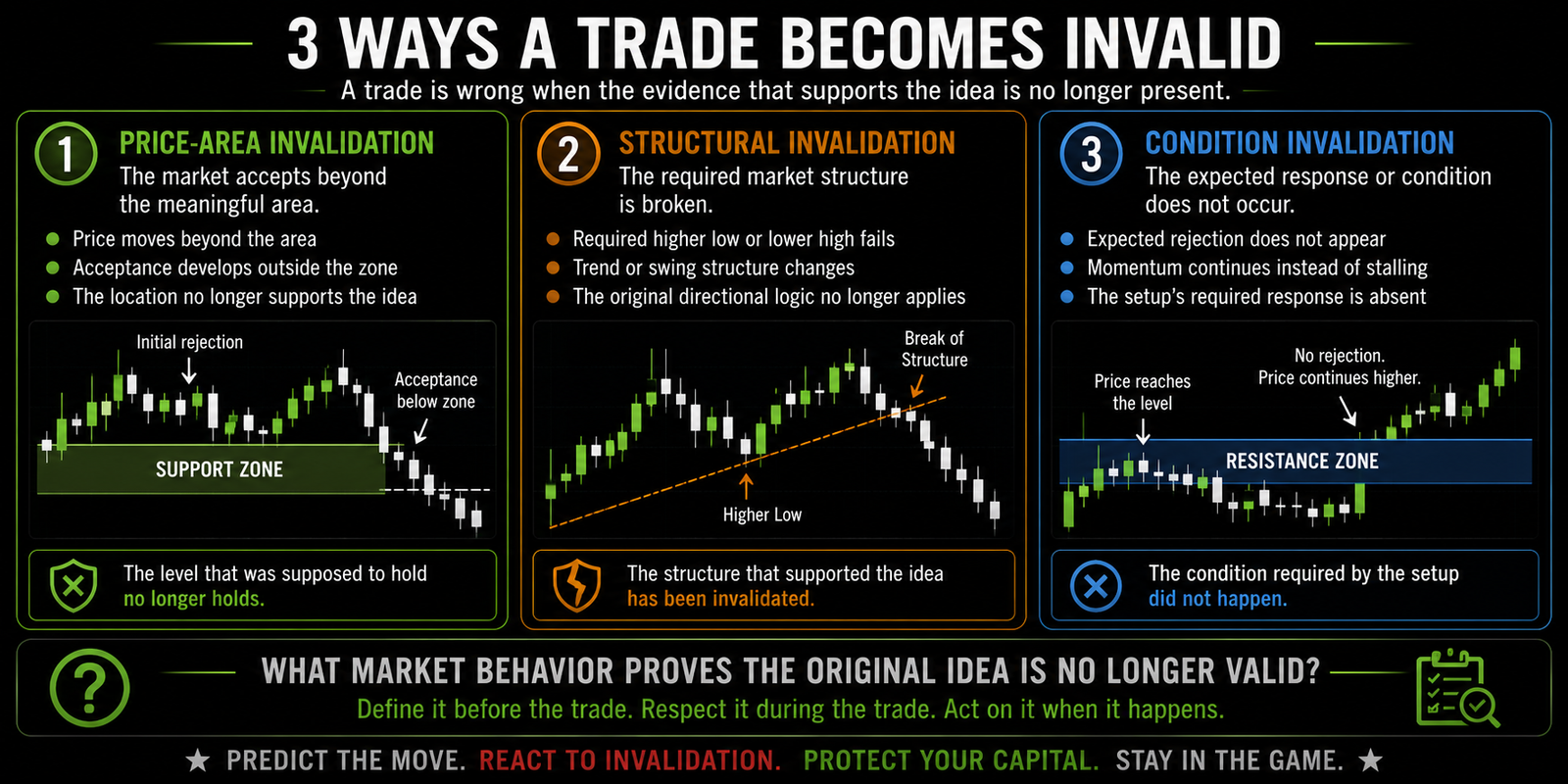
A long trade near support should have a reason that support matters. Buyers may be defending a prior low, price may be rejecting a higher-timeframe area, or structure may show that selling pressure is no longer extending. The trade remains valid only while the evidence behind that reasoning continues to exist. If price accepts below the area or breaks the structure required by the setup, the original idea must be reconsidered.
This is why location is the first filter before the trader begins thinking about an exact entry or target. A meaningful location creates a logical area from which the market should respond if the setup is valid. Poor location often produces an invalidation point that is either arbitrary or too far away to fit the plan. The trader should understand why the area matters before deciding where the trade becomes wrong.
A Trade Can Be Wrong in More Than One Way
Some trades are invalidated by price reaching a specific area. A long idea may fail when price accepts below a support zone, while a short idea may fail when buyers establish acceptance above resistance. The important word is acceptance because one brief probe may not carry the same meaning as sustained trade beyond the area. The trader must define what behavior counts as failure before the order is placed.
Other trades are invalidated by a structural or conditional change rather than one exact price. A higher low may fail, momentum may continue instead of stalling, or the broader market state may shift against the setup. A condition-based invalidation can still require a protective stop, but the reasoning comes from the breakdown of the setup’s required evidence. The trader should be able to describe that failure clearly enough to recognize it while the trade is developing.
An Exact Price Is Not Always the Whole Answer
Markets move through auctions, so important areas are often zones rather than perfect lines. Price may trade slightly through a level, test nearby liquidity, and still produce the response the setup requires. Treating every small penetration as automatic failure can make the invalidation too sensitive to normal market variation. Treating every penetration as acceptable can make the boundary meaningless.
The trader must define the amount and type of movement that would change the idea. A brief rejection beyond a zone may preserve the setup, while sustained acceptance or a structural close beyond it may invalidate the trade. The decision should reflect the market, timeframe, volatility, and setup logic rather than a need for one universal rule. Clear invalidation allows normal variation without allowing unlimited flexibility.
Why Traders Avoid Defining Where They Are Wrong
Traders often resist precise invalidation because it makes the possibility of loss real before entry. Focusing on the target feels constructive, while defining failure can feel negative or overly cautious. A vague boundary also allows the trader to preserve hope when price begins moving against the position. The discomfort of admitting the idea failed makes ambiguity feel useful in the moment.
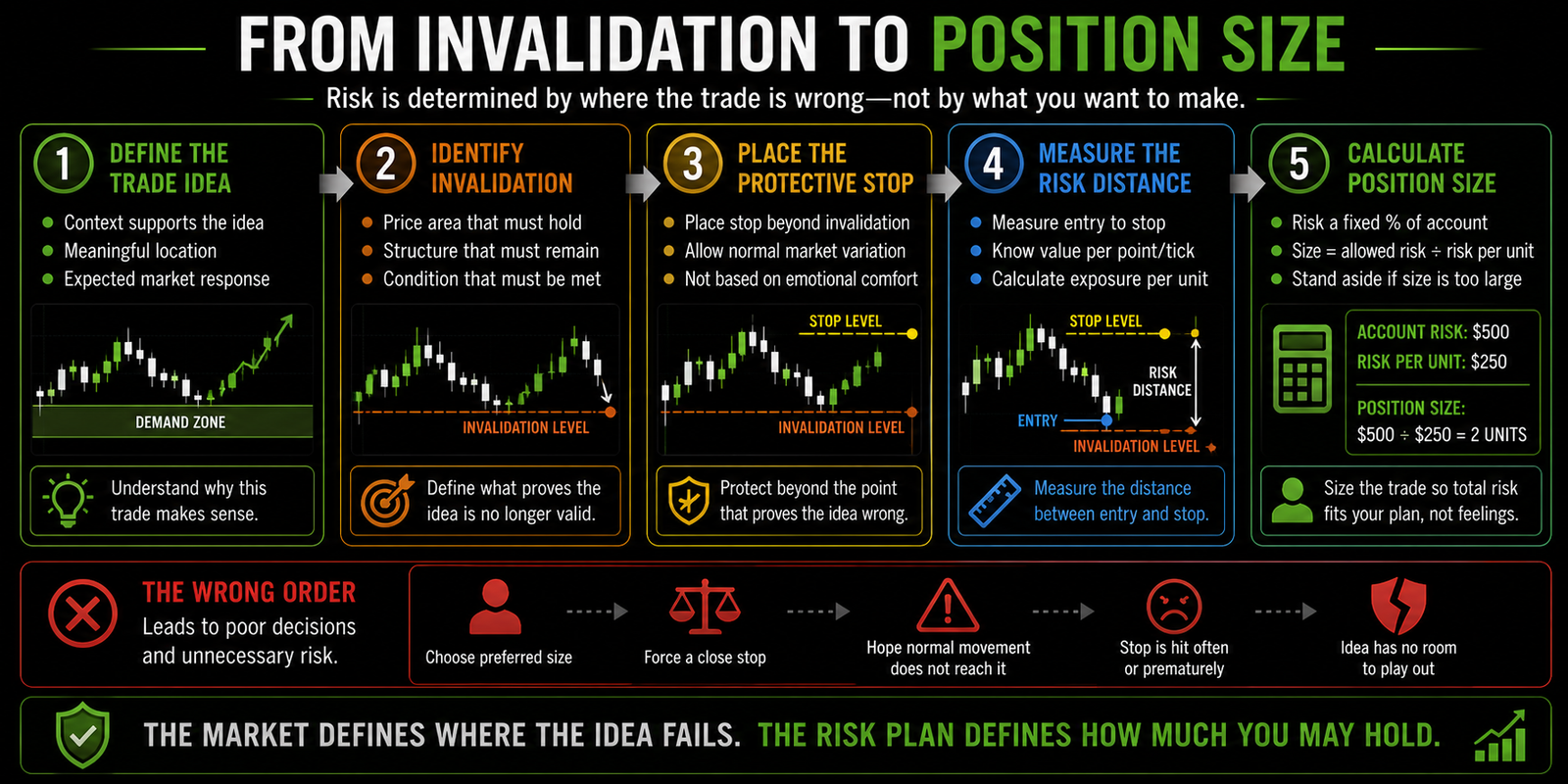
Another reason is that a clear invalidation may reveal that the trade cannot be sized properly. The logical stop may be farther away than expected, making the required exposure too large for the account or plan. The trader may then pull the stop closer to preserve the desired size rather than reject the trade. That adjustment makes the numbers more comfortable without making the market logic stronger.
Where the Trade Is Wrong Determines Position Size
Once the invalidation point is defined, the distance from entry to that boundary becomes measurable. Position size can then be calculated so that the total exposure fits the plan. The trader does not choose a preferred size and search for a stop that makes it work. The setup defines the invalidation, and the invalidation distance helps determine the acceptable size.
The principle that the trade is not ready until the risk is clear applies directly here. If the trader cannot explain the invalidation, the exposure cannot be calculated honestly. If the logical invalidation requires more risk than the plan allows, the trade may need a smaller position or no position at all.
Rejecting an oversized trade is part of setup qualification, not a failure to participate. It is one more example of how good traders disqualify bad trades before risk is ever accepted.
A Logical Stop May Still Produce an Unacceptable Trade
A valid invalidation point does not automatically make the trade acceptable. The stop distance may be so large that the position becomes impractical, or the available destination may not provide enough room relative to the exposure. The setup can make sense technically while still failing the trader’s risk requirements. A logical idea and an acceptable trade are related but separate conclusions.
If the exposure does not fit, the trader should not pull the stop inside the invalidation merely to keep the position. That creates a trade that can be stopped while the original idea remains valid. The cleaner choices are to reduce size, wait for a better entry, or stand aside. The market does not owe the trader an entry that fits every preferred risk amount.
Do Not Move the Point of Failure After Entry
After entry, price movement can make the original invalidation feel less comfortable. The trader may widen the stop because the market is “almost” reacting, reinterpret a structural break, or add a new condition that was not part of the original plan. Each adjustment protects the position from being closed, but it also changes the trade that was approved. The trader is no longer managing the same idea.
Flexibility is appropriate when the plan defines how new information will be handled. A trader deciding when to tighten a stop to breakeven should require a planned structural development, while the trade may be exited early when evidence weakens before the full invalidation is reached. Flexibility becomes story-changing when it is used only to prevent a loss from being realized. The difference is whether the adjustment was supported by the process or invented to defend the position.
A Better Question Before Entry
The question “How far could this trade go?” encourages attention toward reward before the setup is complete. A better question is, “What must price do to prove that my reason for entering is no longer valid?” That question directs the trader toward observable market behavior instead of emotional tolerance. It also makes the later exit easier to understand because the boundary was created before attachment formed.
Before placing an order, the trader can review a short invalidation filter. The answers should form one connected explanation rather than several unrelated stop rules. Each question should be resolved before position size is finalized:
- What specific market behavior supports this trade?
- Is the invalidation based on a price area, structural break, failed response, or changed condition?
- Does invalidation require a brief touch, sustained acceptance, or a close beyond the area?
- Is the stop positioned beyond normal market variation for this setup and timeframe?
- Can the position be sized so the complete exposure fits the plan?
- Is there enough room for the trade to develop before meeting meaningful opposition?
- Would I still exit at this boundary if the trade had already moved in my favor first?
- Can I explain where the trade is wrong in one clear sentence?
These questions prevent a target from becoming the only developed part of the plan. They also reveal when the invalidation remains subjective, too close, too distant, or dependent on how the trader feels after entry. If the answer keeps changing during preparation, the setup has not earned risk yet. Clarity must exist before the order creates emotional pressure.
Traders who repeatedly enter without a defined boundary should examine the broader problem of having unclear risk. The issue may involve vague setup criteria, poor location, fixed position sizing, or a habit of treating stops as optional. The correction should make invalidation part of setup qualification rather than an emergency decision after entry. A complete trade explanation includes where the idea fails and what happens when it does.
Review the Invalidation Separately From the Outcome
Trade review should ask whether the invalidation was logical and respected, not merely whether the stop was hit. A good stop can be reached before price reverses, and a poor stop can survive while the trade eventually works. Later price movement does not automatically prove that the original boundary was right or wrong. The review should focus on whether the invalidation matched the setup evidence available at the time.
A losing trade can therefore represent clean execution when the idea was qualified, the invalidation was logical, and the exposure fit the plan. A favorable trade can reveal weak process when the stop was arbitrary, moved emotionally, or never defined. Separating outcome from invalidation quality creates more useful information for future decisions. The purpose is to improve the clarity of the process rather than defend or criticize one result. For the broader sequence from invalidation to position size, see building a risk-first trade plan.
Final Thought
Knowing where a trade is wrong gives the setup a boundary. It connects the market idea to the stop, the stop to position size, and the position size to the trader’s accepted exposure. Without that sequence, the trade is built around hope for a destination rather than a complete decision. The target matters only after the point of failure can be explained.
The goal is not to identify a perfect stop that avoids every unnecessary exit. It is to define the market behavior that would make the original reasoning no longer valid and respond according to the plan. Clear invalidation does not guarantee the trade will work or prevent normal losses. It gives the trader a disciplined answer when the market no longer supports the idea.
Educational content only. Trading involves substantial risk and is not suitable for everyone.