
Before a loss, the trader may be asking whether context, location, setup quality, and risk justify participation. After a loss, another question can begin operating underneath the analysis: How do I get that money back? The chart may look almost identical, but the purpose of the decision has changed.
That distinction matters because revenge trading can look technically reasonable while it is happening. The trader may still identify support, resistance, momentum, a pullback, or another familiar setup feature. The danger is that urgency has quietly lowered the standard required for the next trade to earn risk.
What Revenge Trading Actually Is
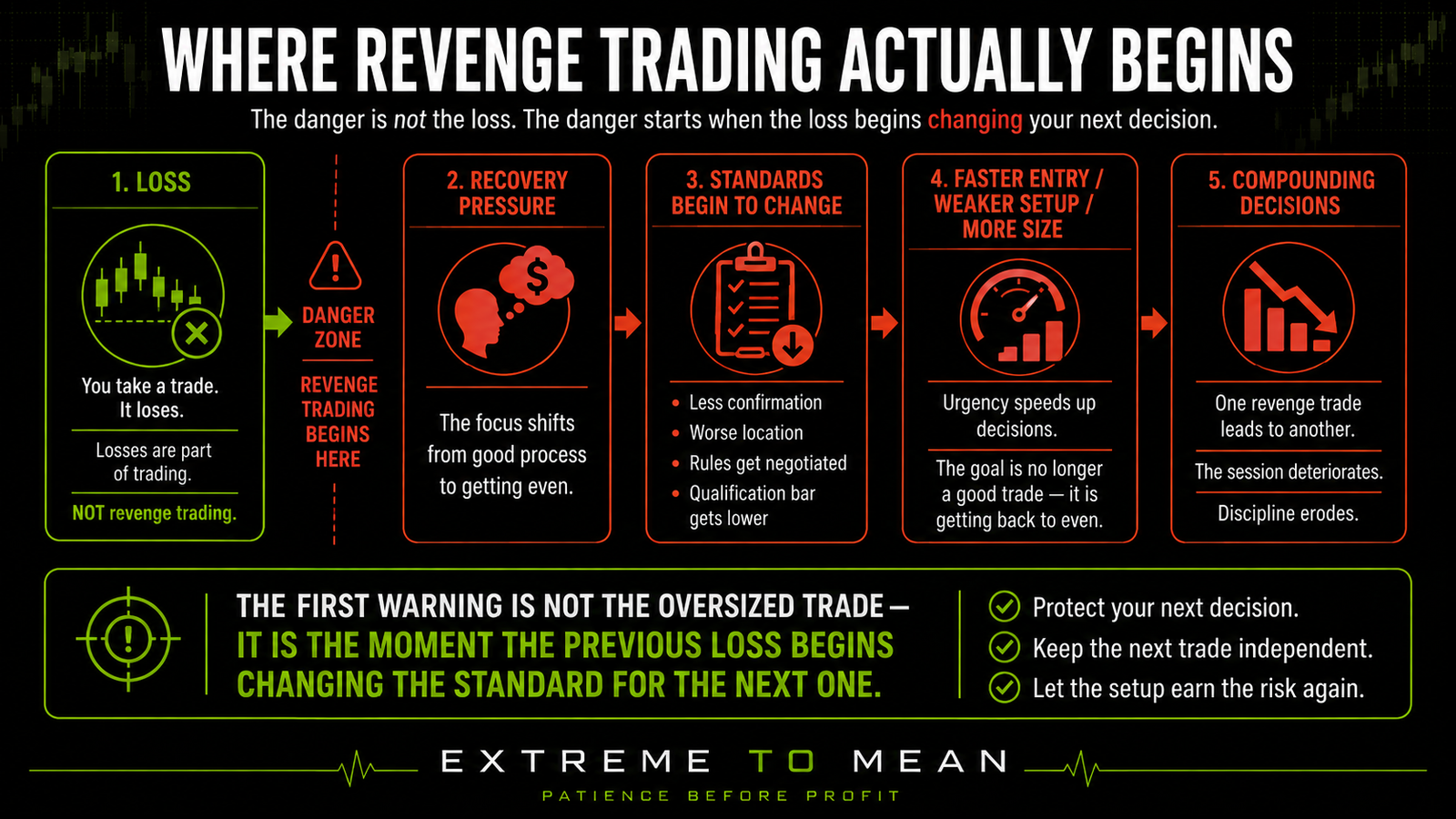
Revenge trading is taking or modifying a trade primarily because the trader wants to recover a recent loss rather than because the new opportunity independently satisfies the trading plan. It does not require anger, shouting, oversized positions, or an obvious emotional breakdown. A trader can appear calm while still allowing the previous P&L result to influence entry timing, setup quality, size, or risk.
The useful distinction is therefore not whether the trader feels emotion after losing. Emotion after a loss is normal; the problem begins when it changes the decision process. This is why protecting the next decision matters more than trying to immediately repair the previous result.
Revenge Trading Usually Starts Small
The first signs are often subtle. A trader begins looking for another entry immediately after being stopped, requires slightly less confirmation than usual, accepts a location that would normally be rejected, or suddenly becomes interested in increasing size "just a little." None of those actions has to look dramatic on its own.
The common thread is a shift from evaluation toward urgency. Attention moves from market conditions toward P&L, and returning to breakeven starts to feel like a goal that the market should provide an opportunity to accomplish. The original directional thesis may still look plausible, which makes the next trade especially easy to rationalize.
Research on emotion and judgment gives another reason to treat the trader's internal state as relevant information without turning emotion into a deterministic rule. Lerner and Keltner's classic work found differences in risk perception associated with fear and anger, but a 2025 registered replication found stronger support for several risk-optimism effects than for the original risk-preference findings. The appropriate takeaway is modest: emotional states can influence judgment, but anger does not automatically make every trader take more risk.
Why Getting Back to Even Feels So Important
A recent loss can become a new mental reference point. Instead of evaluating the next opportunity only by its own expected risk and qualification, the trader can begin evaluating it partly by whether it offers a path back to zero. A marginal setup may suddenly feel more attractive because the possible outcome now includes emotional relief.
Thaler and Johnson's experimental research on risky choice provides useful behavioral support for this mechanism. Their work found that prior outcomes affected subsequent decisions and that, following losses, opportunities offering a chance to break even could become especially attractive. Their experiment was not a study of revenge trading, so it should not be treated as proof of trading behavior, but the break-even effect helps explain why recovery-oriented opportunities may feel unusually compelling after a loss.
The Previous Trade Should Not Set the Standard for the Next One
Before the losing trade, context had to qualify, location had to qualify, the setup had to qualify, and risk had to be acceptable. Those same standards should remain intact afterward. The fact that the account is now down money does not improve the next setup.
A simple test exposes the contamination. If a trader would have rejected an opportunity while flat at 9:45 but accepts the same quality of opportunity at 10:15 because a loss occurred in between, the market may not have changed enough to explain the new decision. The previous result has changed the standard.
Valid Re-Entry vs. Revenge Trade
Being stopped out and later trading in the same direction is not automatically revenge trading. The market can produce new information, a setup can complete later, or location can improve enough to create an entirely new qualified opportunity. What matters is whether the second trade stands on its own.
| Question | Valid Re-Entry | Revenge Trade |
|---|---|---|
| Why am I entering? | New setup qualifies | Want to recover prior loss |
| Evidence | New or completed evidence | Same story forced again |
| Position size | Normal planned size | Increased to recover faster |
| Risk | Predefined normally | Negotiated or expanded |
| Timing | Setup dictates timing | Urgency dictates timing |
| Previous P&L | Irrelevant to qualification | Central to decision |
| Would I take it if flat? | Yes | Probably not |
A valid re-entry uses the same standards that existed before the first trade. Size remains consistent with the plan, risk is defined normally, and the trader would still participate if the prior loss were erased from memory. Revenge is not defined by direction; it is defined by contaminated decision-making.
The Most Useful Post-Loss Question
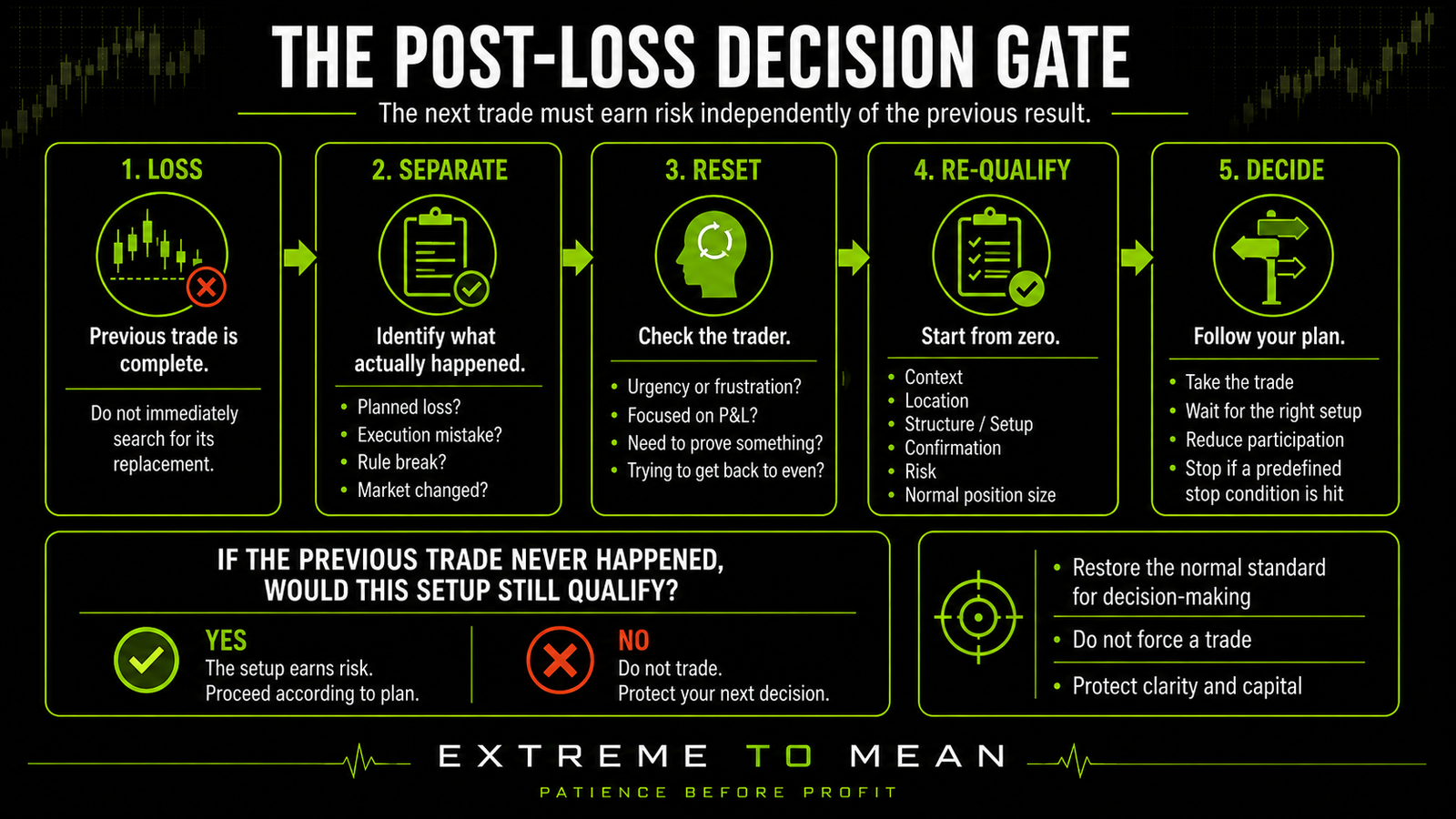
The strongest filter is straightforward: If the previous trade had never happened, would this trade still qualify exactly the same way? That question forces the trader to separate current market evidence from the financial and emotional residue of the previous position. It also makes vague discomfort easier to translate into specific process checks.
Ask whether you would still trade the same location, accept the same setup quality, use the same size, place the same stop, and enter at the same moment if your P&L were flat. If several answers change because of the loss, the next decision is no longer independent. That does not automatically mean the market has no opportunity; it means the trader needs to re-establish the normal qualification standard before acting.
Use a Post-Loss Reset Before Looking for Another Trade
A useful reset is Loss → Separate → Reset → Re-Qualify → Decide. The purpose is not to eliminate frustration or force the trader to feel calm; it is to prevent the previous outcome from rewriting the next decision. This process should be defined before the loss occurs, when there is less pressure to rationalize an exception.
- Loss — Close the previous trade. Do not immediately search for its replacement.
- Separate — Label what happened. Was it a planned loss, an execution mistake, a rule break, or a meaningful change in market conditions?
- Reset — Check the trader. Are you rushed, focused on money, trying to prove the original read was correct, or thinking about getting back to even?
- Re-Qualify — Start from zero. Recheck context, location, structure, confirmation, risk, and normal position size.
- Decide — Follow the existing plan. Trade, wait, reduce participation if that is already part of the plan, or stop when a predefined stop condition has been reached.
The value of the reset is that it turns "be disciplined" into an observable process. A trader does not have to guess whether enough time has passed or whether frustration has magically disappeared. The next opportunity simply has to meet the same standards that applied before the losing trade.
A Cooldown Is a Circuit Breaker, Not the Entire Solution
Stepping away after a loss can create useful distance between decisions, but time alone does not make the next trade valid. A trader can wait five, fifteen, or thirty minutes and still return with the same goal of recovering the previous loss. The relevant test after the pause is whether the next setup has independently earned risk.
Schwab's 2026 trading-psychology guidance similarly recommends creating separation after significant losses and discusses cooling-off periods, reduced size or simulation during re-entry, written if-then rules, and predetermined circuit breakers. Those tools are most useful when they are defined in advance rather than improvised while the trader is under pressure.
Position Size and Daily Limits Reveal Recovery Thinking
A sudden desire to increase size after a loss deserves attention because "one bigger winner fixes this" changes position sizing from a risk decision into a recovery decision. Normal size should not increase merely because the account is down. If elevated emotional pressure is already addressed by a predefined plan through reduced participation, simulation, or stopping, the trader should follow that plan rather than invent a new rule after the loss.
Daily loss limits serve a similar purpose. They are not only financial boundaries; they can prevent a session increasingly influenced by frustration and recovery pressure from continuing indefinitely. The broader principle is already covered in why daily loss limits are decision limits, so revenge-trading prevention should use that boundary rather than renegotiate it during the session.
Revenge Trading Can Follow a Good Loss
The first trade does not have to be a mistake. A completely valid setup can fail, the trader can execute the stop correctly, and the loss can be an ordinary outcome of trading. Revenge behavior may begin only afterward, when the trader decides that a normal loss now needs to be repaired.
That is why the previous trade and the next decision should be reviewed separately. A good loss should remain a good loss rather than becoming the first link in a chain of lower-quality decisions. Knowing when to stop trading for the day matters when the trader can no longer restore normal standards or a predefined session stop has been reached.
What to Review After the Session
Post-session review should look for the first point where the process changed, not merely count how many revenge trades occurred. The most useful evidence is often found before the visibly bad trade, when urgency first began influencing setup qualification. That is where tomorrow's prevention rule should be aimed.
Review the time between the loss and the next entry, whether setup standards changed, whether size changed, whether the next trade was planned or reactive, and whether P&L entered the reasoning. Also ask whether a stop condition was ignored and whether one normal loss led to a sequence of increasingly connected decisions. A strong pre-market routine that protects against impulse can then incorporate the specific circuit breaker identified during review.
A Practical Anti-Revenge Decision Gate
Before another trade after a loss, the trader should prove that the next decision is independent. This is not about demanding emotional perfection; it is about verifying that market evidence still controls participation. The setup has to earn risk again.
Ask:
- Would I take this setup if my P&L were flat?
- Has genuinely new evidence appeared?
- Does the trade meet the same standards I used before the loss?
- Is my position size unchanged for process reasons?
- Is the risk defined exactly as it normally would be?
- Am I trading the market—or trying to repair the previous result?
- Have I reached a predefined daily-loss, rule-break, or emotional stop condition?
If those questions cannot be answered cleanly, the next decision has not earned risk. The better question is not, "How can I make this loss back?" It is: "If the previous trade had never happened, would this next trade still earn exactly the same decision?"
Final Thought
The loss itself does not create revenge trading. Revenge trading begins when the previous outcome is allowed to change the purpose, standards, size, timing, or risk of the next decision. Protecting against it therefore starts earlier than the obvious meltdown.
The trader does not need to immediately repair the P&L. The job is to protect the independence of the next decision—even when that decision is to wait or stop. That space between pressure and action is one of the larger ideas explored in The Patience Principle.
Educational content only. Trading involves substantial risk and is not suitable for everyone.