
A futures prop evaluation is not one standardized product. Different firms—and even different programs inside the same firm—can use different drawdown formulas, consistency rules, contract limits, fees, payout requirements, and simulated or live stages. Inside The Trader, the better question is not merely whether you can reach a target, but whether you understand the environment you agreed to trade inside.
What a Futures Prop Challenge Actually Is
A futures prop challenge is an evaluation designed to determine whether a trader can meet specified performance objectives without violating predefined risk and trading rules. It builds on the basic model explained in What Is a Prop Firm?, but the evaluation itself has a narrower job. You are being measured not only on whether you produce profit, but on how you get there.
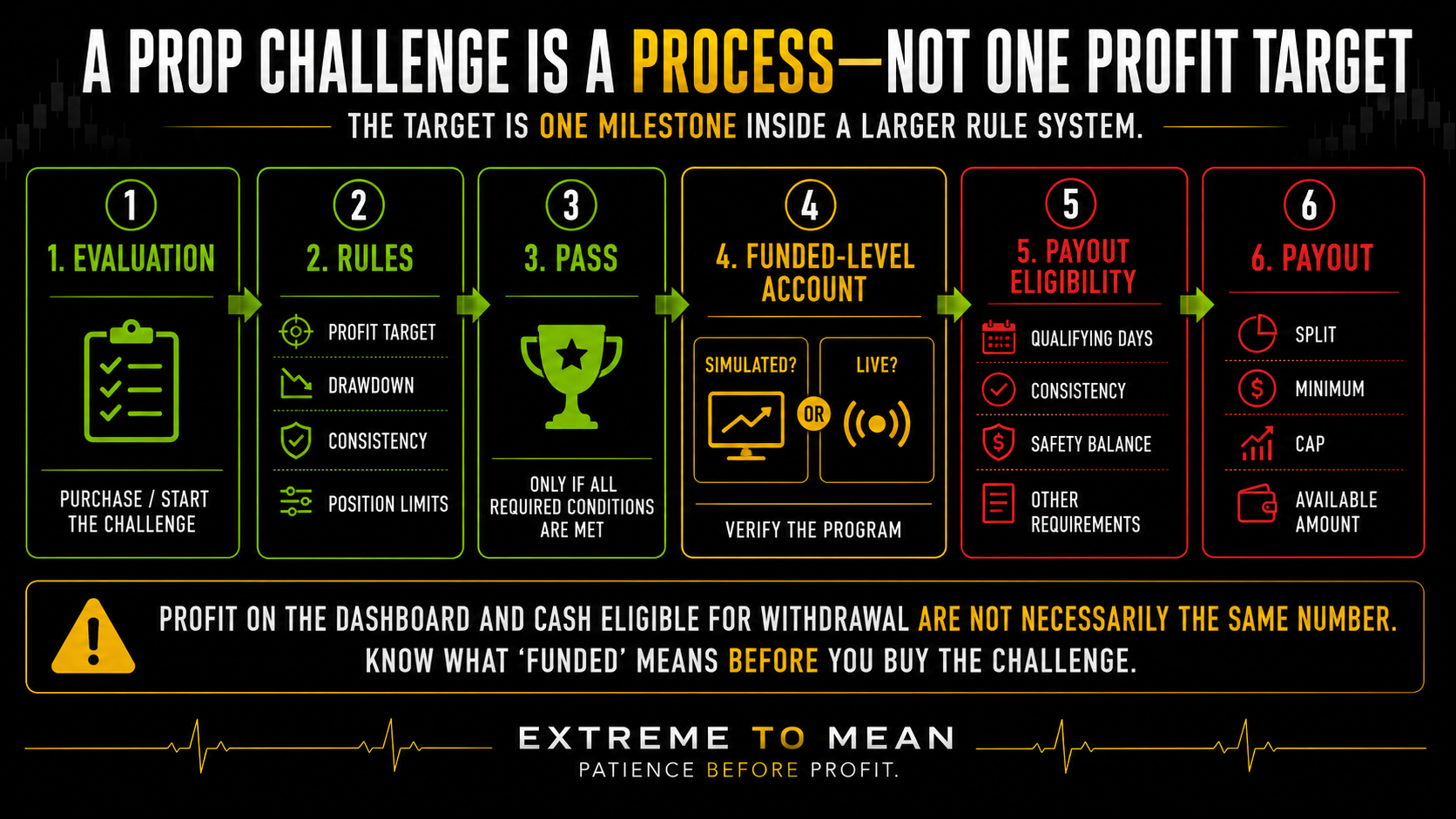
The path often looks something like Evaluation → Rules → Profit Target → Loss Limits → Pass → Funded-Level Account → Payout Eligibility → Possible Live Progression. The exact stages differ by company, so that sequence should be treated as a conceptual map rather than a universal rulebook. The guide to comparing futures prop firms applies that distinction across drawdown, fees, funded-stage rules, and payouts. The target is only one part of what you are purchasing.
That distinction matters because a profitable trading idea can still be a bad prop-firm trade if it puts the account rules in danger. The lesson on why prop-firm rules can outweigh even a strong setup develops that two-part eligibility test. A trade may make sense on the chart while being oversized relative to the remaining drawdown, violating a position limit, or creating a consistency problem. In a prop environment, you are trading the market and the account rules at the same time.
The Headline Account Size Is Not Your Risk Budget
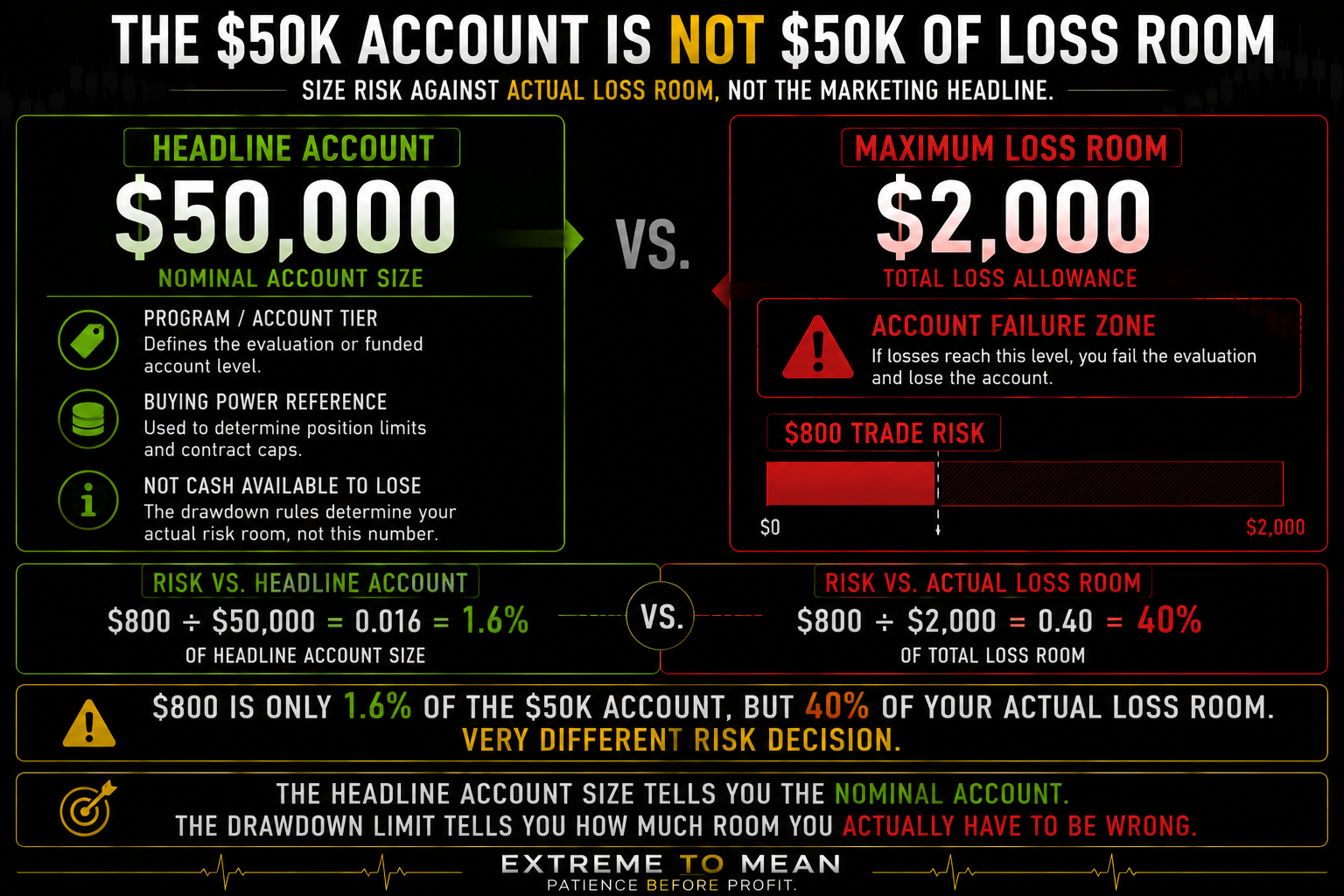
A beginner sees $50,000 Account and naturally thinks they have $50,000 of capital available to lose. That is usually the wrong number for understanding survival risk. If a hypothetical $50,000 evaluation has a $2,000 maximum loss allowance, the $2,000 boundary is far more relevant to how much room the trader actually has to be wrong.
The difference becomes obvious when sizing a trade. Risking $800 might look like only 1.6% of a nominal $50,000 account, but it represents 40% of a $2,000 total loss allowance. That is an entirely different risk decision.
The headline account size tells you the nominal account; the drawdown limit tells you how much room you actually have to be wrong. The goal is not to call the advertised account size misleading, but to understand which number controls your ability to remain in the program. Size risk against the loss room you actually have, not merely the number printed in the account name.
The Profit Target Is Only the Destination
Suppose a hypothetical evaluation starts at $50,000 and requires $3,000 in profit. Reaching $53,000 may satisfy the profit objective, but it may not be enough if the program also requires consistency, qualifying trading days, position limits, or other conditions. The target is the destination; the rules define which paths to the destination are allowed.
This is why “how quickly can I pass?” can become the wrong question. A trader who becomes obsessed with the remaining dollar amount may begin taking trades because the dashboard says they are close rather than because the market earned risk. The challenge should measure the trader’s process, not become the reason that process gets abandoned.
The psychological pressure often increases as the target gets closer. A trader who needs only $400 more may feel that the evaluation should be finished today, even if the market is offering nothing worth trading. The progress bar can become a trading signal if you let it.
Drawdown Is the Rule You Need to Understand Precisely
The term drawdown is not specific enough by itself. A program might use a static loss floor, an end-of-day trailing threshold, or a real-time intraday trailing threshold, and unrealized P&L may affect the calculation under some models. The detailed guide to how drawdown works in prop trading separates those mechanics. A trader needs the actual formula, not just the word “drawdown.”
As of August 27, 2026, Topstep’s standard Trading Combine describes its Maximum Loss Limit as trailing upward from end-of-day balance gains while being monitored intraday, including unrealized P&L. Apex currently offers an intraday trailing evaluation whose threshold follows peak account balance in real time and includes unrealized gains. Those are materially different mechanics, which is exactly why there is no universal prop-firm drawdown model. (help.topstep.com)
Imagine an account begins with a $48,000 failure threshold beneath a $50,000 nominal balance. If gains cause the applicable trailing threshold to rise, giving those gains back later may leave much less room than the trader assumes from looking only at the headline balance. Read the drawdown formula, not just the label.
Daily Loss Limits, Consistency, and Trading Days Are Separate Rules
A daily loss limit answers a different question from the maximum account drawdown: how much damage can occur during one session before trading must stop or the account is restricted. Not every program uses one in the same way, and some programs do not use one at all. Treat maximum loss and daily loss as separate definitions until the firm’s terms say otherwise.
Current rules demonstrate the variation. Topstep presently makes its Daily Loss Limit optional in the Trading Combine and Express Funded Account, while Apex’s current intraday evaluation states that it has no Daily Loss Limit. A trader who assumes “all prop firms have the same daily-loss rule” can therefore misunderstand the product before the first trade is placed. (help.topstep.com)
Consistency rules create another layer. A firm may measure whether one large profitable day represents too much of total profit, which means a trader can be profitable while still not satisfying the relevant consistency formula. Making money and meeting the program’s consistency requirement are two separate measurements.
Trading-day requirements can also differ materially. Some programs require a number of qualifying or profitable days, while others may allow an evaluation to be passed quickly if the other rules are satisfied. The important distinction is that a trading day and a qualifying day may not mean the same thing.
Maximum Position Size Is a Ceiling, Not a Recommendation
Prop programs usually place limits on how many contracts a trader can hold. Those limits may differ by account size, product type, Micro-versus-E-mini treatment, balance, or progression stage. The fact that five contracts are allowed does not mean five contracts are appropriate.
This becomes especially important when loss room is small relative to maximum size. A trader can legally remain under the contract ceiling while still risking an enormous percentage of the account’s actual survival room on one idea. Maximum allowed size is a ceiling, not a recommendation.
Programs may also restrict hedging, account coordination, certain automated behavior, news trading, overnight holding, or other activity. Those policies vary enough that another trader’s summary should never replace the actual terms governing your account. If the account depends on the rule, read the current official rulebook.
“Funded” Does Not Always Mean a Live Brokerage Account
Passing an evaluation does not necessarily mean a company deposits the advertised account amount into an individual live brokerage account. Modern retail futures funding programs can include simulated evaluation stages and simulated funded-level stages where traders may become eligible for real payouts. A separate live progression may come later.
Topstep currently states that its Trading Combine is simulated and that its Express Funded Account is also a simulated funded-level account; its program can later progress traders toward a Live Funded Account. Apex likewise describes its current Intraday Performance Account as a Simulated Funded account awarded after passing the corresponding evaluation. (help.topstep.com)
That is why the word funded needs context. Funded describes your status inside the program; it does not always tell you whether the trades themselves are being routed into a live brokerage account. Know exactly what “funded” means in the specific program you are buying.
Profit on the Dashboard Is Not Automatically Withdrawable Cash
A trader can show positive account P&L and still be unable to withdraw the amount they expect. Payout eligibility may depend on qualifying days, consistency, safety-net balances, minimum withdrawal amounts, caps, waiting periods, splits, or account status. Profitability and withdrawability are therefore related but separate stages.
Current programs illustrate the difference. Topstep’s current Express Funded payout paths include qualifying-day or consistency conditions, payout caps, and a 90/10 split, while Apex’s current intraday Performance Account payout rules include five qualifying days, 50% consistency, a safety-net balance, a $500 minimum request, and per-request caps. (help.topstep.com)
Profit shown on the dashboard and cash currently eligible for withdrawal are not necessarily the same number. A profit split also is not the same thing as a payout cap: one determines how profits are divided, while the other can restrict how much may be requested at a particular time. The payout rulebook deserves the same attention as the evaluation rulebook.
Fees and Resets Change the Economics
The cost of a challenge can include more than the first purchase. Depending on the program, traders may face subscriptions, activation charges, resets, market-data costs, platform charges, or other fees. A more useful question than “What does one evaluation cost?” is often “What does this process cost if I fail and repeat it?”
Reset availability creates a behavioral risk because the failed account can begin feeling disposable. A trader may take a risk they would never accept in an account they were trying desperately to preserve because another reset is only a click away. Easy resets can make bad risk feel temporary while the fees remain very real.
Recurring fees can create similar pressure. The approaching billing date can quietly turn “wait for the right trade” into “I need to make progress before I pay again.” A subscription deadline is not a market catalyst.
Passing and Trading Well Are Not the Same Measurement
A trader can trade poorly and still pass an evaluation through favorable short-term variance. Another trader can make reasonable decisions and fail because losses cluster early in a small sample. Passing matters, but one challenge result should not be treated as complete proof of trading skill or the absence of it.
This is closely related to understanding what an edge actually is. A durable process has to be evaluated across repeated decisions rather than inferred from one evaluation result. The challenge measures performance under one specific combination of market conditions and account rules.
That distinction becomes especially important near the finish line. Following your trading plan before the open can become harder when the dashboard creates an artificial reason to force action. The challenge should measure the process; it should not become the reason you abandon the process.
Rules Can Change
Prop-firm terms are products, and products change. Profit targets, fees, drawdown rules, payout structures, account types, and prohibited activity can be revised, so evergreen education should teach traders what to verify instead of pretending one table will remain accurate forever. Any concrete company example should therefore be date-stamped.
Marketing labels and regulatory status are also separate questions. If a company makes a U.S. futures registration or membership claim that matters to your decision, NFA’s BASIC database provides public information about CFTC registration, NFA membership, and regulatory history. A company calling itself a “prop firm” does not by itself answer those regulatory questions. (nfa.futures.org)
Before purchasing, verify the current official rules for the evaluation, drawdown calculation, funded-stage account type, payouts, fees, prohibited activity, and termination conditions. The prop-firm challenge readiness check organizes those questions before payment adds pressure. Do not rely on a social post, an old YouTube walkthrough, or another trader’s memory when the actual terms control your account. Know the account before you trade the account.
A Practical Prop-Challenge Framework
Use Rules → Risk Room → Trade → Progress → Eligibility → Payout. The framework keeps attention on the complete product rather than allowing the profit target to dominate every decision. It also separates making money from satisfying the conditions required to keep and withdraw it.
- Rules: What exactly can fail or restrict the account?
- Risk Room: How much actual loss capacity exists under the drawdown formula?
- Trade: Does this trade fit both the market setup and the account rules?
- Progress: Are you following the process, or merely reacting to how close the target looks?
- Eligibility: Have all funded-stage and payout requirements actually been satisfied?
- Payout: What amount is currently eligible for withdrawal under the current rules?
| Question | What to Verify |
|---|---|
| Account size | Buying power or actual cash balance? |
| Profit target | Is hitting it alone enough to pass? |
| Drawdown | Static, EOD trailing, or intraday trailing? |
| Unrealized P&L | Can it move or breach the threshold? |
| Daily loss | Required, optional, or absent? |
| Consistency | How is the percentage calculated? |
| Trading days | Trading days or qualifying days? |
| Position size | Maximum contracts and scaling rules |
| Funded stage | Simulated or live? |
| Payout | Days, balance, consistency, split, caps |
| Fees | Evaluation, subscription, activation, reset, data |
| Restrictions | News, overnight, automation, coordination, products |
The better question is not “How fast can I pass this challenge?” Ask, “What exactly can fail this account, how much actual risk room do I have, and can I trade my normal process inside those constraints?” Then ask whether getting closer to the target is improving your decision-making or simply increasing the urge to force the finish.
Final Thought
A futures prop challenge is not just a profit target. It is a trading environment built from loss limits, sizing rules, consistency measurements, fees, funded-stage definitions, and payout requirements, and those conditions can differ substantially from one program to another. Passing the challenge is not just reaching the target; it is surviving the path to the target.
The most important number may not be the advertised account size at all. The drawdown boundary often tells you far more about the room available for mistakes, while the payout rules determine how dashboard profit becomes withdrawable cash. The trader’s job is to understand both before risking the account.
Before buying or resetting another evaluation, ask whether you understand the product well enough to explain its rules without looking at the marketing headline. Preserving your next decision instead of racing the progress bar is part of the longer process behind The Patience Principle.
Educational content only. Trading involves substantial risk and is not suitable for everyone.