
Inside The Setup, the purpose of a mean reversion checklist is not to produce more trades. It should slow the decision down, expose missing information, and eliminate ideas that have not developed far enough to deserve capital. The job of the checklist is not to tell you when to click; it is to make the trade prove it deserves consideration.
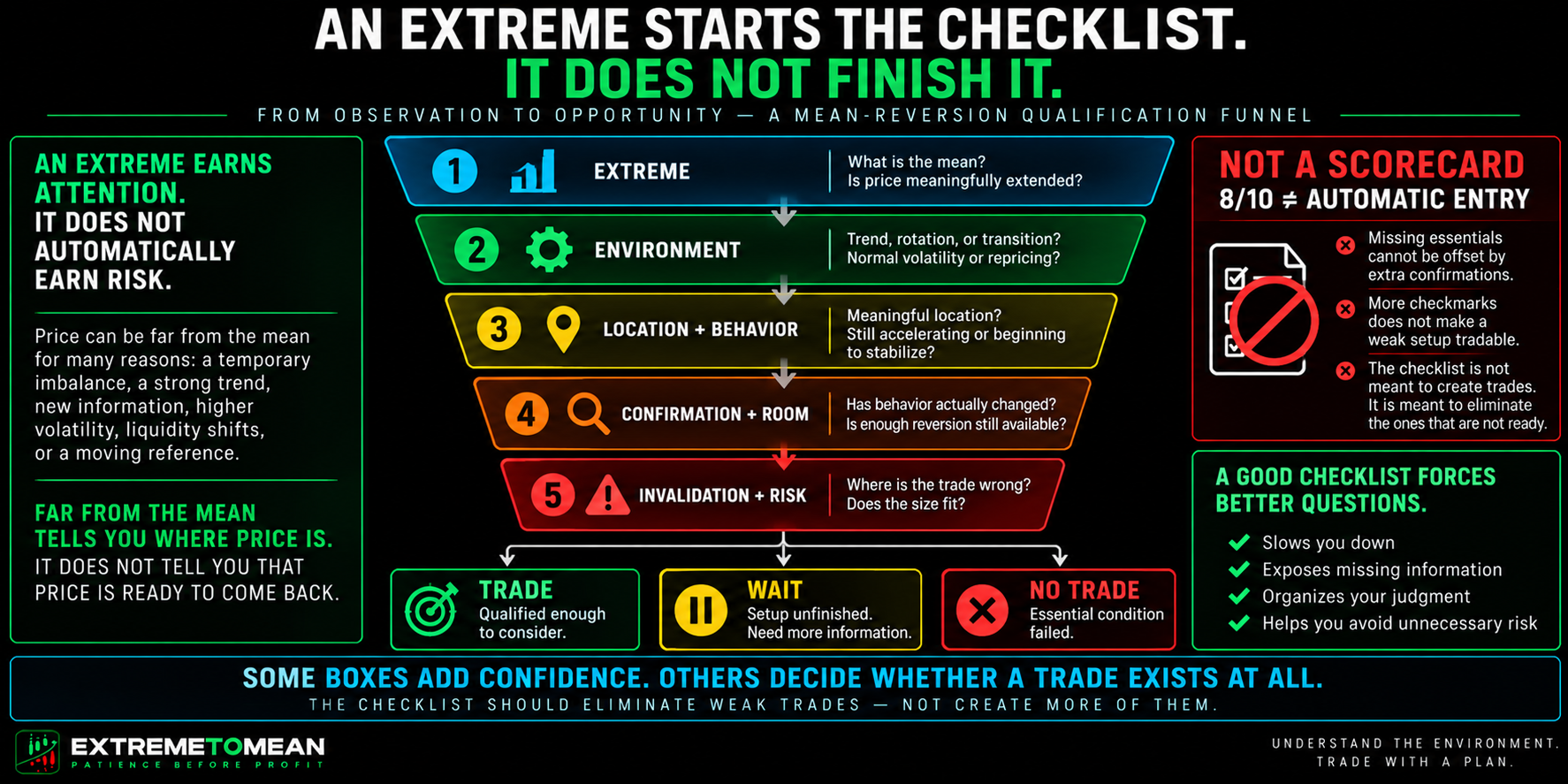
That distinction matters because “it has gone too far” can quickly become a belief, then a prediction, then an entry. Price may be stretched because a temporary imbalance is developing, but it may also be repricing new information, accelerating through a trend, or moving under volatility conditions that make yesterday's definition of extreme meaningless. Far from the mean tells you where price is. It does not tell you that price is ready to come back.
The Checklist Should Be a Funnel, Not a Scorecard
A useful mean reversion trading checklist should operate in sequence rather than award points. If price is not meaningfully extended, there may be no reversion premise; if invalidation cannot be defined, the trade is not ready no matter how many secondary indicators look supportive. A missing essential is not cancelled out by three extra confirmations.
The cleaner hierarchy is Extreme → Environment → Location → Behavior → Confirmation → Room → Invalidation → Risk → Decision. Early questions determine whether continued evaluation makes sense, while later questions determine whether the idea can actually be turned into a defined trade. Some boxes add confidence. Others decide whether a trade exists at all.
Define the Mean Before You Measure the Extreme
Before asking whether price is far from the mean, define the reference. A strategy might use VWAP, an anchored VWAP, a moving average, a value reference, or another predefined measure, but those references are not interchangeable simply because one happens to support the trade at the moment. You cannot measure distance from a reference you have not defined.
The mean also should not be treated as a guaranteed destination. It can provide context, a possible destination, an area of equilibrium, or one component of target planning, and a dynamic mean can move while price is moving toward it. The mean is a reference point—not a magnet with a contractual obligation.
Once the reference is defined, determine whether the extension is meaningful relative to current conditions. Ten ES points can represent a substantial stretch during one session and ordinary movement during another, so raw distance has to be interpreted beside current volatility and normal behavior. An extreme should be extreme relative to something—not merely dramatic on the screen.
Distance also should not be confused with probability. When NQ moves from 150 points extended to 200 and then 250, the increasing distance may indicate that the directional move remains powerful rather than that a reversal has become progressively safer to fade. Farther does not always mean safer to fade; sometimes farther means the trend is still winning.
Read the Environment Before You Fade the Move
The same distance from a mean can carry very different information depending on the market state. The lesson on the three market states is useful here because a balanced rotational market, a persistent trend, and an unstable transition do not create the same reversion environment. The same extreme can look attractive in one condition and dangerous in another.
Trend strength deserves particular respect because a strong directional market can remain extended far longer than a trader expects. Repeated higher highs or lower lows, shallow pullbacks, expanding ranges, acceptance away from prior value, and continued participation can all tell the trader that the force creating the extreme is still active. The market does not become obligated to reverse because the trader becomes increasingly uncomfortable with the distance.
Volatility and news can change the problem again. After CPI, jobs data, an FOMC decision, or another significant catalyst, price may be far from an old reference because the market is discovering a new value rather than temporarily stretching away from an unchanged one. Sometimes price has stretched away from the mean; sometimes new information has made the old mean less relevant.
Demand Meaningful Location and Changing Behavior
Distance becomes more useful when it occurs at a location that mattered before the reaction began. Higher-timeframe structure, established support or resistance, a prior-session reference, or another preidentified area can give the stretch a reason to deserve closer attention. Distance creates the stretch; location tells you where that stretch may matter.
This is why not every extreme is a trade. A level discovered after the bounce cannot qualify an entry that occurred before the level was identified, and stacking six nearby indicators does not necessarily create six independent pieces of evidence. Stronger confluence usually comes from different evidence answering different questions rather than several tools drawing similar lines.
Then ask whether continuation is still easy. An extended market that is accelerating away from the mean is different from one that begins failing to extend, trading more two-sided, compressing, or repeatedly rejecting further progress. Being far away matters less if price is still moving farther away with ease.
Slowing is still not the same thing as reversal. One wick may show a reaction, but it does not establish that the move has finished or that the level will hold when tested again. A wick is evidence of a reaction; follow-through tells you whether the reaction mattered.
Use Confirmation Without Letting It Create the Setup
Confirmation should answer a question that already exists because context, extension, location, and behavior created a legitimate setup to monitor. Depending on the strategy, confirmation might involve a structural turn, failed continuation, a reclaim, momentum change, or supporting internals, but the confirmation should not be the first reason the trade exists. Confirmation should answer a question created by the setup—not create the setup by itself.
Waiting for every available indicator can create the opposite problem. A trader may demand a candle pattern, momentum turn, breadth improvement, TICK confirmation, CVD shift, second candle, and breakout before acting, only to discover that price has already traveled most of the way back toward balance. Confirmation has value only while enough trade remains after you receive it.
This is where room to revert becomes a trade-construction question rather than merely an observation about distance. A reversion thesis may still be correct after price has already snapped back substantially, but the entry can become poor if little realistic target room remains compared with the stop required by the structure. You can correctly identify the move and still miss the trade.
Make Sure There Is Still a Trade Left
Suppose price was originally 50 points from the reference, but confirmation arrives after 38 points of the reversion have already occurred. If only 12 points remain while structural invalidation requires 15 points of risk, the market may continue toward the mean while the present entry still makes little sense. A correct reversion idea can become a bad trade after too much of the reversion has already happened.
The mean itself does not have to be the only target. Logical opposing structure, partial reversion, a moving reference, or another strategy-defined destination may be more realistic, which means the important question is what remains available from the actual entry being considered. The mean may be the destination of the idea without being the only sensible exit for the trade.
This also separates reversion from reversal. A trader can correctly identify a move back toward balance without correctly calling the top, bottom, or end of the larger trend, so the setup should not depend on a dramatic prediction that the entire market direction has changed. A mean-reversion trade only needs the market to do what that specific trade requires.
Risk Has to Be Defined Before the Extreme Earns Capital
Before entry, identify the market behavior that would prove the reversion thesis wrong. That might involve acceptance beyond a meaningful location, continued directional structure, or another strategy-defined failure condition, but it should come from the trade logic rather than from a preferred dollar amount. If you cannot explain what would prove the reversion idea wrong, you do not yet have defined risk.
A statement such as “my stop is $200” describes financial tolerance, not market invalidation. The cleaner order is market invalidation → price stop distance → position size → dollar risk, because the account determines how much exposure can be taken while the market determines where the idea fails. That principle is developed more fully in the trade is not ready until the risk is clear.
Once the stop distance is known, determine whether the appropriate position size fits the account and the instrument being traded. If one contract creates too much risk, a smaller contract may solve the sizing problem, while another setup may simply need to be passed. A setup has not earned risk if the only way to afford it is to distort the stop.
Reward-to-risk deserves the same discipline. A visually attractive 4:1 calculation cannot rescue poor location, accelerating trend, undefined invalidation, or an unrealistic target, because the ratio only describes the geometry of the proposed trade. Reward-to-risk does not create the probability behind the setup.
The Checklist Must Be Able to Say Trade, Wait, or No Trade
A useful checklist should have three possible outcomes rather than one. Trade means the setup is qualified enough to move into the actual execution plan, Wait means the premise remains valid but something important has not developed yet, and No Trade means a required condition has failed or the opportunity no longer makes sense. A checklist that cannot tell you “no” is not filtering anything.
That distinction keeps an unfinished setup separate from a bad setup. Meaningful location and extension with continued acceleration may deserve a wait, while no room, distorted risk, or a market aggressively repricing new information may justify rejecting the trade entirely. Some trades need more time; others need to be left alone.
The scorecard trap works against this idea. Seven checked boxes do not overrule missing invalidation, bad position sizing, or no remaining target room, because essential conditions cannot be averaged together with secondary confirmation. The checklist organizes judgment; it does not outsource judgment.
Urgency belongs in the decision as well. If the trader missed the previous move, every wick or indicator improvement can suddenly look more convincing on the next extreme, which is why a useful behavioral question is: Would I consider this evidence meaningful if I had not just missed another trade? An extreme can demand attention without demanding action.
A Practical ETM Mean Reversion Checklist
Use these five layers as a decision funnel rather than a point system. If a foundational condition fails, stop trying to compensate for it with extra indicators and decide whether the setup needs more time or should be discarded.
EXTREME
- □ I can clearly identify the mean or reference.
- □ Price is meaningfully extended relative to current conditions.
- □ The extension is not based only on how dramatic the chart looks.
ENVIRONMENT
- □ I understand whether the market is trending, rotating, or transitioning.
- □ Current volatility still allows my normal assumptions to make sense.
- □ I know whether news or event repricing is driving the move.
- □ I am not fading strength simply because price traveled farther than expected.
LOCATION & BEHAVIOR
- □ Price is interacting with a meaningful location identified before the reaction.
- □ Continuation is showing some evidence of slowing, failing, or stabilizing.
- □ I have more than a dramatic wick or one isolated reaction.
- □ Any confirmation fits the setup rather than replacing it.
TRADE CONSTRUCTION
- □ Enough realistic room remains for the reversion idea.
- □ I can clearly explain where the trade is wrong.
- □ The stop belongs at invalidation rather than at an arbitrary dollar amount.
- □ Position size keeps the trade inside planned risk.
- □ The target and stop create a realistic trade rather than manufactured reward-to-risk.
DECISION
- □ I am not chasing after most of the reversion has already occurred.
- □ FOMO or urgency is not changing what I consider valid evidence.
- □ If something essential is unfinished, I am willing to wait.
- □ If the trade cannot be defined cleanly, I am willing to pass.
Outcome: TRADE / WAIT / NO TRADE
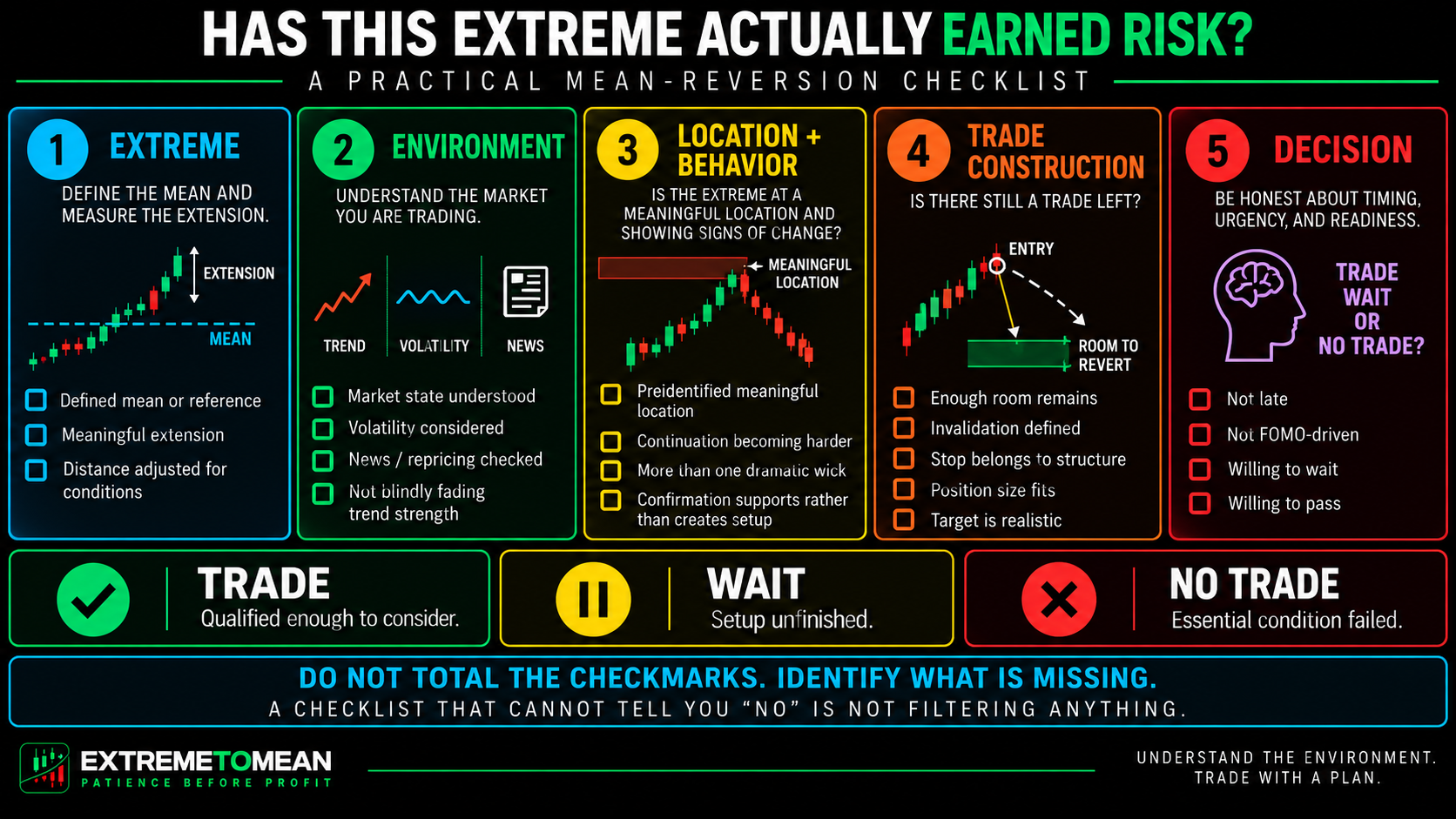
The better question is not “How many boxes did I check?” Ask: “Is anything essential still missing, and if it is, does this setup need more information or does it need to be left alone?” That keeps the checklist focused on qualification instead of turning uncertainty into a numerical permission slip.
Final Thought
The market can be extreme before the trade is ready. Price being far from a mean may create an area worth monitoring, but environment, location, behavior, available room, invalidation, and risk determine whether that observation can become an explainable trade.
Patience in mean reversion is therefore not simply waiting for price to become stretched. It is waiting for the stretch to stop being merely interesting and become structurally tradable. The extreme earns attention first; the complete setup has to earn risk.
A mean-reversion trader is not rewarded merely for noticing that price traveled too far. The better process is to define the reference, evaluate the environment, demand meaningful location and changing behavior, construct the trade honestly, and remain willing to choose Wait or No Trade. That selective process is part of the broader discipline developed throughout The Patience Principle.
The checklist is most useful when it creates a pause between seeing distance and deciding to act. How the RTM Cheatsheet helps you slow down explains how that pause can protect a reversion decision from urgency.
Educational content only. Trading involves substantial risk and is not suitable for everyone.