
A trader may find a valid S&P 500, Nasdaq-100, Dow, or Russell 2000 setup and still discover that one E-mini contract is too large for the planned stop. That creates pressure to tighten the stop, accept more risk than intended, or skip the trade entirely. Micro E-mini contracts create another option: reduce the size of the participation while keeping the market logic intact.
That is the core lesson inside the Basics curriculum. Micros do not make price move more slowly or turn futures into a low-risk product. They give the trader a finer dial for exposure.
What a Micro E-mini Futures Contract Actually Is
Before studying MES, MNQ, MYM, and M2K, it helps to understand what a futures contract actually is. A futures contract is a standardized instrument tied to an underlying market, with its own contract specifications and financial exposure. A Micro E-mini is a smaller version of an established E-mini equity-index futures contract.
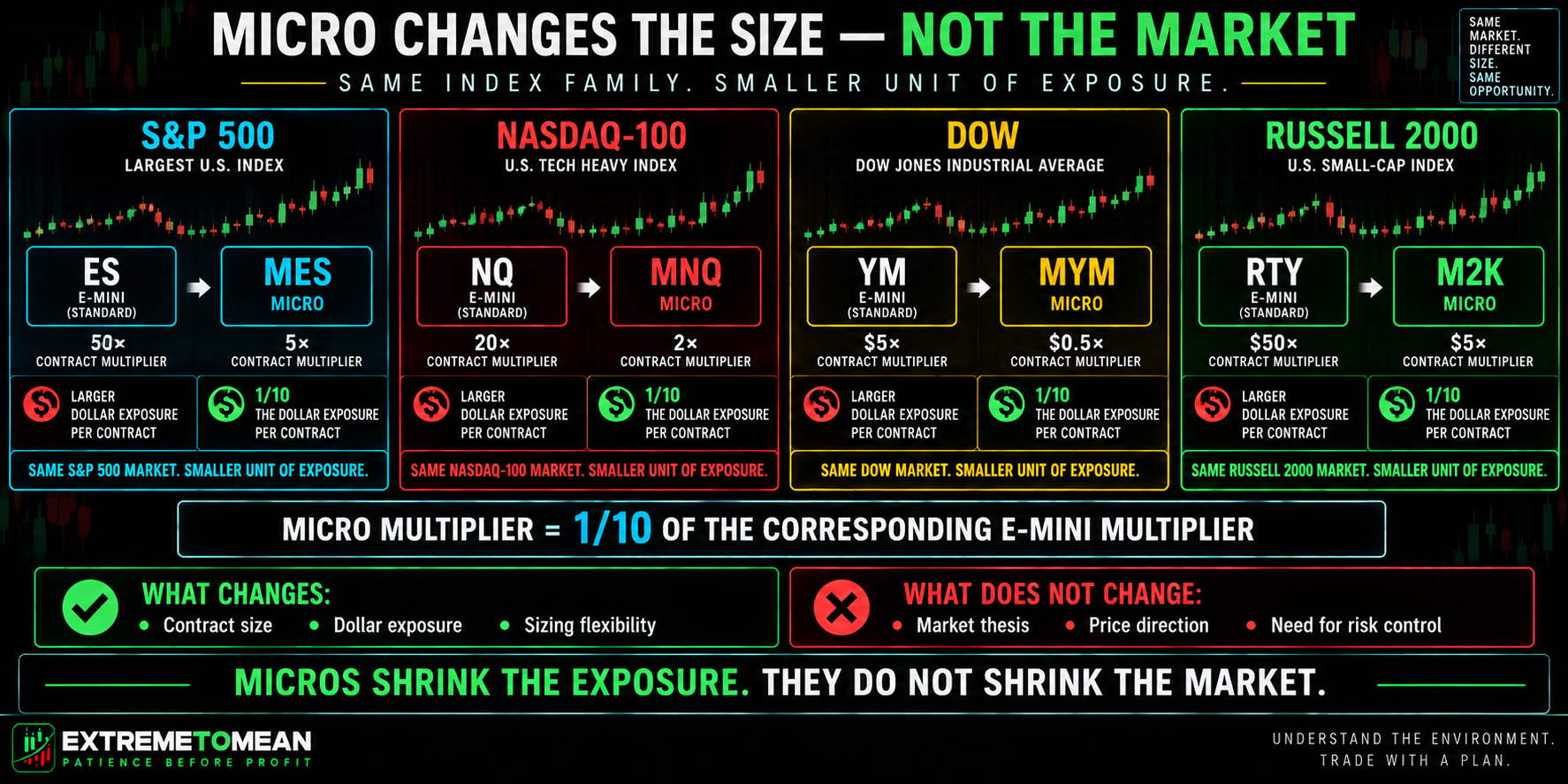
For the four contract families covered here, the Micro contract uses one-tenth the multiplier of its corresponding E-mini contract. That means the same index move produces one-tenth the dollar change per Micro contract compared with one corresponding E-mini contract, before commissions, fees, and execution effects. “Micro” describes the size of the contract, not the importance or speed of the market movement.
That distinction prevents a common beginner mistake. MNQ does not represent a calmer Nasdaq market than NQ, and MES does not represent a different S&P 500 market from ES. The Micro changes the size of your participation, not the market you are trying to trade.
Meet the Four Main Equity-Index Micros
These four contracts give smaller exposure to four U.S. equity indexes. They belong to corresponding E-mini families, but the underlying indexes are not interchangeable. Choosing MES instead of MNQ is therefore both a market-selection and contract-size decision.
| Micro | Tracks | Larger Counterpart |
|---|---|---|
| MES | S&P 500 | ES |
| MNQ | Nasdaq-100 | NQ |
| MYM | Dow Jones Industrial Average | YM |
| M2K | Russell 2000 | RTY |
MES is the Micro E-mini S&P 500 contract, while MNQ is the Micro E-mini Nasdaq-100 contract. MYM provides smaller Dow futures exposure, and M2K provides smaller Russell 2000 exposure. If those symbols still look like alphabet soup, the lesson on futures contract symbols explains how the product root and expiration identify the exact contract.
The important point is not to memorize eight tickers and stop there. Each pair gives access to the same underlying index family at two different contract sizes, while the different index families can still behave differently from one another. First understand the market you want to trade, then decide which contract size fits the risk.
Smaller Contract Does Not Mean Smaller Market Movement
A sharp move in NQ is still a sharp Nasdaq-100 move when viewed through MNQ. The Micro does not slow the chart, reduce volatility in the underlying index, or make a poor entry less poor. It simply changes how much one contract translates that movement into account P&L.
Micro futures are still leveraged futures contracts, so smaller does not mean safe. Ten Micros are designed to approximate the gross multiplier exposure of one corresponding E-mini, but commissions, fees, liquidity, and execution can differ. Small contracts do not protect traders who use large quantities.
Why Micros Matter for Position Sizing
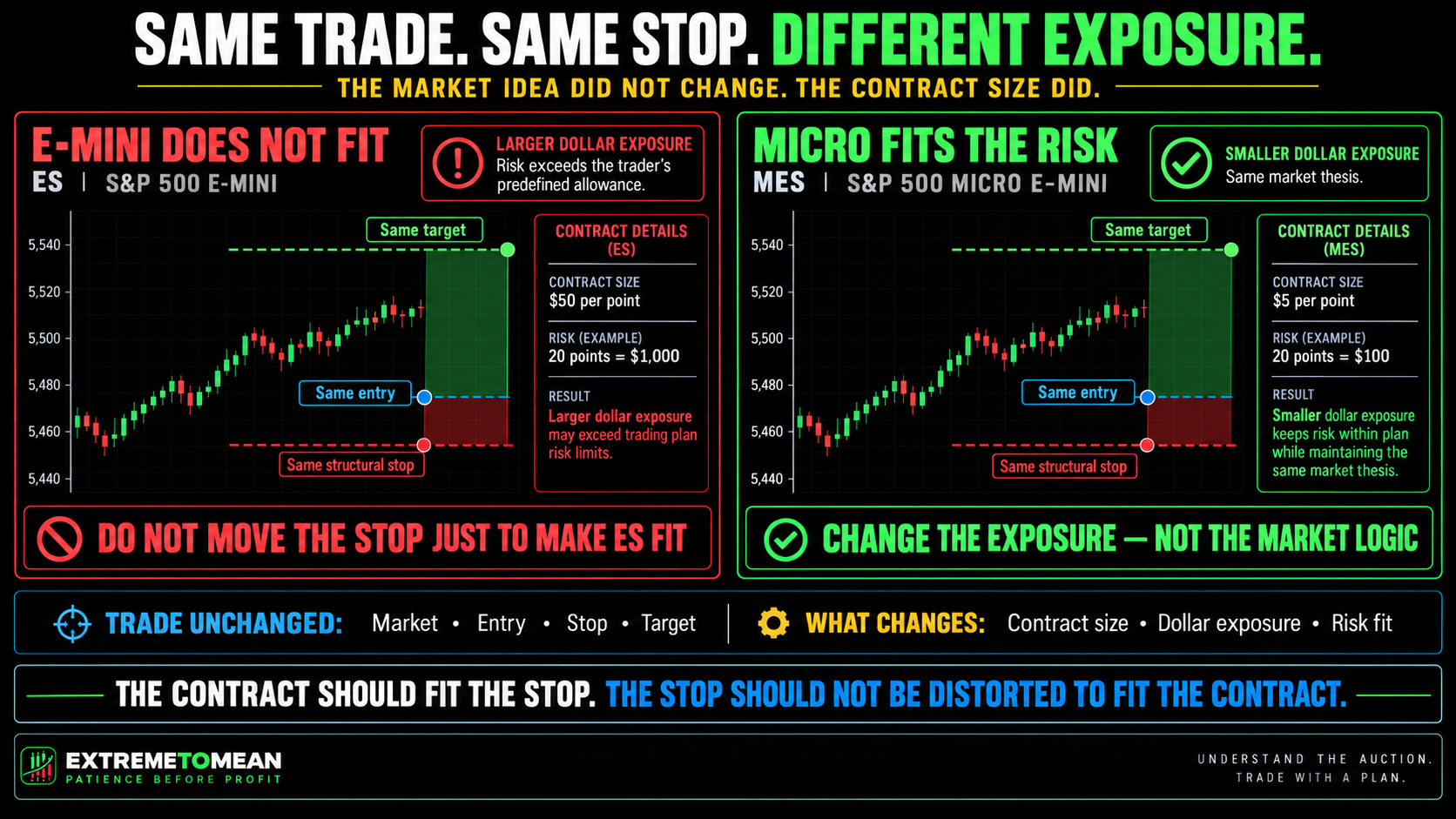
The practical value of Micro futures becomes clearest when a valid stop creates too much dollar risk in the larger contract. Suppose the market structure says the trade is wrong at a certain level, but one E-mini at that stop would exceed the trader’s allowed risk. The wrong solution is to squeeze the stop closer simply to preserve the larger contract.
A Micro may let the trader keep the technically correct invalidation while reducing the exposure. That is why the contract should fit the stop rather than the stop being distorted to fit the contract. The deeper calculation belongs in futures position sizing, but the principle is simple: define the trade first and let contract size become an output.
This finer sizing is often called risk granularity. Instead of an all-or-nothing jump into one E-mini, Micros let the trader adjust exposure in smaller steps. That makes contract size more like a dial than an on/off switch.
Margin Is Not the Same as Trade Risk
Because Micro contracts are smaller, a broker may require less margin to hold them than the corresponding E-mini. That can make the position easier to open, but the amount required to open a trade is not the same as the amount the trade can lose. Margin answers whether the position is permitted; the risk plan answers whether the position is appropriate.
Planned trade risk comes from the distance between entry and invalidation, the contract multiplier, and the number of contracts, with execution costs and slippage also capable of affecting the final result. A platform allowing several contracts does not mean several contracts fit the account. Broker capacity is not risk capacity.
In personal or prop accounts, smaller contracts can create more room to size carefully or introduce meaningful exposure gradually after simulation. They do not create permission to ignore the same risk limits that govern any other leveraged position. Smaller exposure is a tool, not an exemption.
Choose the Market First, Then Choose the Size
Beginners sometimes ask whether MES or MNQ is “safer” because both are Micros. That skips the first decision, because MES tracks the S&P 500 while MNQ tracks the Nasdaq-100, and those markets can produce different trading conditions. The contract-size label does not erase the difference between the underlying indexes.
A cleaner sequence is market first, contract size second. Decide which index-futures market fits the strategy and current conditions, then decide whether the E-mini or Micro version expresses the trade at an appropriate exposure. The broader comparison in Best Futures for Day Trading can help with the first question.
This also explains why experienced traders may choose Micros. MES, MNQ, MYM, and M2K are not training wheels that a trader must eventually abandon. The goal is not to graduate to the largest contract; the goal is to use the contract that fits the trade and the risk.
Price Can Be Linked While Order Flow Stays Contract-Specific
An E-mini and its Micro counterpart are closely linked because they represent related exposure to the same underlying index, which is why their price charts can look extremely similar. But ES volume is not MES volume, and NQ order-book activity is not MNQ order-book activity; each listed contract has its own traded volume, depth, and execution conditions. Traders using order-flow tools need to know which contract’s activity they are actually studying.
Costs matter as well. Several Micros may provide better sizing flexibility while also creating more per-contract commissions or fees, depending on the broker and platform. Compare the total trading economics, not just the contract multiplier.
A Practical Micro-Futures Decision Framework
Micro futures are most useful when they come near the end of the decision instead of the beginning. Do not start with “How many MNQ can I trade?” Start with the market, the setup, and the risk that the trade actually requires.
- Choose the market: Which index-futures market fits the strategy and conditions?
- Define the trade: Identify entry, invalidation, target, and required stop distance.
- Measure the exposure: Understand what one contract means over that stop distance.
- Compare it with the risk plan: Does one E-mini create too much exposure?
- Use the smaller contract if needed: A Micro may preserve the correct stop at lower exposure.
- Check total quantity: Several Micros can quickly become a large position.
- Include trading costs: Commissions, fees, spread, and execution still matter.
- Require a qualified setup: Smaller exposure never lowers the standard for taking the trade.
The workflow is Market → Setup → Stop → Dollar Risk → Contract → Quantity → Execution. That sequence keeps the market responsible for defining the trade and the risk plan responsible for defining the exposure. It is much cleaner than choosing a contract count first and forcing the rest of the trade to fit around it.
Smaller Contracts Do Not Fix Bad Trading
Micros can solve a sizing problem, but they cannot repair a weak setup, poor location, revenge trading, overtrading, or a strategy with no demonstrated edge. Repeated small losses are still losses, and lower dollar exposure does not transform poor decisions into good ones. Micros can reduce the size of a mistake; they do not turn the mistake into a qualified trade.
The smaller numbers can even create a behavioral trap. A trader may take more mediocre setups because each individual loss feels affordable, then discover that many unnecessary trades create meaningful total damage. Use Micros to make qualified trades fit the risk plan, not to make random trading feel cheaper.
A useful better question is: Which contract lets this qualified trade keep its correct invalidation and still fit my risk plan? That question puts market choice, structure, and risk ahead of contract ego. It also keeps the trader focused on evaluate → qualify → define risk → decide.
Final Thought
Micro futures are valuable because they give traders more control over the size of their participation. MES, MNQ, MYM, and M2K provide smaller units of exposure within the S&P 500, Nasdaq-100, Dow, and Russell 2000 futures families, making it easier to adjust size without changing the underlying market thesis. That flexibility matters only when it supports a defined process.
The objective is not to trade the biggest contract your platform allows or to prove that you have graduated beyond Micros. Choose the market for the strategy, define where the trade is wrong, and choose the contract size that lets the exposure fit the risk. For the broader decision process that connects structure, patience, and risk, continue with the Extreme to Mean system.
Educational content only. Trading involves substantial risk and is not suitable for everyone.