
Inside The Setup, multiple timeframes should organize one trade thesis rather than create several competing ones. A bullish hourly market, a bearish five-minute pullback, and a one-minute bounce can all exist together without contradiction. Different timeframes do not need to look the same; they need to tell a coherent story about the trade you are actually planning.
Confusion begins when every chart gets another vote. A five-minute setup looks good, the one-minute turns bearish, the 15-minute remains bullish, and the trader opens another timeframe hoping it will settle the argument. The problem is usually not that the timeframes disagree; it is that the trader never decided what each timeframe was supposed to tell them.
What a Timeframe Actually Changes
A candlestick timeframe changes how the same market activity is grouped and displayed. A five-minute bar compresses five minutes of trading, while an hourly bar compresses much more activity, so each chart emphasizes a different layer of movement. Different timeframes can show different directions because they are describing different layers of the same market.
An hourly uptrend can therefore coexist with a bearish five-minute retracement. That does not make the higher timeframe automatically “more correct,” because usefulness depends on the question being asked. A timeframe becomes valuable because it is relevant to the trade—not because it has the largest number on the button.
Give Each Timeframe One Job
A cleaner approach is to assign three functional roles instead of memorizing one supposedly ideal chart combination. “Higher,” “trading,” and “lower” are relative jobs, so the same interval can serve different roles in different strategies. The role matters more than the exact chart setting.
| Timeframe Role | Primary Job | Main Question |
|---|---|---|
| Higher timeframe | Environment / context | What larger market am I trading inside? |
| Trading timeframe | Setup / decision structure | Is my actual trade setup present? |
| Lower timeframe | Optional timing / refinement | Is there useful detail that improves execution without changing the thesis? |
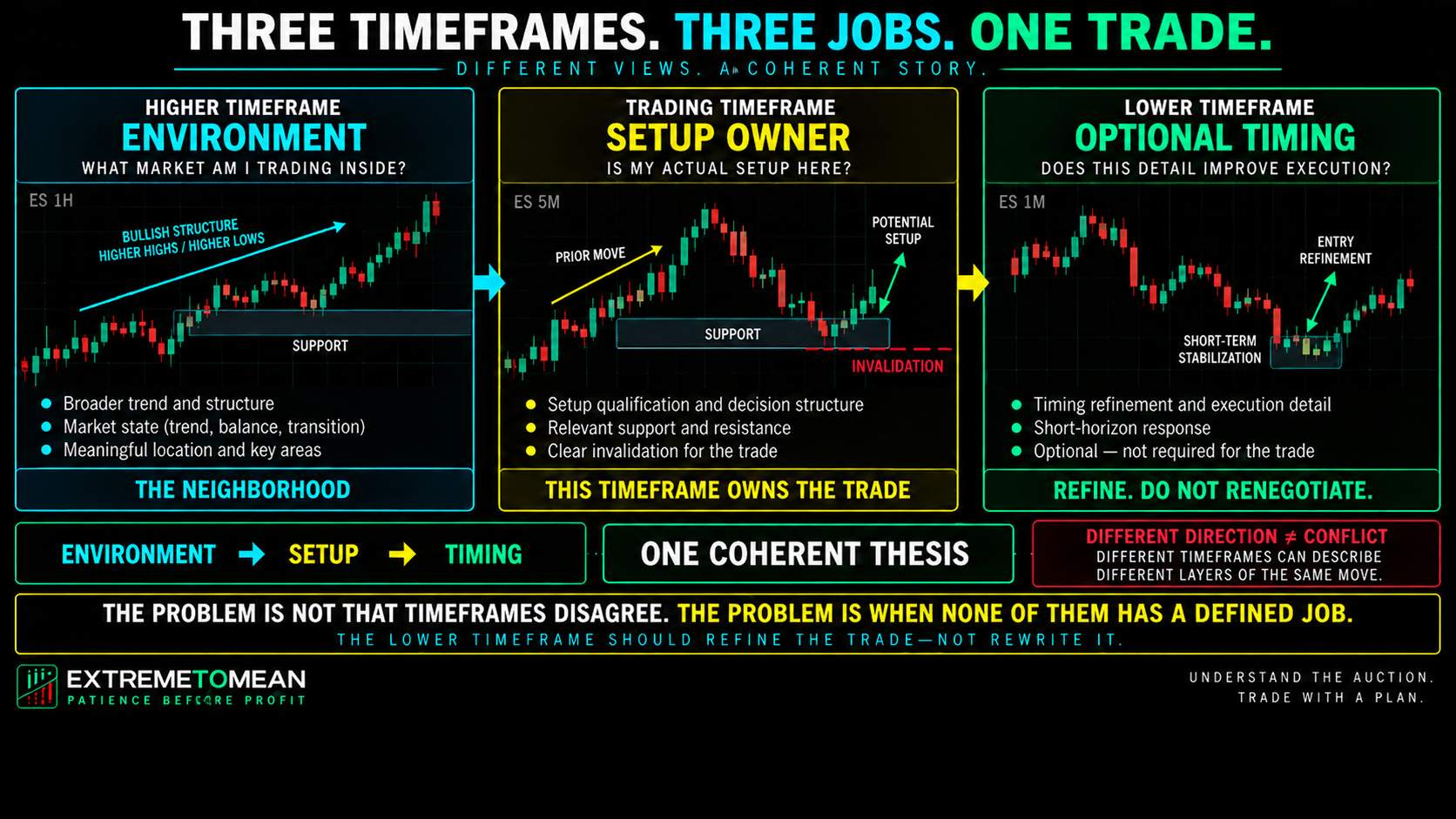
The higher timeframe gives the trade a neighborhood. It can show broader direction, market state, important areas, or larger balance, but it should not command every lower-timeframe trade. A bullish hourly chart does not make every five-minute long good or every short forbidden.
The trading timeframe owns the actual setup. It should generally define whether the setup exists, which structure matters, what qualifies the idea, and where that idea becomes invalid. One timeframe needs to own the trade; otherwise every new candle gets a chance to rewrite the plan.
The lower timeframe is optional. It can refine timing or reveal useful short-horizon detail near an already meaningful location, but it should not manufacture a setup the trading timeframe never produced. The lower timeframe should refine the trade, not renegotiate it.
More Detail Can Create False Precision
Zooming in feels useful because more candles create more information. A clean five-minute setup can become a maze of one-minute swings, tiny breaks, and short-lived reversals, making the trader feel more precise while becoming less certain about the original trade. Zooming in gives you more detail; it does not guarantee that the extra detail belongs in the decision.
This becomes dangerous when the higher-level setup is weak. Granular price action can always produce another pattern, which is why a setup is not a signal. A lower-timeframe signal cannot turn a higher-level non-opportunity into a good trade.
The same problem appears as confirmation overload. If the setup already meets the rules on the timeframe that owns it, dropping lower simply to find reassurance can delay or cancel a qualified trade. The broader lesson from trading confirmation still applies: another chart helps only when it answers a question the strategy actually needs answered.
Different Direction Does Not Mean Conflict
Imagine a bullish 30-minute environment while a five-minute chart pulls back and a one-minute chart begins stabilizing near support. Those charts can describe one coherent sequence: larger bullish environment, temporary bearish retracement, then short-horizon resumption. Different direction does not automatically mean conflicting information.
A lower-timeframe reversal can therefore be nothing more than a higher-timeframe pullback, which connects directly to continuation versus reversal. Actual conflict appears when the trade requires incompatible assumptions—for example, a 15-minute trend must continue higher while a five-minute bearish move must continue lower for the same thesis. Timeframes conflict when the trade requires incompatible things to remain true—not merely when the candles point in different directions.
Stop Treating Timeframes Like Votes
Asking every chart “bullish or bearish?” creates timeframe democracy. Daily bullish, hourly bullish, 15-minute bearish, and five-minute bullish can become a three-to-one vote to buy even though those charts are related views of the same market rather than independent evidence. Five bullish timeframes are not five independent markets agreeing with you.
Perfect alignment can also arrive late, after price has extended toward resistance and away from useful invalidation. The better question is whether each chart performs its assigned job without breaking the thesis, not how many charts share the same color. Let context flow down through the timeframes; be careful about letting noise flow back up.
Timeframe Shopping and Timeframe Drift
Timeframe shopping happens when the trader wants a position first and searches charts until one justifies it. The five-minute chart does not support the long, the 15-minute is unclear, but the hourly contains an old bullish area, so the trader suddenly calls the trade “higher-timeframe confirmed.” Choose the timeframe roles before the trade appears; do not keep changing charts until one gives you permission.
Timeframe drift begins after entry when authority changes because the trade becomes uncomfortable. A five-minute setup invalidates, but the trader points to the hourly trend and decides to give the position more room, silently replacing the original thesis with a larger one. The more uncomfortable the trade becomes, the more important it is to remember which timeframe had authority before money was at risk.
Keep Entry, Invalidation, and Target Coherent
If the trading timeframe owns the setup, its meaningful structure should generally determine what proves that setup wrong. A lower timeframe may refine execution, but choosing a tiny micro-structure stop simply because it creates a smaller distance can make the stop belong to a different thesis. Your stop should belong to the trade you entered—not whichever timeframe gives you the stop you prefer.
Targets require the same coherence. Borrowing a lower-timeframe stop and a much larger-timeframe target can manufacture an impressive reward-to-risk ratio even though the two numbers belong to different market assumptions. Entry, invalidation, and target should speak the same timeframe language.
How Many Timeframes Do You Actually Need?
Not every process needs three charts. For many strategies, a higher timeframe plus the trading timeframe may be enough, while a lower timeframe earns a role only if it consistently improves execution. More timeframes are useful only when they add information the strategy actually needs.
One timeframe can sometimes be enough if the strategy was designed and tested to contain the context it requires. Holding period and volatility influence useful chart intervals, but they do not create a universal formula for scalpers, day traders, or swing traders. The goal is the minimum number of views that reliably answer the strategy's questions.
The ETM Multiple-Timeframe Workflow
Use Strategy → Trading Timeframe → Higher-Timeframe Question → Optional Lower-Timeframe Question → Coherence → Authority → Risk Structure → Review. The workflow defines the trade first, then assigns each timeframe a job before live pressure creates a reason to change those jobs. Timeframes should be part of strategy design—not part of real-time negotiation.
- Strategy: What market behavior am I actually trying to trade?
- Trading Timeframe: Which chart owns the setup, qualification, and invalidation?
- Higher-Timeframe Question: What specific environment or location information do I need?
- Optional Lower-Timeframe Question: Does a smaller chart add useful timing information, or only more noise?
- Coherence: Can the different timeframe directions still fit one trade thesis?
- Authority: Which timeframe controls whether the original trade remains valid?
- Risk Structure: Do entry, invalidation, and target belong to the same thesis?
- Review: After enough trades, does every timeframe materially improve the process?
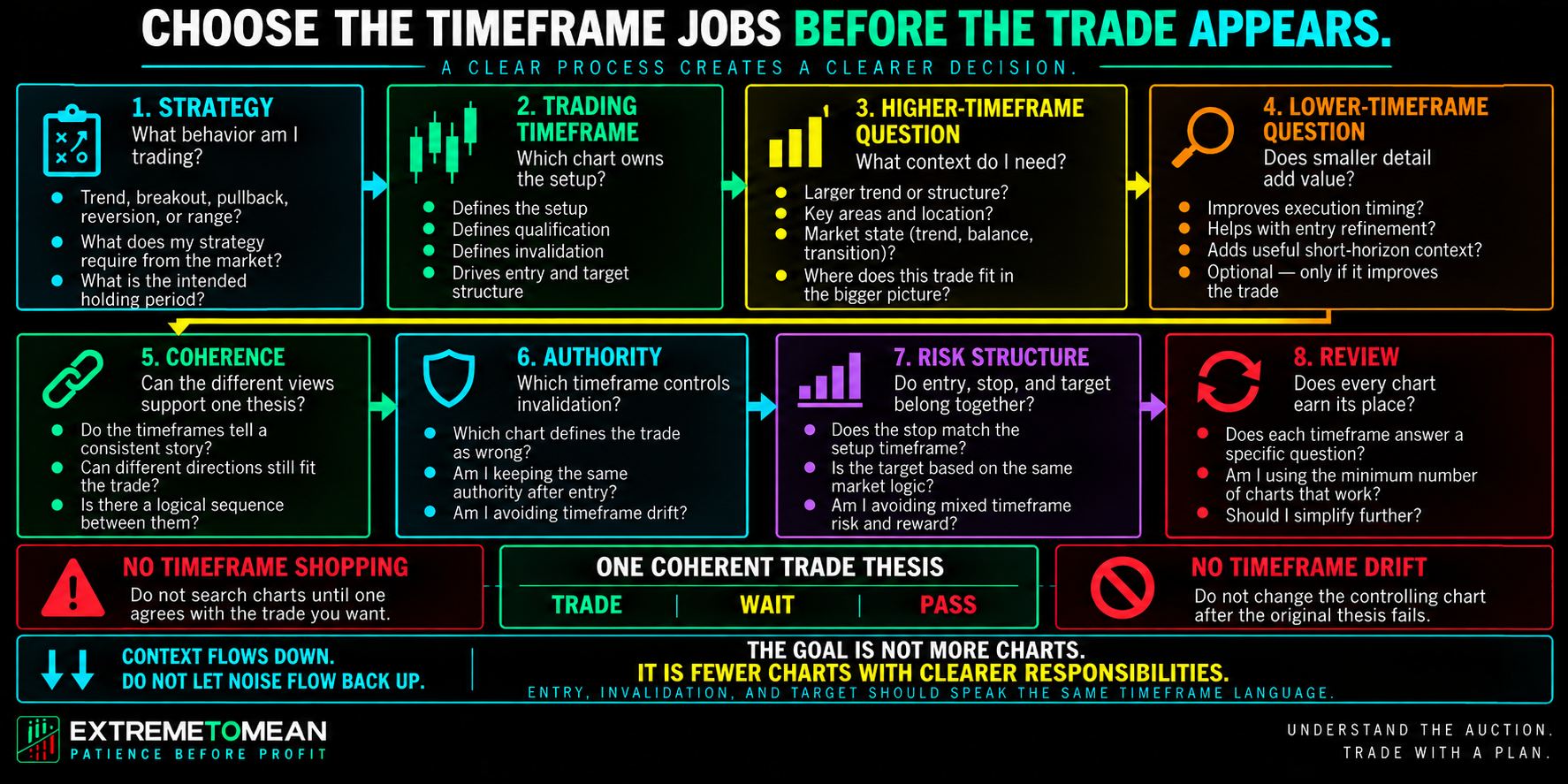
A useful shortcut is to ask three role-specific questions: What market am I trading inside? Is my setup actually here? Is there any lower-timeframe information I genuinely need before acting? Then ask one final question across the stack: Do these views support one coherent trade thesis? That is more useful than requiring every chart to agree.
Sometimes the charts are organized correctly and the market itself is still unclear. A transitioning higher timeframe, unstable trading-timeframe structure, and rapidly flipping lower-timeframe action may be accurate evidence that current market conditions are not worth trading for the strategy. The correct response is not always another timeframe; sometimes it is simply to wait.
Final Thought
Multiple-timeframe analysis is not an alignment contest. The higher timeframe can provide environment, the trading timeframe can own the setup, and a lower timeframe can refine timing when it adds value without requiring every chart to point in the same direction. Different views are useful because they show different layers of one market.
Choose those roles before the trade appears and keep them stable while risk is live. Do not shop for a chart that agrees with the trade you want, let micro-noise veto a setup it was never assigned to judge, or move to a larger timeframe after invalidation simply to keep the position alive. Fewer charts with clearer responsibilities usually create a more coherent decision than more charts with equal authority.
The goal is not to see the market from every possible angle. It is to see enough angles to make one coherent decision, with context, setup, timing, invalidation, and target serving the same thesis. That process-first discipline is part of what we develop throughout The Patience Principle.
A multi-session idea needs the higher-timeframe story to remain connected to risk, catalysts, and available room. Build a simple swing trading checklist to carry those questions into a complete trade plan.
Educational content only. Trading involves substantial risk and is not suitable for everyone.