
Inside The Market, contract selection should come after the trader understands which market they want to trade. If Nasdaq-100 exposure fits the strategy, the next question is whether the E-mini NQ or Micro E-mini MNQ expresses that idea at an appropriate dollar size. Choose Nasdaq because the market fits the strategy; choose NQ or MNQ because the contract fits the risk.
The mistake is treating contract size as a skill level. MNQ is not training wheels, NQ is not a promotion, and switching tickers does not improve a setup. Contract size is a risk decision—not a status symbol.
NQ vs. MNQ: The Short Answer
NQ and MNQ both provide futures exposure to the Nasdaq-100. CME currently specifies NQ at $20 × the Nasdaq-100 Index and MNQ at $2 × the Nasdaq-100 Index, making NQ ten times the contract size of MNQ. Both use a 0.25-point minimum tick for outright futures. (cmegroup.com)
| Specification | NQ | MNQ |
|---|---|---|
| Contract | E-mini Nasdaq-100 | Micro E-mini Nasdaq-100 |
| Underlying | Nasdaq-100 | Nasdaq-100 |
| Multiplier | $20 × index | $2 × index |
| Minimum tick | 0.25 point | 0.25 point |
| Tick value | $5.00 | $0.50 |
| 1 full point | $20 | $2 |
| Relative size | 10× MNQ | 1/10 NQ |
That produces the simplest comparison in the article: same quarter-point movement, ten times the dollar result. If Nasdaq-100 futures move 100 points, one NQ changes by $2,000 while one MNQ changes by $200 before fees and execution effects. Ten MNQ therefore approximate one NQ in multiplier exposure.
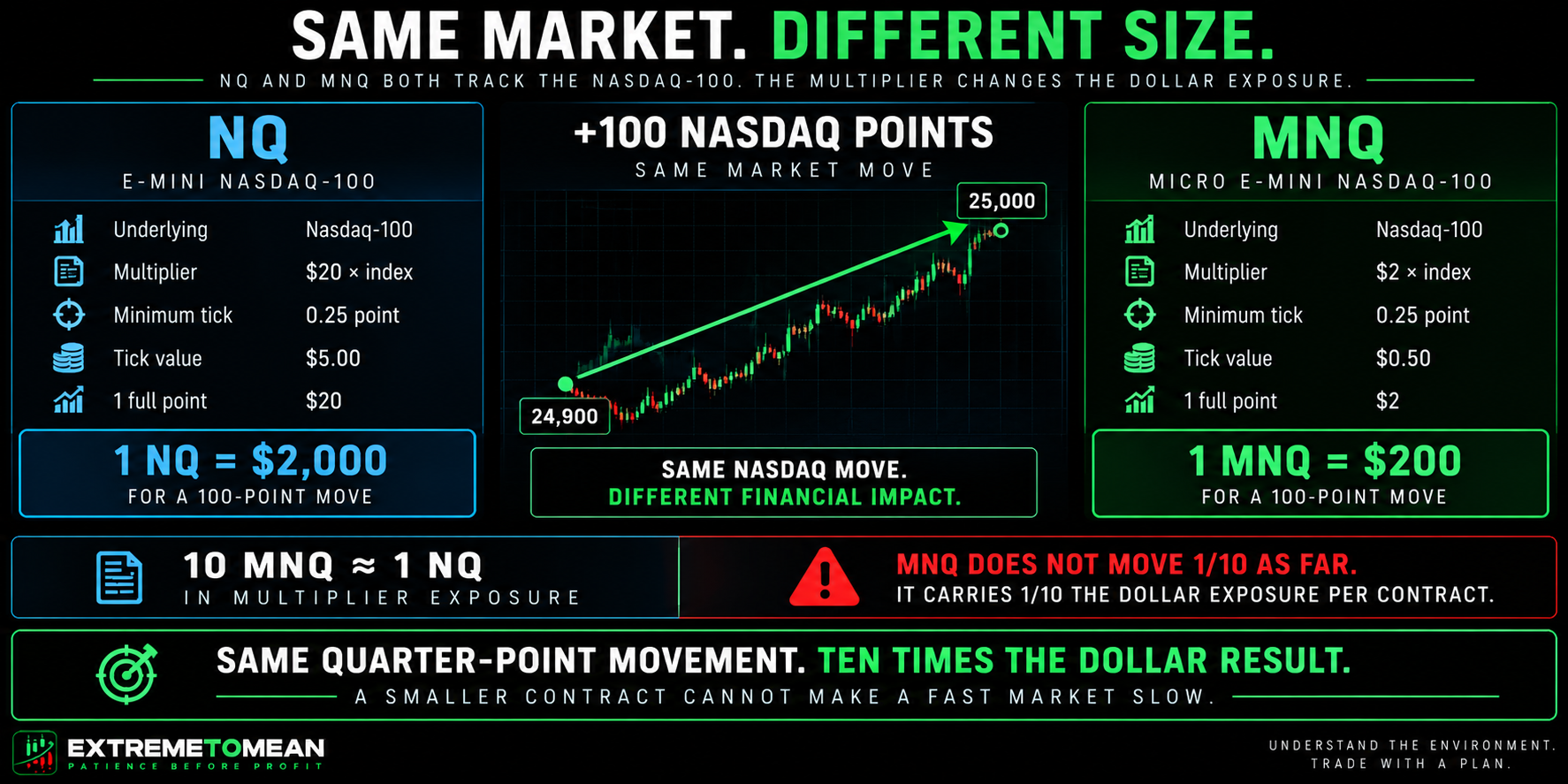
Same Nasdaq Market Does Not Mean the Same Contract
NQ is the E-mini Nasdaq-100 futures contract and MNQ is the Micro E-mini Nasdaq-100 futures contract. Both reference the Nasdaq-100 rather than the broader Nasdaq Composite, so a 75-point Nasdaq-100 move is still approximately a 75-point market move whether the trader uses NQ or MNQ. MNQ divides the dollar exposure by ten; it does not divide the market move by ten.
The contracts are still separate instruments. They have their own trades, volume, order books, bid/ask queues, and potentially slightly different last-traded prices even though their common underlying keeps them closely related. They follow the same index, but your NQ order is not sitting in the MNQ queue.
That distinction matters when testing or executing a strategy. The underlying setup may transfer because NQ and MNQ reflect the same Nasdaq-100 market, but spread, slippage, queue position, and fill behavior still belong to the contract actually traded. Backtest the market behavior—and validate the contract you actually intend to execute.
The Dollar Math Changes Fast
For one NQ, every full Nasdaq point is worth $20 and every quarter-point tick is worth $5. A 10-point move is $200, 25 points is $500, 50 points is $1,000, and 100 points is $2,000 per contract. The multiplier works in both directions.
For one MNQ, every point is worth $2 and every quarter-point tick is worth $0.50. A 10-point move is $20, 25 points is $50, 50 points is $100, and 100 points is $200 per contract. A smaller contract cannot make a fast market slow; it only reduces the dollars attached to the movement. (cmegroup.com)
The small tick value can create false comfort. One hundred Nasdaq points equals 400 quarter-point ticks, so even $0.50 per tick becomes $200 on one MNQ, and ten MNQ bring that same move back to roughly $2,000. Micro describes the contract—not the total position you build with it.
Stop Distance Often Answers the Question for You
The strongest reason to choose between NQ and MNQ is usually not preference; it is the stop required by the actual trade. The futures position-sizing process begins with invalidation and stop distance, converts that distance into dollars per contract, and only then determines quantity. Contract choice should respect that order.
Suppose a Nasdaq setup requires a 25-point structural stop. One NQ represents $500 of planned price risk before costs, while one MNQ represents $50; if the maximum planned risk is $200, one NQ simply does not fit, while four MNQ represent $200. Sometimes the NQ-vs.-MNQ decision is already answered by the stop.
The wrong response would be to pull the valid stop from 25 points to 10 simply so one NQ fits the budget. If that tighter stop no longer represents where the trade is wrong, the contract has started dictating the market logic. Do not change the trade so NQ fits; change the contract size so the trade fits.
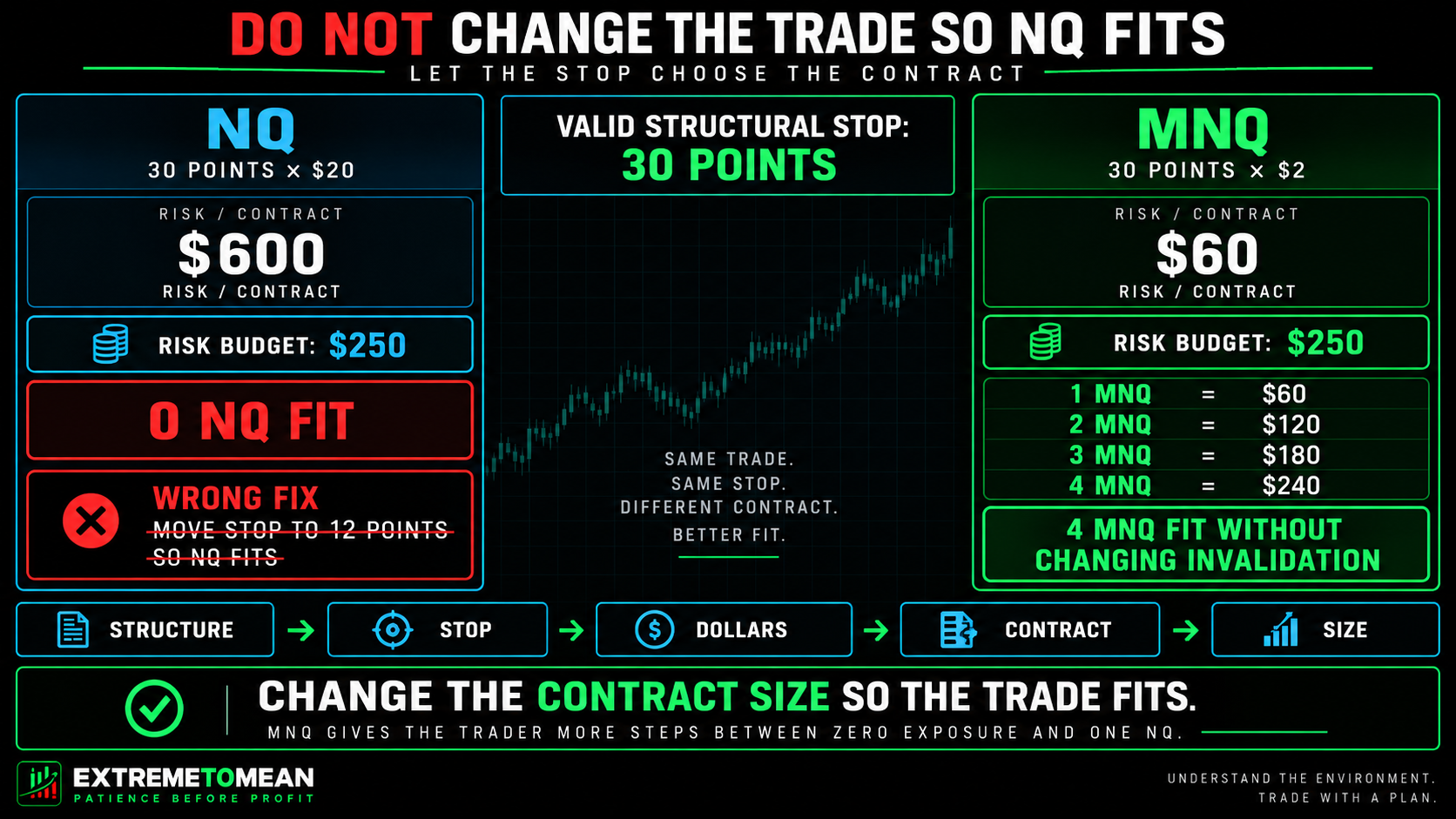
MNQ Gives the Trader Finer Sizing Steps
Every additional NQ changes exposure by another $20 per Nasdaq point, while each MNQ changes exposure by $2 per point. That gives MNQ ten times finer multiplier granularity, which matters when appropriate exposure sits between zero and one NQ. A trader who needs roughly $6 per point can use three MNQ; there is no 0.3 NQ contract.
That flexibility can also create more management units. Three MNQ can be reduced one contract at a time, while one NQ is effectively all in or all out unless another contract is added. A smaller contract can create more management flexibility without automatically creating more total risk.
More units can become a behavioral problem if flexibility turns into constant intervention. Additional contracts provide more opportunities to scale, move targets, take unnecessary partials, or micromanage every fluctuation. More sizing precision is useful only if precision does not become constant intervention.
Costs, Liquidity, and Execution Still Matter
Ten MNQ approximate the multiplier exposure of one NQ, but they are not necessarily economically identical after costs. Commissions, exchange fees, clearing charges, and other expenses are commonly assessed per contract, so entering and exiting ten Micros can cost more than one E-mini with similar gross exposure. Ten times smaller exposure per contract does not mean ten contracts are identical to one NQ after fees.
That does not automatically make NQ the better choice. If MNQ reduces a trade from unacceptable risk to an amount that fits the plan, sizing precision may matter far more than the additional per-contract expense. Conversely, someone consistently needing one NQ-equivalent may find a single NQ simpler and more cost-efficient.
Liquidity also needs to be evaluated inside the actual contract. CME describes NQ as its liquid E-mini Nasdaq-100 benchmark and MNQ as the smaller-sized version, but spread, depth, volume, and queue conditions do not have to scale at exactly ten to one. Contract size scales mechanically; order-book liquidity does not have to. (cmegroup.com)
Slippage can occur in both contracts, particularly during fast news or unstable liquidity. If an exit occurs five points beyond the intended level, that difference is $100 per NQ versus $10 per MNQ, so the smaller contract reduces the dollar consequence without eliminating the execution issue. A Micro contract does not turn an FOMC market into a Micro event.
Margin Is Access, Not Risk
MNQ generally requires less margin than NQ because its multiplier and notional exposure are smaller, but actual margin requirements can change with volatility, exchange rules, broker policy, and whether the position is intraday or overnight. The broader lesson on what margin actually means matters because the quantity a broker permits is not automatically an appropriate position. Lower margin makes MNQ easier to access; it does not tell you how much MNQ you should trade.
Stacking Micros can quickly rebuild substantial exposure. Twenty MNQ equal $40 per Nasdaq point, roughly the multiplier exposure of two NQ; with a 40-point stop, that represents $1,600 of planned price risk before costs. Small margin can hide large aggregate exposure when Micros are stacked.
Notional exposure tells a similar story. At a hypothetical Nasdaq-100 level of 25,000, one NQ controls about $500,000 of notional exposure while one MNQ represents about $50,000, even though the margin deposit is far smaller than either figure. Micros make leverage more divisible; they do not make leverage harmless.
NQ and MNQ also remain futures contracts with specific expirations. Both use the familiar quarterly equity-index cycle, and the root symbols NQ and MNQ identify the product family rather than the complete contract month and year. The futures contract-symbol lesson explains that distinction in detail. (cmegroup.com)
Contract Size Can Change the Trading Experience
A 50-point Nasdaq move represents $1,000 on one NQ and $100 on one MNQ. The technical setup can be identical, yet the trader may experience the position very differently through open P&L, drawdown, hesitation, premature profit-taking, or stop movement. The smaller contract does not improve the setup; it may improve the trader's ability to execute the setup correctly.
This is why moving from MNQ to NQ should not be treated as graduation. A disciplined trader whose position size already fits the strategy, risk, and psychology does not become more legitimate by multiplying the dollar swings by ten. Trading larger is not evidence of trading better.
The reverse trap matters too. Someone may choose MNQ specifically to reduce financial pressure, then continue adding contracts until ten or twenty Micros recreate the exposure that caused the pressure in the first place. If you use Micros to reduce pressure and then stack them until the pressure returns, you solved the math and recreated the behavior problem.
For a smaller account or newer trader, MNQ can provide finer risk increments, but that does not make it automatically safe. Experienced traders may also prefer MNQ when volatility is elevated, structural stops are wide, or several smaller management units are useful. Experience should improve sizing decisions—not automatically increase contract size.
A Practical NQ-vs.-MNQ Decision Framework
Use Market → Stop → Dollars → Contract → Size → Costs → Behavior → Fit. The sequence assumes the trader has already decided Nasdaq exposure fits the strategy; if that choice is still uncertain, the broader guide to choosing futures for day trading should come first. The NQ-versus-MNQ decision is then about expressing that market at an appropriate size.
- Market: Do I actually want Nasdaq-100 exposure?
- Stop: Where is this specific trade structurally wrong?
- Dollars: What does that stop mean at $20 per NQ point and $2 per MNQ point?
- Contract: Does one NQ fit the risk budget, or is MNQ required?
- Size: How many whole contracts stay within planned risk?
- Costs: Do additional Micro contracts materially change the economics?
- Behavior: Can I follow the strategy without dollar P&L changing my decisions?
- Fit: Which contract gives the best combination of risk precision, execution, and discipline?
The better question is not “Am I ready to graduate to NQ?” Ask, “Which contract lets this exact Nasdaq trade fit its structural stop, my risk budget, and my ability to follow the plan?” Choose the contract after you know the risk—not before you know the trade.
One current-product note keeps the comparison accurate in 2026. MNQ remains the Micro E-mini version of NQ, but CME now also lists E-nano Nasdaq-100 futures at $0.20 per index point, one-tenth the MNQ multiplier, so MNQ should no longer be described as the smallest Nasdaq-100 futures contract. That newer product does not change the NQ-versus-MNQ decision at the center of this lesson. (cmegroup.com)
Final Thought
NQ and MNQ provide essentially the same Nasdaq-100 opportunity at very different levels of financial exposure. NQ is $20 per point and MNQ is $2 per point, so the same chart movement produces a ten-to-one difference in dollar impact. The contract that multiplies the winner also multiplies the mistake.
The better contract is therefore not the one with the larger profit potential per point. It is the one that lets the trader preserve the real stop, size exposure appropriately, account for costs, and experience normal Nasdaq volatility without P&L taking control of the decision. The setup should determine the risk requirement; the contract should help express it.
There is no requirement to graduate from MNQ to NQ, and there is no safety rule hidden inside the word Micro. Same market. Different size. Choose the size that lets the process survive the market. That principle—keeping size subordinate to process—is part of the broader discipline developed throughout The Patience Principle.
Educational content only. Trading involves substantial risk and is not suitable for everyone.