
Many traders describe themselves as impatient as if the problem is fixed inside their personality. That explanation may feel honest, but it also makes the problem seem difficult to change. In trading, impatience usually appears because the decision process is unclear, incomplete, or being created in real time. When a trader does not know exactly what must happen before entry, almost any movement can feel urgent enough to act on.
The broader lessons in The Trader category are built around this same idea: better decisions come from a better process, not from stronger emotions. Patience is part of that process because it creates space between seeing market movement and deciding that the movement deserves risk. The trader’s job is to evaluate, not react. That evaluation becomes easier when the rules are clear before the pressure begins.
Patience Is a Decision Process
Patience is often confused with simply waiting longer, but waiting by itself does not create a better decision. A trader can sit in front of a chart for an hour and still act impulsively when price begins moving. Active patience means knowing what evidence is still missing and refusing to act until the setup earns attention. It is a decision process with a reason behind the delay.
The article Why Patience Before Profit Is More Than a Tagline explains the same distinction. The phrase is not telling traders to become passive, emotionless, or endlessly cautious. It is a reminder that timing should come after qualification, not before it. Patience becomes practical when the trader can explain exactly what must appear before risk is considered.
Why Impatience Feels Reasonable
Impatience rarely feels reckless in the moment. It often feels like awareness, speed, confidence, or the ability to recognize an opportunity before everyone else. A sudden candle, a fast breakout, or a quick move away from a level can create the impression that hesitation will cause the trade to disappear. Acting early then feels like protecting an opportunity rather than abandoning discipline.
The weaker decision feels reasonable because the market creates immediate visual evidence while the trader’s rules may still be vague. Price is moving, volume may be increasing, and the screen appears to confirm that something important is happening. Without a clear qualification process, movement becomes the substitute for context. The trader reacts to what is loud instead of evaluating whether the location, structure, and risk are actually clear.
Patience Starts Before the Market Opens
A trader cannot expect to become patient in the middle of a fast move if no plan existed beforehand. This is why preparation gives active patience something to follow. It defines the market conditions, locations, setups, and risk boundaries that deserve attention before emotion begins shaping the story. Without that preparation, every decision must be invented while the market is already moving.
A trading plan is a promise made before the open because it records what the trader intends to respect when pressure is lower. The plan does not need to predict the market, and it should not force a trade. Its purpose is to separate acceptable conditions from everything else. When those conditions are written clearly, waiting is no longer vague because the trader knows what they are waiting for.
Define Conditions Before You Need Them
The first practical step is to turn patience into observable conditions. Instead of writing “be patient,” the trader can define a sequence such as location, structure, confirmation, and clear risk. A setup may earn attention because price has reached a meaningful area, but that does not mean the trade is qualified. Setup recognition and trade qualification are separate decisions.
A useful process asks what must be true at each stage before moving to the next one. The trader first evaluates context, then location, then the behavior of price around that location, and finally whether risk can be defined without forcing the idea. If one part is missing, the process pauses rather than inventing a reason to continue. The pause is not hesitation; it is the rule doing its job.
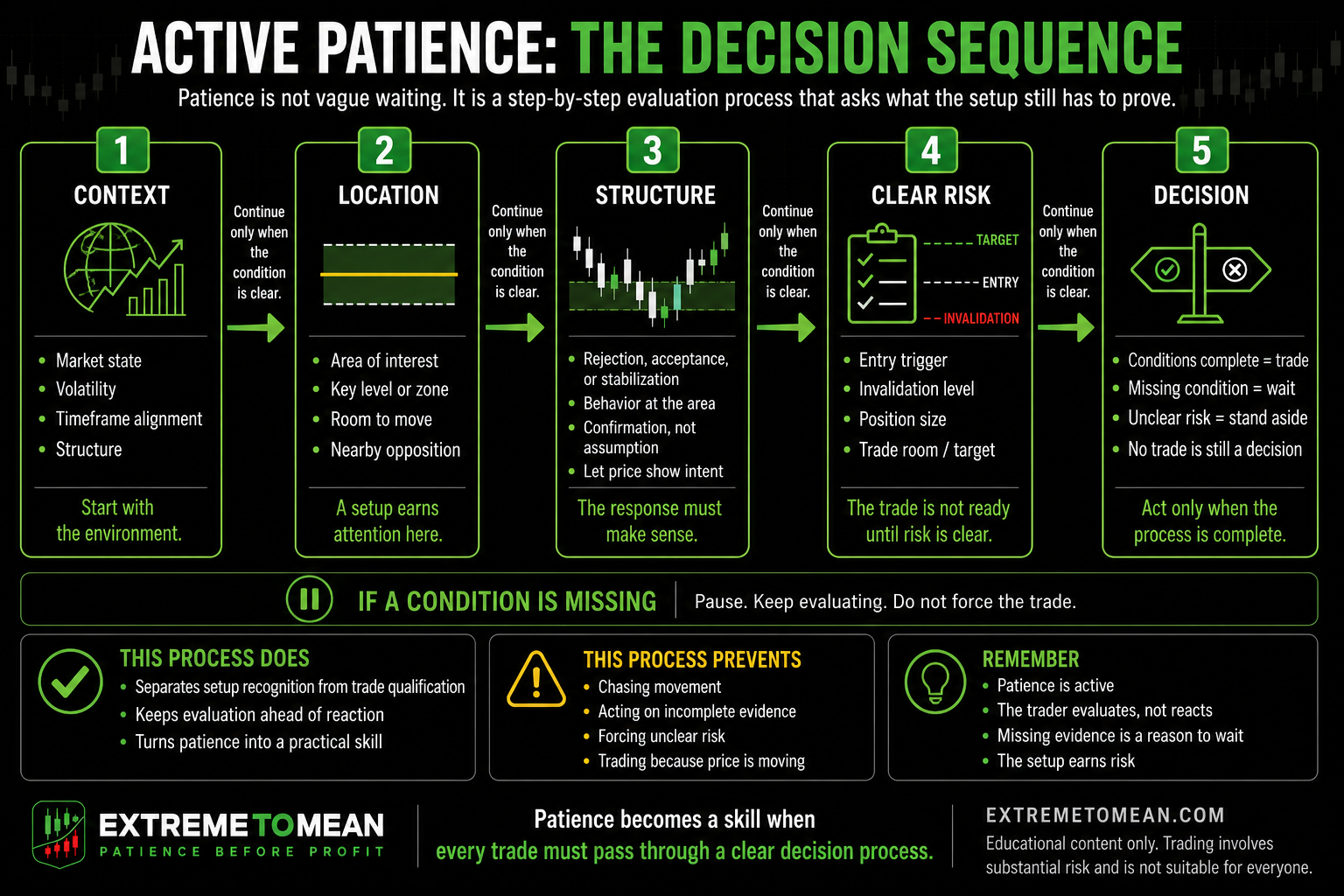
This sequence also prevents one attractive detail from carrying the entire decision. A trader may like the location but still lack structure, or may see a pattern without having enough room for the trade to develop. Active patience keeps the evaluation open until the important pieces align. The setup earns risk only after the trader can explain why the conditions are complete enough to act on.
Patience Is Not Passivity
Passivity means avoiding decisions, delaying necessary action, or watching without a process. Patience means staying engaged while waiting for the market to provide the required evidence. The patient trader is still observing context, updating levels, tracking volatility, and checking whether the original plan remains valid. Nothing about that work is passive.
This is why doing nothing can still be a trading decision. A deliberate no-trade decision can come from clear evaluation, while an impulsive entry can come from the absence of evaluation. The difference is not activity versus inactivity. The difference is whether the trader acted from defined conditions or from the discomfort of waiting.
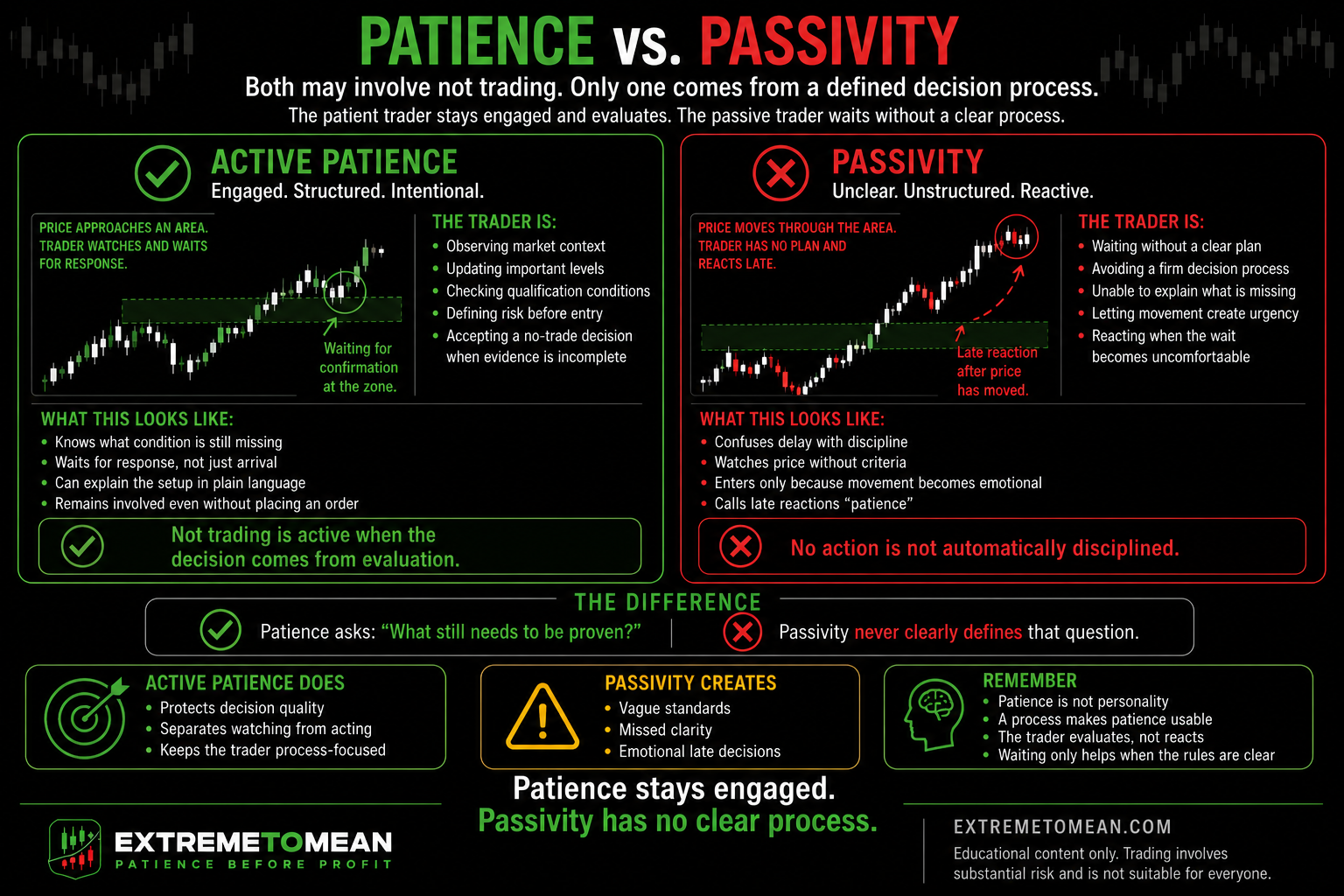
Patience also does not mean refusing to adapt. Market conditions can change, and a trader should remain flexible when new information changes the quality of the setup. Flexibility happens before entry by updating the plan as the evidence changes; changing the story after entry to defend a weak position is something different. Active patience allows the trader to adapt without abandoning the standards that define a qualified trade.
Structure Makes Patience Repeatable
Relying on willpower is one of the least dependable ways to manage impatience. Willpower changes with fatigue, stress, recent outcomes, and the speed of the market. Structure is more reliable because it reduces the number of decisions that must be made under pressure. A checklist, written plan, alert system, or predefined review sequence gives patience a repeatable form.
The goal is not to remove judgment from trading. The goal is to make judgment more consistent by evaluating the same important questions each time. A structured trader can still decide that a setup is unusual, incomplete, or no longer worth attention. What changes is that the decision comes from a stable process instead of whichever emotion is strongest in that moment.
Review the Waiting, Not Just the Trade
Most trade reviews focus on entries, exits, and outcomes, but patience should be reviewed before the order was ever placed. The trader should ask what was seen, what was still missing, and what finally triggered action. This reveals whether the decision followed the intended process or whether the trader acted mainly to escape uncertainty. It also shows whether the trader waited for evidence or merely waited for movement.
A strong review should also include the trades that were not taken. Those decisions may show that the trader protected the quality of the next decision by refusing unclear conditions. The lesson in protecting your next decision is especially useful here because one impulsive action can affect the thinking that follows. Reviewing patience helps the trader understand the full sequence, not just the final result.
A Better Question Before Acting
“Should I take this trade?” is often too broad to be useful because it invites an immediate yes-or-no answer. A better question is, “What condition has appeared, and what condition is still missing?” That question slows the reaction without demanding that the trader become calm by force. Before acting, the trader can redirect attention from urgency to evidence by reviewing a short decision filter:
- Is price at a location that matters?
- Does the current market context support this type of setup?
- Has the setup been qualified, or have I only recognized a familiar pattern?
- Is the risk clear without widening it to make the trade fit?
- Am I acting because the conditions are complete, or because price is moving?
The filter is useful because each question points to something observable. It does not ask the trader to feel patient, confident, or fearless. It asks the trader to explain the decision in plain language. If the explanation is incomplete, the next step is not to guess; it is to keep evaluating.
Traders who struggle with constant action may also benefit from reviewing the process behind trading too much. Overtrading is often treated as a problem of self-control, but it frequently begins with loose standards for what deserves attention. When too many situations qualify, patience has no clear boundary to protect. Tightening the decision process gives the trader fewer reasons to react and more reasons to wait for better conditions.
Final Thought
Patience is not a label that describes the kind of person a trader is. It is a skill expressed through preparation, rules, and the ability to wait for specific evidence. The trader does not need to eliminate urgency or become naturally calm. The trader needs a process that remains clear when urgency appears.
Active patience means staying involved without forcing action. It means knowing what the setup still has to prove, what risk must be defined, and what conditions would invalidate the idea before entry. That process cannot guarantee an outcome, but it can improve clarity, discipline, and consistency of decision-making. Patience becomes real when it is no longer a vague instruction and becomes a series of decisions the trader can practice.
For a practical distinction between purposeful patience and avoidance, see patience versus procrastination.
Educational content only. Trading involves substantial risk and is not suitable for everyone.