
Many traders think patience begins only after they sit down in front of the chart. They imagine the patient trader watching price move while somehow resisting the urge to participate. That picture makes patience seem like an emotional endurance test in which the trader must tolerate boredom, uncertainty, and missed movement. Real patience begins earlier because preparation gives the trader a reason to wait and a standard for deciding when the wait is over.
The lessons in The Trader category focus on improving the person making the decision, but personal discipline cannot replace a defined process. Preparation gives discipline something concrete to follow when the market becomes fast or emotionally persuasive. When the trader already knows which conditions matter, movement no longer needs to be interpreted from scratch. The trader’s job is to evaluate what is happening against the plan rather than react to every change on the screen.
Waiting Without a Plan Is Not Preparation
A trader can spend hours watching price and still be unprepared. Time at the screen does not automatically create clarity because the trader may be observing without knowing what information deserves attention. Price moves, candles form, and levels appear important, but nothing has been organized into a decision process. The trader is present, yet the trade criteria are still being invented moment by moment.
This is where the lesson from patience as an active trading skill becomes practical. Active patience is not measured by how long the trader remains inactive; it is measured by whether the trader can explain what must happen next. A prepared trader knows what evidence is missing, while an unprepared trader merely hopes the next candle will make the answer obvious. The difference is not the amount of waiting but the quality of the work completed before and during that wait.
Why Staring at the Chart Feels Productive
Passive chart watching often feels productive because the trader is constantly receiving new information. Every candle creates another interpretation, and each small move can feel like evidence that a decision is getting closer. The trader may adjust levels, imagine several possible trades, and mentally rehearse entries without ever establishing firm qualification standards. Activity on the screen creates the feeling of progress even when the decision process remains vague.
This weaker approach feels reasonable because preparation can seem slower than reaction. Marking conditions, defining risk, and deciding what would disqualify the setup may feel less useful than watching live movement. The market rewards attention with constant stimulation, while structured planning often produces no immediate action. Without a clear routine, the trader can mistake being occupied for being prepared.
Preparation Starts With Market Conditions
The first part of purposeful patience is identifying the environment in which the setup is developing. A strategy that makes sense in an orderly market may behave differently when volatility expands, price becomes rotational, or broader conditions turn conflicted. Preparation does not require predicting the session, but it does require noticing which conditions are present. The trader should know what type of behavior would support the planned setup and what type would make it less trustworthy.
The principle that context comes before the candle applies directly to patience. A candle does not become meaningful simply because it is large, fast, or visually familiar. Its importance depends on where it forms, what the market has been doing, and whether the surrounding conditions support the interpretation. When context is prepared first, the trader is less likely to let one dramatic candle override the larger decision.
Define the Location Before Price Arrives
Preparation also requires deciding where attention should increase. A trader who marks every small high, low, moving average, and intraday reaction has not necessarily created useful structure. The goal is to identify a limited number of areas where market behavior may become more informative. A meaningful location tells the trader where to begin evaluating, not where an automatic entry must occur.
The location should be connected to a reason that can be explained in plain language. It may reflect prior structure, an important extreme, a recognized area of support or resistance, or another level already used within the trader’s method. The trader should also consider nearby opposition and whether enough room exists for the idea to develop. Defining these details before price arrives prevents the location from being selected only because movement has already started.
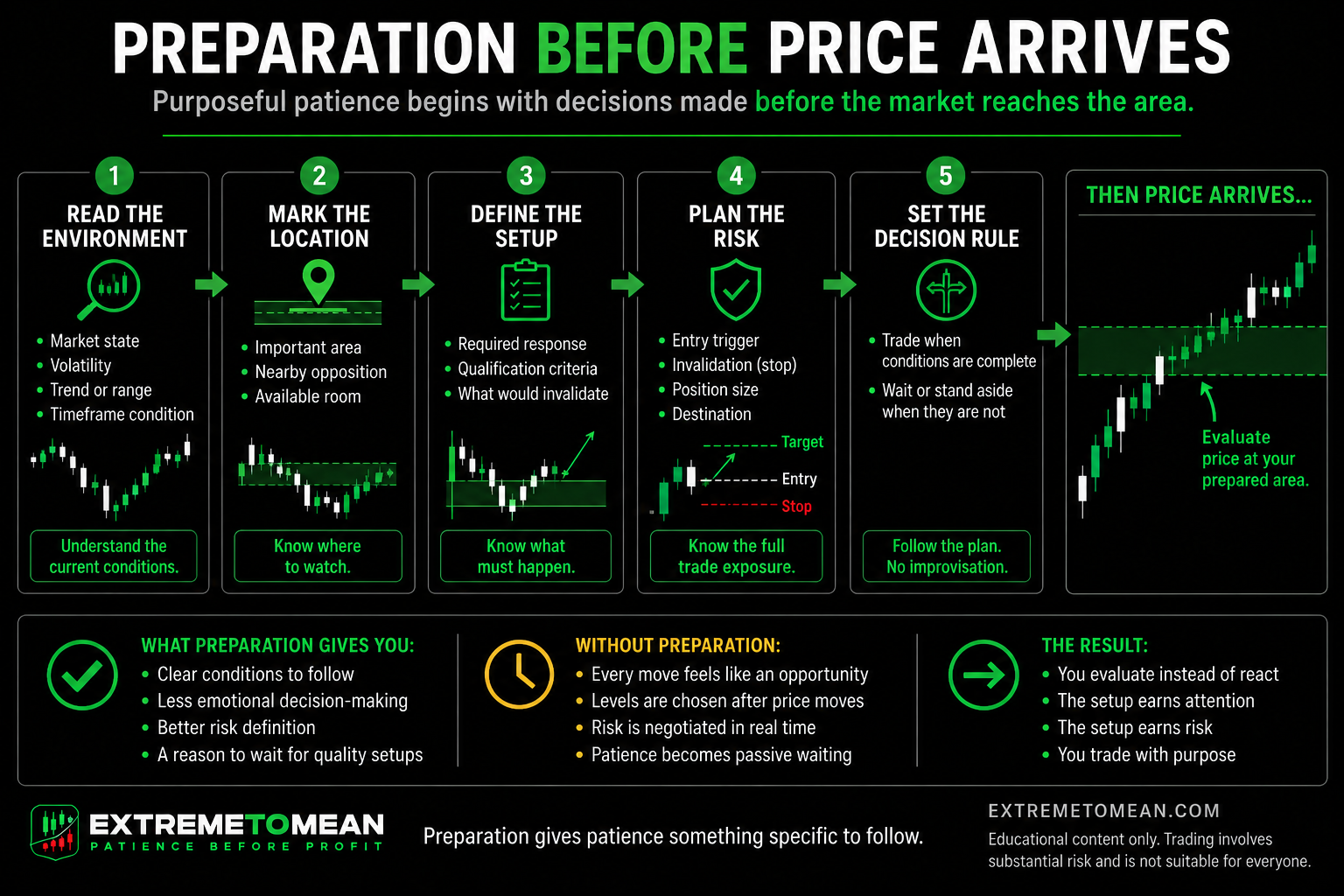
The setup earns attention when price reaches the prepared area, but arrival alone does not make the trade ready. The trader must still observe how price behaves, whether the original market condition remains relevant, and whether the expected response begins to appear. Preparation narrows the field of attention without forcing a conclusion. It tells the trader where to evaluate while preserving the right to stand aside.
Setup Criteria Must Be Observable
Vague setup descriptions make patience difficult because the trader cannot tell when the required conditions have actually appeared. Instructions such as “wait for strength,” “look for rejection,” or “enter when it feels ready” leave too much room for emotional interpretation. Under pressure, almost any favorable candle can be described as confirmation. The trader needs criteria that can be observed, explained, and reviewed after the session.
Observable criteria may include how price responds at the location, whether structure begins to stabilize, whether the intended direction gains acceptance, and whether the setup remains consistent with the larger context. These conditions do not need to remove every judgment call, but they should limit the trader’s ability to change the definition in real time. The cleaner process separates setup recognition from trade qualification. Seeing something familiar earns attention, while completing the required conditions allows the trader to consider participation.
Risk Should Be Planned Before the Entry
A trader is not fully prepared if the entry is clear but the risk is still being negotiated. The invalidation point, position size, available room, and reasonable destination should be considered before the order is placed. Otherwise, the trader may discover after entry that the stop must be widened, the target has little room, or the total exposure does not fit the plan. That is not a risk decision made in advance; it is a repair attempt made under pressure.
The lesson that a trade is not ready until the risk is clear is especially important during purposeful waiting. Risk planning gives the trader another condition that must be completed before action. A promising location and attractive response are not enough if the invalidation cannot be placed logically or the position cannot be sized appropriately. The setup earns risk only when the complete exposure fits the plan.
Confirmation Gives Waiting a Purpose
Waiting for confirmation does not mean demanding certainty from the market. Confirmation is simply the behavior the trader decided would make the setup more qualified than it was on arrival. It might involve rejection, stabilization, acceptance back through a level, or another response defined by the trader’s method. The purpose is not to guarantee the next move but to require evidence before committing risk.
Purposeful waiting therefore remains active. The trader watches whether the speed of price changes, whether the location continues to matter, and whether the anticipated structure begins to form. New information can weaken the setup, strengthen it, or leave it unresolved. The trader is not waiting for permission from one perfect candle; the trader is evaluating whether the planned conditions are becoming clearer.
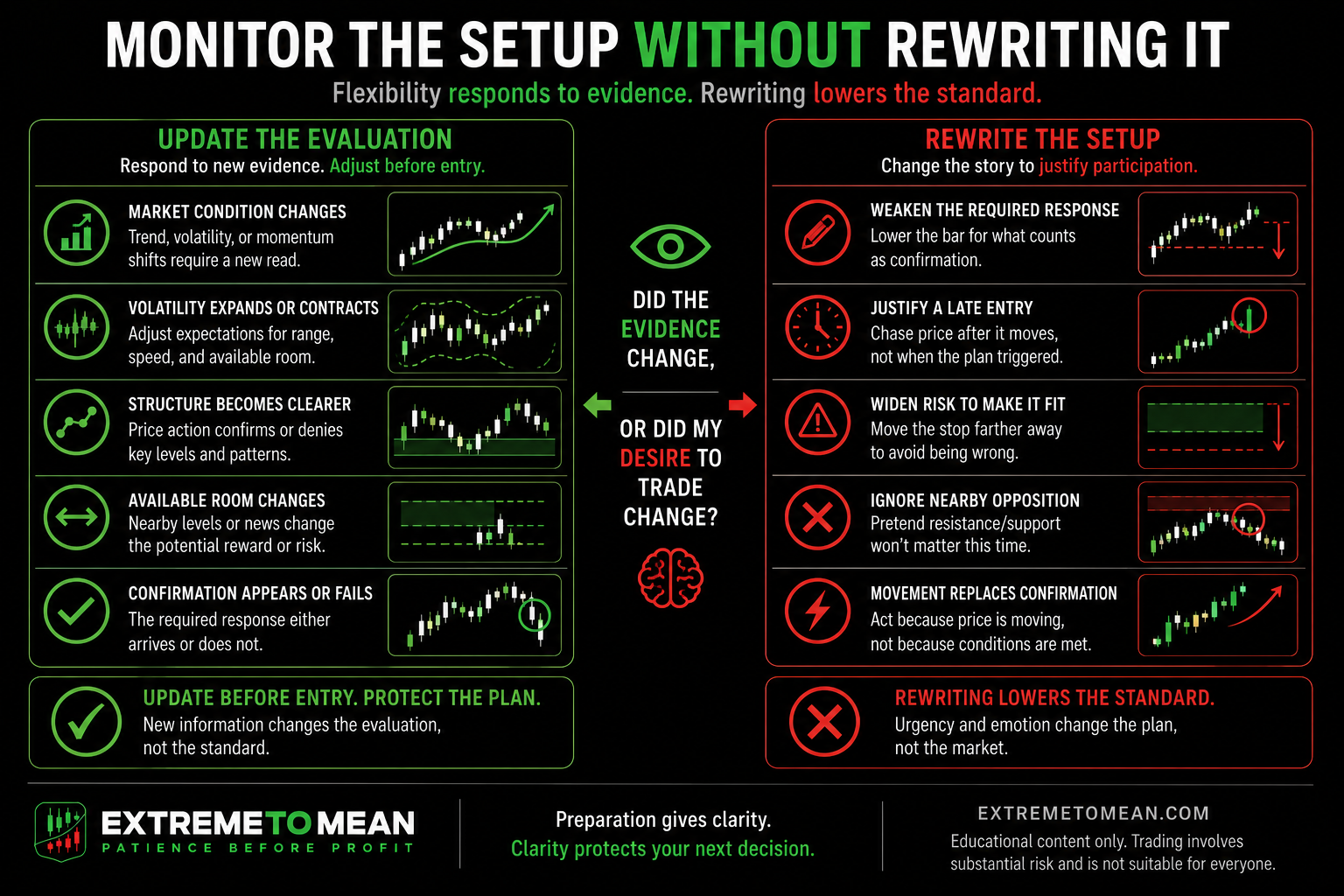
There is also an important difference between updating the evaluation and rewriting the setup. Legitimate flexibility responds to meaningful changes in context, volatility, structure, or available room. Rewriting happens when the trader lowers the original standards because price is moving and participation suddenly feels urgent. Preparation allows the trader to adapt to new evidence without moving the goalposts merely to justify an entry.
Preparation Reduces Dependence on Willpower
Traders often describe impatience as a failure of self-control, but willpower becomes less important when the process is defined clearly. A trader who knows the required location, response, invalidation, and room does not need to debate every candle. The criteria make many situations easier to reject because they are visibly incomplete. Structure carries part of the burden that emotion would otherwise have to manage alone.
A trading plan made before the open can organize this preparation while the trader is under less pressure. The plan should identify what deserves attention, what would qualify the setup, and what would make the idea unacceptable. It should not predict that a trade will appear or require the trader to participate. Its value is that it turns patience from a vague intention into a sequence the trader can follow.
A Better Question During the Wait
The question “How much longer should I wait?” focuses on time rather than evidence. A better question is, “What must become clear before this trade deserves risk?” That wording directs the trader back toward conditions that can be observed and reviewed. It also allows the answer to be “nothing more can make this setup acceptable,” which is sometimes the cleanest decision — a reminder that no amount of preparation entitles a trader to a setup the market simply isn't offering that day.
Before acting, the trader can review a short preparation filter:
- What market condition am I trading in?
- Why does this location deserve attention?
- What specific response must appear?
- What behavior would invalidate the idea?
- Is the risk clear and appropriately sized?
- Is there enough room for the trade to develop?
- Am I following prepared criteria or reacting to movement?
The list should not become another ritual that is completed without thought. Each answer should connect directly to the current market and to the trader’s established method. If several answers remain vague, waiting longer will not automatically improve the trade. The trader may need to gather more evidence, revise the plan before entry, or decide that the opportunity does not qualify.
Preparation should also be part of the post-trade review. The trader can examine whether the important levels were marked in advance, whether the setup criteria remained stable, and whether risk was defined before the order. This review focuses on decision quality rather than judging the process solely by the result. A trade can fail after good preparation, and an unprepared trade can temporarily produce a favorable outcome.
Traders who want to make this process more repeatable can use the planning resources available through the free trading tools. A checklist or written worksheet can preserve the key questions when live movement begins competing for attention. The tool is not a substitute for judgment, but it can help the trader apply the same evaluation sequence more consistently. Preparation becomes more useful when it is recorded rather than left as a loose intention.
Final Thought
Patience is not the empty space between trades. It is the work of defining where attention belongs, what the setup must prove, how risk will be controlled, and what would require the trader to stand aside. That work begins before price reaches the area and continues while the setup develops. The trader remains involved without forcing action.
Purposeful waiting does not make the market predictable, and preparation cannot guarantee that a qualified trade will work. It can create clearer standards, better risk definition, and more consistent decision-making under pressure. Patience becomes preparation when the trader knows exactly what is being watched and why. The wait ends only when the conditions are complete enough to earn risk or when the evidence shows that no trade should be taken.
To separate prepared waiting from avoidance, read patience versus procrastination in trading.
Educational content only. Trading involves substantial risk and is not suitable for everyone.