
Short-term reversal: real edge or microstructure noise? examines why a visually obvious pattern is not automatically a tradable one.
Many newer traders are taught to study candles, patterns, breakouts, reversals, wicks, and momentum moves. That is not wrong. Price is the final result of buying, selling, urgency, hesitation, liquidity, emotion, and positioning. Every candle contains information.
The problem starts when traders treat that information like a forecast. A big green candle becomes “the market is going higher.” A rejection wick becomes “this has to reverse.” A breakout becomes “this move is real.” A fast selloff becomes “something is wrong.”
That kind of thinking feels reasonable in the moment because price is moving right in front of you. The chart looks alive. The candle looks obvious. The trade seems like it is about to leave without you. But price action by itself does not tell you what must happen next. It only tells you what has happened so far and how the market is currently behaving.
This lesson belongs with the broader market context lessons because reading price properly starts before an entry is ever considered. Before a trader asks, “Should I buy or sell?” the better question is, “What kind of market am I reading right now?”
Price Action Is an Observation Tool
Price action means studying how price moves over time. That can include candles, ranges, trends, failed moves, breakouts, pullbacks, wicks, reversals, and how quickly or slowly price travels from one area to another.
But the key word is studying. Price action is not supposed to be a shortcut around thinking. It is not supposed to replace context, location, risk, or patience. It is one part of the evidence-gathering process.
A candle can show strength, but strength into the middle of a range may not mean the same thing as strength leaving a clean support area. A selloff can show pressure, but pressure into a major lower extreme may not mean the same thing as pressure breaking down from a weak consolidation. The same candle can mean different things depending on where it appears and what came before it.
That is why Extreme to Mean teaches that the market comes first. Price action becomes more useful when the trader first understands the environment. Is the market trending, rotating, expanding, compressing, rejecting extremes, or chopping around the middle? Without that context, a trader may be reacting to movement without understanding what the movement belongs to.
Price action should help you describe the market in plain English. For example: “Price is pushing higher, but each push is getting weaker.” Or: “The market is rejecting the same lower area for the third time.” Or: “The move is fast, but it is occurring directly into prior resistance.” These are observations. They do not predict the future. They help organize the present.
Why Patterns Become Dangerous Without Context
Patterns are attractive because they make the market feel more organized than it really is. Traders like the idea that a certain candle or formation has a specific meaning. A hammer means reversal. A breakout means continuation. A double top means weakness. A big candle means momentum.
Sometimes those ideas may be useful. Other times they can be misleading.
The danger is not the pattern itself. The danger is treating the pattern as if it has authority without asking where it appeared, what condition the market is in, and whether the risk can be defined. A reversal candle in a clean extreme area is not the same as a reversal candle in the middle of a messy range. A breakout after compression is not the same as a breakout after an exhausted move. A strong candle near the beginning of a trend is not the same as a strong candle after price has already traveled far.
This is why context comes before the candle. A candle is a piece of evidence, not a complete argument. It needs surrounding information before it becomes useful.
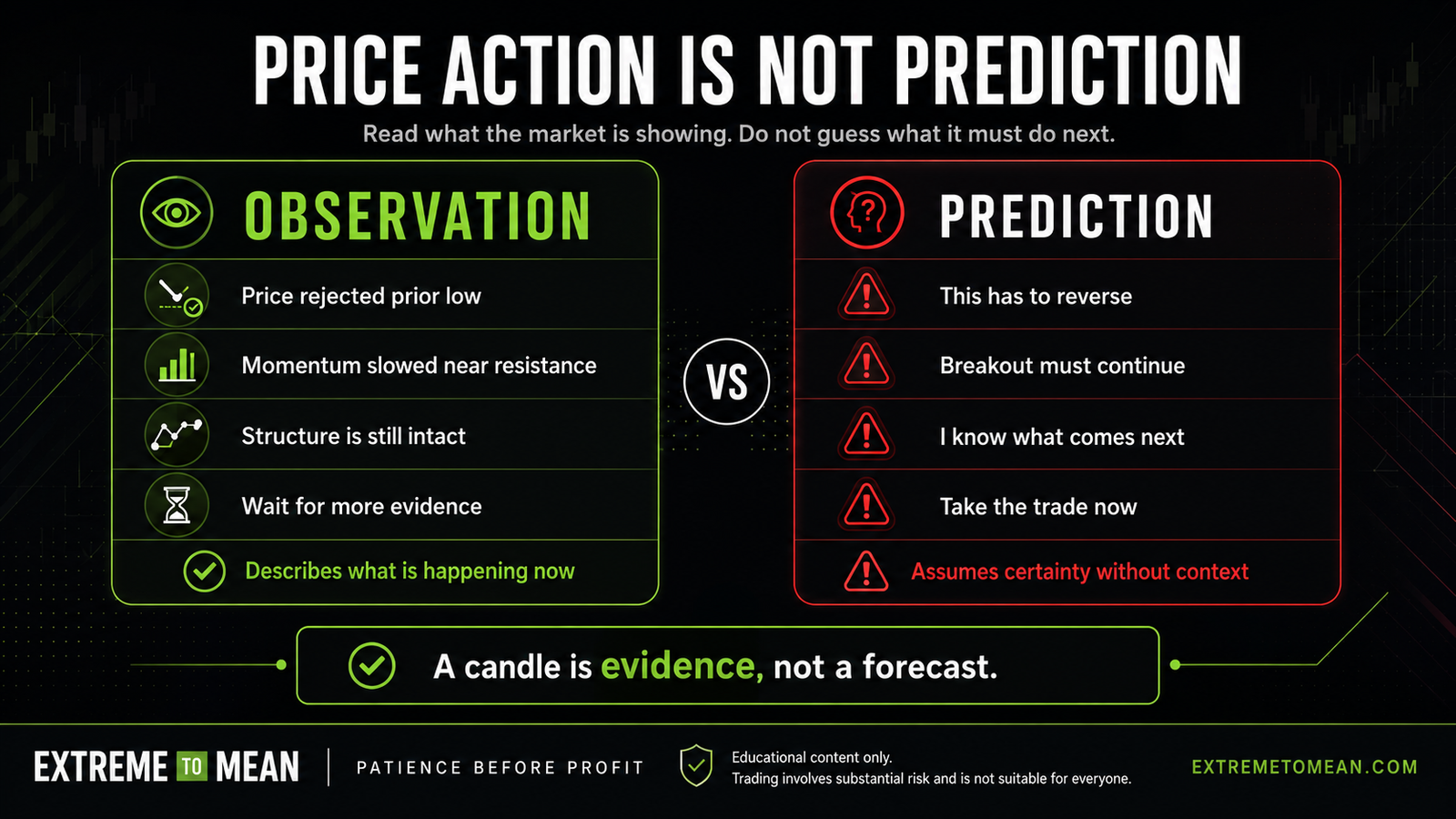
A common mistake is seeing a pattern and immediately converting it into a trade idea. The trader sees the wick, the engulfing candle, the breakout, or the rejection, and the mind jumps from “I see something” to “I should do something.” That jump is where many bad trades begin.
A cleaner process slows that jump down. The trader can still notice the pattern, but the next step is not action. The next step is interpretation. What is the market doing around this pattern? Is price at an important location? Is there room for the trade to develop? Is risk clear? Is the move happening in a clean environment or a noisy one?
The pattern may be real, but that does not mean the opportunity is clean.
The Problem With Turning Evidence Into Opinion
Price action becomes dangerous when the trader stops observing and starts arguing with the market. This often happens quietly. A trader sees one piece of evidence and turns it into a belief.
A fast push up becomes “buyers are in control.” A sharp rejection becomes “sellers are trapped.” A failed breakdown becomes “this is definitely reversing.” The trader may not say those words out loud, but the position is built around that belief.
The issue is not that the trader formed an opinion. Traders need working ideas. The issue is that the opinion often arrives too early and becomes too rigid. Once a trader decides what the market “should” do, every new candle gets filtered through that belief. Evidence that supports the idea feels important. Evidence that challenges it gets ignored.
That is not price action reading. That is confirmation bias.
A better trader can hold an idea lightly. They can say, “This looks like potential rejection,” without turning it into “This must reverse.” They can say, “Price is trying to break higher,” without turning it into “The breakout has to work.” They can say, “The market is stretched,” without assuming that stretch automatically creates a trade.
This matters even more in reversion-to-mean trading. An extreme can create interest, but reversion is not the same as reversal. Price can stretch farther than expected. It can pause without reverting. It can reject briefly and then continue. The job is not to predict the exact turning point. The job is to evaluate whether the evidence is strong enough, the location is clean enough, and the risk is clear enough to justify attention.
A trader who treats evidence as opinion is more likely to chase, defend, average emotionally, or ignore the stop. A trader who treats evidence as information is more likely to stay flexible.
What Better Price Action Reading Looks Like
Better price action reading begins with description. Before forming a trade idea, describe what is happening as neutrally as possible.
For example, instead of saying, “This is bullish,” a trader might say, “Price is making higher highs and higher lows, but it is approaching a prior resistance area.” Instead of saying, “This is a reversal,” the trader might say, “Price rejected the low, but it has not yet broken the short-term structure.” Instead of saying, “This breakout is real,” the trader might say, “Price broke above the range, but I need to see whether it holds or immediately fails.”
Neutral language matters because it keeps the trader from locking into a conclusion too early. It creates space between seeing and acting. That space is where better decisions are made.
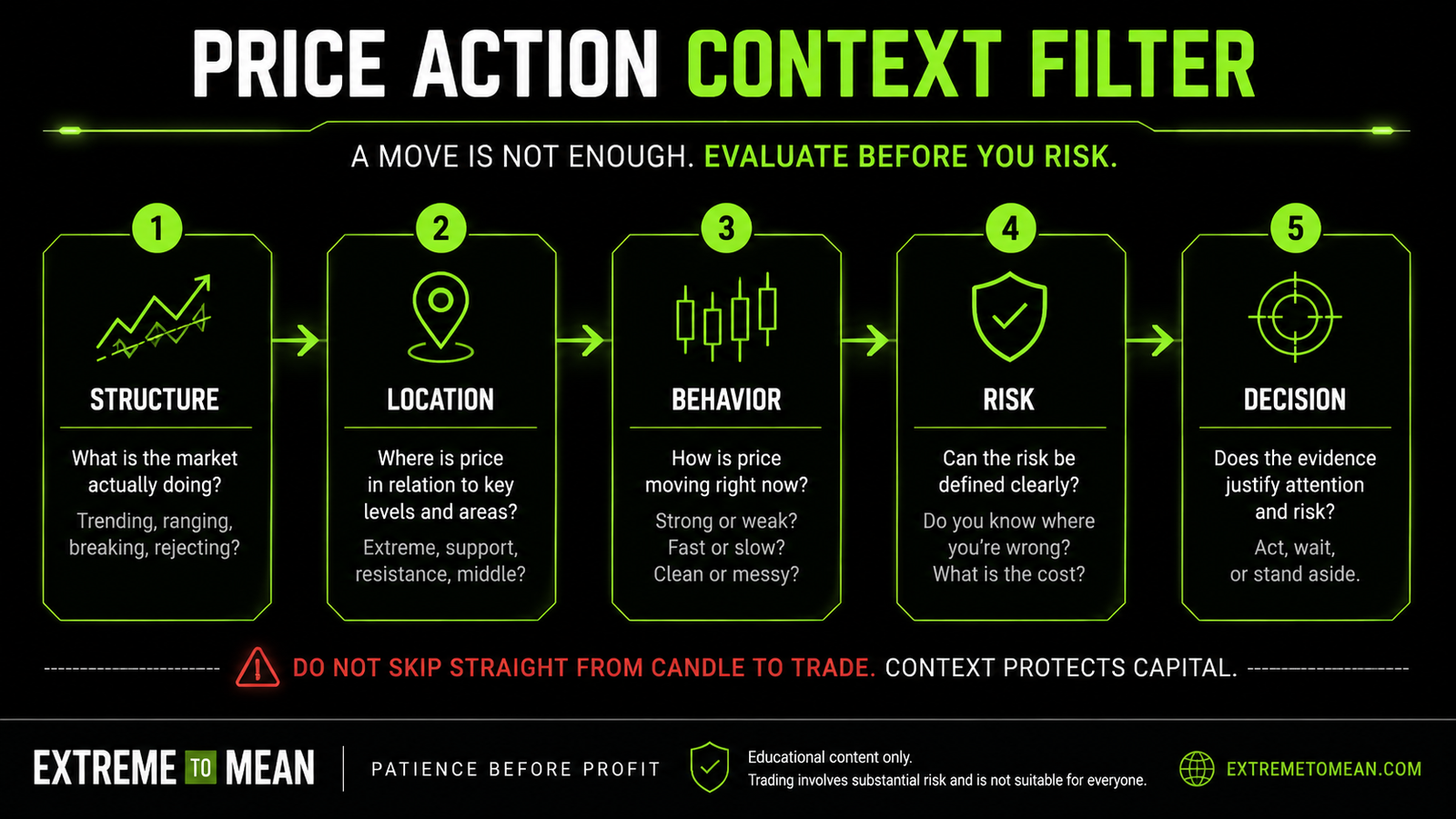
A useful price action read usually includes four parts:
- Structure: Is price trending, ranging, breaking, rejecting, or rotating?
- Location: Is price near an extreme, the middle, support, resistance, or a prior reaction area?
- Behavior: Is movement strong, weak, fast, slow, clean, messy, expanding, or fading?
- Risk: Can the trade idea be defined clearly, or is the trader just reacting?
Location is especially important because the same move can mean different things in different places. A strong candle near a clean extreme may be meaningful. The same candle in the middle of a range may only be noise. Before a trader studies entries, they need to understand why location is the first filter.
Better reading does not make the market predictable. It makes the decision process more organized. The goal is not to know the future. The goal is to know whether the current evidence is good enough to keep watching, wait, or step aside.
A Simple Price Action Decision Filter
A newer trader does not need to make price action complicated. In fact, complicated interpretation can create more confusion. A simple filter can help separate useful observation from emotional prediction.
Before acting on price action, ask:
- What is the market currently doing?
- Where is price doing it?
- Is this movement happening near a meaningful location or in the middle of noise?
- What evidence supports the idea?
- What evidence would prove the idea wrong?
- Is there room for the trade to develop?
- Can the risk be clearly defined before entry?
- Am I observing, or am I predicting because I want a trade?
That last question is often the most important one. Many trades begin because the trader wants the chart to offer something. Price moves, the trader feels urgency, and the mind starts building a story. The story may sound logical, but if it is built on one candle, one wick, or one emotional reaction, it is usually weak.
A better question is: What would I need to see before this deserves risk?
That question changes the job. The trader is no longer trying to catch every move. The trader is filtering. They are waiting for the setup to earn attention before it earns risk. If the answer is unclear, the decision may be to wait. Waiting is not weakness. It is part of the process.
This is also where a beginner path can help. If a trader is still learning how to connect price action with context, risk, and execution, it can be useful to start with the beginner trading path before trying to trade every pattern that appears on the chart.
Price action should not pressure a trader into action. It should help the trader decide whether action is justified.
Final Thought
Price action is valuable, but only when it is treated as evidence. A candle is not a prediction. A move is not a promise. A pattern is not permission to ignore context.
The market is always giving information, but not all information deserves a trade. The trader’s job is to read what is happening, understand where it is happening, and decide whether the evidence is strong enough to continue the process.
Observation comes before opinion. Context comes before action. Risk comes before entry.
That is how price action becomes useful without becoming a guessing game.
Educational content only. Trading involves substantial risk and is not suitable for everyone.