
Many traders treat bias as a statement about what the market will do next. They decide the market is bullish or bearish, then begin looking for price action that supports that conclusion. The opinion feels useful because it creates direction and reduces uncertainty before the session begins. The danger is that a working read can quietly become a prediction the trader feels compelled to defend.
The lessons in The Market category emphasize that the environment must be evaluated before a trade is approved. Bias belongs inside that process, but it should not sit above the evidence that created it. A responsible bias summarizes current conditions and remains open to revision as those conditions change. It helps organize attention without claiming control over the next move.
What Market Bias Actually Means
A market bias is a directional preference based on the evidence currently available. The trader may prefer longs because price is accepting higher, pullbacks are holding, participation is broad, and related markets are supportive. The trader may prefer shorts because rallies are failing, lower prices are being accepted, and risk-sensitive areas are weakening. In both cases, the bias is a description of the stronger side of the evidence, not a promise about the outcome. Monetary debates suffer from the same shortcut when commodity money is assumed sound and fiat money is assumed doomed before the actual trade-offs of each system are weighed.
Prediction works differently because it treats the future as though it has already been decided. A prediction says the market must rise, must fall, or must reach a particular destination. Bias says one direction currently has better support, provided the conditions behind that view remain present. The distinction may sound small, but it changes how the trader responds when the market disagrees.
Bias and Prediction Create Different Behaviors
A responsible bullish bias can survive a normal pullback while still having a clear condition that would weaken or remove it. A fixed bullish prediction often interprets every decline as a better buying opportunity, even after structure and participation have changed. The same problem appears with a bearish prediction when every rally is treated as temporary regardless of the evidence. Prediction protects the opinion, while bias is supposed to serve the decision process.
This is why Context Before Bias: What Market Am I Trading Inside? should come before any directional conclusion. The trader first identifies whether the market is trending, ranging, chopping, expanding, contracting, risk-on, risk-off, or rotational. Only then can a directional preference be judged against the environment in which it is expected to work. Bias without that description is often little more than an early opinion.
Why a Fixed Bias Feels Useful
A fixed opinion can feel efficient because it simplifies the session. The trader believes that choosing one direction will reduce hesitation, filter noise, and prevent impulsive switching between long and short ideas. That goal is reasonable because constant indecision can create poor execution. The problem begins when decisiveness is confused with refusing to update.
Bias can also provide emotional comfort. Uncertainty is uncomfortable, while a clear bullish or bearish story makes the market feel easier to understand. Once the story is accepted, conflicting evidence creates tension because it threatens both the trade idea and the trader’s sense of control. Ignoring that evidence can feel easier than rebuilding the market read.
Bias Must Fit the Market State
The framework of the three market states helps prevent that emotional shortcut. A directional bias carries more weight in an established trend than in a range or disorderly chop. In a range, location may matter more than direction because price can rotate repeatedly between boundaries. In chop, the most accurate bias may be that no directional preference has earned confidence.
Volatility must also be part of the read. Expanding movement can strengthen a directional move when price is making progress and holding gains, but it can also signal unstable liquidation or aggressive two-way trading. Contracting movement can reduce follow-through and make a strong bias premature even when the broader structure leans one way. The trader should ask whether volatility is confirming the directional read or weakening its usefulness.
Participation and intermarket context add another layer. A rising index with narrow leadership, weakening breadth, and defensive rotation may not support the same bullish bias as a rise confirmed across sectors and related risk assets. A falling index with stable credit, firm cyclicals, and improving participation may not support the same bearish conclusion as broad risk-off behavior. Bias becomes more reliable as a working framework when several parts of the market tell a similar story.
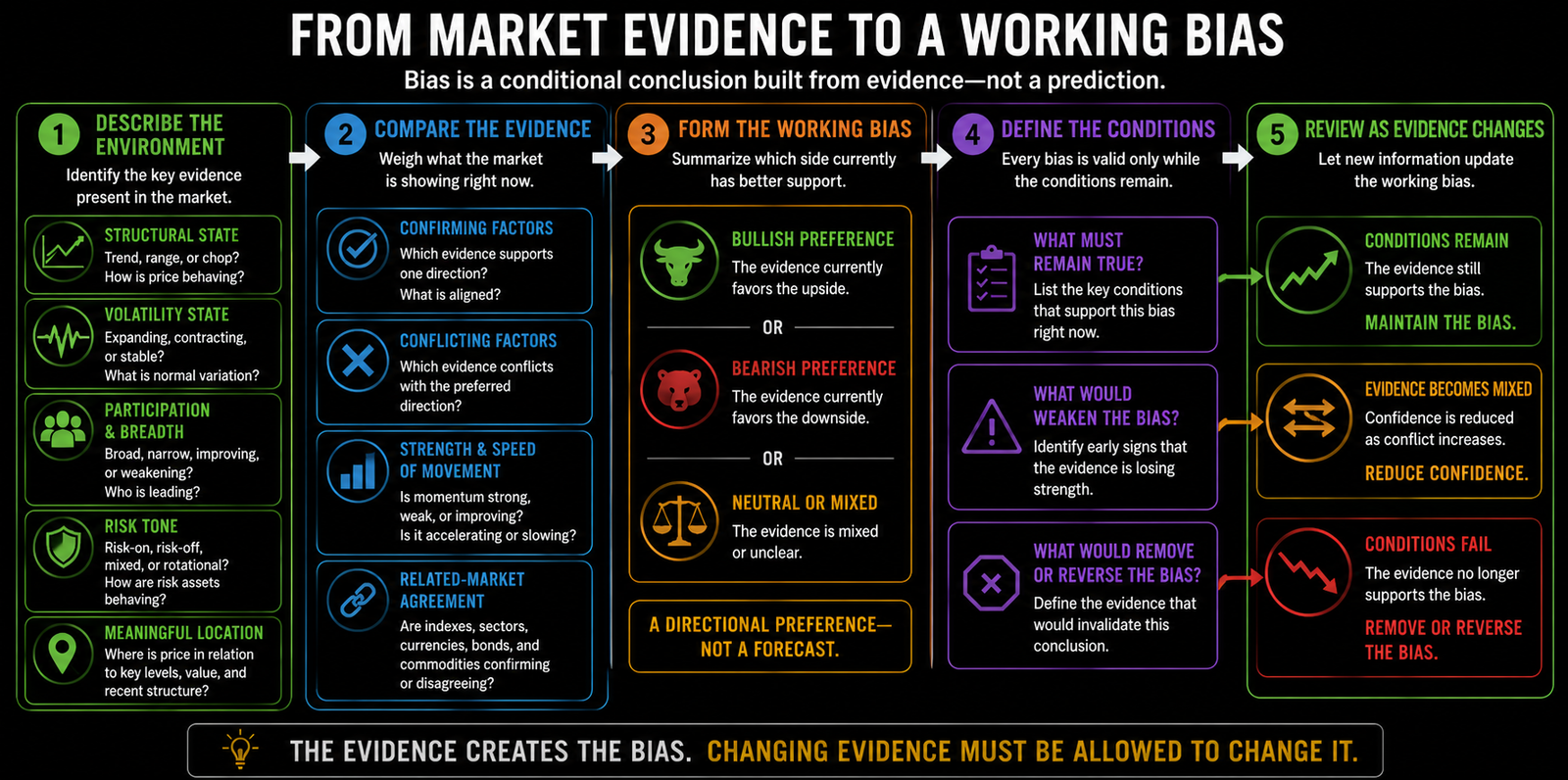
A Useful Bias Is Conditional
A good bias is conditional because it includes the evidence required to maintain it. A trader might say, “I prefer longs while price holds above the prior value area, pullbacks remain controlled, and participation stays broad.” That statement contains both a direction and the conditions supporting it. It also gives the trader a reason to reassess if those conditions fail — the same conditional structure behind writing If-Then trading rules instead of a fixed forecast.
Conditional bias is not weakness or indecision. It is an acknowledgment that markets change and that no early-session read deserves permanent authority. The trader is not required to switch direction after every candle, but the trader must know what evidence would matter enough to review the original conclusion. Flexibility is part of discipline when it is tied to observable conditions.
The principle that context comes before the candle also applies after the session begins. One bullish candle does not automatically confirm a bullish bias, and one bearish candle does not automatically invalidate it. The trader must judge whether the broader structure, location, participation, and response have changed. Bias should be updated by meaningful evidence rather than by every small fluctuation.
Bias Does Not Approve the Trade
A bias does not approve a trade by itself. A bullish environment may still offer a poor long entry if price is extended, trapped beneath resistance, or located where the invalidation is unclear. A bearish environment may still offer a poor short entry if price is already stretched into support or the available room is limited. Directional preference narrows attention, but location and risk determine whether a specific setup earns participation.
This is why market conditions change the quality of a setup. The same pullback, breakout, or reversal can have different meaning depending on the surrounding structure and risk tone. Bias can help the trader recognize which side may deserve more attention, but it cannot repair a weak location or incomplete trade plan. The setup still must earn risk on its own terms.
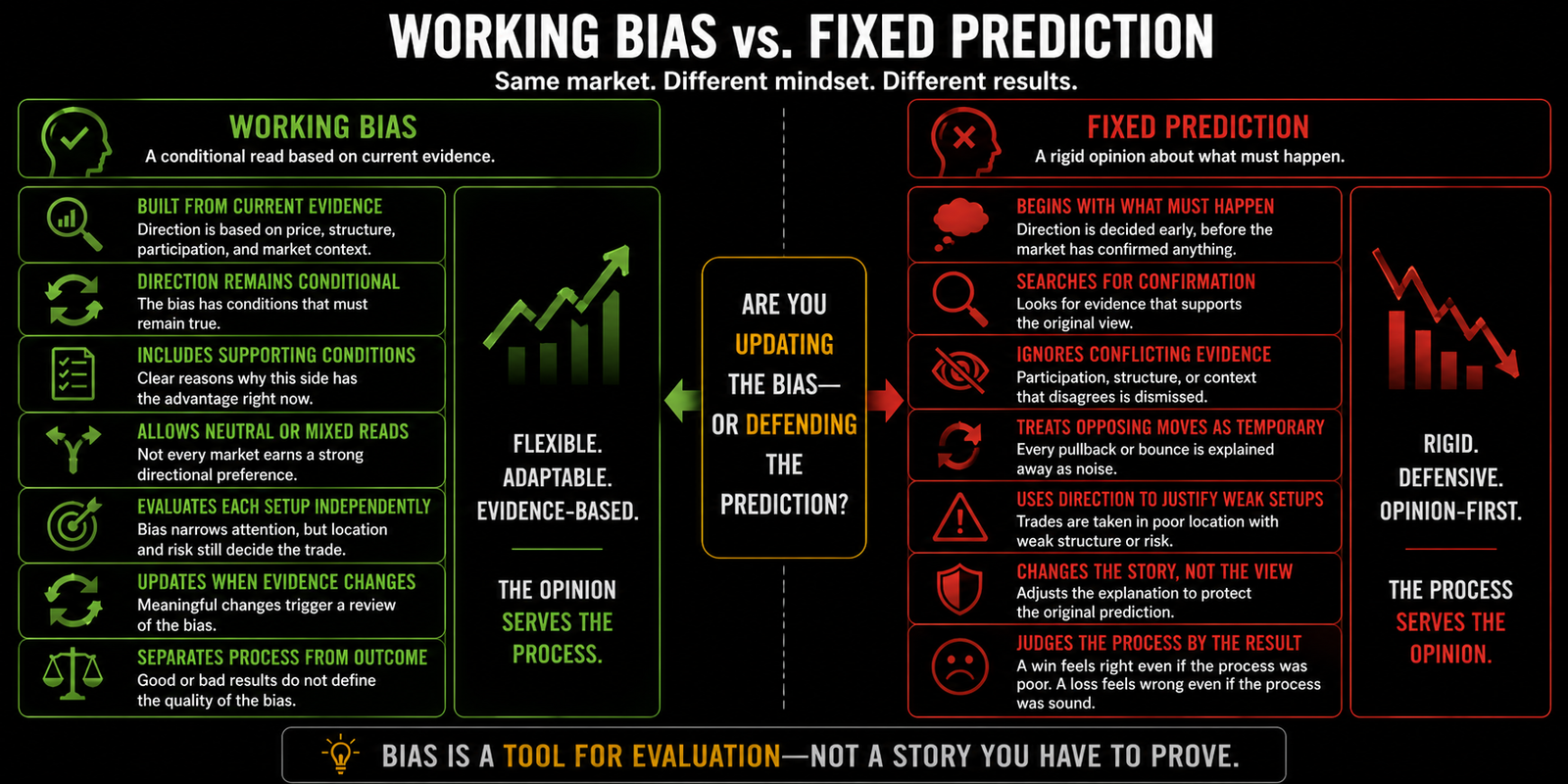
When Bias Becomes a Belief
Several behaviors show that bias has become a fixed belief. The trader begins ignoring failed follow-through, explaining away structural breaks, or adding new reasons to preserve the original view. Opposing setups are dismissed automatically, even when they are better located and more clearly qualified. The bias is no longer organizing evidence; it is controlling which evidence is allowed to count.
Another warning sign is using bias to justify a trade that was already desired. The trader sees a familiar pattern, feels urgency to participate, and then points to the bullish or bearish bias as permission. That sequence reverses the proper process because the bias becomes a reason to lower the qualification standard. A responsible bias should filter opportunities, not excuse weak ones.
Build Bias From Evidence
A cleaner process begins by describing the market before naming a direction. The trader identifies structure, volatility, participation, location, and the behavior of related markets. The trader then states a directional preference only if the evidence supports one. If the evidence is mixed, the bias should remain limited, neutral, or conditional.
The bias should then be written in a form that includes its supporting conditions. Instead of “I am bullish,” the trader might write, “I prefer longs while price remains above the overnight balance, breadth improves, and pullbacks continue to hold.” Instead of “I am bearish,” the trader might write, “I prefer shorts while rallies fail beneath resistance and defensive participation remains strong.” The added conditions make the statement useful because they explain what would require a review.
A Practical Bias-Responsibility Filter
Before acting, the trader can apply a short bias-responsibility filter. The questions should be answered from current evidence rather than from the desire to make a trade. A strong bias does not require every answer to point in the same direction, but meaningful conflict should reduce confidence. The goal is to know whether the bias is organizing the market read or replacing it:
- What structural state is present: trend, range, or chop?
- Is volatility expanding, contracting, or stable?
- Are participation and sector leadership confirming the directional read?
- Is the bias based on current evidence or on what I expected before the session?
- What specific conditions support the bias?
- What evidence would weaken, suspend, or reverse it?
- Does the planned setup fit the bias without sacrificing location or risk quality?
- Would I still approve this trade if I removed the directional label?
- Am I interpreting conflicting evidence, or explaining it away?
- Is a neutral bias more honest than forcing a directional conclusion?
The better question is not, “Where do I think the market is going?” It is, “Which direction currently has better evidence, and what would make that conclusion no longer valid?” That question preserves the usefulness of bias while removing the demand for certainty. It also gives the trader a clear reason to update rather than defend.
Traders can include that question in a repeatable preparation framework such as the 2026 Trader’s Macro Playbook. The purpose is not to create a permanent forecast before the open. It is to establish a working read, define the conditions behind it, and decide what kind of evidence deserves attention. A bias is most useful when it improves preparation without becoming permission to predict.
Review the Bias Separately From the Outcome
Trade review should compare the original bias with the evidence that appeared during the session. The trader should record which conditions supported the read, which conditions changed, and whether the bias was updated at the appropriate time. A losing trade does not automatically prove the bias was poor, and a winning trade does not prove the bias was responsibly formed. The review should separate decision quality from the result of one position.
The journal should also identify moments when the trader used bias as justification. If an entry was taken in poor location, after failed confirmation, or without clear invalidation, the directional view may have lowered the standard for participation. That is a process problem even if the market later moved in the expected direction. Bias should make the trade-selection process clearer, not easier to bypass.
Final Thought
Market bias is a working assumption, not a prediction about what must happen next. It summarizes the direction currently supported by structure, volatility, participation, and risk tone. Its value comes from helping the trader organize evidence and focus attention. Its danger begins when the trader becomes more committed to the opinion than to the conditions that created it. How to use bias without marrying it applies that distinction to live decisions.
The goal is not to avoid directional views or change them constantly. It is to hold them conditionally, qualify trades independently, and revise the read when meaningful evidence changes. Some sessions will support a clear bullish or bearish bias, while others will support only caution or neutrality. The trader’s job is to use bias as a flexible tool for evaluation rather than a fixed story about the future.
Educational content only. Trading involves substantial risk and is not suitable for everyone.