
Inside The Trader, drawdown belongs in the risk conversation before an order is placed. The trader needs to know which account rule is closest, how that boundary is calculated, and how much of the remaining room the next trade could consume. Drawdown is not merely an account rule you check after losing; it changes the economics of every trade before you enter it.
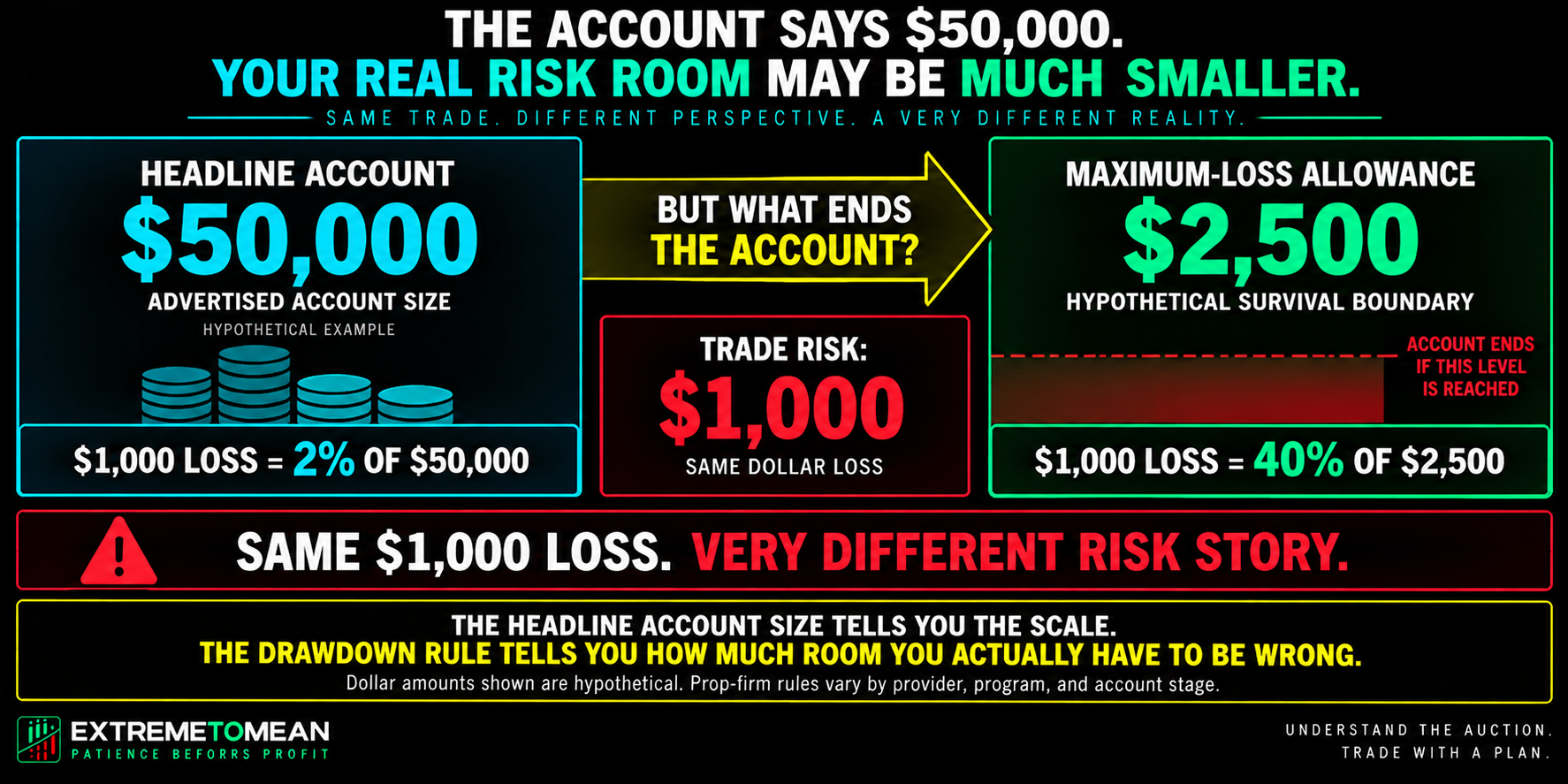
This matters because the headline balance is psychologically powerful. A trader who sees “$50,000 account” can easily think about a $500 loss as only 1% of the account, even though the program might allow only a small fraction of that headline amount to be lost. The account number describes scale; the drawdown rule describes survival.
The $50,000 Account Illusion
Consider a completely hypothetical $50,000 evaluation with a $2,500 maximum-loss allowance. A $1,000 trade would look like only 2% of the advertised account balance, but it would consume 40% of that hypothetical loss allowance. The headline account size tells you the scale of the account; the drawdown rule tells you how much room you actually have to be wrong.
That does not mean every $50,000 program has a $2,500 drawdown, because the amounts and calculations vary widely. The broader futures prop-firm challenge process is built around program-specific rules, and the exact formula matters more than the marketing label. A trader should therefore stop thinking of the advertised balance as ordinary bankroll.
A useful educational concept is effective risk room: the distance between the account's current state and the nearest applicable loss threshold. That is not necessarily terminology the firm itself uses, but it forces the trader to look at the number that actually governs survival. If a trade loses, the important question becomes how much room remains afterward.
Drawdown Can Mean Two Different Things
In ordinary performance analysis, drawdown usually describes a decline from a previous account high to a later low. A trader might review an equity curve and say the strategy experienced a certain peak-to-trough drawdown. That is a description of what happened to performance.
Inside a prop program, drawdown can also define a rule the account is not allowed to cross. The threshold may remain fixed, move upward as the account performs, or interact with another daily limit depending on the program. Drawdown can describe what happened to an account, but inside a prop program it can also define the line the account is not allowed to cross.
Beginners therefore need to separate four ideas before thinking about position size:
| Rule | Basic Job | Key Question |
|---|---|---|
| Daily Loss Limit | Limits loss during a defined trading day | How much can I lose today before violating the rule? |
| Maximum Loss / Maximum Drawdown | Defines the larger account-level loss boundary | How far can the account fall before eligibility is affected? |
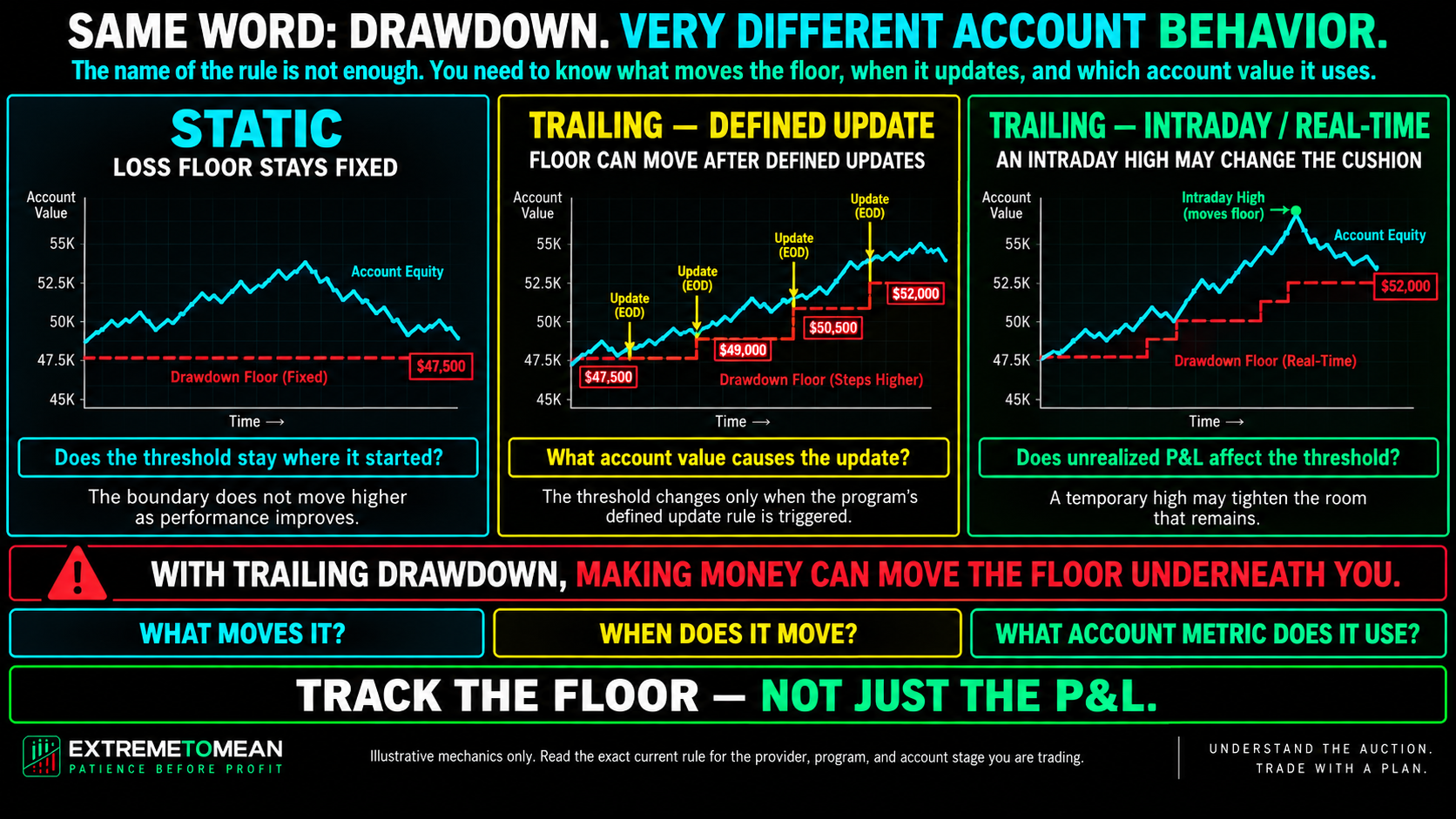
| Trailing Drawdown | Allows the loss threshold to move higher as qualifying account performance rises | Does my loss floor move when I make money? |
| Static Drawdown | Keeps the loss threshold fixed according to the program's defined rule | Does the loss floor stay where it began? |
Those names are only the starting point. Two programs can both advertise “trailing drawdown” while using materially different calculations, update points, and account metrics. Never trade from the name of the rule alone; read the exact calculation.
Why Trailing Drawdown Changes the Account
A trailing drawdown is especially important because the floor can move underneath the trader. In simple terms, a program may begin with a loss threshold a certain distance below the starting reference and then move that threshold higher as qualifying account performance reaches new levels. With trailing drawdown, making money can move the floor underneath you.
The exact mechanism is where traders need to slow down. Some structures can respond to intraday account highs, while others may update using an end-of-day metric or another defined calculation, and some trailing mechanisms may eventually stop moving under specified conditions. The useful question is not merely “Does this account trail?” but “What causes the threshold to move, and when is that movement calculated?”
Realized and unrealized P&L can matter for the same reason. If a hypothetical rule responds to intraday equity highs, a position that moves strongly into unrealized profit and then reverses may affect the account differently from a rule that updates only from another metric. Do not assume a profit matters only after the trade is closed; first learn what account value the rule actually watches.
This also explains why profit and cushion are not always the same thing. A trader can make money and still discover that the future distance to the failure threshold did not increase dollar-for-dollar because the floor rose too. A trailing drawdown can turn yesterday's profit into today's tighter risk boundary.
Your Nearest Rule Is the One That Matters Right Now
A prop account can have several boundaries operating at once. The trader may have substantial room before the overall maximum-loss threshold while being much closer to a separate daily-loss limit after several losing trades. Your true risk boundary is the rule you are closest to violating.
That is why a daily limit and a maximum drawdown should never be collapsed into one number. A trader can remain comfortably above the larger account boundary and still be finished for the day under the program's daily rule, subject to the exact terms. The broader lesson that daily loss limits are decision limits becomes even more important when an external program imposes another hard constraint.
The profit target is different again. A hypothetical evaluation requiring $3,000 in profit while allowing $2,000 of maximum loss is not simply a race to make $3,000 before losing $2,000, because the path can include daily limits, trailing mechanics, sizing rules, and other restrictions. The profit target is the destination; drawdown determines how narrow the road may be on the way there.
Drawdown Changes Position Size Before the Trade
Suppose two traders see the exact same valid NQ setup with the same structural stop. One has substantial risk room in a personal account, while the other has only a small amount of prop drawdown remaining. The market setup is identical, but the accounts cannot necessarily afford the same expression of it.
The correct sequence still begins with market invalidation. As the futures position-sizing process explains, stop distance and contract value determine the dollar risk of one contract before contract count is chosen. Position size should be based on the risk room that actually exists—not the account number that looks impressive on the dashboard.
If the structurally correct NQ position consumes too much of the remaining cushion, the trader does not get to pull the stop closer simply to make the arithmetic work. The cleaner alternatives are fewer contracts, an appropriate Micro contract such as MNQ, or no trade if even the smallest reasonable position does not fit. Do not change the market's invalidation because the account cannot afford the trade; change the position—or skip it.
Micro futures improve the granularity of that decision, but they do not make the account safe. Several Micros can create substantial exposure, and a trader who ignores the drawdown calculation can violate a loss rule with smaller contracts just as surely as with an E-mini. A Micro contract gives you smaller units of exposure; it does not make poor risk management harmless.
Remaining Cushion Is a Resource
Imagine Trader A has $2,000 of remaining drawdown room and Trader B has $400. Both are considering a trade that would risk $200 under their planned size, so the same market loss would consume 10% of Trader A's cushion but 50% of Trader B's. The closer you are to the drawdown boundary, the more expensive the same trade becomes to the account.
This is why maximum loss should never be treated as the trader's recommended risk budget. The firm's limit is the outside wall, while the trader's own operating rules should normally create room inside it for normal variance, commissions, execution uncertainty, and a sequence of losses. The firm's loss limit tells you when the account is in trouble; your own risk rule should tell you long before that.
Survival matters even when a strategy has positive expectancy. If ordinary losing variance can end the account after only a handful of attempts, the strategy may never receive enough opportunities for its long-run edge to matter. An edge cannot help you after the account no longer has enough room to trade it.
Drawdown Is Where Arithmetic Becomes Psychology
As remaining cushion shrinks, an ordinary loss can begin to feel like something larger than one trade outcome. The trader may now be thinking about failing an evaluation, losing account status, or giving back weeks of progress, so the same $100 loss can create much more pressure than it did earlier. Drawdown can shrink the account and the trader's patience at the same time.
That pressure can push behavior in opposite directions. Some traders become excessively cautious, take profit too early, or skip qualified setups because every fluctuation feels dangerous; others increase size or take lower-quality trades because they want to recover the account quickly. Neither response makes the next market outcome more predictable.
The breakeven obsession is one common version. Once the account falls below a starting balance or prior high, the trader can quietly change the objective from taking qualified setups to “getting the account back,” even though the market has no knowledge of the balance being recovered. The market does not know the balance you are trying to recover.
Extra cushion can create the opposite mistake. A trader performs well, sees more apparent room, and decides that being ahead makes it acceptable to double size or lower setup standards, even though the next trade has not improved. More cushion gives the process more room; it does not make lower-quality trades better.
Know the Calculation, Reset, and Account Stage
Drawdown rules can depend on operational details that sound boring until they matter. The trader should know the account metric used, whether unrealized P&L counts, when any daily rule resets, whether fees affect the calculation, and what causes a trailing threshold to update. A risk rule you have not understood down to the reset and calculation method is not a rule you are ready to trade around.
Execution uncertainty belongs in that conversation too. A planned stop is not a promise of a perfect fill, and fast markets can create slippage or other differences between intended and realized loss. Operating with almost no room between the planned exit and an external failure boundary leaves very little tolerance for that reality.
Rules may also change after an evaluation is passed. Depending on the provider and program, a funded-level stage may have different drawdown mechanics, position limits, payout conditions, or other restrictions, and the account may remain simulated rather than representing live firm capital. Passing one set of rules does not mean the next account stage uses the same ones.
This is also why comparing futures prop firms requires more than looking at the advertised maximum-loss amount. The trader needs to understand whether the threshold moves, when it updates, what other limits coexist with it, and what changes between stages. The size of the drawdown tells you how wide the lane is; the calculation tells you whether the lane is moving underneath you.
The Questions You Need Answered Before Trading
A trader should be able to answer the following questions from the program's current rule documentation rather than from memory, social media, or an old video. This is an understanding checklist, not permission to infer how a firm probably calculates anything.
| Question to Answer | Why It Matters |
|---|---|
| What is the maximum-loss amount? | Defines the outer account boundary |
| Is the drawdown static or trailing? | Determines whether the floor can move |
| If trailing, what causes it to move? | Shows how profits can affect future cushion |
| Is it calculated intraday or at a defined update point? | Changes how session highs and reversals may matter |
| Does unrealized P&L count? | Changes risk while positions remain open |
| Is there a separate daily-loss limit? | Creates another independent boundary |
| When does the daily rule reset? | Prevents incorrect assumptions about available room |
| Do commissions or fees affect the calculation? | Helps identify the account metric that actually matters |
| Do the rules change after the account advances stages? | Prevents applying evaluation rules to a different stage |
| What is my own internal operating limit? | Keeps normal trading inside the firm's outer boundary |
Then use Account Rules → Drawdown Method → Actual Risk Room → Trade Risk → Position Size → Remaining Cushion → Next Decision. The point is to define the market trade first while still recognizing that the account determines how much of that trade can responsibly be expressed. Account room determines how much of the trade you can take; it should not determine where the market proves the trade wrong.
A practical ETM version is:
- Know the Rule: Identify every external loss boundary and how it is calculated.
- Find the Real Cushion: Determine the current distance to the nearest applicable threshold.
- Set Your Operating Limit: Create your own risk boundaries inside the firm's outside limit.
- Define the Trade First: Establish market invalidation before choosing contract size.
- Size to the Cushion: Convert the valid stop into dollar risk and choose size that fits.
- Protect the Next Attempt: Ask what remains if this trade loses normally.
- Reassess After Changes: Update your understanding after profits, losses, trailing moves, or account-stage changes.
- Trade the Market, Not the Target: Do not manufacture an opportunity because the account dashboard makes a milestone feel urgent.
The better question is not “How much can I make with this account?” Ask, “What is the nearest loss boundary, how is it calculated, how much cushion do I actually have, and what remains if this trade loses?” That question turns the account from a marketing number into a risk structure the trader can actually evaluate.
Final Thought
A prop account is not difficult only because it has a profit target. The larger challenge is operating inside a finite risk envelope that can shrink and, under some structures, move upward as the account changes. Traders who understand that stop treating the headline balance as their bankroll and begin paying attention to the room their process actually has to survive.
That does not mean trading scared or refusing valid risk. It means defining the trade from market structure, sizing it from the account's real constraints, and preserving enough room for the next ordinary loss rather than treating the firm's maximum as money waiting to be spent. One trade is allowed to lose; the account is not allowed to lose beyond its rules.
Know the rule, know the cushion, define the trade, size the risk, and protect the next decision. The profit target should never manufacture a setup, and the drawdown boundary should never rewrite market invalidation. That risk-first discipline is part of the broader process developed throughout The Patience Principle.
Smaller size is often the first practical way to preserve the room a prop account actually gives you. Why small position size is a prop trader's first advantage explains the process benefit of reducing pressure before it creates a rule break.
Limited risk room can also expose whether a trader treats the account balance as permission to force recovery. How small accounts expose big discipline problems examines that behavioral pressure directly.
How small mistakes become big problems in prop accounts shows how reduced room can alter the decisions that follow a manageable loss.
Educational content only. Trading involves substantial risk and is not suitable for everyone.