
Inside The Trader, comparing prop firms should begin with the trading process rather than the promotional offer. A $50 evaluation can be a poor fit for a trader whose normal strategy conflicts with its drawdown or payout rules, while a more expensive program can make more sense if its structure allows the trader to execute normally. Best is not a firm; best is a fit between a trader and a rulebook.
That is why this comparison does not rank firms according to coupon size, advertised buying power, or whichever company currently offers the loudest promotion. The seven programs below were reviewed against their current first-party documentation, with emphasis on drawdown, evaluation and funded-stage differences, payout access, costs, live progression, and operational clarity. The comparison should remain useful even if every promotional discount disappears.
Best Futures Prop Firms: The Short Answer
Before comparing firms, readers should understand how futures prop-firm challenges actually work. Evaluation rules are only the first stage, and a firm that looks attractive during the challenge may behave very differently after passage. Passing the evaluation is only half the rulebook.
“Best” can therefore mean several different things. One trader may prioritize end-of-day drawdown, another may care most about payout flexibility, while another wants a clearly documented path from simulated funding to live capital. A trader who dislikes intraday trailing drawdown may reasonably choose a different firm from a trader who closes every position quickly and rarely allows large unrealized profit to retrace.
For this version, we compared Topstep, Apex Trader Funding, Take Profit Trader, TradeDay, My Funded Futures, Earn2Trade, and Tradeify. Each currently operates a materially different futures-focused model, and several offer multiple programs whose rules should never be collapsed into one company-wide description. The rule must always be read as Firm → Program → Stage → Rule.
How We Evaluated the Firms
The comparison emphasizes six areas: drawdown and risk structure, payout accessibility, real path cost, trading flexibility, live progression, and transparency or operational factors. Profit split matters, but only after the trader becomes eligible to withdraw money, while advertised account size matters far less than the actual loss room. Maximum contract limits are treated as ceilings rather than advantages.
We also separate the evaluation from the funded-level stage because several current programs change drawdown, consistency, payout, news, or sizing rules after passage. Topstep, Apex, Take Profit Trader, My Funded Futures, Earn2Trade, TradeDay, and Tradeify all illustrate why the word “funded” needs further definition. Some funded-level accounts remain simulated before a possible later transition to live trading. (help.topstep.com)
The table uses one representative current path for each company rather than mixing unrelated plans. It is not a permanent scorecard because these products change too quickly for one frozen ranking to remain responsible. The purpose is to show why apparently similar programs can create very different trading environments.
| Firm / Representative Path | Evaluation Model | Drawdown Type | Daily Loss Rule | Consistency | Min Days | Funded Stage | Profit Split | Payout Timing | Major Payout Restriction | Live Path |
|---|---|---|---|---|---|---|---|---|---|---|
| Topstep — 50K Trading Combine → XFA Standard | Monthly Combine | $2K MLL trails from EOD gains; enforced intraday | Optional soft session stop | 50% evaluation target | No fixed minimum | Express Funded Account is simulated | 90/10 | 5 winning days of $150+ | 50% of balance, subject to $2K Standard 50K cap | Risk-team call-up to Live Funded Account (help.topstep.com) |
| Apex — 50K EOD Evaluation → EOD PA | 30-day one-time evaluation | $2K EOD trailing | $1K soft pause | None in evaluation; 50% for payout | None | PA is Sim Funded | 100% of approved PA payout | 5 qualifying days | Safety net, $500 minimum, per-request caps, six-PA-payout lifecycle | Invitation-based live prop program (apextraderfunding.com) |
| Take Profit Trader — 50K Test → PRO | Monthly Test | $2K EOD in Test; intraday in PRO | None | 50% in Test; none in PRO | 3 for new Tests | PRO is simulated | 80/20 PRO; 90/10 PRO+ | Day-one / daily | PRO withdrawals above buffer; withdrawing inside it can close account under different split | Performance review for live PRO+ (try.takeprofittrader.com) |
| TradeDay — 50K Make It Take It Intraday | Monthly evaluation | $2K intraday trailing | None listed for selected path | 30% evaluation; none Sim Funded | 5 | Funded Sim | 50/50 below $4K net, 80/20 above; 90/10 live | Day-one eligible | $250 minimum; selected path has no payout buffer | Separate Funded Live progression (tradeday.com) |
| My Funded Futures — Rapid 50K | Standardized Rapid evaluation | $2K EOD evaluation; intraday trailing Sim Funded | None | 50% evaluation; none Sim Funded | 2 | Sim Funded | 90/10 Rapid Sim | Daily; first eligibility after 24 hours from first trade | $2,100 buffer and $500 minimum | Automatic trigger in defined case or risk-team review to Rapid Live (help.myfundedfutures.com) |
| Earn2Trade — Gauntlet Mini 50K | Structured evaluation | EOD drawdown | Hard daily-loss rule | 30% evaluation | No stated fixed minimum; consistency effectively requires multiple profitable days | Partner offers LiveSim or Live | Withdrawal-size dependent; 50% or 80% for GM50 | Weekly | LiveSim withdrawal caps and withdrawal fees can apply | LiveSim bridge or Live offer from prop partner (help.earn2trade.com) |
| Tradeify — Select 50K | Select evaluation | $2K EOD | None in evaluation | 40% evaluation; none funded | 3 | Sim Funded; choose Flex or Daily | 90/10 Sim Funded | Flex every 5 winning days or Daily eligibility | Flex/Daily have different caps; Daily requires $2,100 buffer | Discretionary Tradeify Elite live selection (help.tradeify.co) |
Why Account Size Is the Wrong First Comparison
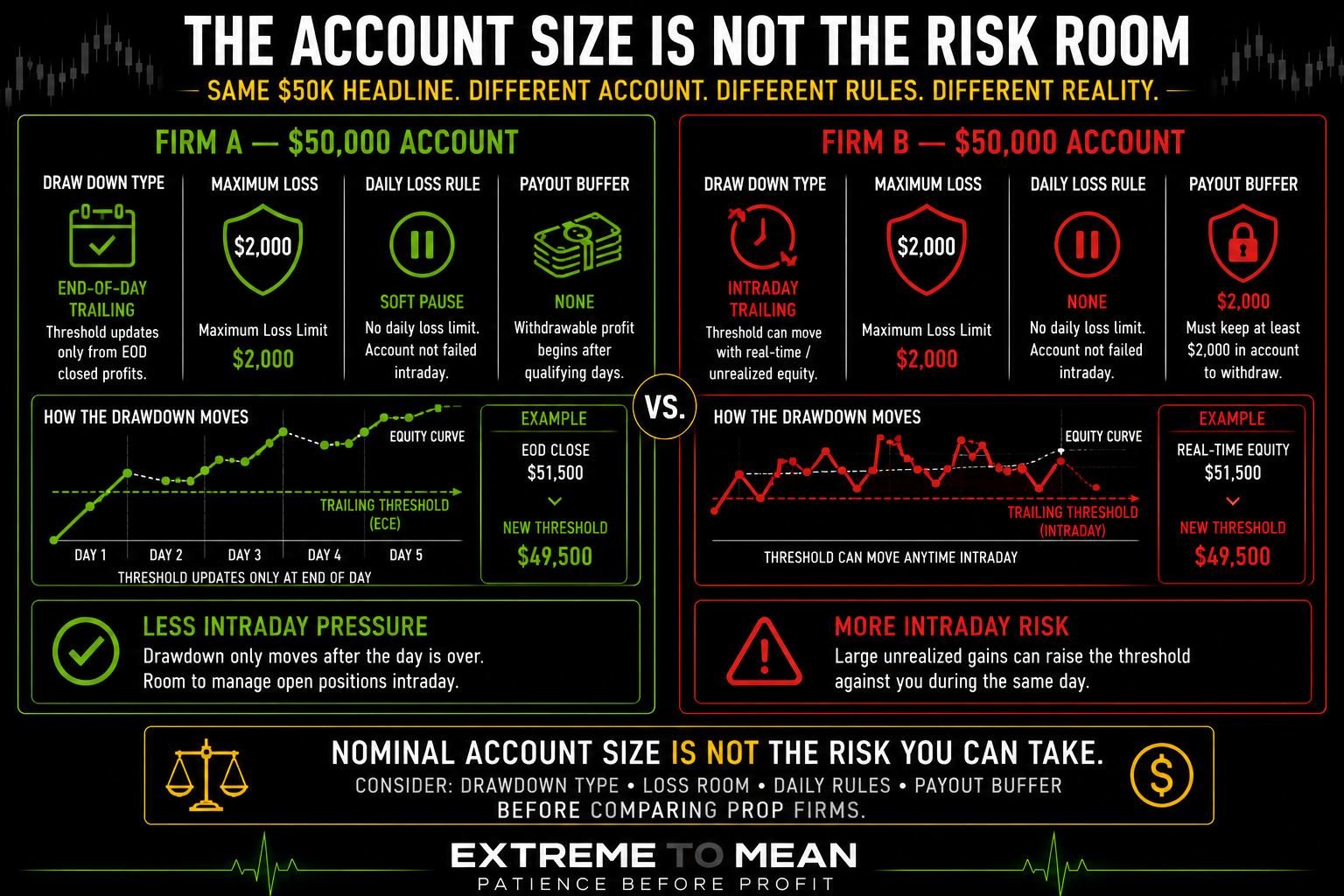
A $50,000 prop account does not usually mean the trader has $50,000 available to lose. If the program allows only $2,000 of drawdown, that $2,000 tells the trader far more about survival than the number printed on the account name. The guide to how prop-trading drawdown works explains why the calculation method matters as much as the amount. In prop trading, the drawdown is often more important than the headline account size.
Drawdown type matters almost as much as drawdown amount. An end-of-day trailing model can move its threshold based on closing performance, while an intraday trailing model may react to real-time equity or unrealized gains; two programs can therefore advertise the same $2,000 drawdown while behaving very differently. Apex's current EOD program and Topstep's MLL are examples of rules whose thresholds use end-of-day gains but remain enforceable during the following or current trading session. (apextraderfunding.com)
Imagine two hypothetical $50,000 programs with $2,000 maximum loss room. One updates only from end-of-day performance, while the other follows a large intraday unrealized gain upward before the position retraces; a runner-based strategy can experience those accounts very differently despite identical headline numbers. Same account size and same stated drawdown do not necessarily create the same trading environment.
Passing the Evaluation Is Only Half the Rulebook
The trader should compare evaluation and funded-stage rules separately. Take Profit Trader currently moves from an EOD-drawdown Test to a simulated PRO account using intraday drawdown, while My Funded Futures Rapid moves from an EOD evaluation into a Sim Funded stage with intraday trailing drawdown. A trader who studies only the evaluation can therefore pass into a materially different risk structure. (try.takeprofittrader.com)
“Funded” also does not automatically mean live exchange capital. Topstep explicitly describes its Express Funded Account as simulated, Apex calls its Performance Account Sim Funded, and Tradeify distinguishes Sim Funded from its Elite Live program. Read what “funded” means at that firm before comparing funded accounts. (help.topstep.com)
Live progression is another separate question. Apex's live program is invitation-based, Tradeify's current Elite thresholds create eligibility for consideration rather than automatic qualification, and Take Profit Trader reviews PRO performance before moving selected traders to PRO+. A path to live trading is not the same promise as a guaranteed live account. (apextraderfunding.com)
Payout Access Matters More Than the Headline Split
A 100% payout split looks superior to 90% until the rest of the rulebook is added. Apex currently advertises 100% of approved EOD PA payouts, but the PA requires qualifying days, a safety net, 50% consistency, a minimum request, per-request caps, and a six-payout lifecycle. Profit split is the last step in payout math—not the first. (apextraderfunding.com)
Other firms illustrate different tradeoffs. Take Profit Trader's PRO uses an 80/20 split with daily withdrawal access above its buffer, while Tradeify's Select lets the trader choose between a five-winning-day Flex path and a Daily path with a buffer and smaller withdrawal caps. A trader can reasonably prefer either structure depending on how often the strategy generates qualifying profits and how much account cushion they want to preserve. (try.takeprofittrader.com)
Payout eligibility and processing speed should also be separated. A firm can process approved payments quickly while still requiring five qualifying days, a consistency threshold, or a protected balance before the trader becomes eligible to request one. Fast processing and fast eligibility are not the same thing.
The Cheapest Evaluation May Not Be the Cheapest Path
Real cost begins with more than the checkout price. Renewals, resets or repurchases, activation charges, data costs, funded-stage fees, commissions, and withdrawal costs can change the economics substantially. The cheapest evaluation is not necessarily the cheapest path from evaluation to payout.
Topstep's current 50K Standard Trading Combine, for example, is $49 per month and carries a $149 XFA activation fee after passage, while its $95-per-month No Activation Fee path removes that activation charge. Apex's current evaluations instead use one-time 30-day access, do not auto-renew, and cannot be reset; an unsuccessful trader purchases a new evaluation. Those are different cost structures even before trading performance enters the equation. (help.topstep.com)
This is where low evaluation prices can become a behavioral problem. A failed challenge can feel inexpensive enough to replace immediately, then another discount appears, and several small purchases quietly become a large recurring expense. A cheap challenge becomes expensive when failure turns into a subscription habit.
Different Rulebooks Create Different Winners
Topstep may appeal to traders who value a clearly documented progression from Combine to simulated XFA and possible Live Funded trading, but its payout paths and MLL still need to fit the strategy. Apex's EOD path may appeal to traders who prefer no evaluation consistency rule and no intraday-updating drawdown calculation, but its Sim Funded payout safety net, consistency requirement, caps, and lifecycle still matter. Neither advantage makes either firm universally better. (help.topstep.com)
Take Profit Trader currently emphasizes daily PRO payout access and a possible live PRO+ progression, while its rules also change between the Test and PRO stages and major-news restrictions apply after passage. TradeDay's selected Make It Take It path offers day-one Sim Funded payout eligibility without a payout buffer, but the funded split changes according to net-profit level and its selected path retains intraday trailing drawdown. The right comparison depends on which of those constraints affects the trader's process most. (try.takeprofittrader.com)
My Funded Futures Rapid combines an EOD evaluation with daily Sim Funded payout eligibility after its required buffer, but its funded drawdown switches to intraday trailing. Earn2Trade uses a more structured evaluation with daily-loss, EOD-drawdown, and 30% consistency requirements, followed by a partner offer of LiveSim or Live and a withdrawal-size-dependent split. Those models serve very different definitions of simplicity. (help.myfundedfutures.com)
Tradeify's Select program demonstrates why comparison must occur at the plan level. The evaluation uses one rule set, but after passage the trader chooses Flex or Daily payout rules with different buffers, caps, and daily-loss structures, while Elite Live remains a discretionary progression rather than an automatic reward for reaching the minimum threshold. Different rulebooks create different winners. (help.tradeify.co)
Operational Risk and the Agreement Matter Too
Prop-company risk does not end with the trading rules. Traders should identify the legal entity, read the current agreement, understand payout-review and account-closure provisions, check support and status communication, and investigate how rule changes affect existing accounts. The promotional page explains the offer; the agreement governs the relationship.
For U.S. derivatives due diligence, NFA's BASIC database is a free tool for researching registration, membership status, contact information, and disciplinary history of firms and professionals that appear in the system. An NFA ID alone does not prove membership, and a non-member status does not by itself establish that a particular business model is unlawful because registration requirements depend on actual activities. Verify what the company claims to be rather than assuming the label “prop firm” answers the regulatory question. (nfa.futures.org)
Old YouTube videos, social posts, Reddit threads, and review sites can still reveal questions worth investigating, but they should not be the authority for the rule table. Apex retired its old new-purchase products in March 2026, Take Profit Trader changed new Test accounts from five to three minimum days in August, and Tradeify changed certain payout caps for accounts purchased after September 1. A comparison page that is not maintained can become wrong surprisingly quickly. (apextraderfunding.com)
A Prop Firm Should Fit the Trader—not Rewrite the Trader
The behavioral trap begins with the headline: “$100K account for almost nothing.” That framing encourages the trader to think about access and payout before asking whether the normal strategy survives the drawdown, funded-stage rules, news restrictions, or payout structure. A prop account should not become the reason a trader abandons the plan made before the open.
Maximum contract size creates the same temptation. A firm permitting ten NQ contracts has established a ceiling, not decided that ten contracts fit the trader's stop distance or remaining loss room. Protecting the next decision still matters more than using every unit of leverage the dashboard makes available.
The cleaner question is therefore not, “Which firm gives me the most?” Ask, “Which rulebook interferes least with the strategy I have already defined, tested, and learned to execute?” That is why prop-firm rules can matter more than the best-looking setup. The firm should fit the discipline rather than become the reason the discipline disappears.
A Practical ETM Prop-Firm Decision Framework
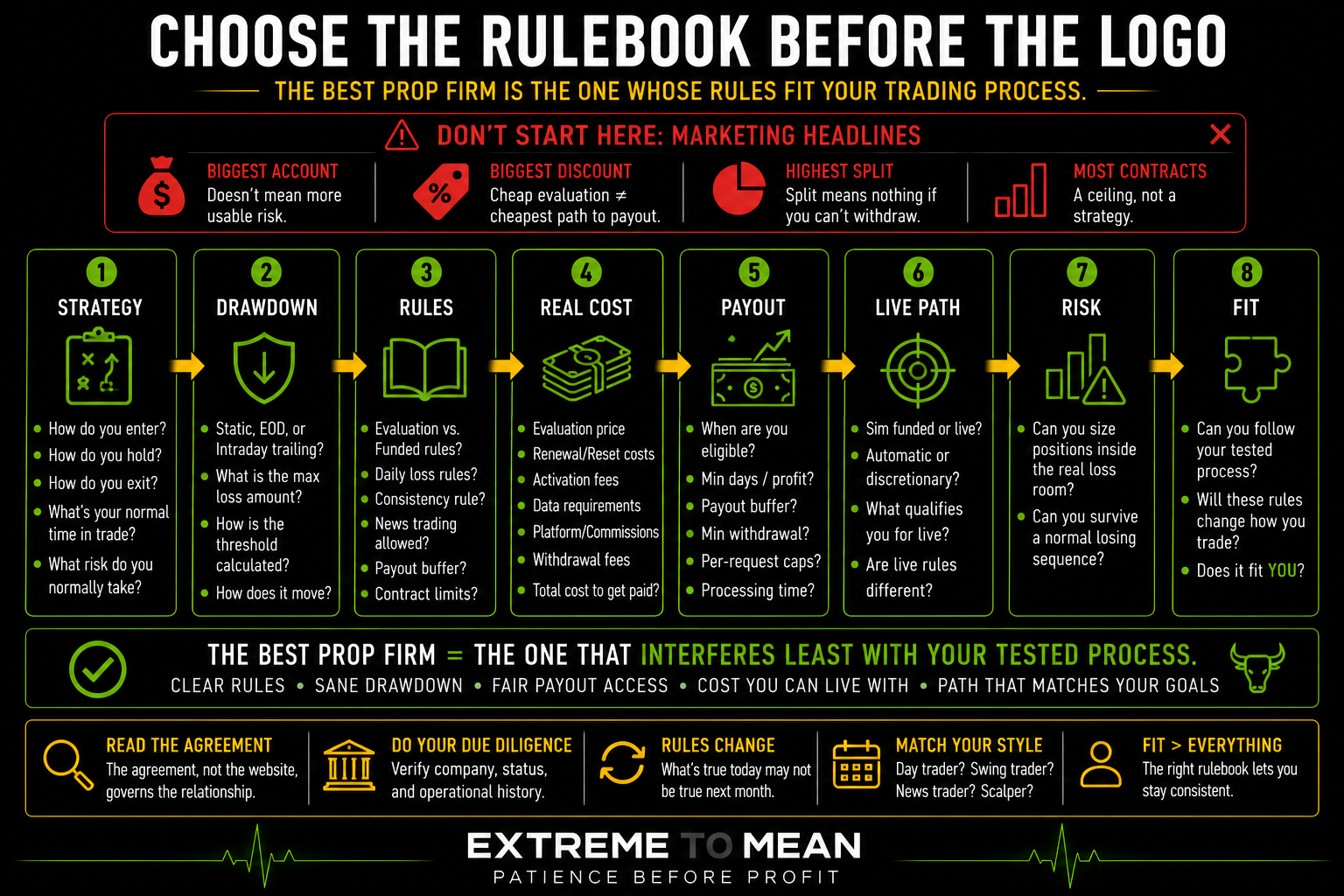
Use Strategy → Drawdown → Rules → Real Cost → Payout → Live Path → Risk → Fit. The sequence deliberately puts the firm's logo, coupon code, and nominal account size outside the decision process. It starts with the trader because the same program can be an excellent fit for one process and a poor fit for another.
- Strategy: How do you normally enter, hold, scale, and exit?
- Drawdown: Can that strategy tolerate this exact loss-threshold calculation?
- Rules: What changes between evaluation and funded stages?
- Real Cost: What can evaluation, renewal, reset, activation, data, and withdrawal costs realistically become?
- Payout: When does account profit become withdrawable profit?
- Live Path: Is the funded stage simulated, and what actually qualifies a trader for live capital?
- Risk: Can sensible position size fit inside the real loss room?
- Fit: Can you follow your normal process without trading differently merely to satisfy the account?
The better question is not “What is the best futures prop firm?” Ask, “Which firm's complete rules allow my tested process to remain my tested process?” Then read the current agreement once more before paying, because the marketing summary should never be the final authority.
Final Thought
There is no universal winner in this comparison because the firms are selling materially different rule environments. One trader may value an EOD drawdown enough to accept slower payout access, while another may prioritize daily withdrawals and accept tighter funded-stage constraints. Best is a fit—not a logo.
The account-size headline should therefore come late in the decision. Drawdown determines how much room the trader really has, funded-stage rules determine what happens after passage, payout rules determine how dashboard profit becomes withdrawable money, and real cost determines whether the cheap evaluation was actually cheap. Choose the rulebook before you choose the logo.
The best futures prop firm is not the one that gives the trader the largest imaginary account. It is the one whose rules give an already-defined trading process the clearest chance to remain that process without creating pressure to chase, oversize, or constantly renegotiate risk. That process-first approach is part of the broader discipline behind The Patience Principle.
Educational content only. Trading involves substantial risk and is not suitable for everyone.