
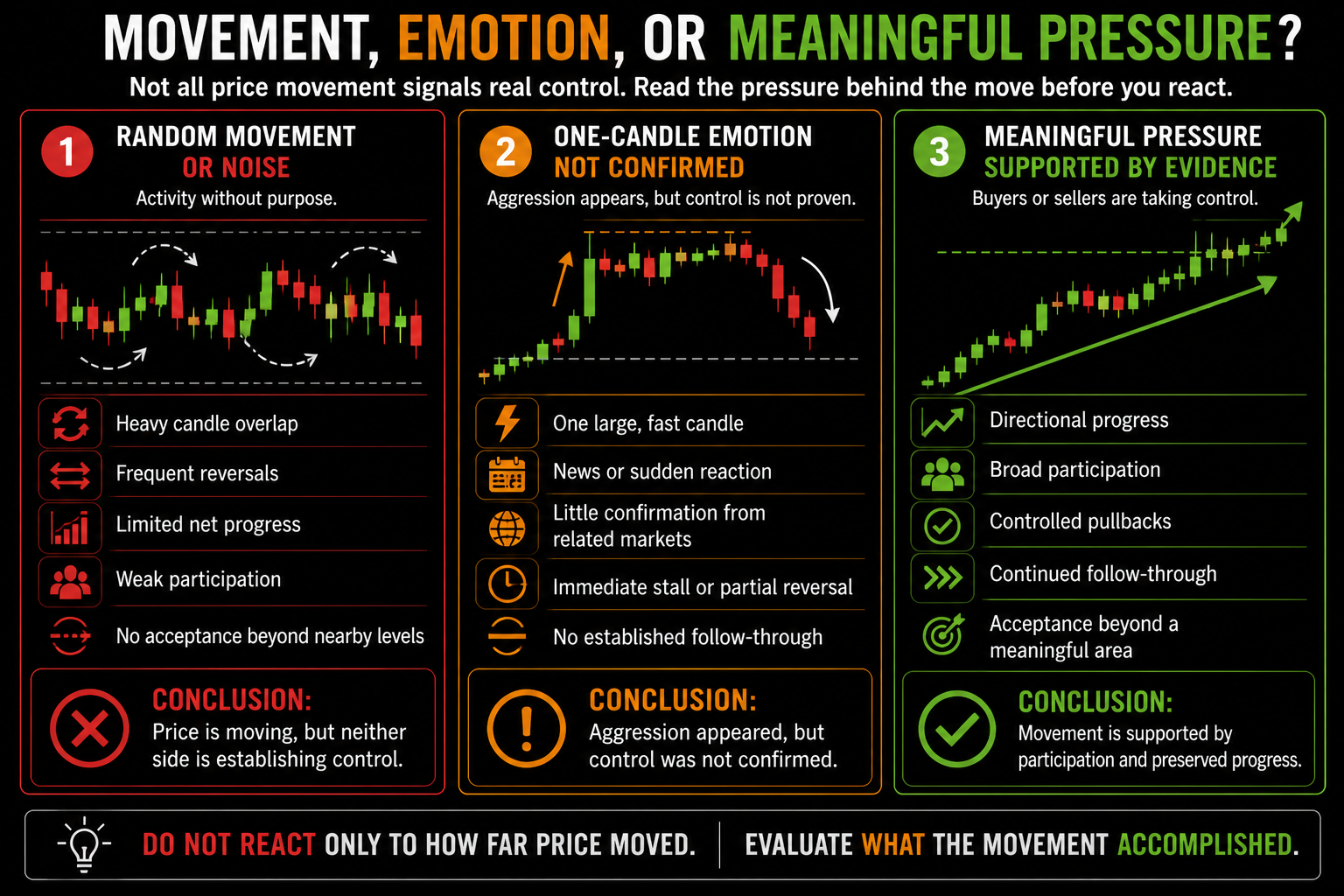
Many traders react to movement before they understand what produced it. A large green candle can create urgency to buy, while a sharp red candle can make a short entry feel immediately justified. The speed of the move creates the impression that one side has taken control. That impression may be correct, but the candle alone does not provide enough evidence.
The lessons in The Market category emphasize that price must be interpreted within its environment. Movement can come from broad participation, a temporary order imbalance, low liquidity, a reaction to news, or one aggressive push that receives no follow-through. Those causes do not carry the same meaning for the next decision. Reading pressure requires the trader to slow down long enough to observe what happens around and after the move.
Price Movement Is Not the Same as Pressure
Price movement shows that transactions occurred at different prices. Pressure describes whether buyers or sellers are consistently producing progress and maintaining control of that movement. A market can cover distance because liquidity is thin without showing broad conviction. It can also move slowly while one side steadily absorbs opposition and preserves progress.
This distinction builds directly on the lesson that trend describes the environment while momentum describes the pressure. Trend explains the larger structure, while immediate pressure explains how forcefully price is moving inside it. Neither speed nor direction proves that the move will continue. The trader must evaluate whether the pressure is effective within the surrounding structure.
Meaningful Pressure Leaves More Than One Clue
Meaningful buying pressure usually produces more than one bullish candle. Buyers may create upward progress, hold much of that progress during pauses, respond quickly to pullbacks, and continue accepting higher prices. Meaningful selling pressure often produces the opposite pattern through sustained declines, weak bounces, and repeated acceptance lower. The important feature is that the pressure continues to influence behavior after the first move.
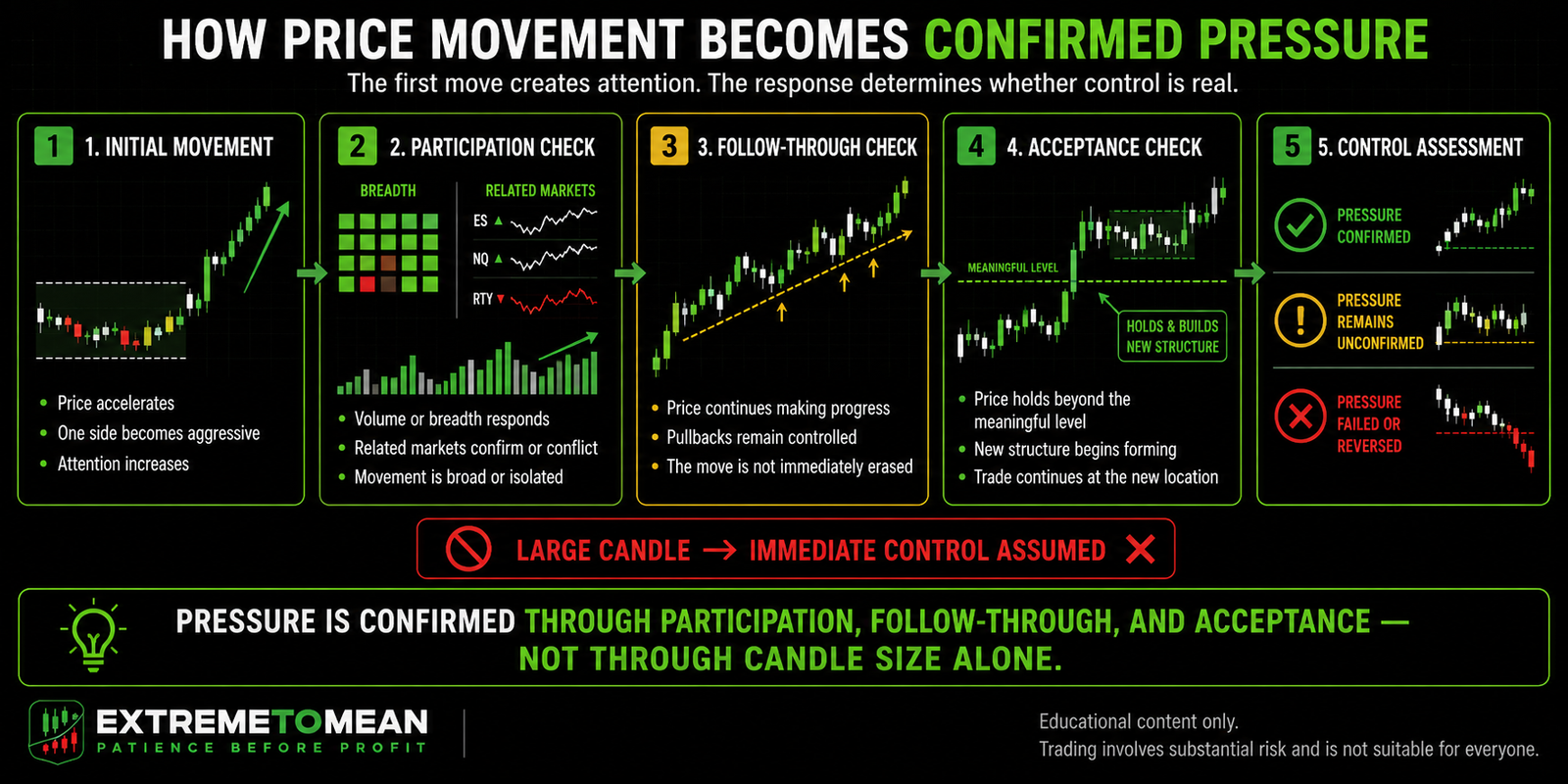
Participation adds another clue. Broad movement across related indexes, sectors, or leading instruments may carry more information than an isolated move in one thin or highly reactive product. Volume, breadth, and the behavior of related markets can help show whether the movement has wider support. These measures do not guarantee continuation, but they help distinguish broader pressure from a narrow event.
A Fast Candle Can Be Emotion, Not Control
Fast candles attract attention because they compress a large amount of movement into a short period. The trader may fear missing the move and assume that immediate participation is required. That response feels reasonable because strong pressure often does produce fast candles. The mistake is treating speed as proof before observing whether the market can maintain the progress.
A fast candle may represent a stop run, a news reaction, a liquidity gap, or the final emotional push of a move already near exhaustion. Price may travel quickly and then reverse because the aggressive orders were not supported by continued participation. The candle still mattered, but its meaning became clear only through the response that followed. Reacting before that response appears turns movement into an automatic signal.
One Candle Cannot Prove Control
A large candle can show temporary dominance without proving lasting control. Buyers may drive price above resistance and then fail to hold the breakout, or sellers may force price below support before the market immediately rejects lower prices — the kind of failed push examined in morning reversal trading. The initial movement shows aggression, while the response shows whether the market accepted the new area. Control requires more than reaching a price.
This is one reason market conditions change the quality of a setup. A breakout candle inside a strong directional environment may deserve a different evaluation from the same candle inside overlapping chop. A fast move near the beginning of available room may carry different potential than one arriving directly into major opposition. The market environment and location determine how much weight the candle deserves.
Pressure Requires Follow-Through and Acceptance
Follow-through shows whether the initiating side can continue producing progress after the first push. Buyers demonstrate follow-through when price extends, pullbacks remain controlled, and attempts to sell are absorbed without erasing the move. Sellers demonstrate it when bounces fail, lower prices continue to attract trade, and the market preserves downward progress. Without follow-through, the initial candle may have been an event rather than a durable change in control.
Acceptance describes the market’s ability to remain and transact beyond a meaningful area. A brief move above resistance does not carry the same message as price holding above it, building structure, and receiving continued participation. A quick break below support does not prove bearish control if the market immediately reclaims the area. Pressure becomes more meaningful when movement produces acceptance rather than only penetration.
Location Changes the Meaning of Pressure
The same pressure can carry different meaning depending on where it appears. Strong buying pressure near the lower boundary of a range may support a rotation toward the opposite side, while the same pressure directly beneath major resistance may offer little remaining room. Strong selling pressure after an extended decline into support may be less attractive than similar pressure beginning from a failed rally. Location helps determine whether the pressure is developing or already late.
This is why the trader should ask what market is being traded before forming a bias. Trending, ranging, and choppy environments create different expectations for how far pressure can travel and how reliably it may persist. Pressure that aligns with a trend may reinforce continuation, while pressure inside a range may represent only rotation. The movement must be evaluated within the structure that contains it.
Pressure Can Support or Fight the Broader Trend
Short-term pressure does not always align with the larger trend. An uptrend can contain strong selling pressure during a pullback, while a downtrend can contain aggressive buying during a relief rally. The immediate force is real even though the broader environment has not changed. The trader must decide whether the pressure is corrective, transitional, or strong enough to threaten structure.
The principle that context comes before the candle prevents one forceful move from replacing the larger market read. Strong opposing pressure may justify caution, reduced confidence, or waiting for structure to respond. It does not automatically prove that the trend has reversed. A new environment requires evidence beyond the existence of temporary opposing force.
Build the Read From a Sequence
A cleaner process begins with observation rather than reaction. The trader identifies the market state, the location of the move, the speed of price travel, and whether related markets are participating. The next step is to watch how price behaves after the initial push. Pressure should be judged through the complete sequence rather than through the first dramatic candle.
The trader can then compare aggression with effectiveness. Buyers may appear aggressive but fail to hold higher prices, while sellers may appear active but produce little downward progress. Effective pressure changes location, preserves progress, and limits the opposing side’s ability to respond. Activity without progress may reveal absorption, exhaustion, or conflict rather than control.
Before acting, the trader can use a short pressure-reading filter:
- Where is the move occurring within the larger market structure?
- Is the movement supported by broad or narrow participation?
- Did price make meaningful progress or only create one large candle?
- Is the initiating side receiving immediate follow-through?
- Are pullbacks controlled, or is the move being erased quickly?
- Has price established acceptance beyond a meaningful level?
- Are related indexes, sectors, or instruments confirming the move?
- Is pressure aligned with the broader trend or fighting it?
- Is there enough available room for the pressure to matter?
- What evidence would show that the apparent pressure has failed?
The better question is not, “How fast is price moving?” It is, “Is this movement producing control, participation, and continued progress?” Traders can add that question to a structured preparation process such as the 2026 Trader’s Macro Playbook. The goal is not to delay every decision but to prevent candle speed from becoming the only reason to act.
Review the Pressure Separately From the Outcome
Trade review should record what evidence of pressure was present before entry. The trader should note the location, participation, follow-through, acceptance, and relationship to the broader trend. A trade may lose even when those factors were evaluated properly, while a weak reaction-based entry may succeed temporarily. The review should focus on whether the pressure read was supported rather than whether one trade produced a favorable result.
The journal should also identify moments when movement was mistaken for control. A large candle may have created urgency, but the later response may show that participation was narrow or acceptance never developed. Recording those distinctions helps reveal which pressure clues were useful and which were assumed. Over time, the trader can improve the quality of observation without pretending that every move can be classified perfectly.
Final Thought
Price movement earns attention, but pressure must earn belief. Meaningful pressure produces progress, attracts participation, receives follow-through, and establishes acceptance within a relevant market location. One fast candle can begin that process, but it cannot complete it. The trader should evaluate what the movement accomplishes before deciding what it means.
The goal is not to wait until every uncertainty has disappeared. It is to slow the reaction enough to distinguish control from noise, emotion, or temporary imbalance. Buyers and sellers reveal pressure through the behavior that continues after the initial move. The trader’s job is to read that evidence before deciding whether the setup has earned risk.
Educational content only. Trading involves substantial risk and is not suitable for everyone.