
Many traders use the words trend and momentum as though they mean the same thing. When price rises quickly, they call the market bullish, trending, and strong without separating the broader structure from the immediate move. When price slows, they may assume the trend has ended even though the structure remains intact. That confusion can cause traders to chase short bursts of pressure or exit valid ideas before the environment has actually changed.
The lessons in The Market category emphasize that traders should describe what the market is doing before judging a setup. Trend and momentum are two parts of that description, but neither provides a complete answer by itself. Trend helps identify the environment in which the trade is being considered. Momentum helps identify the pressure currently acting inside that environment.
What Trend Actually Describes
Trend describes the market’s broader directional structure over a chosen timeframe. An uptrend generally makes upward progress, holds important pullbacks, and accepts higher prices over time. A downtrend generally makes downward progress, rejects important rallies, and accepts lower prices. A market that repeatedly rotates between boundaries without sustained progress is not trending merely because one move inside the range is strong.
The framework of the three market states provides the starting point for that classification. Trend is present when movement continues to build structure in one direction rather than repeatedly returning to the same area. The trader should observe swings, acceptance, pullback behavior, and the ability of price to preserve progress. One large candle or fast move is not enough to establish a broader trend.
What Momentum Actually Describes
Momentum describes the force, speed, and persistence behind the current movement. Strong momentum may appear through expanding candles, rapid price travel, shallow pullbacks, repeated closes near candle extremes, or immediate follow-through after a break. Weak momentum may appear through slowing progress, smaller candles, deeper pullbacks, greater overlap, or repeated failure to extend. These observations describe pressure, not necessarily the market’s larger structural state.
Traders can evaluate momentum without relying on one indicator or formula. Price behavior, volume, breadth, sector participation, and the response after important levels can all contribute to the read. The important question is whether buyers or sellers are producing meaningful progress with the pressure they are applying. Activity can be high while directional effectiveness remains weak.
The Same Trend Can Carry Different Pressure
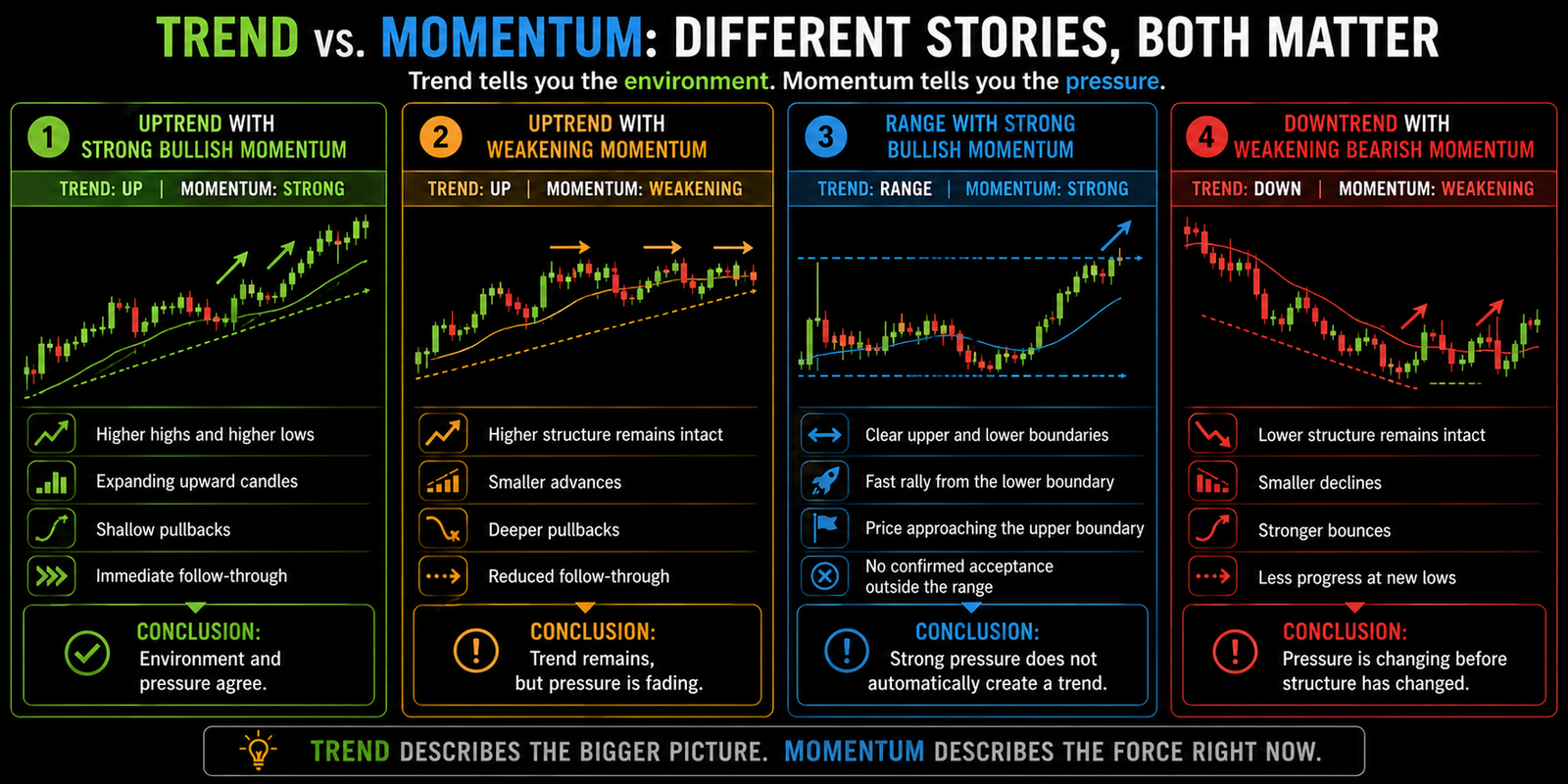
A market can remain in an uptrend while bullish momentum weakens. Price may continue holding above important structure and maintaining higher swing points, but each advance may cover less distance or require more effort. That environment is different from an uptrend in which buyers are expanding ranges and producing immediate follow-through. Both are technically upward, but the pressure supporting them is not the same.
This distinction supports the habit taught in Context Before Bias: What Market Am I Trading Inside?. A trader who sees an uptrend with weakening momentum may still prefer longs, but should not evaluate them as though pressure is accelerating. Entries may require better location, clearer confirmation, or more conservative expectations. The trend provides direction, while the momentum read changes how aggressively that direction should be trusted.
A downtrend can also continue while bearish momentum weakens. Sellers may still control the broader structure, but declines may become smaller, bounces may deepen, and new lows may receive less follow-through. That does not automatically create a long setup or prove that the downtrend is over. It shows that the pressure supporting the trend is changing and deserves closer evaluation.
Strong Momentum Can Exist Inside a Range
A ranging market can produce powerful momentum in either direction. Price may accelerate from the lower boundary toward the upper boundary with large candles and little interruption. The move can feel like the beginning of a new trend because the pressure is clear and immediate. If price remains inside the established range, however, the environment has not yet changed.
This is why strong momentum should not be confused with confirmed directional acceptance. Momentum can carry price quickly toward a boundary, but structure determines whether the move becomes a breakout or another rotation. A trader who chases near the opposite edge may be responding to pressure after the available room has already narrowed. The stronger the move looks, the easier it can be to forget where it is occurring.
Momentum Can Change Before Trend Changes
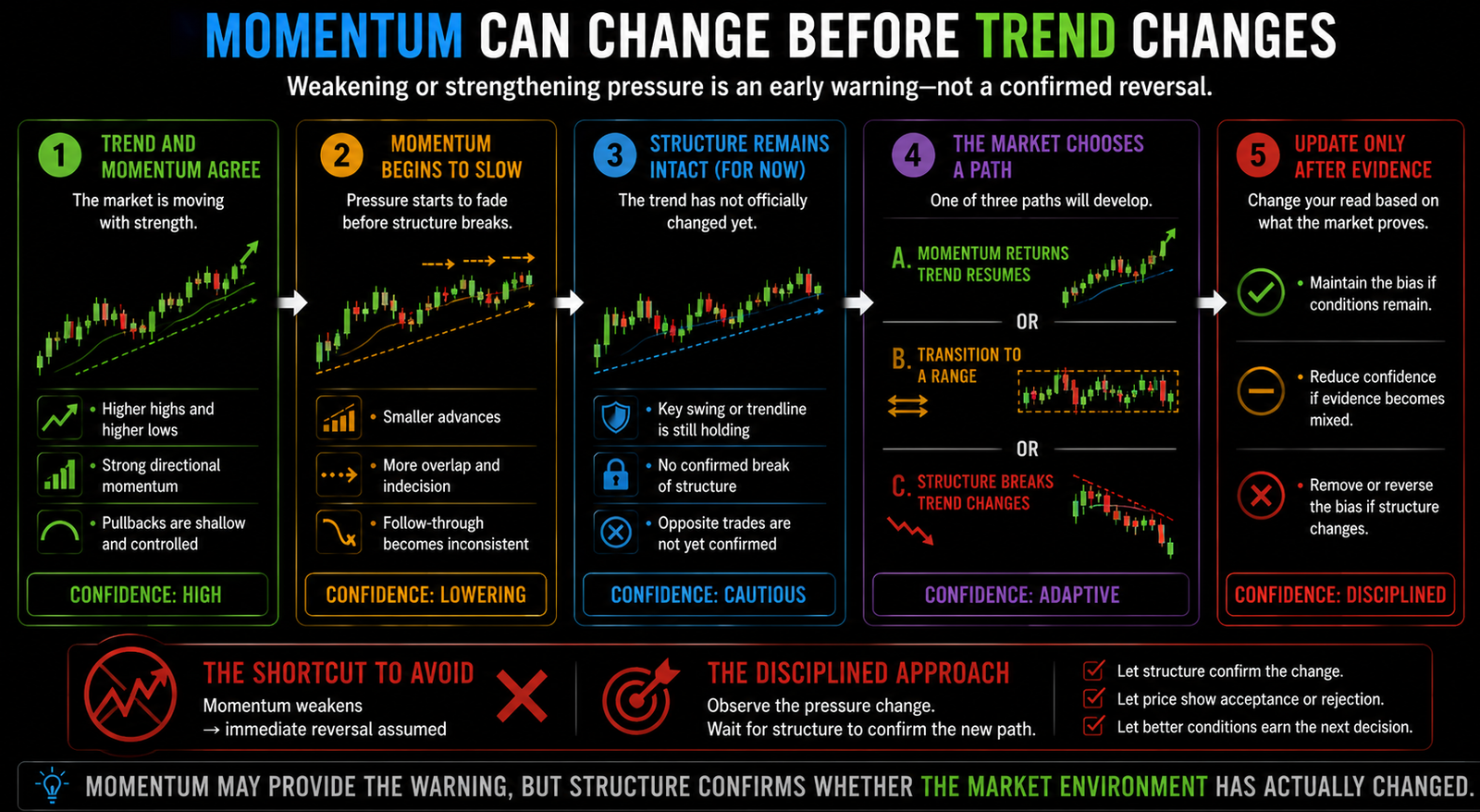
Momentum often changes before the broader structure changes. An uptrend may begin losing speed before a meaningful higher low fails, while a downtrend may begin losing selling pressure before an important lower high is broken. This makes momentum useful as an early warning that the environment may be becoming less efficient. It does not make momentum a reliable prediction that reversal must follow.
The lesson that market bias is not a prediction applies directly to this transition. Weakening momentum should cause the trader to review the evidence, not declare that the opposite trend has already begun. The market may pause, range, pull back, and then resume the original direction. A structural change requires structural evidence, even when pressure has already shifted.
Weakening Momentum Is Not Automatic Reversal
Weak momentum can produce several outcomes. The trend may pause while participation rebuilds, develop a deeper pullback, transition into a range, or eventually reverse after structure fails. The trader cannot know which path will occur from slowing pressure alone. Momentum tells the trader to become more observant, not to replace one prediction with another.
Patience matters during this stage because the market may be between clear conditions. Entering automatically with the old trend can ignore the loss of pressure, while entering against the trend can anticipate a structural change that has not happened. The cleaner process is to identify the weakening pressure and define what evidence would confirm continuation, consolidation, or reversal. Waiting for that evidence is active evaluation rather than indecision.
Timeframe Changes the Trend and Momentum Read
Trend and momentum must always be connected to a timeframe. A market can be trending higher on an hourly chart while showing strong bearish momentum during a short-term pullback. It can also be ranging on a higher timeframe while trending sharply on a lower execution chart. These statements do not conflict because they describe different layers of market behavior.
A trader should identify which timeframe defines the environment and which timeframe is being used to evaluate immediate pressure. The higher timeframe may provide the structural context, while the execution timeframe shows whether momentum currently supports or fights that context. Problems arise when the trader switches timeframes only to preserve a preferred conclusion. The timeframe relationship should be defined before the trade creates emotional pressure.
Use Trend and Momentum to Evaluate the Setup
Trend helps the trader determine which directional ideas may fit the broader environment. In an established uptrend, long setups may deserve more attention than shorts, while an established downtrend may favor the opposite. In a range, neither directional preference should automatically dominate near the middle. The environmental read narrows the kinds of decisions that deserve consideration.
Momentum helps the trader judge the current pressure surrounding the setup. A pullback long in an uptrend may be stronger when selling momentum slows and buyers begin responding from a meaningful area. The same setup may deserve more caution when bearish pressure is still expanding through the proposed entry location. Momentum does not approve the trade, but it helps explain whether the immediate pressure supports or challenges it.
Location remains necessary even when trend and momentum agree. A strong uptrend with accelerating momentum can still offer a poor long entry if price is extended into resistance or far from a logical invalidation point. A strong downtrend can still offer a poor short entry after price has already stretched into meaningful support. The principle that context comes before the candle prevents directional pressure from replacing full trade qualification.
A Practical Trend-and-Momentum Filter
A cleaner process begins by identifying the environment before measuring the pressure. The trader first determines whether the market is trending, ranging, or chopping on the timeframe that defines the setup. The trader then evaluates whether current momentum is strengthening, weakening, opposing, or remaining neutral within that structure. Only after those two questions are answered should the specific trade be evaluated.
Before acting, the trader can use a short trend-and-momentum filter. The answers should produce a connected description rather than a collection of unrelated bullish or bearish observations. When trend and momentum conflict, the conflict should be acknowledged instead of explained away. A setup may still be valid, but it should be judged according to the environment actually present:
- What timeframe defines the broader market environment?
- Is that environment trending, ranging, or chopping?
- Is current momentum expanding, weakening, or becoming mixed?
- Is momentum moving with the broader structure or against it?
- Is strong momentum occurring near the beginning of available room or near an important boundary?
- Has momentum changed while structure remains intact?
- What structural evidence would confirm that the trend has changed?
- Does the setup have clear location, room, and invalidation?
- Would the trade still qualify without using momentum alone as justification?
- What evidence would require the market description to be updated?
The better question is not, “Is momentum bullish or bearish?” It is, “What environment is present, and what pressure is acting inside it?” Traders can incorporate that question into a repeatable preparation routine such as the 2026 Trader’s Macro Playbook. The distinction helps organize evidence without turning either trend or momentum into a prediction.
Review Environment and Pressure Separately
Trade review should record the trend and momentum reads separately. The trader may correctly identify an uptrend but enter while short-term bearish pressure is still expanding, or correctly identify strong bullish momentum inside a range but mistake it for a breakout. Separating the two observations makes the process error easier to find. A single label such as bullish or bearish often hides too much information.
The journal should also note when momentum changed before the structure did. The trader can review whether that change was treated as a warning, ignored entirely, or mistaken for immediate reversal confirmation. Over time, this can improve the recognition of transitions without encouraging prediction. The goal is to understand how pressure evolved inside the environment and how the trader responded.
Final Thought
Trend and momentum describe different parts of market behavior. Trend tells the trader whether the broader structure is progressing upward, downward, or not progressing at all. Momentum tells the trader how much force buyers or sellers are applying during the current move. Reading one without the other can produce an incomplete or misleading picture.
The goal is not to find perfect agreement between every timeframe and every form of evidence. It is to know whether the setup is operating with the broader environment, with the current pressure, with both, or with neither. Trend helps frame the opportunity, while momentum helps qualify the immediate conditions. The trader’s job is to evaluate that relationship before deciding whether the setup has earned risk.
That distinction supports a structure-first approach to trend trading, where continuation is evaluated rather than assumed.
Educational content only. Trading involves substantial risk and is not suitable for everyone.