
The difference between a good setup and a good trade explains why technical validity is only one part of the final decision.
Traders often assume that a complicated explanation reflects deeper analysis. They collect indicators, switch between timeframes, mark additional levels, and search for more reasons to support the trade because more evidence feels safer. The process can look thorough while making it harder to identify which part of the idea actually matters. Macro language can hide the same problem — conflating inflation with currency debasement can make an argument sound sophisticated while actually blurring which mechanism is being discussed.
A strong setup does not need to be simplistic, but its central logic should be simple enough to follow. The trader should be able to explain why the location matters, what behavior is creating the opportunity, where the idea becomes invalid, and what destination the market could reasonably reach. When those pieces are clear, the trade can be evaluated without forcing the chart to support a preferred conclusion.
This lesson belongs in the broader setup and risk lessons because clarity is part of qualification. A familiar pattern may earn attention, but the trader still needs to understand whether the complete decision makes sense. Simplicity helps reveal whether that understanding is actually present.
Simplicity Is a Test of the Logic
A clean setup usually follows a short and understandable chain of reasoning. Price reaches a meaningful area, the market begins responding in a way that supports the idea, the invalidation point is visible, and enough room exists toward a reasonable target. Each part supports the next without requiring the trader to invent missing pieces.
This is closely related to what makes a trading setup actually tradable. A setup does not qualify merely because a candle, indicator, or pattern appears. It becomes useful when location, structure, risk, timing, and available opportunity form one coherent decision.
Consider a market pulling back toward established support during an orderly upward structure. Selling pressure slows inside the area, buyers begin producing higher lows, and the next major resistance remains far enough away to provide usable room. The trader can explain the idea in a few sentences because the structure itself is doing most of the work.
Now compare that with a bullish signal appearing in the middle of overlapping movement. The trader may point to an oscillator, a small divergence, a moving average, a prior candle, and a larger-timeframe bias, yet still struggle to explain why this exact location deserves risk. The explanation becomes longer because the market is not providing one clear reason for participation.
Simplicity does not make the outcome certain. The clean setup can still fail because every trade involves uncertainty. The advantage is that the trader understands what is being accepted and can recognize when the original reasoning is no longer valid.
Why Weak Setups Become Complicated
Weak setups often become complicated because the trader has already decided to like the trade. Once that attachment forms, analysis can shift from evaluation to justification. Instead of asking whether the trade is clear, the trader searches for enough evidence to make it feel acceptable.
The process usually begins innocently. One indicator supports the idea but the location is weak, so another timeframe is opened. That chart shows a conflicting structure, so a different indicator or level is added until the trader finds something that agrees with the preferred direction.
Each added reason may sound reasonable on its own. The problem is that the reasons do not form one clean argument; they form a collection of separate observations being used to overcome the weakness of the setup. Complexity becomes a substitute for clarity.
This mistake feels responsible because the trader appears to be checking more information before acting. In reality, the growing explanation may reveal that the decision cannot stand on its strongest evidence. When the central trade idea is weak, more analysis can make it harder to see the weakness rather than easier.
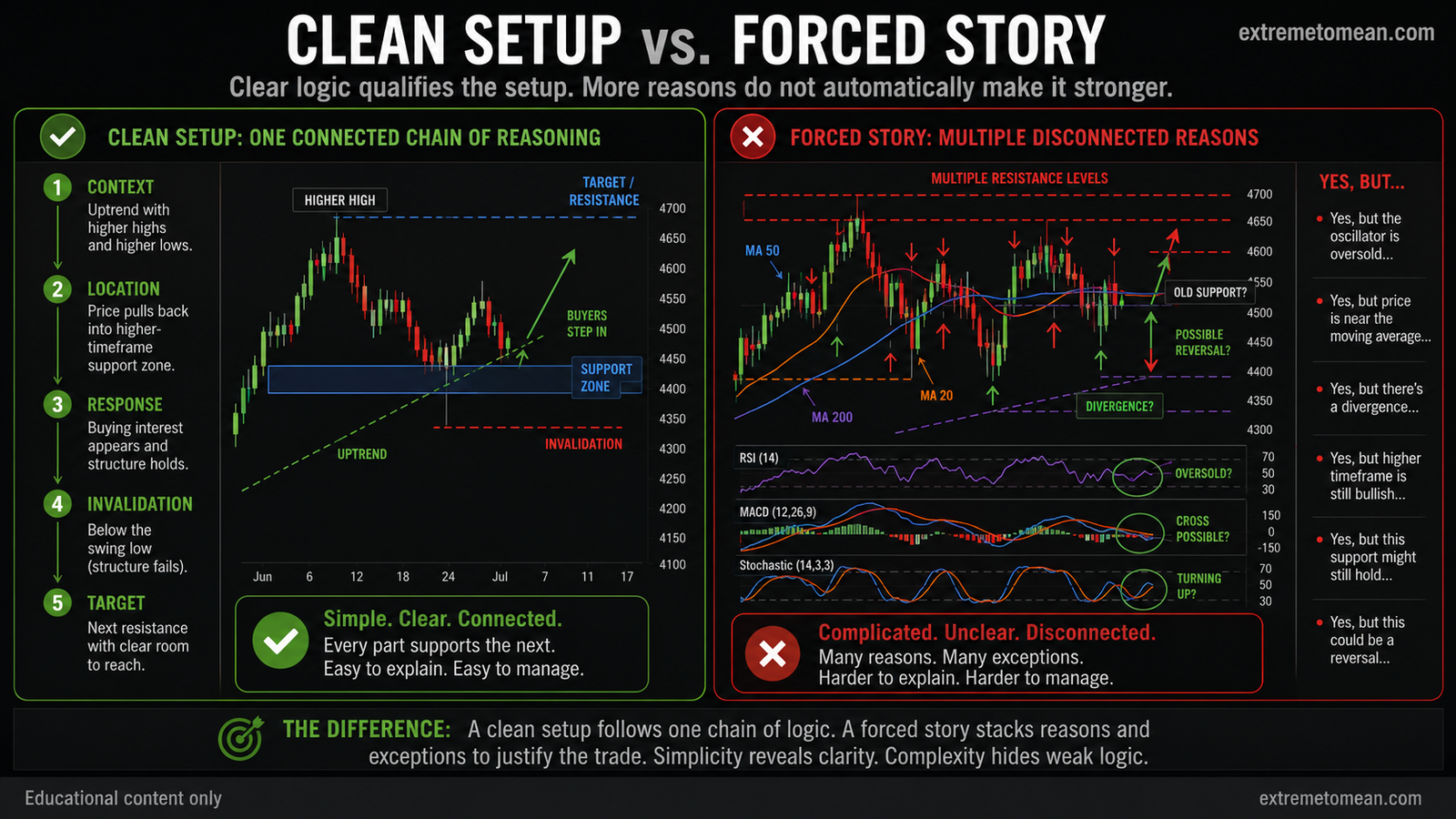
A practical warning sign is the phrase, “Yes, but…” The setup is in a poor location, but an indicator is turning. Risk is unclear, but the larger timeframe might support the trade. The target is crowded, but price could break through the obstacle.
One exception does not automatically invalidate a trade. Markets are rarely perfect, and every setup contains uncertainty. The concern begins when exceptions become the main structure holding the idea together.
More Indicators Do Not Automatically Add Clarity
Indicators can organize information, highlight changes in momentum, or help a trader apply a repeatable method. They become a problem when several indicators are used to answer the same question until one finally provides the desired response. Agreement created through repetition is not necessarily stronger evidence.
Three of the common mean-reversion indicators may appear to confirm one another because they are all calculated from similar price information. Several moving averages may also create the impression of independent support even though they are describing related aspects of the same movement. The screen becomes busier without necessarily adding a new reason for the trade.
This is one reason a setup is not the same as a signal. An indicator can identify a condition, but it cannot decide whether the location is meaningful, whether the market state supports the idea, or whether the risk and target make sense. The signal should fit inside the trade logic rather than become the logic by itself.
A cleaner process assigns each tool a specific job. One element may define the market environment, another may identify location, and another may help time the response. When two or three tools are performing the same job, the trader should ask whether they are providing independent information or merely repeating the same message in different forms.
The better question is not, “How many indicators agree with me?” It is, “What essential information does each tool add to this decision?” If an indicator cannot answer that question, it may be creating confidence without improving clarity.
Exceptions and Changing Stories Are Warning Signs
A clean setup should remain understandable as price approaches the planned entry. New information may require the trader to adjust or reject the idea, but the original reasoning should not need to be rewritten every few minutes. A constantly changing explanation often means the trader is protecting the desire to participate rather than evaluating the market.
Suppose the trade begins as a continuation setup. When momentum weakens, it becomes a pullback entry; when support breaks, it becomes a false-break idea; and when the position moves deeper against the trader, the larger timeframe is used to justify holding. The trade has not become more sophisticated—it has changed identities several times.
Every new explanation may be plausible in isolation, but the position is no longer being managed according to one defined setup. The trader is replacing failed evidence with a new story because closing the trade feels more difficult than revising the narrative. Flexibility has become avoidance.
A strong plan allows the trader to explain what would confirm the idea and what would invalidate it. The lesson on using enough confirmation without ruining the entry clarifies why evidence needs a defined job. When the invalidating behavior occurs, the conclusion should become clearer rather than more complicated. The trader may later identify a completely new setup, but it should be evaluated as a new decision rather than used to rescue the old one.
This distinction protects decision quality. The market is allowed to change, and the trader is allowed to update an opinion. What should not change casually is the definition of the trade after risk has already been accepted.
Clear Setups Make Risk Easier to Define
Risk becomes easier to understand when the trade logic is clear. If the setup depends on support holding, the trader can identify the behavior that would show support is no longer controlling the decision. If the trade depends on a breakout being accepted, a return beneath the area may provide a logical invalidation condition.
When the explanation is vague, the stop usually becomes vague as well. The trader may know that the position feels wrong but cannot describe what market behavior actually invalidated the idea. That uncertainty encourages stops based on discomfort, arbitrary dollar amounts, or hope that the market eventually returns.
The lesson on why the trade is not ready until the risk is clear reinforces this connection. A setup that cannot explain where it is wrong is not merely missing a risk-management detail. It is missing part of the logic required to qualify the trade.
Clear risk also helps determine position size and available room. Once the invalidation distance is known, the trader can calculate exposure instead of choosing size first and forcing the stop to fit. The realistic target can then be compared with the risk to determine whether the trade structure deserves participation.
This is why simplicity improves more than the explanation. It makes the decision measurable. The trader can identify what is being risked, what evidence must remain present, and what market movement the trade is reasonably attempting to capture.
Use the One-Sentence Setup Test
One useful review is to explain the trade in a single complete sentence. The sentence should not contain every management rule or every piece of background information. It should state the central logic clearly enough that another trader could understand why the setup deserves evaluation.
For example:
Price is pulling back into higher-timeframe support within an intact uptrend, and I will consider a long only if buyers regain control while the prior structural low remains valid and enough room exists toward resistance.
That sentence identifies the environment, location, required response, invalidation logic, and realistic opportunity. It does not guarantee that the trade will work, but it describes one coherent setup. The trader can then expand the plan with the exact entry, stop, target, size, and management rules.
A forced setup may produce an explanation like this:
Price is near a moving average, the oscillator is oversold, another indicator is showing divergence, the daily chart is generally bullish, the earlier support might still matter, and this could become a reversal if buyers appear.
The second explanation contains several observations but no clear decision structure. The location is uncertain, the response has not occurred, invalidation is missing, and the target is undefined. The trader is describing reasons to remain interested rather than explaining a qualified setup.
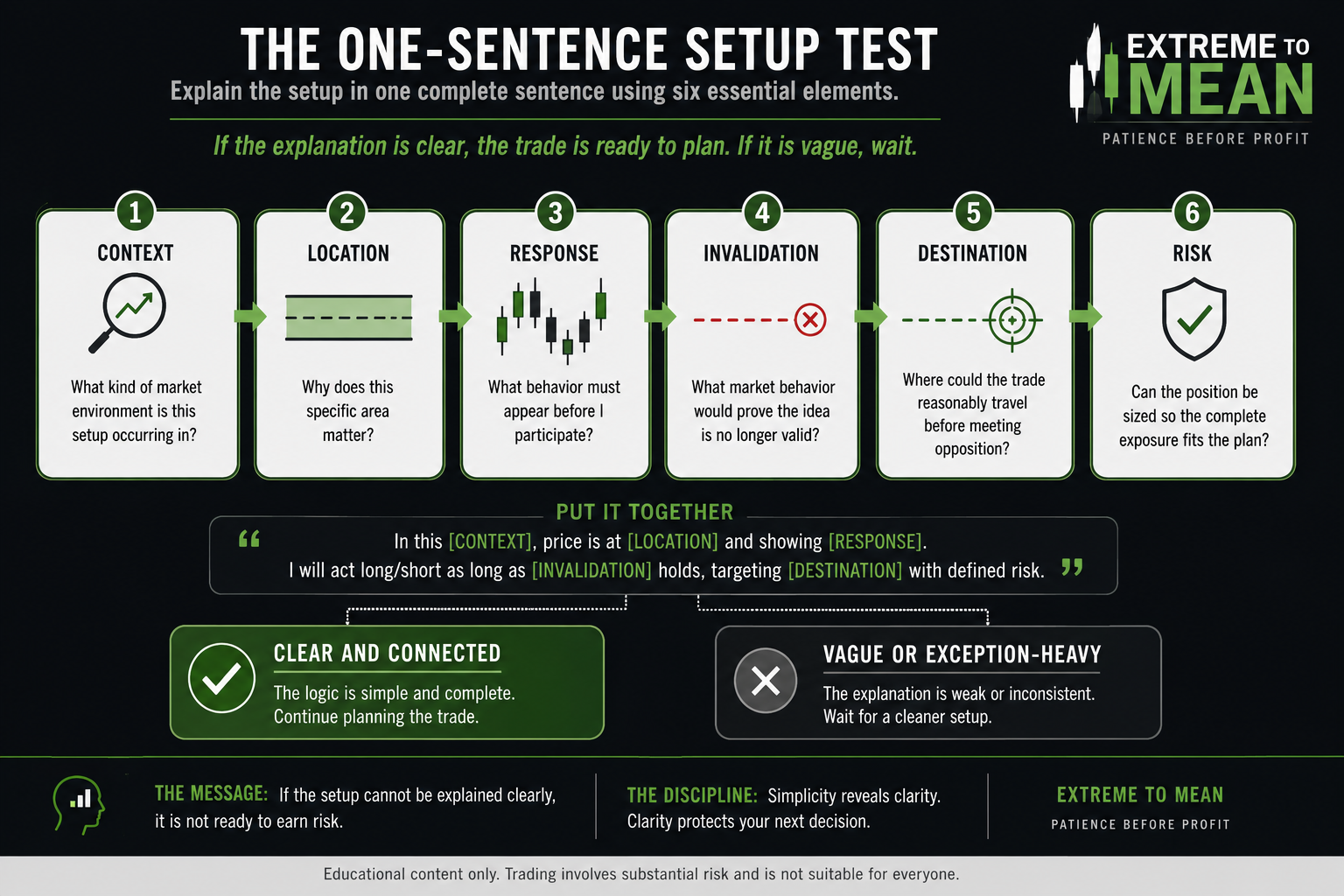
Before acting, the trader should be able to answer:
- Context: What kind of market is this setup occurring inside?
- Location: Why does this specific area matter?
- Response: What behavior must appear before participation?
- Invalidation: What would prove that the setup is no longer valid?
- Destination: Where could the trade reasonably travel before meeting opposition?
- Risk: Can the position be sized so the complete exposure fits the plan?
These questions should make the explanation clearer, not longer. When each answer adds a direct piece of the trade, the setup becomes easier to evaluate. When each answer creates another exception, the cleaner decision may be to wait. The quality of the answers depends on the quality of the questions, which is why better questions create better trades in the first place.
Simplicity Does Not Mean Ignoring Context
A simple explanation is not an excuse to reduce trading to one pattern or indicator. “The candle is bullish, so I am buying” is easy to explain, but it is not a complete setup. Simplicity should come from organizing the important information, not from ignoring it.
Market context still matters because conditions change the quality of a setup. A pullback can be useful in an orderly trend and unreliable in overlapping chop, even when the visible pattern looks similar. A short explanation must still include the conditions that materially affect the decision.
The goal is disciplined compression. The trader identifies the few pieces of information that determine whether the trade makes sense and removes observations that do not change the decision. The final explanation may be brief because the thinking is organized, not because the market has been oversimplified.
Experienced traders may evaluate many details quickly, but those details should still support one central idea. The trader should be able to separate essential evidence from background information. When everything is treated as equally important, the decision becomes difficult to explain because no hierarchy exists.
A clean setup is therefore not the setup with the fewest possible inputs. It is the setup in which every important input has a clear role and the complete logic remains understandable.
The Explanation Should Survive the Entry
A useful test of setup quality is whether the explanation remains stable after the position opens. Normal movement may occur, and the trader may receive additional information, but the original reason for participating should still be recognizable. The position should not require a new argument every time price moves against it.
Before entry, the trader may explain that a long setup depends on buyers defending support and producing renewed upward structure. After entry, a brief pullback may be acceptable if that structure remains intact. If support fails and sellers maintain control beneath the area, the original explanation no longer describes the market.
The trader should not respond by adding new indicators or changing timeframes until the position looks reasonable again. The clean conclusion is that the original setup has been invalidated. A future trade may form, but it should earn risk through its own logic.
This approach separates patience from stubbornness. Patience allows a valid setup enough room and time to develop, while stubbornness keeps changing the explanation to avoid accepting that the idea failed. The difference is visible in whether the original reasoning still applies.
Final Thought
The cleanest setup is not the one with the most agreement on the screen. It is the one whose context, location, required response, invalidation, and realistic destination form one understandable decision. The explanation becomes simple because the logic is organized.
Complicated setups are not always bad, and simple setups are not guaranteed to work. The warning appears when complexity is being used to hide unclear location, undefined risk, conflicting evidence, or a story that keeps changing. More information should improve the decision rather than make the trade harder to explain.
Before acting, describe the setup in one complete sentence and then test each part of that sentence. When the logic is clear, the trader can define the complete plan. When the explanation requires too many exceptions, patience may be the cleanest decision.
The free trading tools and checklists can help organize the setup, location, invalidation, target, and risk before capital is committed.
Educational content only. Trading involves substantial risk and is not suitable for everyone.