
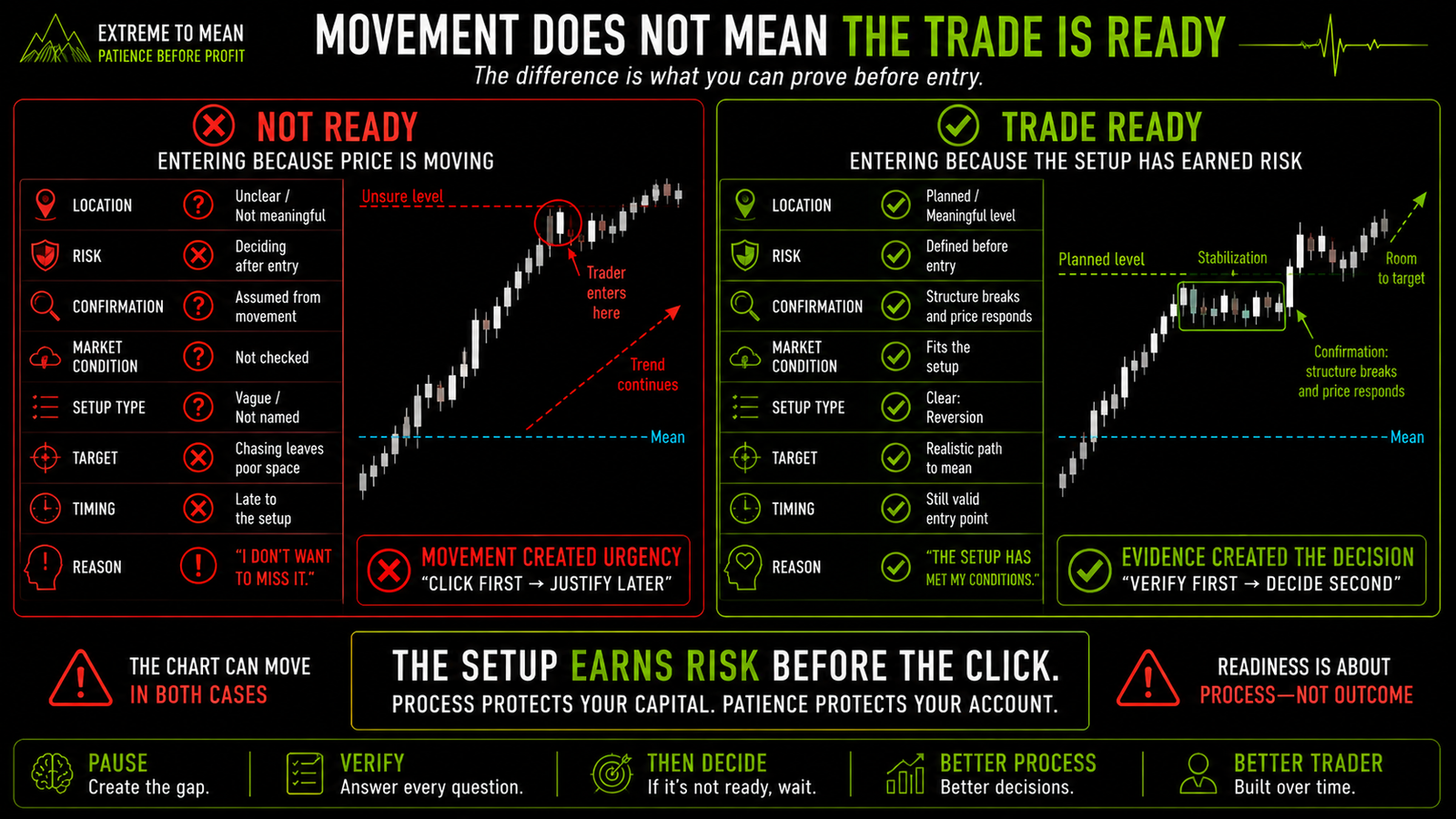
Most poor entries do not feel obviously reckless in the moment. Price starts moving, a familiar pattern appears, and the trader feels pressure to act before the opportunity disappears. That urgency makes skipping one or two questions feel reasonable because the chart seems to be answering them already. The problem is that movement and readiness are not the same thing.
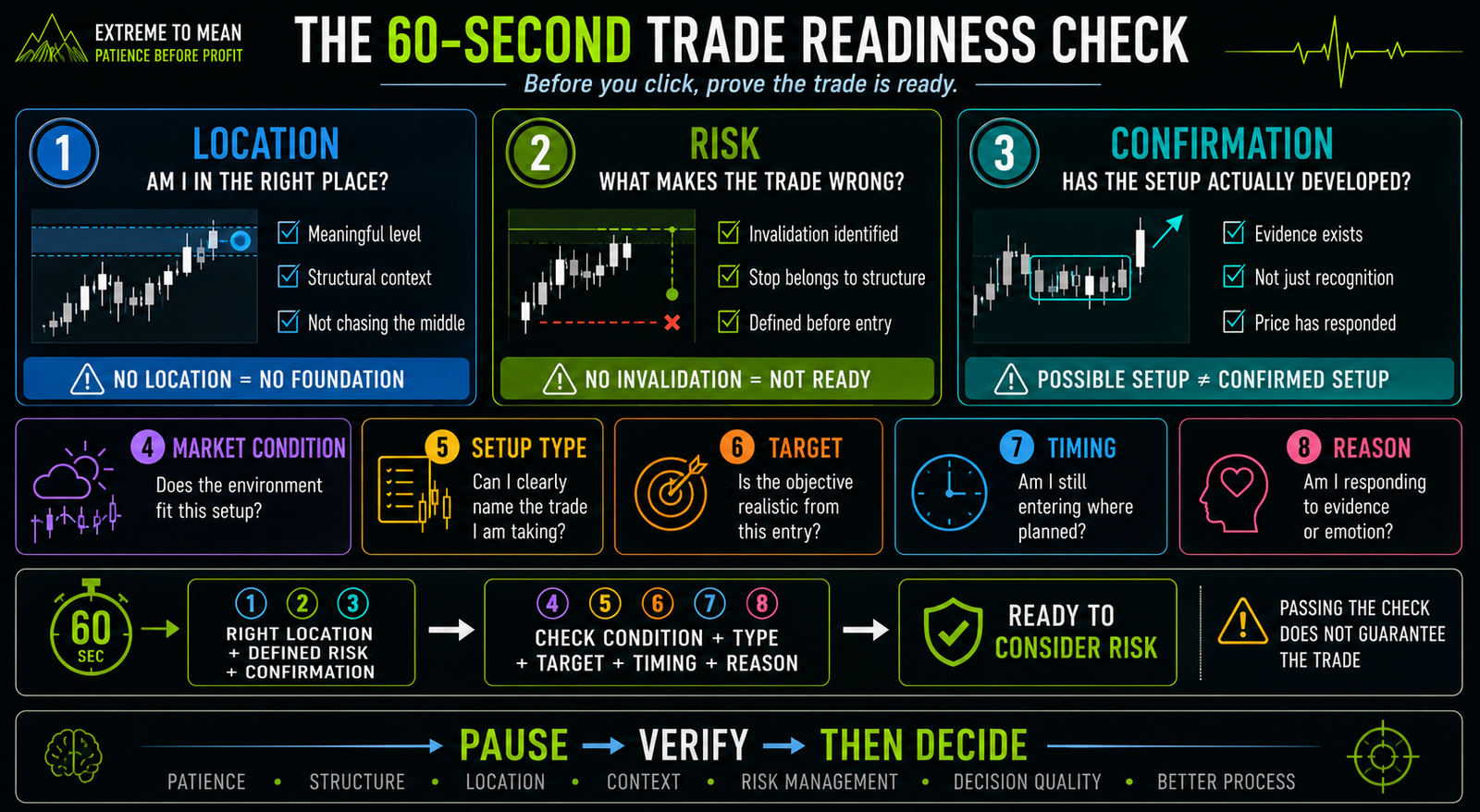
A cleaner process inside The Setup creates a short gap between recognition and commitment. The trader uses that pause to confirm what the setup is, where it is occurring, what invalidates it, and whether current conditions make the trade worth considering. Sixty seconds is not meant to replace analysis that should already have happened during preparation. It is the final check that the idea on the screen still matches the trade the trader is about to take.
Why the Pause Matters
Fast markets create the illusion that thinking costs opportunity. When candles expand or price begins moving away from an important level, the trader can feel that every extra second increases the chance of missing the entry. Clicking quickly feels like decisiveness, while pausing can feel hesitant. That emotional pressure is exactly why a repeatable readiness check is useful.
The check is not designed to talk the trader out of every trade. It is designed to expose missing information before capital is committed, when correcting the mistake is still cheap. A trade that remains valid after a short review has lost nothing important because the thesis still exists. A trade that falls apart under basic questions probably had not earned risk yet.
Question One: Am I in the Right Location?
Location should be the first question because an otherwise attractive pattern can be poor when it develops in the wrong part of the market. Price might be reacting at a meaningful extreme, established support or resistance, a higher-timeframe reference, a range boundary, or another area where the setup has a structural reason to exist. If the trader cannot explain why the current area matters, the entry is already missing an important piece. This is why location is the first filter, not something to justify after the trade is entered.
The weaker decision is entering because price started moving in the desired direction before location was evaluated. Momentum makes the setup feel more legitimate, but movement does not repair poor placement. A late long beneath resistance or a reversion entry in the middle of congestion can still be structurally weak even if the first candle looks impressive. The readiness check asks whether the trade begins from a place that supports the thesis rather than merely from a place where price became exciting.
Question Two: Is the Risk Clearly Defined?
Before entry, the trader should know what market behavior would make the original idea wrong. That might be acceptance beyond a structural level, failure of a reclaim, loss of a setup boundary, or another invalidation that belongs to the trade thesis. The stop should not exist merely because the trader prefers a certain dollar amount or number of points. Risk becomes meaningful when it is connected to the structure that justified the entry.
This is the central lesson behind the trade is not ready until the risk is clear. If the trader is still deciding where the stop belongs after entering, the planning stage has continued into the live trade. That creates room for emotion to move the invalidation point as price moves against the position. A 60-second review forces that decision to happen while the trader can still decline the trade entirely.
Question Three: Has the Setup Actually Confirmed?
Recognition happens before confirmation. A trader may see price approaching a planned area and correctly identify that a setup could develop there, but that does not mean the setup has finished forming. Confirmation means the market has produced enough evidence consistent with the thesis to move the idea from possible to actionable. The exact evidence depends on the setup, but the trader should be able to name it.
This is where the principle of setup, not signal becomes practical. One candle, indicator touch, cross, rejection, or burst of momentum may contribute evidence without completing the whole decision. The readiness question is not, "Did I see my favorite signal?" It is, "What has price actually done that tells me this setup has progressed far enough to consider risk?"
Does the Market Condition Fit the Setup?
A trade can be recognizable and still be poorly matched to the current environment. Reversion ideas behave differently in a strongly directional market than they do in balanced conditions, while breakout or trend setups can struggle when price is rotating inside congestion. Volatility also changes what normal movement, practical stops, and realistic targets look like. The readiness check should therefore include a quick assessment of the state surrounding the setup.
The trader does not need a perfect market label before every entry. The goal is to avoid applying the setup as though conditions never matter. If the strategy depends on a type of price behavior that the current market is not producing, the burden of proof should be higher. The setup earns attention first, but the surrounding condition helps determine whether it should earn risk.
Do I Know What Type of Trade I Am Taking?
Naming the setup sounds basic, but it prevents a surprisingly common problem: entering one trade and managing it as another. A trader may begin with a reversion idea, watch price move only slightly, and then convince themselves it has become a trend trade when the original invalidation is threatened. Another trader may chase momentum and later describe the entry as a planned breakout because the label feels cleaner in hindsight. Undefined setup type makes it easier to change the story after entry.
The 60-second check forces the trader to state the trade in plain language before clicking. Is this a reversion, breakout, pullback, continuation, or another defined setup from the plan? What conditions should exist if that setup is genuinely present? If the trader cannot describe the trade without improvising, the idea may still be too vague to execute consistently.
Is the Target Realistic From Here?
A valid entry still needs somewhere sensible to go. Structure between the entry and the target can reduce the usable path, while entering after a large move may leave little distance before the next opposing level. This is why where you enter matters more than what you predict. Direction can be correct while the practical location of the entry makes the trade unattractive.
The target check should also consider the current market condition. A target that makes sense during expanding volatility may be unrealistic during a compressed session, while a target placed directly through major structure may require more than the market has shown it can deliver. The trader is not predicting exactly where price must stop. The question is whether the intended objective is reasonable enough to justify the trade from the current entry.
Is the Timing Still Good?
A setup can deteriorate simply because the trader waited too long to enter it. Price may have already moved significantly away from the original location, the risk may have widened, or the available target distance may have shrunk. Entering late often happens because the trader wants confirmation but then confuses confirmation with chasing. The readiness check should ask whether the trade is still being taken where the original thesis was designed to operate.
Timing also includes the session environment. An entry immediately before scheduled economic news, near a session transition, or after volatility has already expanded sharply may carry different behavior than the same setup under calmer conditions. That does not make those times automatically untradable. It means the trader should know what additional condition is being accepted before committing capital.
Why Am I Entering Right Now?
The final question is personal but should still be process-based: why am I about to click now? The answer should describe the market, not the trader’s feelings. “Price confirmed at my planned location with defined risk” is evidence; “I do not want to miss this move” is urgency. The difference is easy to recognize when the question is asked before entry and much harder to admit afterward.
Emotional reasons can hide inside technical language. A trader chasing a move may say momentum confirmed, while someone trying to recover a loss may suddenly discover a setup they would normally reject. The 60-second pause interrupts that automatic behavior long enough to compare the planned reason with the emotional one. It does not eliminate emotion; it prevents emotion from being the only unexamined reason for the trade.
The 60-Second Trade Readiness Check
The complete check should be simple enough to use under real market pressure. It is not a new analytical system and should not require opening ten additional charts before every trade. Most of the information should already be available because the trader prepared the session and knows the setups being considered. The final minute is about verification.
- Location: Am I entering at a location that actually matters?
- Risk: Do I know exactly what invalidates this trade before entry?
- Confirmation: Has the setup developed far enough to justify action?
- Condition: Does the current market environment fit this setup?
- Setup type: Can I clearly name the trade I am taking?
- Target: Is there a realistic, structurally usable objective from this entry?
- Timing: Am I still entering at the right point in the setup?
- Reason: Am I responding to evidence or reacting to urgency, fear, or FOMO?
The important part is not giving every question an automatic green checkmark. One serious failure can be enough to make the trade unready, particularly when location, risk, or confirmation is missing. The checklist should help the trader identify what remains incomplete rather than rationalize why the missing piece probably will not matter. A setup-specific mean reversion checklist applies the same discipline to an extreme that has not yet earned risk. Sometimes the correct result of the readiness check is simply not yet.
Use the Check to Improve Review, Not Just Entry
The same eight questions become useful after the trade because they make mistakes more specific. Instead of recording “bad trade,” the trader can identify that the location was weak, risk was undefined, confirmation was incomplete, the entry was late, or the actual reason for clicking was FOMO. Specific process failures can be reviewed more effectively than vague judgments about discipline. Over time, the check provides a consistent vocabulary for comparing decisions.
It also prevents the trader from judging readiness by outcome. A poorly qualified trade can win, and a fully planned trade can lose, because no checklist controls the market. The goal is better decision quality, not retroactively proving that every good process should produce a profitable result. Traders who want to connect this readiness filter with the broader framework can continue into the Extreme to Mean system.
Final Thought
The 60-second trade readiness check is not about slowing trading down for the sake of being cautious. It creates a final barrier between seeing something interesting and deciding that it deserves capital. Location, defined risk, and actual confirmation form the core, while market condition, setup type, target realism, timing, and the reason for entering protect the decision from becoming incomplete. A minute is enough to expose many problems when the questions are already defined.
The trader does not need perfect certainty before clicking because perfect certainty does not exist. The objective is to know what trade is being taken, why it belongs here, what would make it wrong, and whether the market has produced enough evidence to justify action. If those answers are unclear, patience is not passivity; the setup simply has more work to do. The trader’s job is to evaluate first and commit second.
Educational content only. Trading involves substantial risk and is not suitable for everyone.