
Many traders treat stop placement as a separate decision made after they choose an entry. They identify the setup, decide how much they want to trade, and then search for a stop distance that feels acceptable. That sequence puts emotional comfort ahead of market logic. The result may look like risk management while still being driven by fear or hope.
The lessons in The Setup category emphasize that a trade must be qualified through location, structure, context, and risk. A stop is part of that qualification because it defines the boundary the setup must respect. If the trader cannot explain why the trade becomes wrong beyond that boundary, the stop is only a number. A complete plan connects the entry, invalidation, stop, and position size before the order is placed.
A Stop Has One Primary Job
A protective stop limits exposure when the evidence supporting the trade is no longer present. It is not designed to prevent every losing trade, avoid every uncomfortable fluctuation, or guarantee that price cannot reverse after the exit. Its purpose is to close the position when the original setup has failed according to the plan. That makes the stop an execution tool connected to invalidation.
The distinction matters because Where Is the Trade Wrong? must be answered before the stop can be placed logically. A long trade may become invalid when support fails, buyers cannot produce the required response, or structure breaks beneath an important area. A short trade may fail when sellers lose control, resistance no longer holds, or price establishes acceptance above the planned boundary. The stop should sit where that evidence has failed, not where the trader first begins feeling nervous.
Structural Stops and Emotional Stops
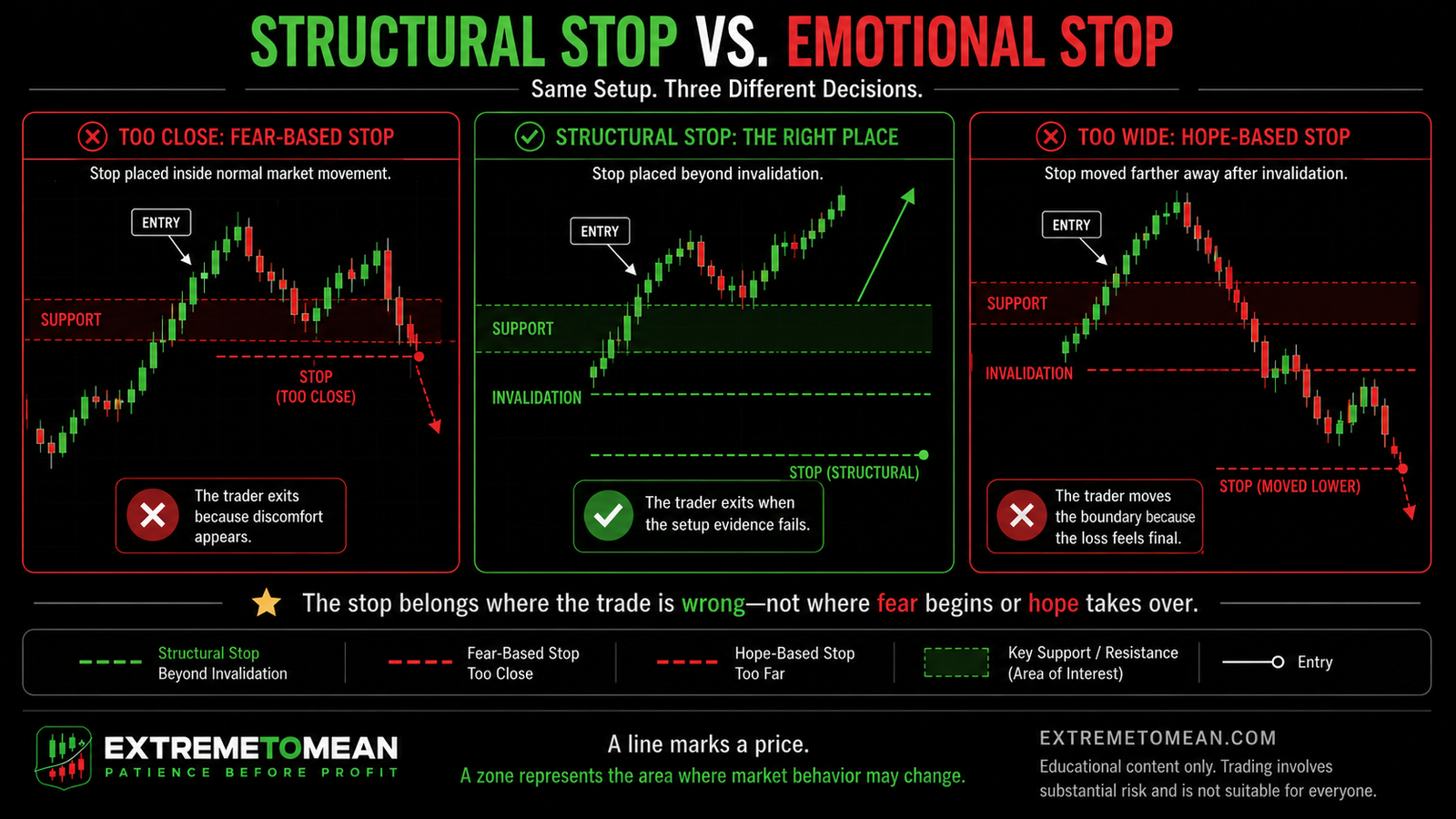
A structural stop is based on the market behavior required by the setup. It may sit beyond a meaningful swing, outside a support or resistance zone, past a failed-breakout level, or beyond another condition that would disprove the trade. The exact placement depends on the timeframe, volatility, and logic of the setup. What makes the stop structural is not the chart label but the reason the boundary matters.
An emotional stop is based mainly on the trader’s discomfort. It may be placed at the maximum dollar amount the trader wants to lose, a round number of ticks, or the nearest location that preserves a preferred position size. The trader may still describe the stop as technical, but the true reason is often fear of a larger loss. When the market has no reason to respect that boundary, ordinary movement can remove the trader while the setup remains valid.
Fear Often Pulls the Stop Too Close
A tight stop can feel responsible because the potential loss appears smaller. The trader may believe that reducing the distance automatically creates better risk control, especially after several recent losses or a difficult session. That feeling is understandable because a close stop makes the trade easier to accept emotionally. It does not necessarily make the trade better qualified.
When fear determines the distance, the stop may sit inside normal market variation. Price can test liquidity, probe beyond a level, or rotate through a zone without invalidating the broader setup. A stop placed inside that ordinary movement can be reached before the market has answered the actual trade question. The trader then experiences repeated small losses and may wrongly conclude that the setup itself does not work.
A close stop is appropriate when the structure genuinely allows one. A precise entry near a clear boundary may create a small invalidation distance without forcing the issue. The problem is not that tight stops are always wrong, but that they must be earned by the location and setup logic. Small risk distance should be the result of a well-defined opportunity rather than a demand imposed on every trade.
Hope Often Pushes the Stop Too Far Away
The opposite mistake occurs when the trader keeps moving the boundary farther from the entry. A wider stop can be justified as giving the trade room, respecting volatility, or avoiding a liquidity sweep. Those reasons can be valid when they are defined before entry and supported by the setup. They become dangerous when the stop expands only because price is approaching it.
The lesson in Why a Trade Without Invalidation Is Just Hope applies directly to this behavior. Once the planned evidence has failed, moving the stop preserves the position rather than the trade idea. The trader is no longer allowing reasonable room but changing the story to avoid an exit. Hope turns a defined risk into an exposure that can keep growing.
A wider structural stop may still be the correct choice when volatility or market structure requires it. The trader must then reduce position size or reject the trade if the full exposure does not fit the plan. Widening the stop while keeping the same preferred size changes both the risk and the quality of the decision. The stop distance cannot be separated from the amount held.
Location, Volatility, and Timeframe Shape the Boundary
Stop placement must be evaluated in the context of where the trade begins. An entry near a meaningful boundary may allow the trader to define invalidation clearly, while an entry in the middle of a range often leaves no clean place for the stop. Poor location can force the trader to choose between an arbitrary close stop and an impractically wide one. That is often evidence that the trade should be skipped rather than repaired.
Volatility also changes the amount of normal movement a setup may require. A distance that is reasonable during a quiet session may be too sensitive when ranges expand, news approaches, or liquidity becomes uneven. The trader should not respond by using one universal stop size across all conditions. The boundary must reflect both the structure and the environment in which the trade is occurring.
Timeframe matters because a setup should be managed according to the evidence that created it. A trade based on a higher-timeframe area may require more room than a short-term scalp built around a nearby intraday structure. Using a very small execution timeframe to override the original setup can place the stop inside noise. Using a much larger timeframe after entry can become an excuse to widen the trade beyond its original plan.
Structure Is Often an Area, Not a Perfect Line
Important market locations are frequently zones rather than exact prices. Price may briefly trade beyond a prior swing, test nearby liquidity, and then return without establishing acceptance outside the area. A stop placed exactly on the most obvious line may therefore be vulnerable to ordinary auction behavior. The trader must decide what type of movement would truly invalidate the setup.
That decision may depend on a touch, a close, sustained acceptance, or the failure of an expected response. There is no single rule that fits every market, timeframe, and setup. The condition must be clear enough to follow while still allowing the market the amount of variation that the trade logically requires. Precision comes from defining the behavior, not pretending that one exact price always carries complete meaning.
Position Size Must Adapt to the Stop
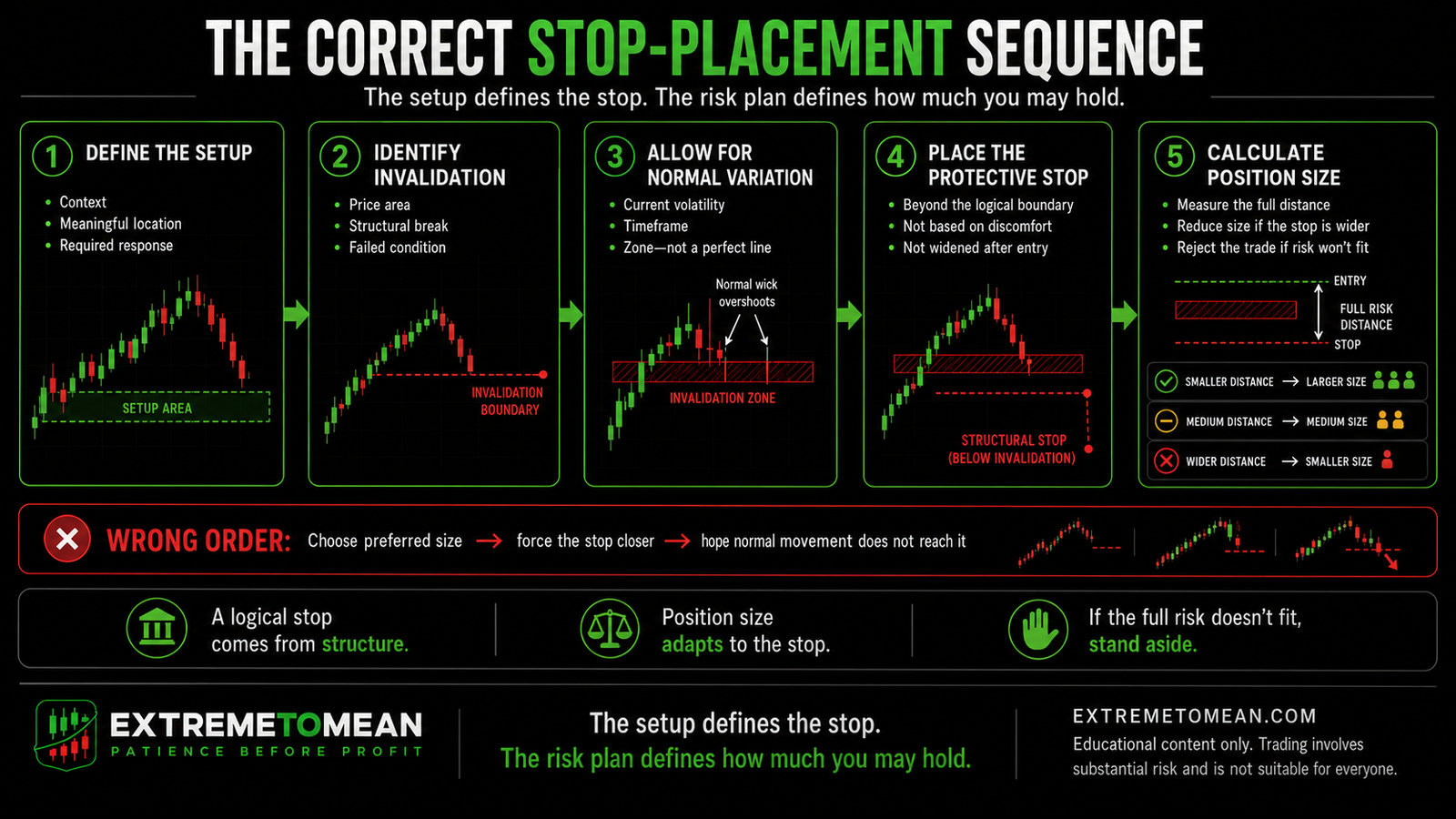
The logical stop should be identified before the trader finalizes position size. Once the distance from entry to invalidation is known, the trader can calculate how much exposure fits the plan. A wider stop normally requires a smaller position, while a narrower structural stop may allow more size without increasing total planned risk. The amount held follows the boundary rather than controlling it.
The principle that the trade is not ready until the risk is clear prevents the trader from forcing the stop to fit a preferred contract or share amount. If the correct stop creates too much exposure, the clean choices are to reduce size, wait for a better entry, or stand aside. Pulling the stop closer only to preserve size changes the market logic of the trade. Expanding it after entry changes the accepted risk.
A Better Question Before Entry
The question “How much am I willing to lose?” is important, but it should not determine where the market proves the idea wrong. A better first question is, “What must price do for this setup to no longer make sense?” That question identifies the logical boundary before the trader thinks about emotional tolerance or preferred size. The risk limit is then used to decide whether the resulting trade is acceptable.
Before entering, the trader can review a short stop-placement filter. The answers should form one connected explanation rather than several unrelated reasons for the stop. If the boundary changes whenever the potential loss feels uncomfortable, the trade has not been planned clearly:
- What price area, structural point, or failed condition invalidates the setup?
- Is the stop outside normal variation for this market and timeframe?
- Does the stop reflect current volatility rather than a fixed universal distance?
- Am I placing it closer because I am afraid of the full logical risk?
- Am I placing it farther away because I do not want the trade to end?
- Can position size be reduced enough for the complete risk to fit the plan?
- Would I keep the same stop location if I were trading one unit?
- Can I explain the stop in one sentence without referring to how I feel?
The checklist does not create certainty or prevent price from reversing after the exit. It helps the trader separate market evidence from fear, hope, and attachment. A logical stop can still be reached, and the market can still move in the original direction later. The quality of the stop should be judged by whether it matched the setup, not whether it produced a perfect outcome.
Review the Stop Separately From the Result
Trade review should compare the original invalidation with the stop that was actually used. The trader should note whether the stop began at the logical boundary, moved because the setup changed, or moved because discomfort increased. This review reveals whether the position was managed according to evidence or emotion. It also shows whether recurring stop problems begin with poor location, unsuitable sizing, or unclear setup criteria.
Traders who repeatedly place stops from fear or move them from hope should examine the broader issue of having unclear risk. The problem may not be a lack of discipline in the moment but a plan that never defined invalidation clearly enough to follow. Better preparation reduces the number of decisions that must be improvised under pressure. The goal is a repeatable process for deciding where the trade ends before emotional attachment begins. That repeatable process is laid out in full in the risk-first trading framework.
Final Thought
A stop should mark the point where the trade idea has failed, not the point where the trader first becomes uncomfortable. Fear can pull the boundary inside normal movement, while hope can push it beyond the evidence that originally justified the trade. Both mistakes replace market structure with emotion. A structural stop keeps the decision connected to the setup.
The trader’s job is not to find a stop that guarantees a favorable outcome or avoids every unnecessary exit. The job is to define invalidation, account for normal variation, calculate the resulting exposure, and reject the trade when those pieces cannot fit together. A logical stop may still produce a loss, but it gives that loss a reasoned boundary. That is the difference between controlling a decision and trying to control the market.
Educational content only. Trading involves substantial risk and is not suitable for everyone.