
Risk is not the same as stop size adds the position-size and exposure context that turns invalidation into actual planned risk.
Many traders know where they want price to go but cannot explain what would prove the trade wrong. They may have a target, an entry, and even a stop order, yet the reasoning behind the exit remains vague. That vagueness feels harmless before entry because the trader has not yet experienced pressure from the position. Once price moves against the trade, the missing boundary becomes the space where emotion begins making decisions.
The lessons in The Setup category emphasize that a pattern earns attention before it earns risk. A complete setup must explain why the location matters, what response is required, and what behavior would invalidate the idea. Without that final condition, the trader is not preparing for uncertainty but merely assuming it will eventually resolve in their favor. The trade may look organized on the chart while still depending on hope underneath.
Hope Begins Before the Trade Is Entered
Hope is usually discussed as something that appears after a position begins losing. In reality, it often enters the process earlier when the trader avoids defining what failure would look like. The trader focuses on the destination, imagines the favorable path, and postpones the uncomfortable question of where the reasoning stops being valid. That omission creates emotional attachment before any money is at risk.
A trade can therefore become hope-driven even when the entry is technical. The chart may contain a recognizable pattern, an important level, and a plausible target, but those elements do not complete the decision. If the trader cannot state what evidence must remain present, there is no objective point where the idea ends. The position is then managed according to tolerance rather than market logic.
A Plan Needs a Condition That Ends It
Every trade idea rests on a claim about current market behavior. A long setup may depend on buyers defending a zone, a failed breakdown, or a structural higher low, while a short setup may depend on rejection, weakening momentum, or resistance holding. The idea remains valid only while the required evidence continues to exist. Invalidation names the behavior that removes that evidence.
The article Where Is the Trade Wrong? explains how invalidation may come from a price area, structural break, or failed condition. That distinction matters because a stop is not merely a number placed below or above the entry. It is the execution boundary connected to the setup’s logic. When that connection is missing, the trader has an order level but not a reasoned exit.
Why Undefined Invalidation Feels Comfortable
A vague invalidation point can feel flexible and intelligent before entry. The trader may believe that refusing to use a rigid boundary allows room to respond to changing conditions. In practice, the lack of a defined boundary often delays the moment when the trade must be judged honestly. Flexibility becomes permission to keep the idea alive regardless of what price does.
Uncertainty Creates Room to Change the Story
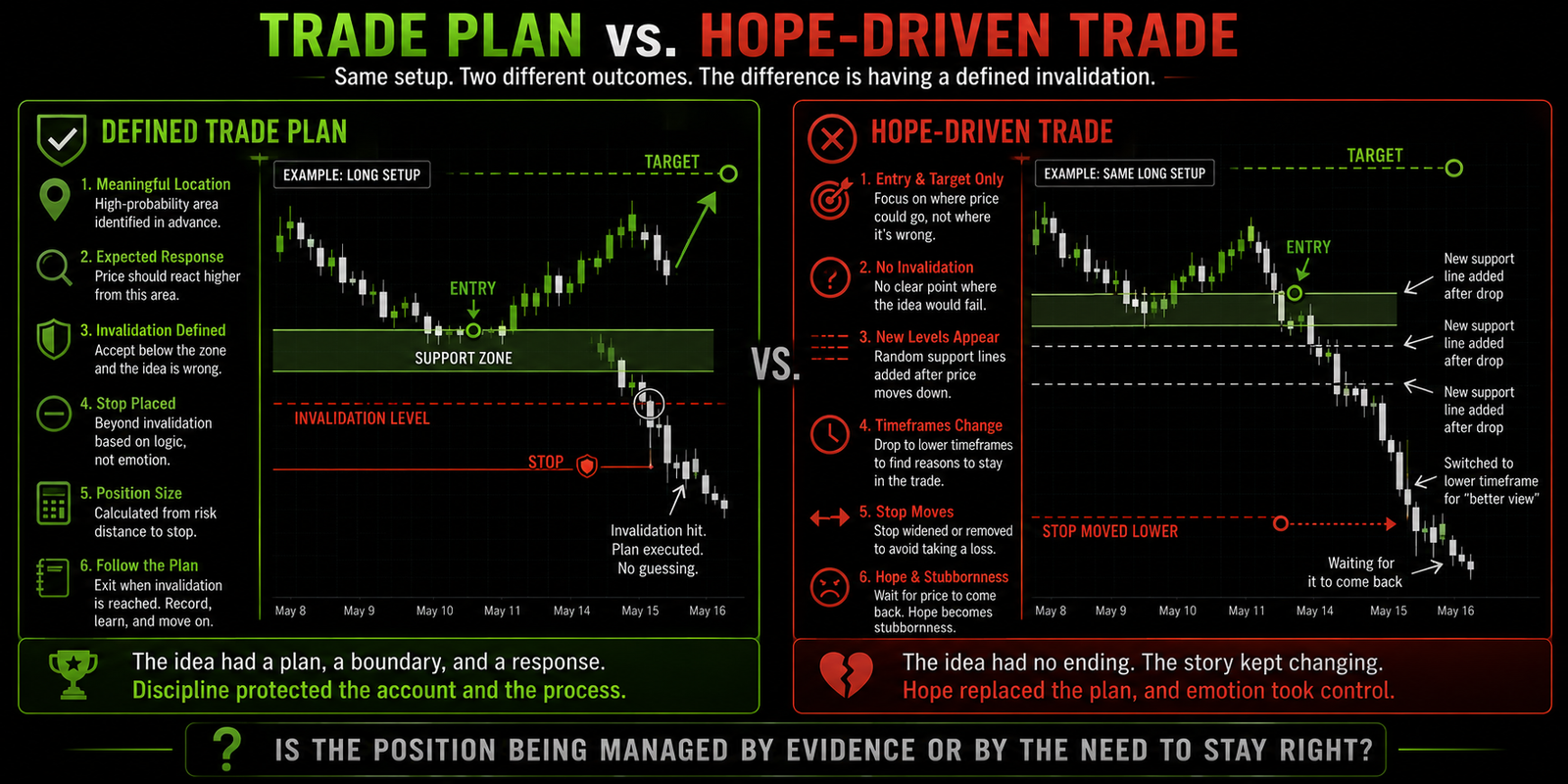
Markets always contain uncertainty, but a trade without invalidation turns that uncertainty into an unlimited argument for staying involved. A small break becomes a liquidity test, continued weakness becomes a better price, and a failed response becomes a need for more time. Each explanation may be possible in isolation, which makes the changing story feel reasonable. The problem is that none of those explanations was part of the original plan.
As the position moves against the trader, the reasoning often becomes more complicated instead of clearer. New timeframes are introduced, unrelated levels gain importance, and the target may be adjusted to justify continued exposure. The trader is no longer evaluating whether the original setup remains valid. The trader is searching for any version of the market that allows the position to stay open.
Hope Can Look Like Patience
Patience means waiting for the conditions required by the plan and allowing a valid trade reasonable room to develop. Hope means remaining exposed after the evidence supporting the trade has weakened or disappeared. The two can feel similar because both involve doing nothing while price remains uncertain. Their difference is whether the decision is still governed by a defined boundary.
This is why stubbornness can be mislabeled as discipline. The trader may say that good trades need time, weak hands exit early, or price often returns after a temporary break. Those statements can sometimes be true, but they do not answer whether this specific trade remains valid. Patience protects a process, while stubbornness protects a position from being judged.
Emotion Takes Over Trade Management
Without invalidation, every management decision becomes more personal. The trader must decide whether the loss feels too large, whether the discomfort has lasted too long, or whether another candle deserves more patience. Those questions are driven by emotional tolerance rather than the setup’s evidence. The result may be inconsistent exits across otherwise similar trades.
Undefined Invalidation Distorts Risk
A trade cannot be sized honestly when the point of failure is unknown. Position size depends on the distance between entry and the protective exit, along with the amount of exposure the plan permits. If that distance can expand after entry, the true risk was never defined. The account may be carrying more exposure than the trader believed at the moment of entry.
The principle that the trade is not ready until the risk is clear applies before any order is placed. A trader who cannot explain the invalidation cannot calculate complete exposure or decide whether the trade fits the plan. The correct response may be a smaller position, a better entry, or no trade. Unclear risk does not become acceptable merely because the chart looks promising.
A Stop Alone Does Not Solve the Problem
Placing a stop order does not automatically create disciplined invalidation. The stop may be chosen from a fixed dollar amount, an arbitrary number of ticks, or a distance that preserves the trader’s preferred size. Price can reach that stop while the original idea remains valid, which encourages the trader to distrust stops or move them farther away. The real problem is that the stop was never connected to the setup.
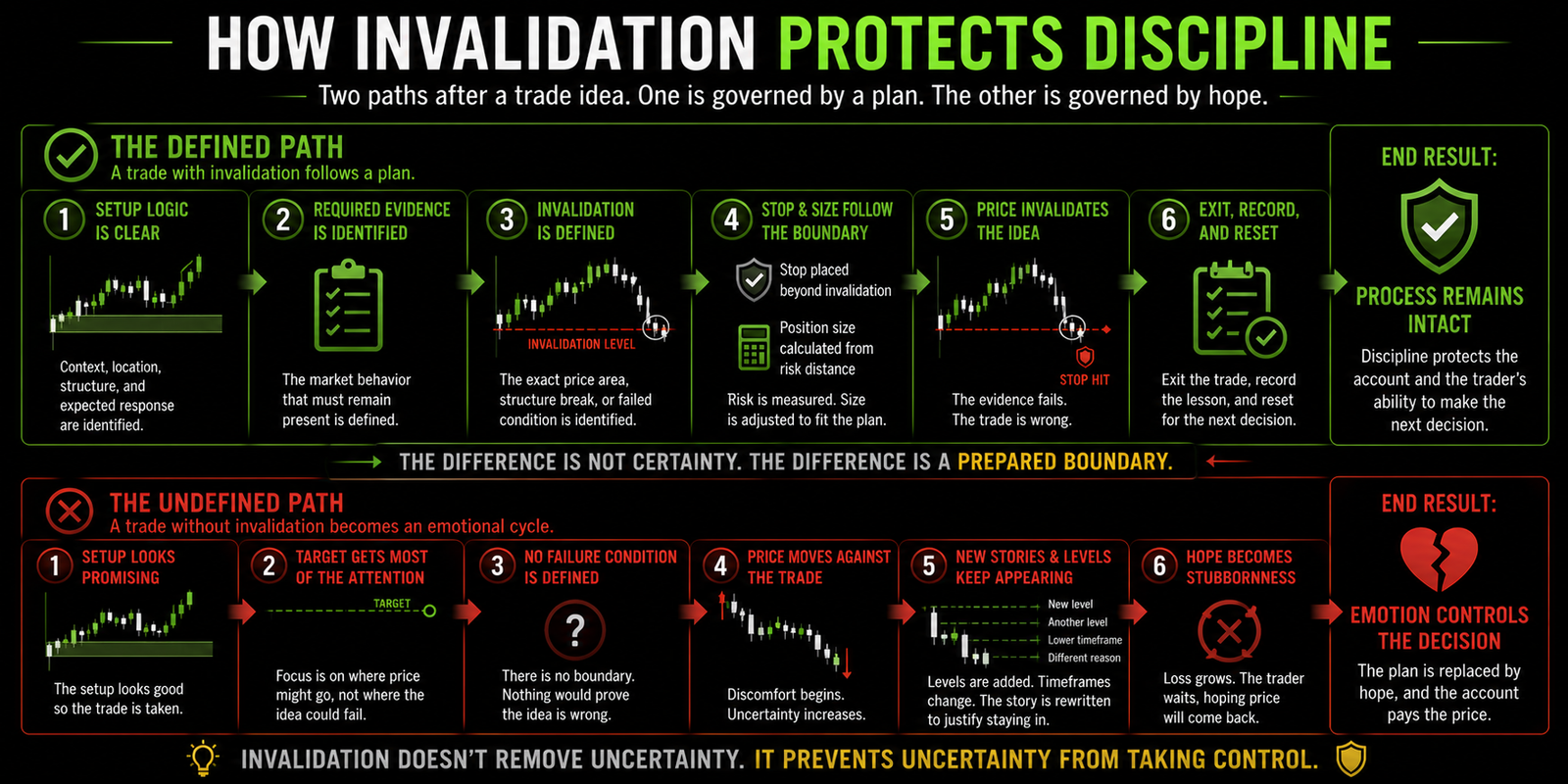
The correct sequence begins with context, location, and expected response. The trader then identifies what behavior would disprove that reasoning, places the protective exit beyond the logical boundary, and calculates size from the resulting distance. This is part of the broader principle that a setup is where location, structure, and risk align. When those elements cannot align, the setup has not earned participation.
Invalidation Protects Discipline
A defined invalidation point does not remove emotion, but it reduces the number of decisions emotion is allowed to make. The trader may still dislike the loss, question the setup, or wish price had more room. The boundary provides an answer that was created before those feelings appeared. Discipline becomes following a prepared conclusion rather than inventing courage under pressure.
Invalidation also prevents one trade from demanding endless attention. Once the idea is no longer valid, the trader can exit, document the evidence, and prepare for the next decision. The market may later return to the original direction, but that does not automatically make the exit incorrect. The trade was closed because its planned evidence failed, not because the trader claimed to know what every later candle would do.
Invalidation Is Not a Prediction of Failure
Defining where the trade is wrong does not mean the trader expects the trade to fail. It means uncertainty has been accepted as part of the decision before risk is taken. The invalidation point is a condition for ending one idea, not a forecast of what price must do next. Price can invalidate the setup and later reverse without making the original plan dishonest.
A Better Question Before Entry
The question “Do I think this trade will work?” invites confidence, prediction, and attachment. A better question is, “What evidence must remain present for this trade to stay valid?” That question shifts attention from belief to observable behavior. It also gives the trader a cleaner basis for deciding when continued exposure is no longer justified.
Before entering, the trader can use a short hope-versus-plan filter. The answers should produce one connected explanation that can still be followed after money is at risk. If the explanation depends on how the trader feels later, the setup is not complete:
- What market behavior supports the trade?
- What exact price area, structure, or condition would invalidate that support?
- Does failure require a touch, acceptance, a close, or another defined response?
- Is the protective stop connected to that invalidation?
- Can position size be calculated from the complete risk distance?
- Would I exit at that boundary even if I still believed price might come back?
- Am I prepared to reject the trade if the logical risk does not fit?
- Can I explain the invalidation in one clear sentence?
The filter is not designed to create a perfect exit. It is designed to prevent the trade from becoming an open-ended argument after entry. If the trader cannot answer the questions clearly, more analysis is not always the solution. The cleaner conclusion may be that the setup has not earned risk.
Traders who repeatedly manage from hope should examine the broader problem of having unclear risk. Vague setup criteria, poor location, fixed sizing, and reluctance to accept a planned loss can all contribute to undefined invalidation. The correction should occur during preparation rather than during the most emotional part of the trade. A written boundary is more reliable than another promise to stay disciplined, which is the starting point behind planning risk before you enter.
Review Whether the Trade Became a Different Story
Post-trade review should compare the original explanation with the reasoning used near the exit. If new levels, timeframes, or conditions appeared only after price moved against the position, the trade may have shifted from planning to hope. The review should identify the first moment when the evidence changed and whether the planned invalidation was respected. That moment is often more useful than the final profit or loss.
Final Thought
Invalidation is what gives a trade plan an honest ending. It defines the evidence that must remain present, connects the idea to the stop, and prevents uncertainty from becoming unlimited permission to hold. Without it, the trader is left deciding how much discomfort, loss, and story-changing to tolerate. That is not structured risk management; it is hope under market pressure.
The goal is not to eliminate every premature exit or create certainty about the next move. It is to know what would make the original reasoning no longer valid and to act when that condition occurs. A trade with invalidation can still lose, and a trade without it can still recover. The difference is that one is governed by a plan while the other depends on the market eventually forgiving the decision — and knowing how to reject the second kind is really about learning the discipline good traders use to disqualify bad trades before entry rather than negotiating with them after.
Educational content only. Trading involves substantial risk and is not suitable for everyone.