
If you already trade stocks, options, or CFDs, a futures chart will probably look familiar. The dangerous assumption is believing that the position underneath that chart works the same way.
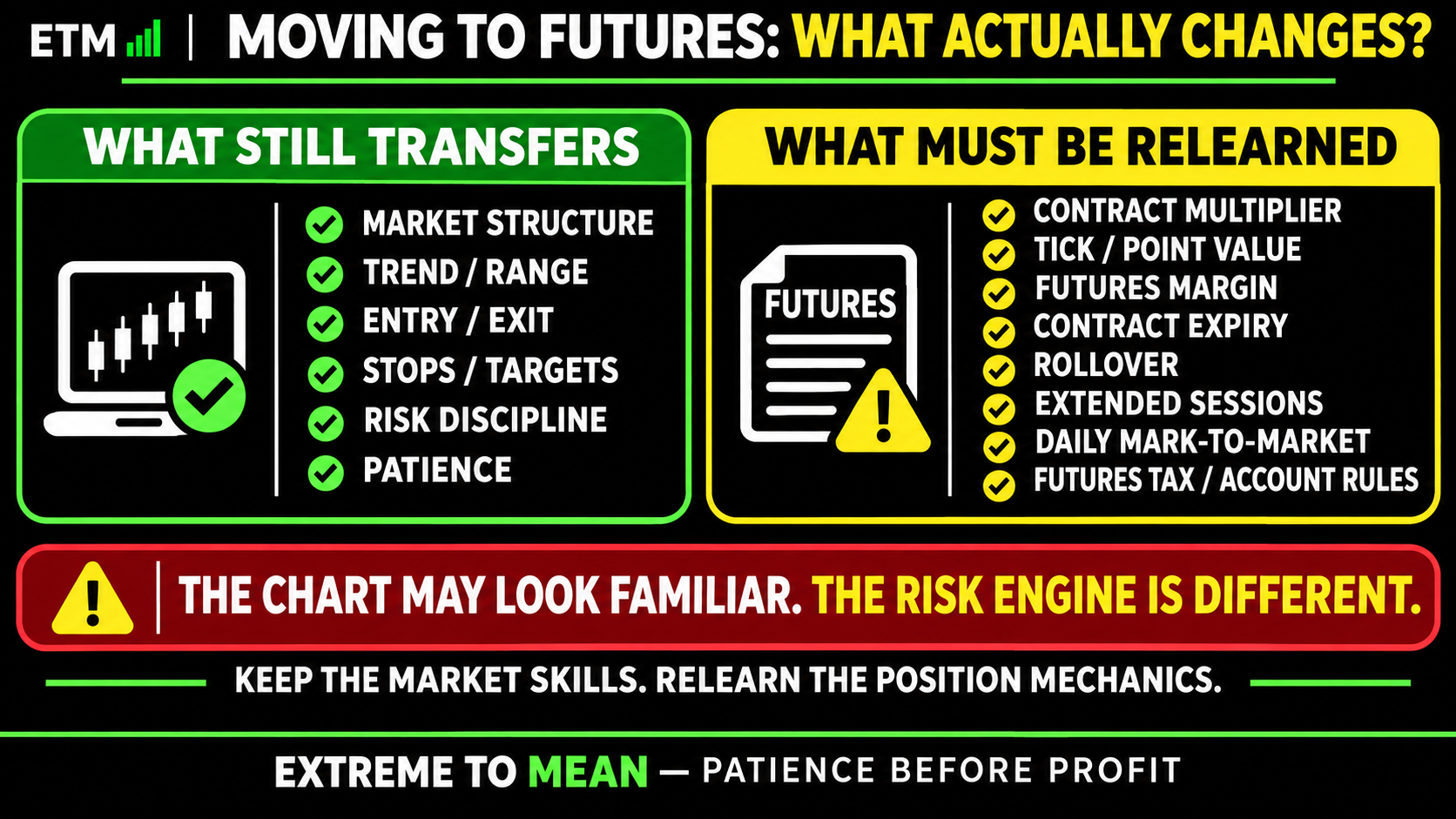
The chart may look familiar. The risk engine is different.
A trader moving into futures does not need to forget market structure, trend, range, entries, stops, targets, or patience. What needs to be rebuilt is the translation from a chart idea into financial exposure. You are not starting over as a trader. You are starting over as a position mechanic.
That distinction belongs early in the broader ETM lessons, because the biggest transition mistake is usually not chart reading. It is carrying assumptions from shares, option premium, or CFD lot sizes into an instrument built around standardized contracts, multipliers, margin, expiration, and direct leveraged P&L. Simpler pricing does not mean simpler risk.
What Transfers—and What Does Not
The easiest mistake is assuming that because the market idea transfers, the position mechanics transfer with it. A bullish breakout in SPY, a QQQ call, a Nasdaq CFD, and a long MNQ position may express a similar directional opinion, but each packages the exposure differently. The thesis can be similar while the financial consequence is not.
| Concept | What Transfers | What Changes in Futures |
|---|---|---|
| Chart reading | Structure, trend, levels | Contract and session context |
| Position unit | Exposure still needs sizing | Contracts replace shares, premium, or broker-defined lots |
| P&L | Direction still matters | Multiplier determines dollar movement |
| Leverage | Can magnify results | Futures use performance-bond margin |
| Shorting | Bearish thesis | No stock borrow is needed for index futures |
| Hours | Session context still matters | Many major contracts trade nearly around the clock |
| Expiration | Options traders already respect it | Futures contracts expire and liquidity rolls |
| Risk | Stop and invalidation still matter | Point value turns distance into dollars |
The existing comparison of stocks, ETFs, futures, and options explains those instruments at a basic level. This lesson owns the next question: what does an experienced trader need to stop assuming when switching into futures?
Shares and Premium Become Standardized Contracts
Stock traders naturally think in shares, while options traders often think in contracts, premium, and a contract multiplier. Futures also use contracts, but the number of contracts is meaningless until you know what one contract represents. In futures, “one contract” tells you almost nothing until you know the multiplier.
CME currently specifies Micro E-mini S&P 500 futures, or MES, at $5 times the S&P 500 Index with a 0.25-point minimum tick, making one tick worth $1.25. Micro E-mini Nasdaq-100 futures, or MNQ, use a $2 multiplier with a 0.25-point minimum tick, making one tick worth $0.50. That means one full index point is worth $5 in MES and $2 in MNQ.
If MES were trading at 7,500, one contract would represent approximately $37,500 of notional exposure because 7,500 × $5 = $37,500. The trader does not pay $37,500 to open the position, but that does not make the exposure disappear. The margin deposit is not the position size; the contract multiplier reveals the exposure.
Futures Margin Is Not Stock Margin
This is where stock intuition can become dangerous. Securities margin commonly involves borrowing part of a purchase price, while futures margin acts primarily as a performance bond supporting the trader's financial obligations on a leveraged contract. Futures positions are also marked to market as prices change.
That makes MARGIN REQUIRED ≠ MONEY AT RISK one of the most important distinctions in the article. A broker may require relatively little capital to open a contract, but the contract's multiplier and price movement still determine what happens to the account. Lower margin changes how much you can open; it does not change what one point is worth.
The existing ETM lesson on what margin actually means goes deeper into initial margin, maintenance margin, and buying power. Here, the migration lesson is narrower: do not replace your old position-sizing process with the number shown in the futures margin column.
Position Size Starts With the Stop and Point Value
Suppose a stock trader moves into MES and identifies a 12-point structural stop. At $5 per point, one MES contract creates 12 × $5 = $60 of planned price risk before fees, slippage, or a worse-than-planned fill. Three contracts turn the same stop into $180 of planned price risk.
The cleaner sequence is therefore STOP DISTANCE → POINT VALUE → CONTRACT COUNT. Margin is a separate account-access check after the risk has been calculated. Choose contracts after you know the stop—not because the margin screen says you can afford them.
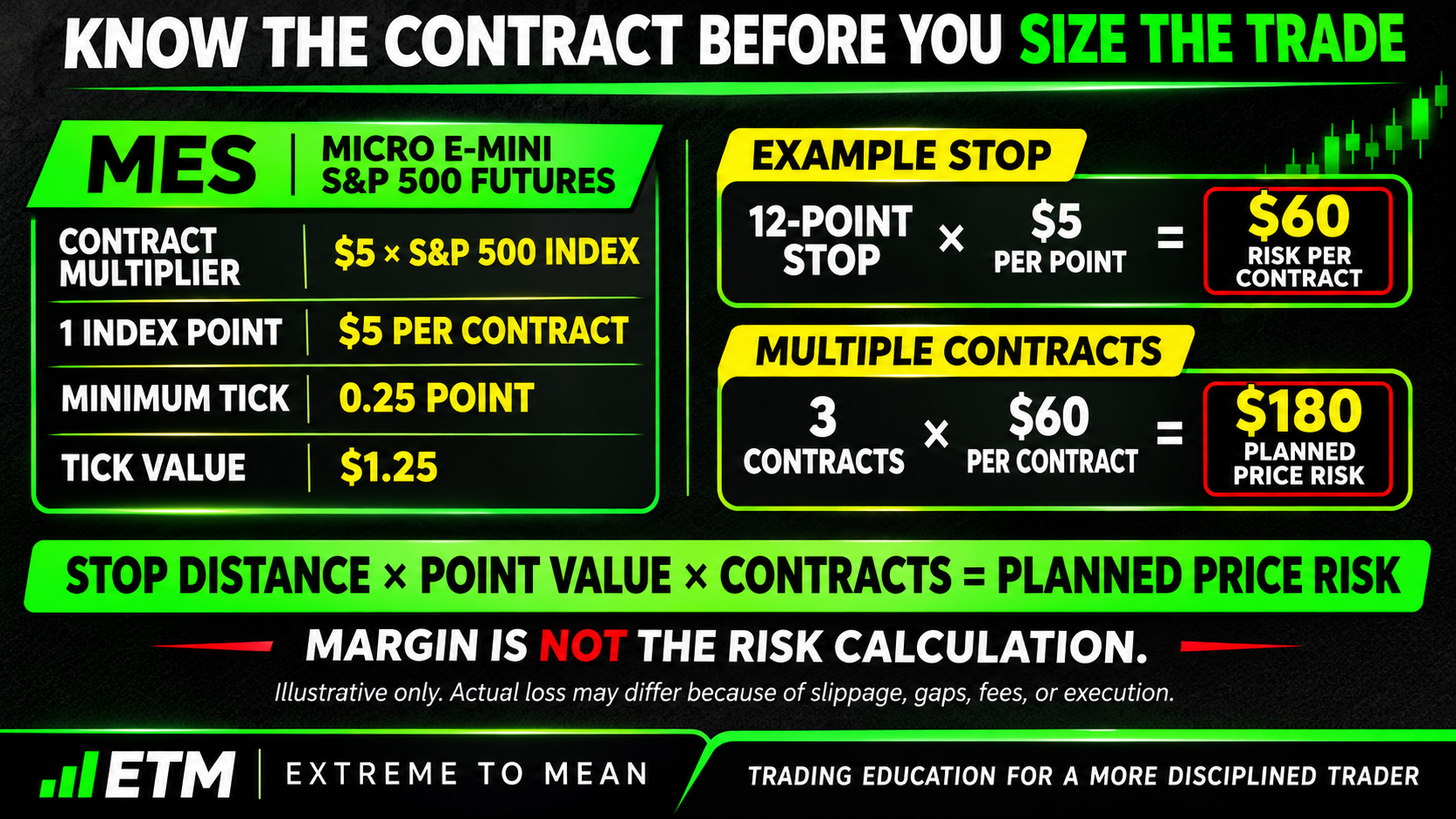
Micro contracts make that sizing process more flexible, but they do not make oversizing impossible. Ten MES contracts have the same $50-per-point multiplier as one ES contract because 10 × $5 = $50. MICRO CONTRACT ≠ AUTOMATICALLY SAFE CONTRACT. Smaller contracts improve sizing precision; they do not prevent oversizing.
Moving From Options: No Greeks Does Not Mean No Risk
An options trader moving into outright futures no longer has to choose a strike or interpret the position through Delta, Gamma, Theta, Vega, and implied volatility. Option premium can be sensitive to both time decay and volatility in addition to movement in the underlying. An outright futures position has a more direct relationship between the futures price movement and the contract multiplier.
Imagine a QQQ options trader switching to MNQ. A 50-point move in one MNQ contract changes P&L by about $100, while a 200-point adverse move represents about $400 per contract before fees and execution differences. There is no Theta or volatility crush required to explain that outright futures result.
That can make the pricing engine feel simpler, but SIMPLER PRICING ≠ LOWER RISK. Option premium and futures margin are not interchangeable measures of risk, and a trader who normally spends $500 on option premium should not conclude that $500 of futures margin creates an equivalent position. Futures remove the options pricing layer; they do not remove the need to control the underlying exposure.
Trading Hours Expand—and So Can Overtrading
Major CME equity-index futures trade much longer than the traditional U.S. stock session. Current CME equity-index trading hours extend from Sunday evening through Friday afternoon with a daily maintenance break. That makes overnight, premarket, cash-session, and post-close trading possible without waiting for the stock market to open.
But access is not the same as opportunity. Liquidity, spreads, volatility, and participation can vary substantially across sessions, so EXTENDED HOURS ≠ EQUAL LIQUIDITY. More available hours can create more flexibility—or more ways to overtrade.
A trader switching from stocks may initially love the idea that the market is available almost all day. The better question is not, “When can I trade?” but, “Which session actually belongs in my process?” Being able to trade does not mean you should trade every session.
Expiration, Rollover and the Actual Contract Matter
Options traders already respect expiration, but futures traders have to add rollover to the workflow. Specific futures contracts expire, and liquidity eventually migrates toward a later contract month. A flat day trader may simply begin trading the newer active contract, while someone carrying exposure may need to close or roll according to the product and plan.
Charting platforms can hide some of that complexity with continuous symbols such as ES1! or NQ1!. Those are useful for analysis, but the actual trade ultimately belongs to a listed expiration. CONTINUOUS CHART ≠ EXECUTABLE CONTRACT. The chart you analyze may be continuous; the contract you trade expires.
This is why the beginner futures workflow starts with identifying the exact instrument and contract before sending the order. Options traders already respect expiration; futures traders need to respect rollover as well.
Shorting and Index-Level Exposure Feel Different
Stock traders may associate short selling with borrowed shares, locate availability, hard-to-borrow conditions, and securities-specific rules. Index futures are structurally more symmetrical: a trader can buy to establish long exposure or sell a futures contract to establish short exposure without borrowing shares of the index. Short exposure is mechanically simpler in futures; risk is not.
The position is still leveraged and subject to margin, liquidity, broker controls, and potentially fast adverse movement. A short futures trade loses as the market rises just as a long loses when the market falls. Easier mechanics do not create easier risk management.
The catalyst mix changes too. A trader moving from individual stocks toward ES, MES, NQ, or MNQ is moving away from primarily company-specific event risk and toward broader index, macroeconomic, rate, Federal Reserve, and global-market exposure. Major constituent earnings still matter because they can materially reprice the index, so “futures do not have earnings risk” would be an overstatement.
Moving From CFDs: Translate the Structure, Not the Lot Name
For readers coming from CFDs in jurisdictions where retail CFD trading is permitted, the important change is structural. CFDs are generally OTC/provider-created instruments whose sizing and financing conventions depend on the provider and jurisdiction, whereas CME futures are standardized exchange-traded contracts with defined multipliers, tick values, expiration cycles, and central clearing. Contract math is more useful than a headline leverage ratio.
For U.S. readers, there is an important regulatory boundary. CFDs are generally treated as swaps, and U.S. retail persons generally cannot enter those swaps off exchange unless offered on an appropriate regulated market. This article should therefore treat CFD-to-futures migration as an international comparison rather than implying that ordinary U.S. retail traders casually choose between OTC CFDs and CME futures.
A CFD or FX trader should not try to match a familiar “mini lot” to one futures contract by feel. The cleaner translation is multiplier → point/tick value → stop distance → contracts. Translate the risk mathematically—not by matching the names of position sizes.
PDT, Taxes and Costs Change at the Account Level
Futures accounts operate outside FINRA's securities-account day-trading framework, but the old comparison with a fixed $25,000 securities PDT requirement now needs qualification. FINRA's new intraday-margin requirements became effective in 2026, replacing the old trade-count-based PDT framework, while brokerage firms were permitted a transition period. Traders using securities accounts during that transition should check their actual broker rather than rely on the old shorthand.
The ETM article on PDT versus futures margin should reflect the current 2026 transition before this link is retained. Futures did not suddenly become exempt in 2026; standard futures were already outside the securities PDT framework, while the rules governing securities margin accounts changed.
U.S. federal tax treatment can differ as well. Qualifying regulated futures contracts may fall under Section 1256, which generally applies year-end mark-to-market and a 60% long-term / 40% short-term capital-character split regardless of actual holding period. That is not a universal tax rate or a rule for every instrument or taxpayer, so specific filing and planning questions should go to a qualified tax professional.
Costs may also feel different to someone coming from zero-commission equity trading. Futures can involve commissions, exchange and clearing fees, regulatory charges, market-data costs, and platform expenses depending on the broker and setup. A small contract does not mean a zero-cost trade.
Your Old Strategy Does Not Automatically Transfer
A setup that worked in low-float stocks, SPY options, QQQ options, or CFDs may behave differently in ES, MES, NQ, or MNQ. Liquidity, volatility, session structure, catalysts, execution, costs, and contract economics can all change the distribution of results even when the pattern on the screen looks familiar. OLD STRATEGY KNOWLEDGE ≠ VALIDATED FUTURES EDGE.
The strongest migration sequence is therefore: Transfer the hypothesis first. Revalidate the strategy second. Transfer the size last. Do not assume that because the setup name transfers, the same stop, frequency, session, or position size belongs in the new instrument.
The Futures Migration Checklist
Before placing the first live futures trade, be able to answer:
- What actual contract and expiration am I trading?
- What does one contract represent?
- What are its multiplier, point value, tick size, and tick value?
- What is my planned stop distance?
- What is my dollar risk per contract?
- How many contracts fit the risk plan?
- What margin does my broker currently require?
- Is that intraday or overnight margin?
- What session am I actually planning to trade?
- When does the contract expire, and when does liquidity normally migrate?
- What commissions, exchange, clearing, platform, and data costs apply?
- How are my stops, brackets, and automation implemented?
- Have I revalidated the strategy on futures rather than assuming it transfers?
The better final question is: If one point moves against me, do I know exactly how many dollars I lose? If the answer is no, the position mechanics are not ready yet. The ETM free tools can help organize the arithmetic and review, but they cannot replace understanding the contract.
The ETM Translate → Size → Margin → Session → Expiry → Execute Framework
Use TRANSLATE → SIZE → MARGIN → SESSION → EXPIRY → EXECUTE. TRANSLATE asks what one futures contract represents; SIZE converts stop distance and point value into dollars; MARGIN confirms that the account can support the position. SESSION defines when the strategy belongs, EXPIRY identifies the actual active contract, and EXECUTE asks whether the orders, costs, and risk process fit the futures market.
The operating rule is UNDERSTAND THE CONTRACT BEFORE YOU TRADE THE CHART. The trader's job is not to react to the buying power that appears on the platform, but to evaluate whether the contract mechanics and planned risk fit the trade. The chart may look familiar. The risk engine is different.
Final Thought
Switching from stocks, options, or CFDs to futures does not require throwing away everything you already know about markets. Structure, entries, exits, stops, targets, patience, and risk discipline still transfer. What changes is how the instrument converts price movement into account exposure.
Stocks teach traders to think in shares, options add premium and Greeks, and CFDs often use provider-specific lots and leverage conventions. Futures require standardized contract math: multiplier, point value, tick value, margin, expiration, session, and quantity. The margin deposit is not the position size, one contract is not automatically small, and simpler pricing does not mean lower risk.
The strongest transition is not the trader who immediately copies an old setup into MES or MNQ at familiar size. Keep the useful market knowledge, relearn the futures mechanics, revalidate the strategy on the new instrument, and size the position from risk rather than buying power. Transfer the hypothesis first. Revalidate the strategy second. Transfer the size last.
Educational content only. Trading involves substantial risk and is not suitable for everyone.