
Futures were not later exempted from PDT because they were never governed by the standard PDT framework in the first place. They operate under a different regulatory and margin system, with different account mechanics and different risks.
That distinction matters because traders moving between stocks, options, and futures can easily mistake an account restriction for a trading rule. The fact that a securities margin account historically restricted frequent day trading below a certain equity level tells you nothing about whether a particular futures trade is sensible, properly sized, or worth taking. Likewise, the absence of a PDT restriction tells you nothing about how much risk a futures contract can create.
Does PDT Apply to Futures? The Direct Answer Is No
Standard exchange-traded futures are not subject to the Pattern Day Trader regulations that historically applied to stocks, ETFs, and listed options in securities margin accounts. For the typical trader asking whether PDT applies to products such as equity-index futures, the answer is straightforward: no.
The confusion usually comes from the fact that stocks, options, and futures can all be bought and sold intraday from a trading platform, yet the rules governing those products are not identical.
Futures operate under their own regulatory structure and use a different form of margin. That is why understanding the product itself comes before trying to compare account restrictions.
What the Old PDT Rule Actually Did
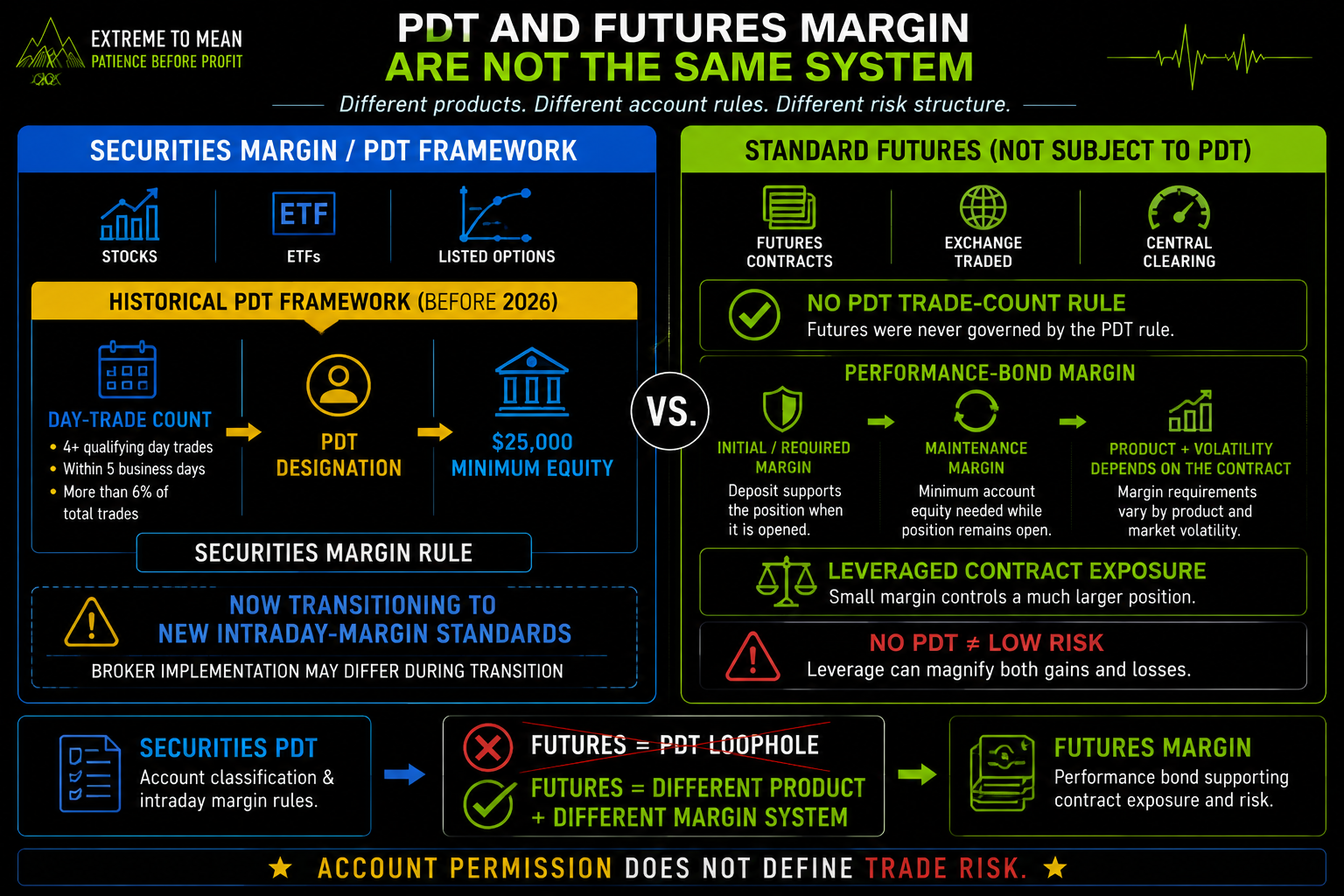
Under the longstanding FINRA framework, a trader generally became a Pattern Day Trader after executing four or more qualifying day trades within five business days in a margin account, provided those day trades represented more than 6 percent of the account’s total trades during that period. A designated Pattern Day Trader was generally required to maintain at least $25,000 in account equity.
In everyday trader language, the rule was usually experienced much more simply: if you were trying to remain below the PDT threshold, you effectively had three qualifying day trades available in a rolling five-business-day period, and the fourth could trigger PDT status. The actual rule included the 6-percent test and other account-specific considerations, but that three-trade reality was what many smaller active traders had to manage around.
The important point is that this was a rule governing securities day trading in margin accounts. Traders coming from stocks or listed options often carried the $25,000 concept with them when they began learning futures, even though the futures market operated under a different framework.
Futures Margin Works Differently
Futures margin is better understood as a performance bond rather than the same type of securities-margin arrangement that produced the PDT framework. The margin posted in a futures account is designed to help ensure that market participants can meet their financial obligations as the value of a contract changes.
Initial margin generally refers to the amount required to establish a position, while maintenance margin represents the minimum equity that must remain available as the position continues. Those requirements can vary by contract and can change as market volatility and risk conditions change.
This is why simply asking whether an account has $25,000 misses the larger issue. A futures contract can create market exposure substantially larger than the cash committed as margin, and the account is credited or debited as the contract moves. A smaller required deposit should never be confused with a smaller economic risk.
Leverage Is the Trade-Off Traders Cannot Ignore
The attraction of futures for smaller accounts is easy to understand. A trader does not face the old securities-account rule requiring $25,000 simply because the account has been designated as a Pattern Day Trader, and futures allow market exposure without paying the full notional value of the contract upfront.
But capital efficiency and safety are not the same thing.
A relatively small amount of account equity can control much larger contract exposure, which means relatively modest price changes can create gains or losses that are significant compared with the cash posted as margin. The absence of PDT changes an account constraint. It does not reduce the leverage embedded in the product or eliminate the need for disciplined position sizing.
Futures therefore do not replace patience, risk management, or a trading plan with a more permissive account rule. The account may allow the trade. That does not mean the trader should take it.
What Changed With PDT in 2026?
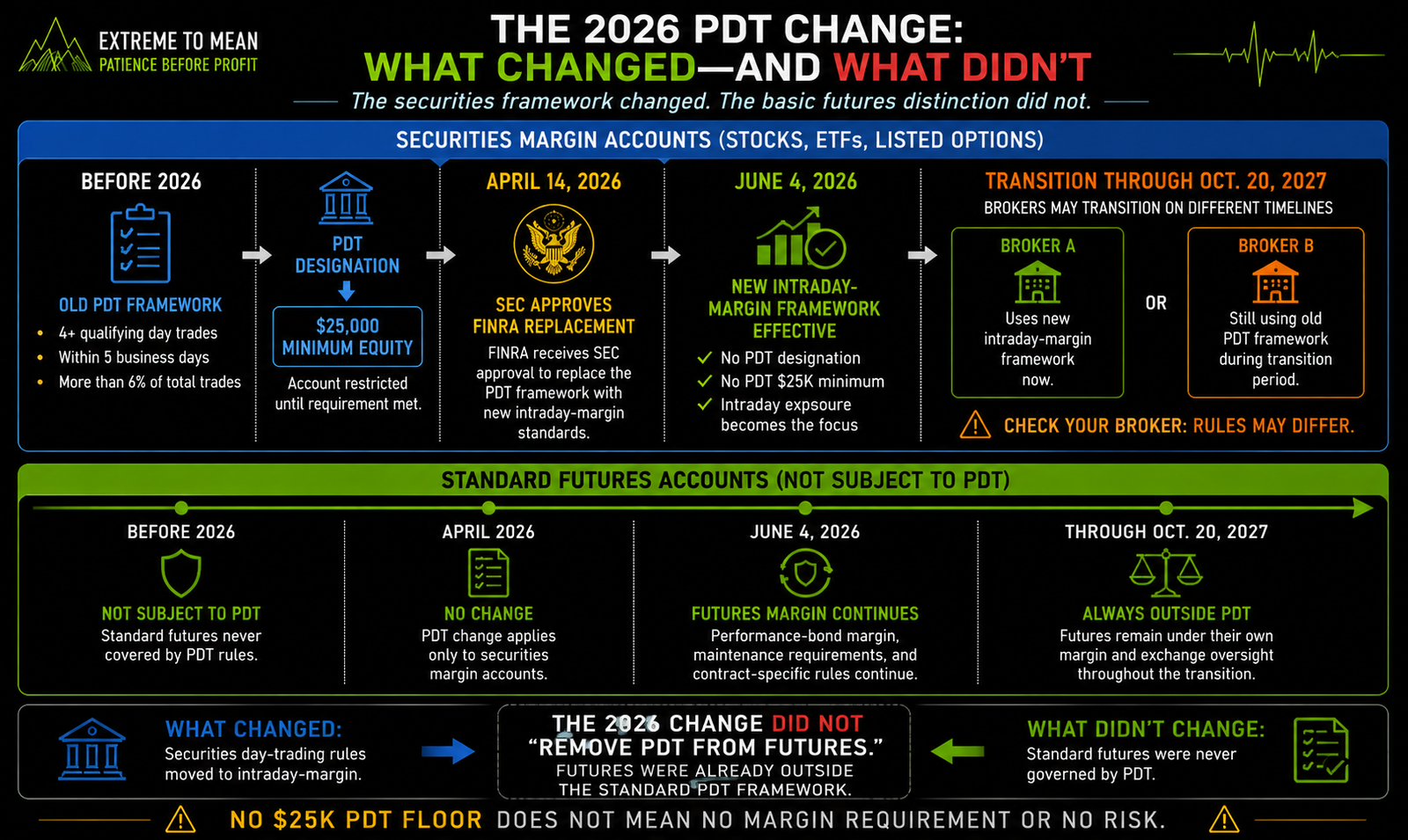
FINRA made a major change in 2026, but that change occurred on the securities side of this comparison. On April 14, 2026, the SEC approved FINRA amendments replacing the existing day-trading margin provisions with new intraday-margin standards.
Under the new framework, the trade-count-based Pattern Day Trader designation and its associated $25,000 minimum-equity requirement are being replaced by requirements designed to focus more directly on intraday exposure and margin risk.
The new requirements became effective June 4, 2026, but that does not mean every brokerage firm changed its account rules on the same day. FINRA permits firms that need additional time to transition through October 20, 2027. A firm may migrate to the new framework sooner, while another may continue applying the older PDT provisions during the transition period.
That means traders using securities margin accounts during 2026 and 2027 should check the actual policy of their brokerage firm rather than assume that every account has already moved to the same system.
The 2026 Change Did Not Remove PDT From Futures
The wording here matters because it is easy to create the wrong timeline.
The 2026 FINRA amendment did not suddenly free futures traders from the $25,000 PDT requirement. Standard futures traders were not subject to that requirement before the amendment. What changed was the framework governing qualifying securities margin accounts.
There is therefore a meaningful before-and-after story for PDT treatment in securities accounts, but there is no comparable June 2026 moment when ordinary futures suddenly became PDT-free. Futures continued operating under their own margin system.
The regulatory change affected the securities side of the comparison. It did not change the basic nature of futures trading.
Your Broker Still Matters
Even when two traders are using the same general type of product, their account experience can differ because brokerage firms establish their own policies within the applicable regulatory and margin framework.
During the current FINRA transition, that distinction is especially important for securities traders. One firm may already be operating under the new intraday-margin structure while another may still be using the previous PDT rules.
The same general principle applies to futures. A futures broker may establish intraday margin requirements that differ from the exchange’s overnight requirements or from the policies of another brokerage firm.
So “Does PDT apply?” and “What does my broker require?” are not the same question. The correct starting point is to identify the product being traded, understand the rules governing that product, and then verify the requirements of the actual account being used.
Can You Day Trade Futures With Less Than $25,000?
Yes. The old PDT minimum-equity rule itself does not impose a $25,000 floor on standard futures day trading.
That does not mean a trader with any account balance can trade any futures contract. The account still has to satisfy the applicable margin requirements and the brokerage firm’s policies for the product being traded.
More importantly, the better question quickly becomes less about “Am I allowed to place this trade?” and more about “What exposure am I actually taking?”
A trader can satisfy the minimum account or margin requirement for a leveraged product while still taking far more risk than the account can reasonably absorb. Margin tells you what is required to support the position under the applicable framework. It does not tell you what position size is appropriate for your trading plan.
The ability to place the trade is not proof that the trade should be placed.
Is Futures Trading a Way Around PDT?
Calling futures a way around PDT makes the product sound like a workaround designed to escape a restriction. That gets the history backwards.
Standard futures were already outside the PDT framework because they operate under a separate futures-margin structure. The cleaner way to think about it is that futures are a different product with different account mechanics.
That distinction also protects beginners from choosing an instrument for the wrong reason. Someone should not move from stocks or options into futures simply because a futures account may permit more frequent intraday trading with less than $25,000.
Futures introduce leverage, contract specifications, tick values, expiration, margin requirements, and substantial loss potential that need to be understood on their own terms. The product should fit the trader’s knowledge, risk tolerance, and process—not merely solve an account restriction.
Account Rules and Risk Management Are Different Questions
The PDT discussion is ultimately an account-rules lesson, not a trading-edge lesson.
Whether an account allows ten intraday round trips or restricts the fourth tells the trader nothing about whether any of those trades has meaningful location, a defined setup, a sensible stop, or an appropriate position size. A regulatory rule determines what the account permits. A trading process determines what the trader chooses to risk.
That distinction becomes even more important with leveraged products. Futures margin can allow substantial market exposure with considerably less deposited capital than the contract’s full value. That efficiency is useful, but it is also precisely why the absence of a $25,000 requirement should never be treated as evidence that futures are easier or safer.
Better access does not eliminate the need for better risk decisions.
Better Questions When Comparing PDT and Futures Margin
Instead of asking only whether PDT applies, traders should identify the product, account structure, margin framework, and exposure involved. That turns a confusing rule question into a practical trading-account decision and prevents the $25,000 threshold from becoming the trader’s entire definition of risk.
A better set of questions is:
- Am I trading a security or a standard futures contract?
- Am I using a securities margin account or a futures account?
- If I trade securities, has my broker transitioned to FINRA’s new intraday-margin framework?
- What margin does my futures broker require for the contract I want to trade?
- What is the contract’s actual dollar value per point or tick?
- How much leverage and total exposure am I taking relative to my account?
- Am I choosing futures because I understand the product, or simply because PDT does not apply?
Those questions separate regulatory permission from trading readiness. The old PDT rule, the new securities intraday-margin framework, and futures margin all describe ways accounts and firms manage exposure. None of them determines whether the next trade is good.
A trader moving among stocks, options, and futures should understand the mechanics first and choose risk deliberately.
Final Thought
The Pattern Day Trader rule did not apply to standard futures trading because futures operate under a different regulatory and margin framework from the securities margin accounts for which PDT was created.
Historically, the securities rule could designate a trader as a Pattern Day Trader after four or more qualifying day trades within five business days and generally required designated accounts to maintain at least $25,000 in equity. In 2026, FINRA began replacing that framework with new intraday-margin standards, while allowing brokerage firms to transition on different schedules through October 20, 2027.
None of that turns futures into a loophole or makes them inherently safer for a smaller account. Futures margin supports leveraged contract exposure, and the amount required to establish a position is not the same thing as the amount that can ultimately be lost.
The trader’s job is to understand the account rules, understand the instrument, and then make a separate decision about whether the risk belongs in the plan.
Regulatory access and responsible risk management should never be confused.
Educational content only. Trading involves substantial risk and is not suitable for everyone.