
Inside The Market, Time & Sales belongs downstream of context and location. A trader should know what market condition they are in, why the current price area matters, and what question they want answered before the tape becomes useful. The tape is a microscope; context tells you where to point it.
The weaker process begins with the scrolling colors. Green flashes, size increases, the stream accelerates, and the trader feels that the market is demanding an immediate decision. That urgency is understandable, but the tape can show market urgency without creating trader urgency.
What Tape Reading Actually Shows
“The tape” is the modern name for an old idea. Physical ticker tape once distributed transaction information, while futures traders today usually mean a Time & Sales window that presents completed transactions in sequence. CME’s own Time & Sales report records transaction time, price, and size, with additional fields for certain market conditions. (cmegroup.com)
The distinction between Time & Sales and the order book is fundamental. The DOM and market-depth view primarily shows liquidity currently resting and available to trade, while the tape shows completed interaction after matching occurs. The DOM shows displayed intention; the tape shows completed interaction.
A platform may also color or classify prints according to whether a trade occurred at or near the bid, ask, or under another convention. Those colors are presentation choices rather than universal trading rules, so a trader needs to know what the platform is actually encoding. Learn the data your platform is showing before you learn to interpret the colors.
Every Trade Still Has a Buyer and a Seller
Tape reading is not a contest between a world full of buyers and a world full of sellers. Every completed futures transaction has both sides, so 500 contracts trading does not mean 500 buyers appeared without sellers. The useful distinction is which side demanded immediate execution.
An aggressive buyer accepts available sell-side liquidity rather than waiting passively, while an aggressive seller accepts available buy-side liquidity. That describes how the transaction executed, not why the participant wanted the trade or whether the participant will ultimately be right. Aggressive is an execution description—not a personality judgment.
This also keeps tape reading from turning into participant mythology. A large aggressive buy could be a new long, a short being closed, a hedge, part of a spread, or another purpose that ordinary Time & Sales does not reveal. CME’s more granular Market by Order feed still preserves customer anonymity, which is a useful reminder that transaction size does not provide a name tag. (cmegroup.com)
Speed, Size, and Price Progress
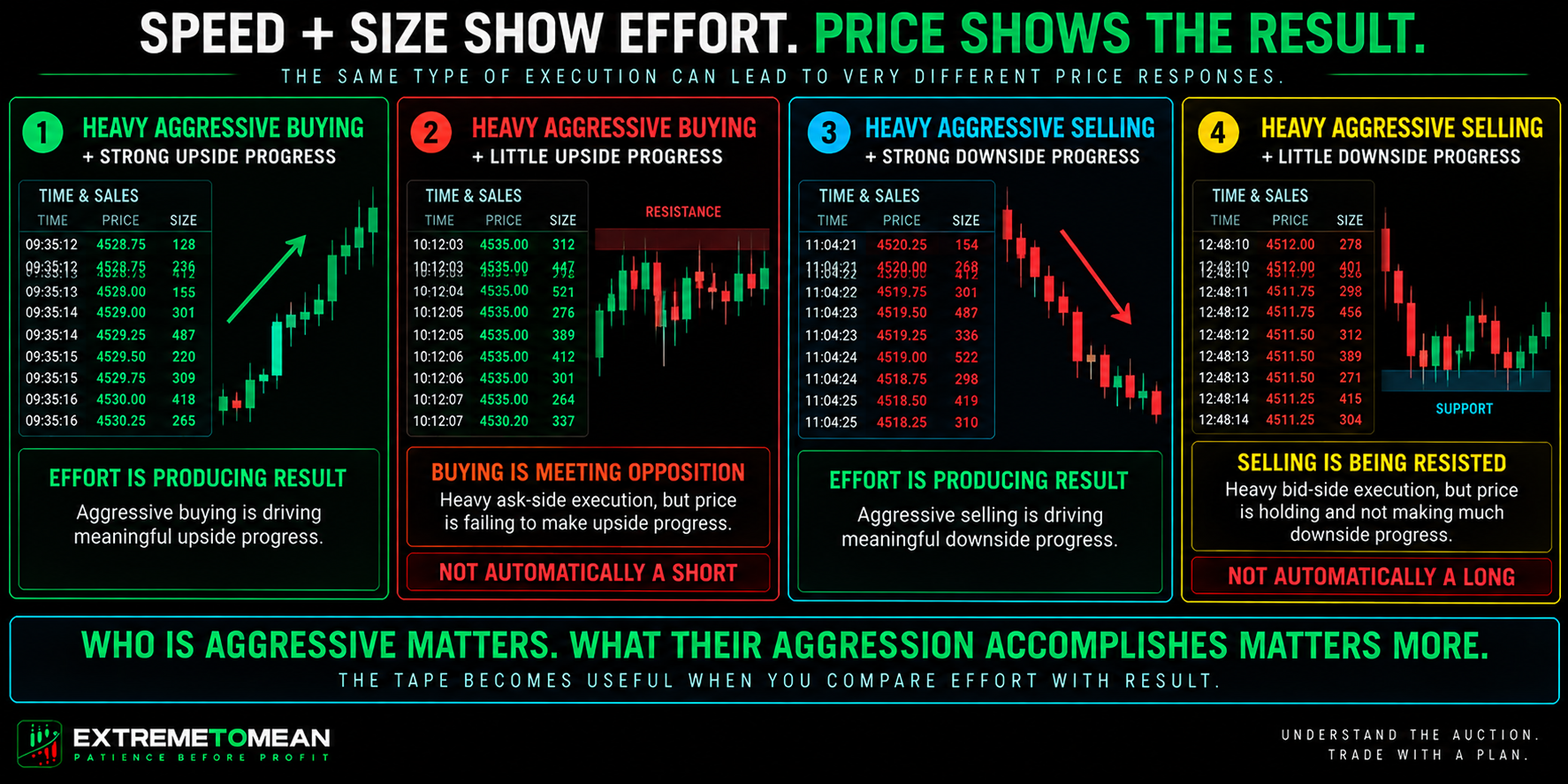
Three variables matter more than the color of any single print: speed, size, and price progress. Speed tells you how quickly transactions are arriving, size tells you how much is executing, and price progress tells you what all that activity is actually accomplishing. Speed and size describe effort; price progress tells you whether the effort is working.
A faster tape can indicate increased urgency, participation, or volatility, but “fast” is relative. Activity that is ordinary just after the 9:30 cash open may be exceptional during a quiet midday period, and NQ may naturally produce a different rhythm from YM. Tape speed becomes information only after you understand what normal looks like in that market at that time.
Size needs the same baseline. A 50-contract print may be notable in one environment and routine in another, while one isolated large transaction may matter less than repeated execution at the same level or across adjacent prices. The sequence often matters more than the spectacle of one large print.
The most useful comparison is effort versus result. Heavy ask-side execution with clean upward price progress tells a different story from equally heavy ask-side execution that repeatedly fails to move price higher. Who is aggressive matters; whether that aggression moves price matters more.
Location Changes the Meaning of the Tape
Tape information becomes more useful when price reaches a level that already matters. At established resistance, the trader may ask whether aggressive buyers are actually pushing through; at support, the question may be whether aggressive selling is still producing downside progress. The same transaction stream in the middle of a featureless range may be real information while adding almost nothing to a trade decision.
This is where the broader order-flow trading foundation matters. Order flow can help explain what is happening at a location, but it cannot make an unimportant location important or replace the structure that defines the trade. Order flow can be real and still be irrelevant.
Context also changes how much weight the tape deserves. Opening volatility, a midday lull, an economic release, and a mature trend can all produce different normal transaction rhythms, while a burst during FOMC repricing may simply be too fast to improve execution decisions. More information arriving faster does not mean the information has become easier to trade.
Tape, CVD, Footprints, and Volume Answer Different Questions
Tape is the transaction stream: what just executed, in what sequence, at what price, and in what size. Cumulative Volume Delta compresses classified aggression into a running summary across a chosen period, so the two tools trade detail for shelf life differently. Tape gives you the stream; CVD gives you the running summary.
Footprint charts preserve execution by price inside a bar, while Time & Sales preserves sequence through time. Raw volume answers how much traded rather than how the activity arrived, while volume versus open interest separates trading activity from outstanding contracts. Volume tells you how much traded; tape shows how that trading unfolded.
The Big-Print and Fast-Tape Traps
A large print attracts attention because it looks important. The mistake is turning “a large transaction occurred” into “an institution just told me what price will do next,” even though Time & Sales cannot establish participant identity, motive, or whether more demand remains behind that transaction. The trade being large does not make your response to it intelligent.
Fast tape creates a similar behavioral problem because market speed feels like personal urgency. A trader sees transactions accelerating and begins to chase, even when location is poor, the setup is incomplete, or most of the move has already occurred. The tape can speed up without requiring you to speed up.
Read Effort and Result, Not a Story
Suppose repeated aggressive buying appears at NQ resistance but price cannot establish higher. The observation is that buying aggression occurred while upside progress remained limited; a reasonable interpretation is that opposing liquidity may be meeting that demand. The unjustified leap is “therefore the market must reverse now.”
The mirror image can occur at ES support. Aggressive selling increases, transaction speed rises, and repeated sell-side execution produces less and less downside progress. That can tell the trader that pressure is being resisted before it proves that a reversal has qualified.
This distinction makes tape observations reviewable. “The tape looked bullish” is too vague, while “ask-side execution accelerated at the range high, but price failed to establish above it and I entered before acceptance” separates observation from interpretation and decision. Tape reading becomes dangerous when observation quietly turns into prediction.
A Practical ETM Tape-Reading Framework
Use Context → Location → Question → Tape → Response → Structure → Risk → Decision. The sequence prevents Time & Sales from becoming the first reason a trade exists and makes the tool answer a defined question inside an existing setup process. Do not watch the tape until the market gives you a reason to care about what it says.
- Context: What market condition and session environment are you in?
- Location: Why does this price area matter?
- Question: What specifically do you need the tape to clarify?
- Tape: What speed, size, aggression, and sequence are observable?
- Response: What did price actually accomplish with that activity?
- Structure: Did the market change in the way the setup requires?
- Risk: Can invalidation and position size be defined?
- Decision: Trade, wait, or pass.
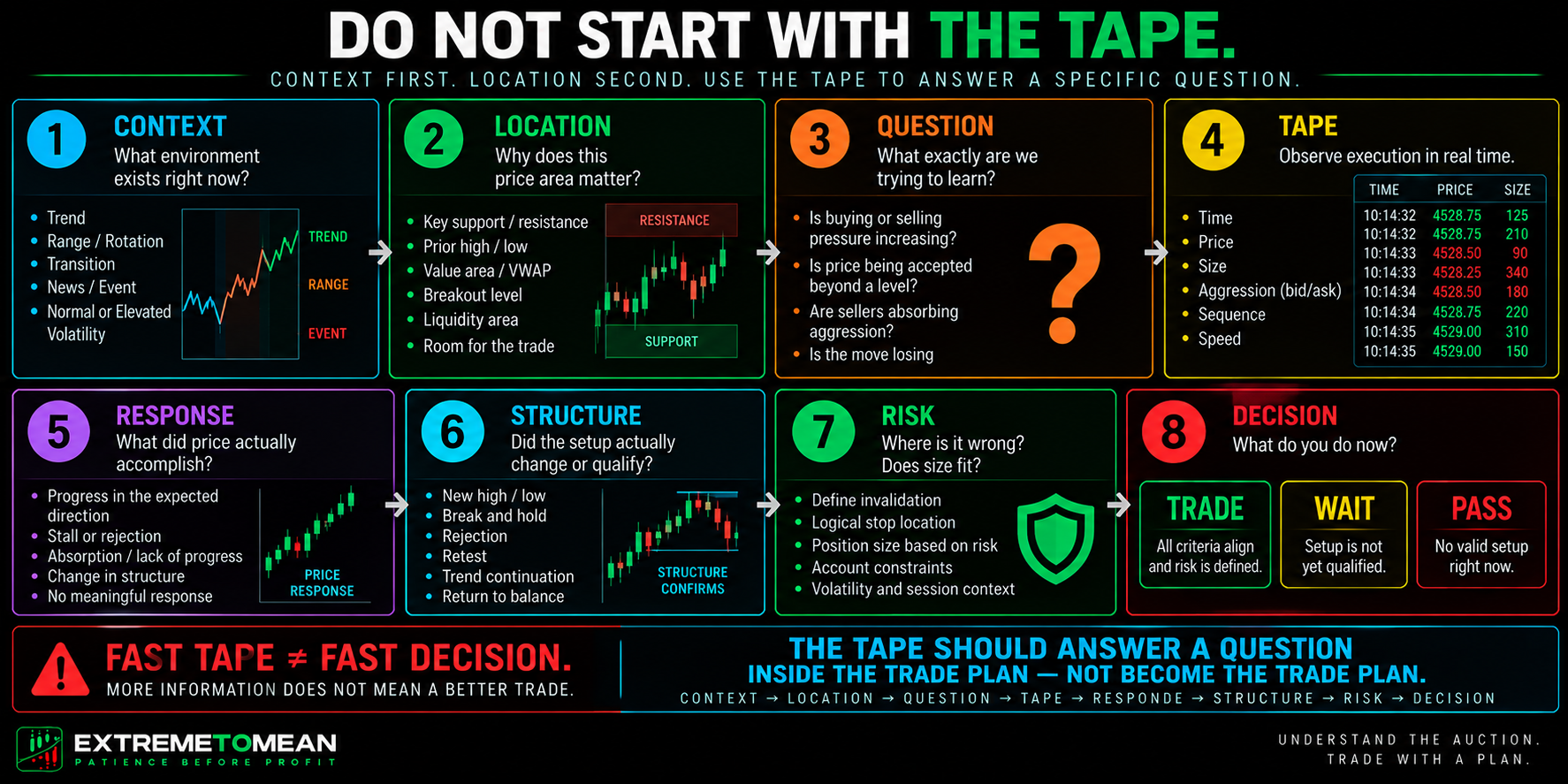
The better question is not “Does the tape look bullish or bearish?” Ask, “What is being executed here, is that effort producing price progress, and does the answer make an already valid trading question clearer?” If the tape does not improve that decision, watching more prints is not automatically better analysis.
Do You Actually Need Tape Reading?
Tape reading is not a requirement for serious trading. A trader with tested rules, clear structure, and a sufficient execution process may decide that Time & Sales adds useful timing information, or may decide that it adds more noise than clarity. A tool is valuable only if it improves the decision more than it increases the noise.
Filtering can make the stream easier to process, but every filter hides information. Minimum-size filters can remove smaller transactions, aggregation settings can change what appears as one print, and platform presentation can make the same activity look different across screens. Treat filtering as a visibility choice, not an “institutional” detector.
Common mistakes include reacting to every print, treating colors as universal signals, following one large trade, using fixed tape-speed thresholds, ignoring time of day, and reading the tape without meaningful location. Requiring so much tape confirmation that most of the opportunity is already gone creates the opposite problem. Fast information can still support a patient decision process.
Final Thought
Tape reading is not the skill of predicting the next tick from a flashing stream of transactions. It is the skill of watching real execution at a meaningful location, comparing effort with result, and deciding whether the information makes an already valid trading question clearer. The tape shows what happened; price response tells you what that activity accomplished.
Context comes first, location comes second, and Time & Sales comes only when there is a question worth asking. The tape should support structure and risk rather than replace them, and sometimes the best conclusion is that the stream is adding noise instead of clarity. That selective use of information is part of the broader market-reading discipline developed throughout Decode the Market.
Educational content only. Trading involves substantial risk and is not suitable for everyone.