
Good trade management is not constant intervention. It is the process of comparing what the market is doing now with the plan that existed before entry, then deciding whether anything important has changed. Inside The Setup, the goal is not to touch the position whenever price moves; it is to respond only when information relevant to the trade actually changes.
The behavioral challenge is that the trader changes as soon as money becomes real. A stop that looked reasonable before entry can suddenly feel too far away, while a target that looked logical can feel too ambitious once open profit appears. Trade management is where a written plan collides with live emotion.
Trade Management Starts Before the Entry
You cannot manage a trade intelligently if there was no original plan to manage. Before entry, the trader should already know why the setup exists, where the idea is invalidated, how much risk is acceptable, whether partial exits or trailing are part of the strategy, and what kind of market behavior would justify an early exit. The post-entry rules should not be invented under pressure.
That is where risk management and trade management meet. Risk management establishes the starting boundaries: position size, initial stop, account risk, target logic, and whether the trade is acceptable at all. Trade management governs what happens after entry when those boundaries may need to remain, tighten, or change.
| Risk Management | Trade Management |
|---|---|
| Primarily defined before entry | Primarily applied after entry |
| Determines initial risk | Governs changing exposure |
| Position size | Stop adjustments |
| Initial invalidation | Breakeven decisions |
| Initial stop | Partial exits |
| Account risk | Trailing |
| Initial target framework | Target adjustments |
| Whether the trade can be taken | Whether the trade should remain open |
The two are not independent systems. Moving a stop after entry is a trade-management decision that also changes risk, while taking a partial changes both exposure and the distribution of possible outcomes. Risk management sets the starting boundaries; trade management can change those boundaries—but only for a defined reason.
The Stop Still Has a Job After Entry
The initial stop should represent where the original trade idea is no longer valid, not merely where the trader becomes uncomfortable. That is why risk-first trading matters before any management decision begins. Once price starts moving, the question becomes whether the original invalidation still makes sense or whether new structure has genuinely changed the trade.
One of the weakest forms of “management” is widening the stop simply because the trade is losing. The trader decides the position “needs more room,” moves the stop farther away, and quietly increases the loss they originally agreed to accept. Moving a stop farther away does not manage the original risk; it creates new risk.
That does not mean a systematic strategy could never widen a stop under any circumstance. If such a rule exists, it should be defined before entry and total account risk still has to remain controlled. What should not happen is a live negotiation with the loss because the trader no longer wants the original invalidation to count.
Tightening the stop is not automatically better management either. A favorable move may tempt the trader to reduce risk immediately, but a tighter stop also reduces the trade's ability to survive normal rotation. Less room is not automatically better management; it is simply different management.
The same tradeoff applies to moving a stop to breakeven. That choice may make sense under a predefined rule, but it changes the trade from accepting the original planned loss to trying to remove or reduce remaining downside. The dedicated lesson on when to move a stop to breakeven goes deeper into that decision because entry price is not automatically the new structural invalidation.
The P&L Window Is Not Market Information
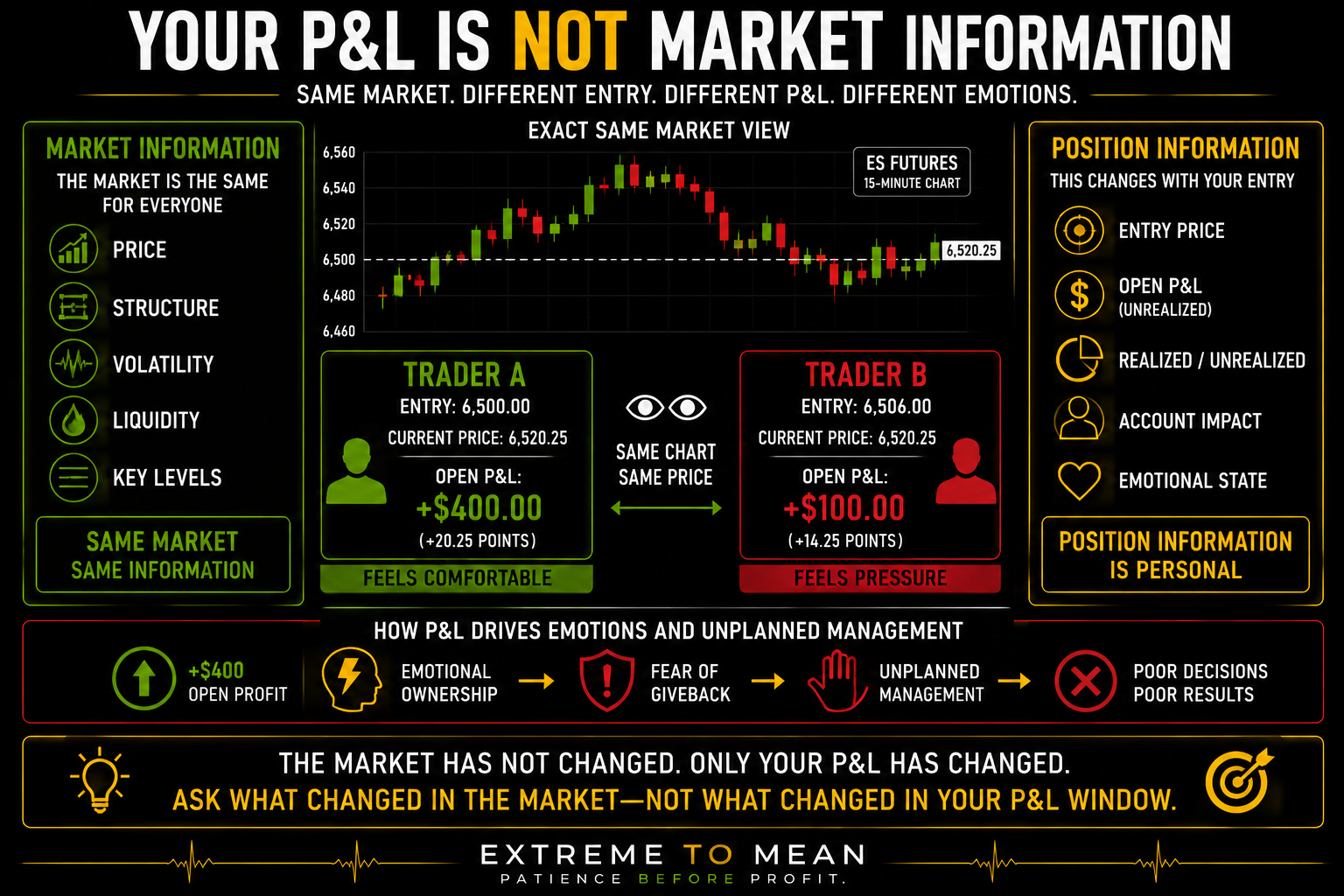
Open profit creates a new psychological problem. A trader sees +$400 unrealized, then watches the position pull back to +$250 and emotionally experiences the change as “losing $150,” even though the $400 was never realized. That sense of ownership can trigger an early exit, an arbitrary partial, a tighter stop, or a smaller target even when the market itself has not materially changed.
Price, structure, volatility, and liquidity are market information. Unrealized P&L is information about the position relative to the trader's entry, and two traders with different entries can see very different P&L while looking at the exact same market. Your P&L can change your emotions without changing the market.
This is why managing a winner cannot mean protecting every dollar of open profit. More protection can reduce giveback, but more room can allow the position to survive normal pullbacks and participate in a larger move. You cannot maximize room and minimize giveback at the same time.
Targets, Partials, and Added Exposure All Change the Trade
Targets should ideally have logic before entry, whether that logic comes from structure, an opposing level, available room, volatility, or another tested method. If the target is changed after entry, the key question is what market information justified the change rather than how much more profit the trader suddenly wants or how badly they want relief. A target should change because the trade changed—not because greed or fear increased as the target got closer.
Partial exits create another explicit tradeoff. Closing part of a position realizes some profit and reduces remaining exposure, but it also removes size from any larger continuation that follows. A partial exit trades future upside for present certainty, which is why the full mechanics belong in how to scale out without killing your winners.
Adding after entry is still trade management, but it moves exposure in the other direction. A planned scale-in can be legitimate when the strategy defines the additional entry and total risk remains controlled; scaling into a trade because new information supports the plan is different from adding merely because a losing position now has a more attractive average price. A better average entry can coexist with a worse risk position.
Early Exit, Trailing, and Time-Based Decisions
A trader does not always have to wait passively for the original stop if the reason for the trade disappears sooner. A meaningful structural change, failed expected follow-through, a reclaimed or lost level, or a predefined time-based condition can justify an earlier exit. Exit early when the reason for the trade has changed—not merely because the trade has become unpleasant to watch.
Trailing is another possible management method rather than the definition of management itself. A fixed stop may remain at one level while the trade develops, whereas a trailing stop adjusts according to a predefined reference such as structure, volatility, prior bars, or distance. The correct question is not whether trailing sounds more active; it is whether the trailing rule belongs to the strategy being executed.
Rule-Based, Discretionary, and Automated Management
Rule-based management might say, “When condition X occurs, move the stop to Y.” That can improve consistency and testability, but a poor rule will still execute consistently. Discretionary management can adapt to context, but it is more vulnerable to emotion and hindsight if the trader has no boundaries.
The cleaner middle ground is bounded discretion. The trader may interpret changing structure or conditions, but the reasons that permit an adjustment should still be identifiable before the decision is made. Discretion does not mean improvisation without rules.
Platforms can automate predefined stop, target, trailing, and OCO behavior, which can reduce the delay between entry and protective-order placement. Automation is useful only to the extent that the underlying rule is useful, and order handling can vary by platform, broker, connection, and order type. Automation can execute a management rule; it cannot make a bad management rule good.
A stop is a trigger rather than a guarantee of an exact fill, while a stop-limit can provide price control but may remain unfilled if price moves away too quickly. That means a management instruction still has execution risk after the rule itself is chosen. Every protective order trades one execution risk for another, so the trader needs to understand how the actual platform implements it.
Trade Management Changes the Strategy
Management rules are not cosmetic additions to an entry system. If a strategy was tested with a -1R stop and +3R target but the trader later moves to breakeven at +0.5R, takes half off at +1R, and trails tightly after +1.5R, the live payoff structure is no longer the same. The new management may improve the strategy or damage it, but it has unquestionably changed it.
That is why a higher win rate is not enough to prove that aggressive management is better. More scratches and small winners can make more trades finish green while also eliminating larger winners and reducing average payoff. The relevant question is what the management rules do to the full distribution of outcomes.
A trader therefore cannot backtest only the entry and then improvise the exits live while claiming to be executing the tested system. Stops, targets, partials, breakeven rules, trailing logic, time exits, and early-exit conditions are all part of the strategy. You cannot claim to have tested the trade if you only tested the entry.
A Practical Trade-Management Framework
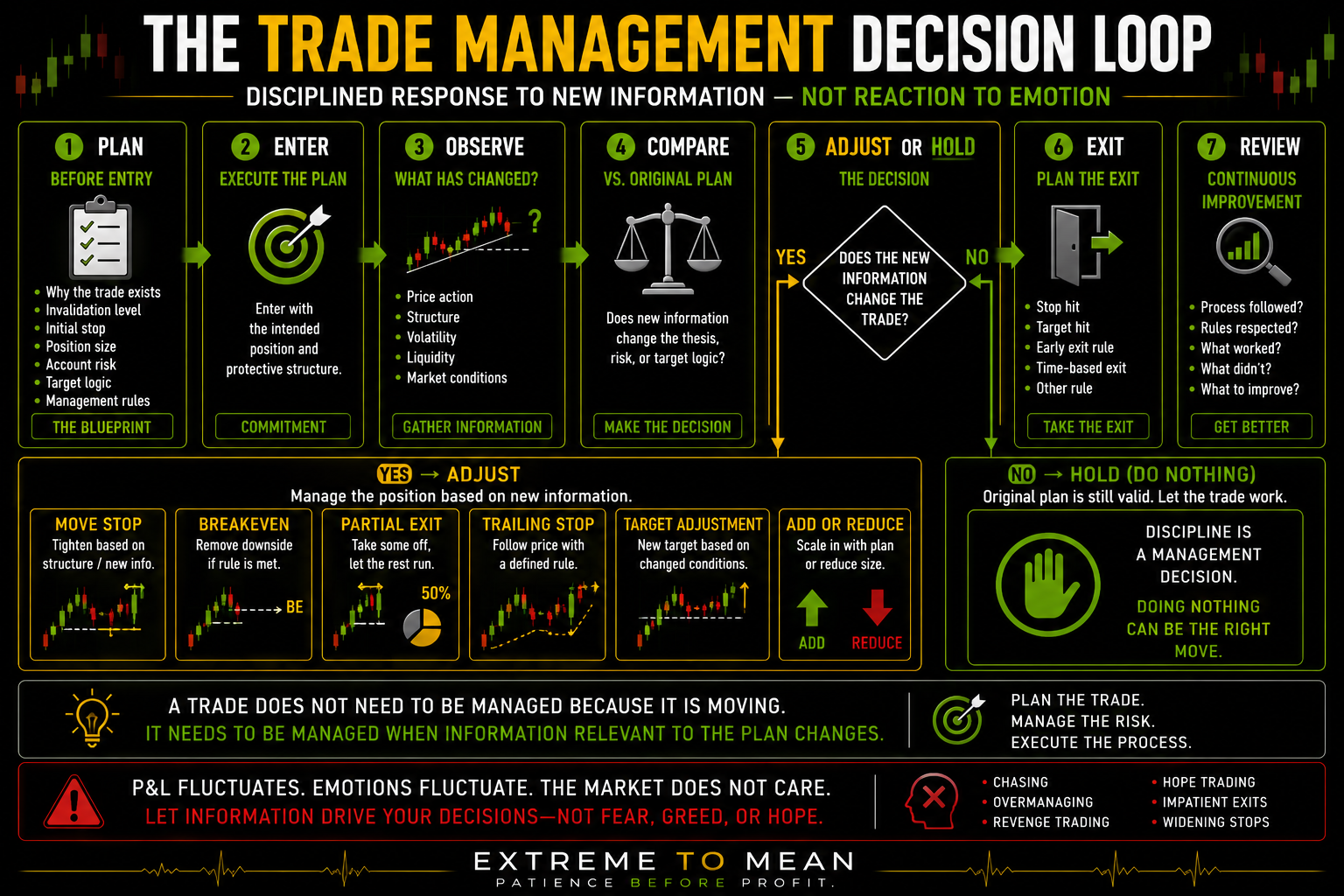
Use Plan → Enter → Observe → Compare → Adjust or Hold → Exit → Review. The sequence forces the trader to compare new information with the original plan before touching the position. A trade does not need to be managed simply because it is moving; it needs to be managed when information relevant to the plan changes.
- Plan: What were the original stop, target, sizing, and management rules?
- Enter: Was the intended position and protective structure actually executed?
- Observe: What has changed in price, structure, volatility, or market condition?
- Compare: Does that information alter the original thesis, risk, or target logic?
- Adjust or Hold: Move the stop, take a partial, trail, exit—or deliberately do nothing.
- Exit: Let a predefined exit condition end the trade.
- Review: Did the management follow the process, and what did it do to the trade outcome?
The better question is not “What should I do with this trade right now?” Ask, “What has changed in the market that was important enough to change my original plan?” If the answer is nothing, doing nothing is also a trade-management decision.
Final Thought
Good trade management is not a contest to see how many times the trader can improve the position after entry. The trader begins with a plan, the market provides new information, and only information relevant to that plan should justify changing the trade. Sometimes that means moving a stop, taking a partial, trailing, or exiting early.
Sometimes the correct decision is to leave the trade alone. That can feel passive when money is moving, but patience after entry is still part of disciplined execution. The purpose of management rules is not to remove uncertainty; it is to stop uncertainty from rewriting the plan every few seconds.
Trade management therefore has to be evaluated as part of the entire strategy rather than as a collection of clever post-entry tricks. The strongest process is the one that can explain why exposure changed, why it stayed the same, and whether those decisions were consistent with the strategy rather than the emotion of the moment. That larger patience-and-process problem is explored throughout The Patience Principle.
Educational content only. Trading involves substantial risk and is not suitable for everyone.