
The central question is whether the market has progressed enough that the original invalidation point no longer describes where the trade is wrong. Profit alone does not answer that question. Inside The Setup, a breakeven move is a trade-management decision rather than an automatic milestone.
What Moving a Stop to Breakeven Actually Means
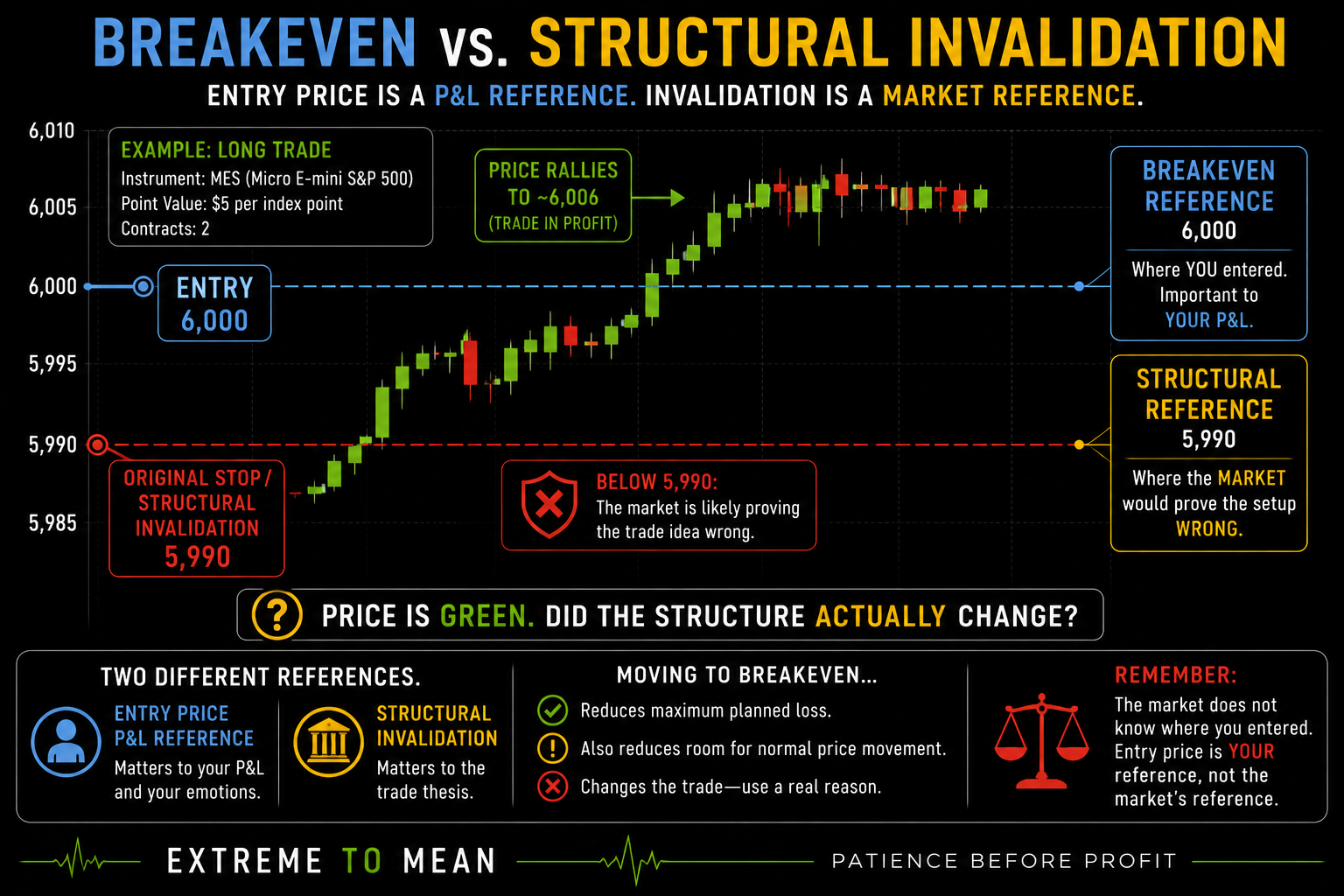
Suppose a trader buys at 6,000 with an initial stop at 5,990. Moving the stop to breakeven generally means raising that stop to the 6,000 entry so a reversal can reduce most or all of the original market loss. The trade also has less room to move than it had when opened.
“Breakeven” does not guarantee exactly zero net P&L. Fees and execution can affect the final result, while futures stop orders have different mechanics depending on order type. CME distinguishes stop-with-protection from stop-limit execution, and the triggered price does not necessarily equal the eventual fill in every circumstance. (cmegroup.com)
The Original Stop and the Entry Price Answer Different Questions
The stop should ideally answer where the market would prove the setup wrong. The entry price answers where the trader happened to enter. Those prices can be related, but they are not automatically interchangeable.
That is why where the trade is wrong remains the stronger reference after entry. CME notes that price-action-based stop placement is specific to the trader and strategy. (cmegroup.com) If a long remains structurally valid down to 5,990, a rally above 6,000 does not automatically make entry the new invalidation.
Moving the stop to entry simply because open profit exists replaces a market-based reference with a P&L-based one. Green P&L tells the trader something about the account, but it does not by itself tell the market that the setup has entered a new phase. Breakeven is a financial reference for the trader; it is not automatically a structural reference for the market.
Why Breakeven Feels So Attractive
Before a trade moves favorably, the trader may be willing to accept the original planned stop. Once the position turns green, the thinking can shift to “I can’t let this become a loser,” even though the setup itself has not materially changed. The discomfort makes sense because unrealized profit creates something visible that now feels possible to lose.
This is where risk-first trading still matters after entry. The initial stop was accepted because the trade supposedly needed that much room, so a tighter stop should require a reason beyond a change in the P&L display. Favorable movement changes price; meaningful progress changes the logic of the trade.
Moving to Breakeven Too Early Can Remove a Valid Trade
Consider a hypothetical long position in two MES contracts at 6,000 with an original stop at 5,990 and a target at 6,030. CME specifies MES at $5 per S&P 500 index point, so the 10-point stop represents $50 per contract and $100 of gross risk across two contracts. (cmegroup.com) The example illustrates mechanics, not a recommended setup.
Price rallies to 6,010, and the trader moves the stop to 6,000. Price then makes a normal pullback to 5,998, triggering the tighter stop area, before later resuming toward 6,030. The lesson is not that the trader should have predicted the rally; it is that if 5,998 remained valid inside the original structure, the stop changed before the thesis did.
A breakeven stop can therefore remove planned loss exposure and remove still-valid trades at the same time. That can be acceptable when it is an intentional, tested property of the strategy. It should not be mistaken for preserving the original trade without changing anything.
When Moving the Stop Can Make Sense
A stop move becomes easier to justify after a meaningful structural step. A breakout may hold, new structure may form, or the market may create a closer logical failure point. In those cases, the original invalidation may genuinely be outdated.
A planned management event can also authorize a change in risk. CME’s trade-plan material presents taking some profit and then moving the remaining stop to breakeven as one possible choice, not a universal requirement. (cmegroup.com) The lesson is not “Target 1 means breakeven”; it is that a predefined event can change the management state if the strategy says it should.
Taking a partial and moving the stop are still separate decisions. Closing size changes exposure, while moving the stop changes the risk location of what remains. The trader should be able to explain both actions independently rather than assuming that realized profit automatically makes entry the correct stop.
Structure May Matter More Than Exact Breakeven
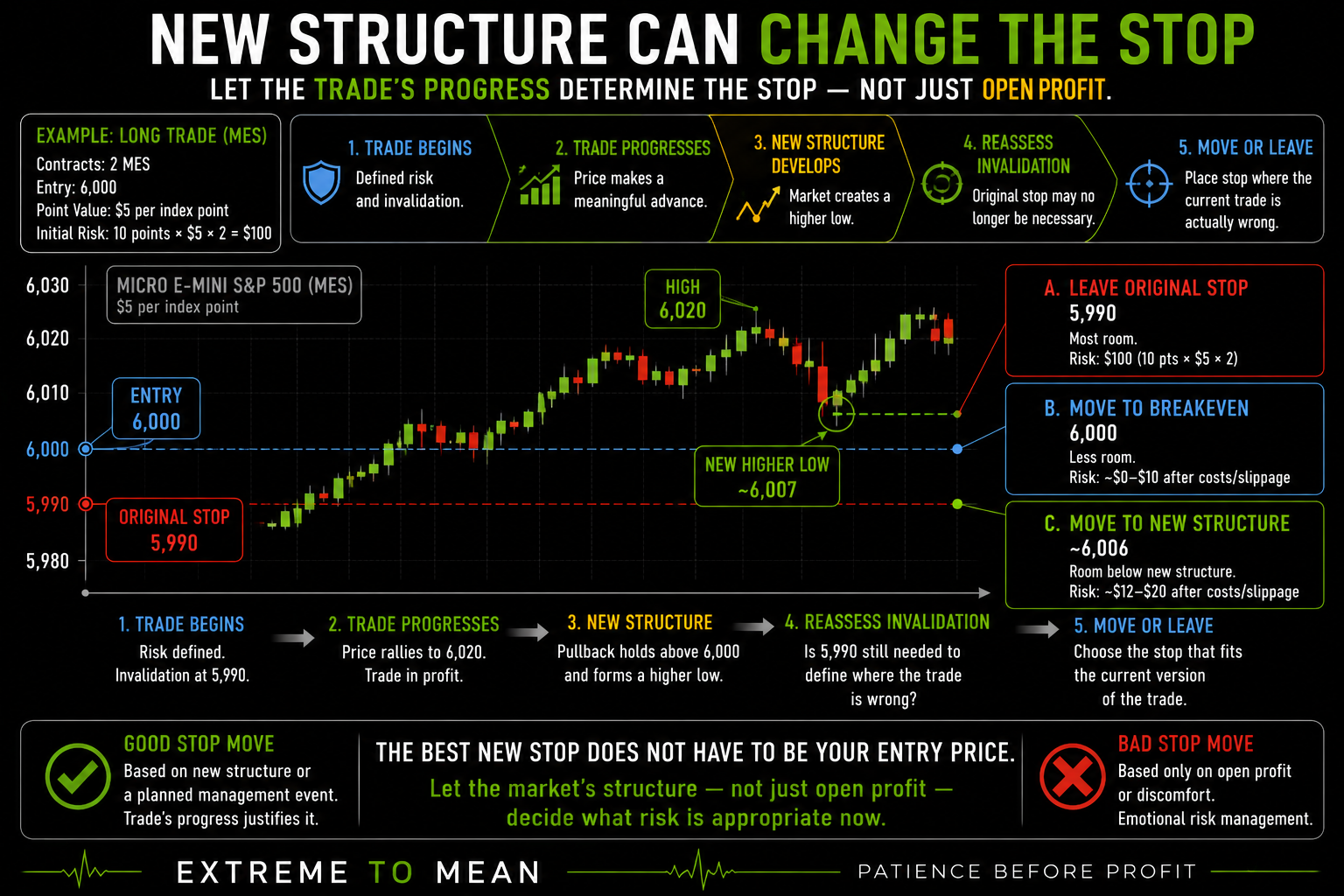
Suppose the trader entered at 6,000 with the original stop at 5,990, price later reached 6,020, and a meaningful higher low formed around 6,007. The choices now include leaving the original stop, moving exactly to entry, or using a new structural stop if the strategy allows it. The best new stop does not have to equal the entry price.
That is why the trade is not ready until the risk is clear remains relevant after the trade progresses. The question changes from where the trade was wrong at entry to where the current version of the trade is wrong now. If new structure provides that answer, the stop can adapt to market information instead of P&L anxiety.
| Question | Structural Stop Move | Emotional Breakeven Move |
|---|---|---|
| Why move it? | Trade materially progressed | P&L is green |
| New structure? | Yes or developing | Not necessarily |
| Original invalidation obsolete? | Possibly | Usually unchanged |
| Timing | Planned event or structure | Discomfort |
| New stop location | Fits current structure | Automatically at entry |
| Repeatable? | Can be defined and tested | Often varies |
| Main goal | Adapt to new information | Avoid feeling a loss |
Breakeven After a Partial Still Needs Its Own Reason
Imagine four contracts where two are closed at a planned first objective and two remain. The partial has already changed position size and realized P&L; moving the stop changes the risk location of the remaining contracts. Those decisions can be linked in a plan without becoming the same decision.
A breakeven stop on the runner also does not mean the whole trade made nothing. If the first two contracts realized a gain and the final two exit around entry, the runner may be approximately flat on price before costs while the complete trade still contains the earlier realized gain. Review should therefore separate the runner result from the complete trade result.
Breakeven Rules Change the Strategy
Tightening a stop changes the distribution of outcomes. Some larger losses may become smaller losses or breakevens, while some trades that would have survived normal movement may be removed before later continuation. Average winner, average loser, and the mix of wins, losses, and breakevens can all change.
That is why one memorable trade cannot validate the rule. Compare an original-stop plan with alternatives such as moving after a structural event or after a planned first objective, then review the results across a meaningful sample after costs. Fixed triggers such as +1R, +2R, or a time threshold can be legitimate rules inside a tested strategy, but they are not universal laws.
CME’s stop-management material supports incorporating exit parameters into the trade plan while recognizing that exact stop placement depends on the trader and strategy. (cmegroup.com) That supports testing a repeatable rule rather than treating one numerical threshold as universally correct.
Sometimes Leaving the Stop Alone Is the Better Decision
Leaving the stop unchanged can be active management when the original plan is still doing its job. Price may have barely progressed, normal volatility may still require room, no new structural protection may exist, or the only reason for tightening may be fear that a green trade could turn red. Sometimes the best management decision is no new decision.
The same discipline matters after a premature move. Widening a stop again as price approaches it renegotiates risk to avoid the exit. A premature breakeven rule should be fixed in future testing rather than reversed inside the current trade.
This keeps entry, stop, and target connected to one coherent plan. Moving a protective stop closer can reduce permitted loss, while moving it farther away again because the market is threatening the stop increases permitted loss. Those are different decisions and should not be blurred together under the label of trade management.
A Practical Stop-Movement Filter
Use Original Risk → Progress → New Structure → Reassess → Move or Leave. The sequence begins with why the original stop existed and requires new evidence before risk is altered. It keeps the decision tied to trade development rather than open-profit discomfort.
- Original Risk: Where was the trade wrong when you entered?
- Progress: What has actually happened since entry?
- New Structure: Has the market created a new logical failure point?
- Reassess: Has the original invalidation become unnecessary?
- Normal movement: Would the proposed stop survive ordinary movement for this setup?
- Repeatability: Is this part of a rule you can define and test?
- Motivation: Are you reacting to the chart or to green P&L?
- Move or Leave: Change the stop only when structure or the plan justifies it.
The better question is not, “Can I move my stop to breakeven yet?” Ask: “What has changed in the market that makes my original invalidation point unnecessary?” Then use a second filter: “If I had no P&L display and could only see the chart, would I still move this stop right now?”
Final Thought
A stop should not move to breakeven merely because the trade became profitable. It should move when the trade has progressed enough that the original risk no longer makes structural sense, or when a tested management rule calls for the change. Entry price matters enormously to the trader, but the market is not required to treat it as the new invalidation point.
Sometimes new structure will justify tightening the stop, and the best new location may not be exact breakeven. Sometimes the original stop should remain because nothing important has changed. Patience does not end when the entry fills; allowing a planned trade room to develop instead of changing the rules because open profit feels uncomfortable is part of the larger problem explored in The Patience Principle.
Educational content only. Trading involves substantial risk and is not suitable for everyone.