
Many traders assume that a technically valid setup should produce a technically valid result. They identify the correct pattern, wait for the expected trigger, and place the trade according to the rules they have studied. When the move fails, they often blame the entry, the stop, or their execution. The missing question is whether the market was strong enough to support the setup in the first place.
The lessons in The Market category emphasize that individual trade ideas operate inside a larger environment. A setup cannot create participation, conviction, available room, or directional agreement that the market does not already possess. The pattern may still be valid as a visual structure, but that does not make the complete trade attractive. Setup recognition and trade qualification are related decisions, not interchangeable ones.
A Clean Setup Is Not a Complete Trade
A clean setup describes a recognizable arrangement of price, structure, and timing. It may include a pullback into a meaningful area, a breakout from consolidation, a rejection at resistance, or another repeatable pattern. Those features can tell the trader where an opportunity may be developing. They do not explain whether the surrounding market is capable of carrying the move.
A complete trade requires more than the pattern itself. The trader must also evaluate market state, participation, higher-timeframe structure, location, available room, and risk. This is why market conditions change the quality of a setup, even when the technical picture appears familiar. The same setup can behave cleanly in one environment and fail repeatedly in another.
Weak Markets Often Lack Participation
A weak market does not always mean that prices are falling. Weakness can appear as narrow participation, limited breadth, inconsistent leadership, or movement driven by only a small group of instruments. An index may rise while most sectors remain flat or negative, creating the appearance of strength without broad support. A bullish setup inside that environment may struggle because too few participants are helping sustain the move.
The same problem can affect bearish setups. One index may weaken while other major markets hold firm, defensive sectors fail to lead, and selling pressure remains isolated. The short pattern may look correct, but the broader market is not confirming the same message. Without participation, the setup depends on a narrow pocket of pressure that may disappear quickly.
Participation does not need to be perfect before a trade can work. Markets often move with uneven leadership, and broad agreement is not guaranteed. The trader’s job is to determine whether participation is strong enough for the specific idea being considered. A setup requiring continuation should be judged more cautiously when the market is showing only scattered commitment.
Poor Follow-Through Exposes Weak Market Quality
Follow-through reveals whether buyers or sellers can preserve the progress created by the setup. A breakout may trigger correctly, but price can immediately return to the prior range. A pullback entry may produce the expected initial response, yet stall before reaching the next meaningful area. The first reaction looks valid while the lack of continuation reveals the weakness underneath it.
This is where the distinction taught in Reading Pressure Before Reacting to Price becomes important. One fast candle or temporary push can create the appearance of control without proving that participation will continue. Meaningful pressure should produce preserved progress, controlled pullbacks, and acceptance beyond important areas. When every move is quickly erased, the market is communicating low conviction.
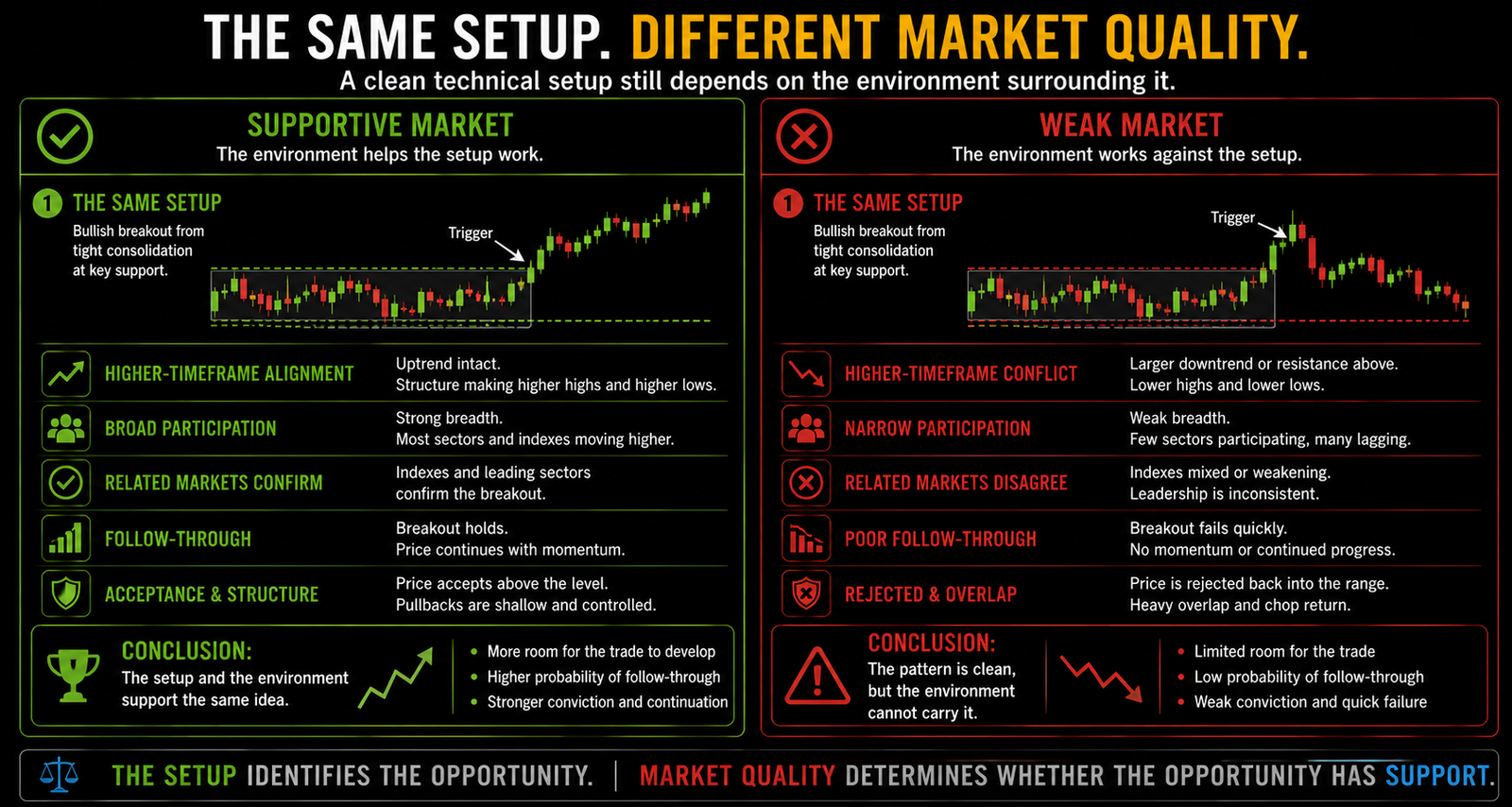
Conflicting Higher-Timeframe Structure Can Limit the Setup
A lower-timeframe setup may look clean while developing directly against stronger higher-timeframe structure. A bullish pattern can form beneath major resistance, inside a broader downtrend, or after a higher-timeframe rally has already become extended. The lower chart may show an attractive trigger, but the larger environment can limit the available room. The setup is valid on one layer while poorly positioned on another.
The same conflict can occur with short setups. A clean bearish signal may appear directly above higher-timeframe support or during a broader market structure that continues accepting higher prices. The trader may focus on the immediate pattern and overlook the stronger area controlling the decision. When timeframes disagree, the setup usually requires better location, stronger confirmation, or reduced confidence.
Why the Pattern Still Feels Convincing
Clean setups are appealing because they create clarity inside an uncertain market. The pattern is visible, the entry can be defined, and the trader can point to specific rules that appear to justify participation. That structure feels more dependable than the messy and sometimes conflicting evidence surrounding it. The trader may therefore give the pattern more authority than the market environment.
Familiarity also creates emotional confidence. A trader who has studied a particular setup repeatedly may feel that recognizing it correctly should be enough. Passing on the pattern can feel like abandoning the plan or becoming afraid to trade. In reality, the plan should require both setup recognition and environmental qualification before risk is approved.
Choppy Conditions Can Make Good Patterns Behave Poorly
Chop creates movement without dependable progress. Price may trigger a breakout, reverse into the range, trigger an opposing setup, and then reverse again before either side reaches a meaningful destination. The patterns are not necessarily imaginary; they are developing inside an environment that repeatedly removes follow-through. The market is active, but the activity does not provide clean directional control.
This is why traders can take several technically reasonable losses during a weak session. Each setup may meet the visible rules while failing for the same environmental reason. Heavy overlap, changing boundaries, weak participation, and repeated reversals reduce the value of directional signals. The solution is not always to improve the entry; it may be to stop asking a poor market to produce a clean trade.
Location Cannot Repair a Weak Environment by Itself
Good location can improve a setup, but it cannot force the market to participate. A trade near meaningful support may still fail if buyers show no follow-through, related markets remain weak, and higher-timeframe pressure continues lower. The location gives the idea a logical starting point. It does not guarantee that the expected response will appear.
The reverse is also true. Strong market conditions cannot repair a setup entered after most of the available move has already occurred. The trader still needs room, structure, and a clear invalidation point. Market quality and setup quality must work together rather than being used to excuse weaknesses in one another.
Market Quality Should Be Evaluated Before the Trigger
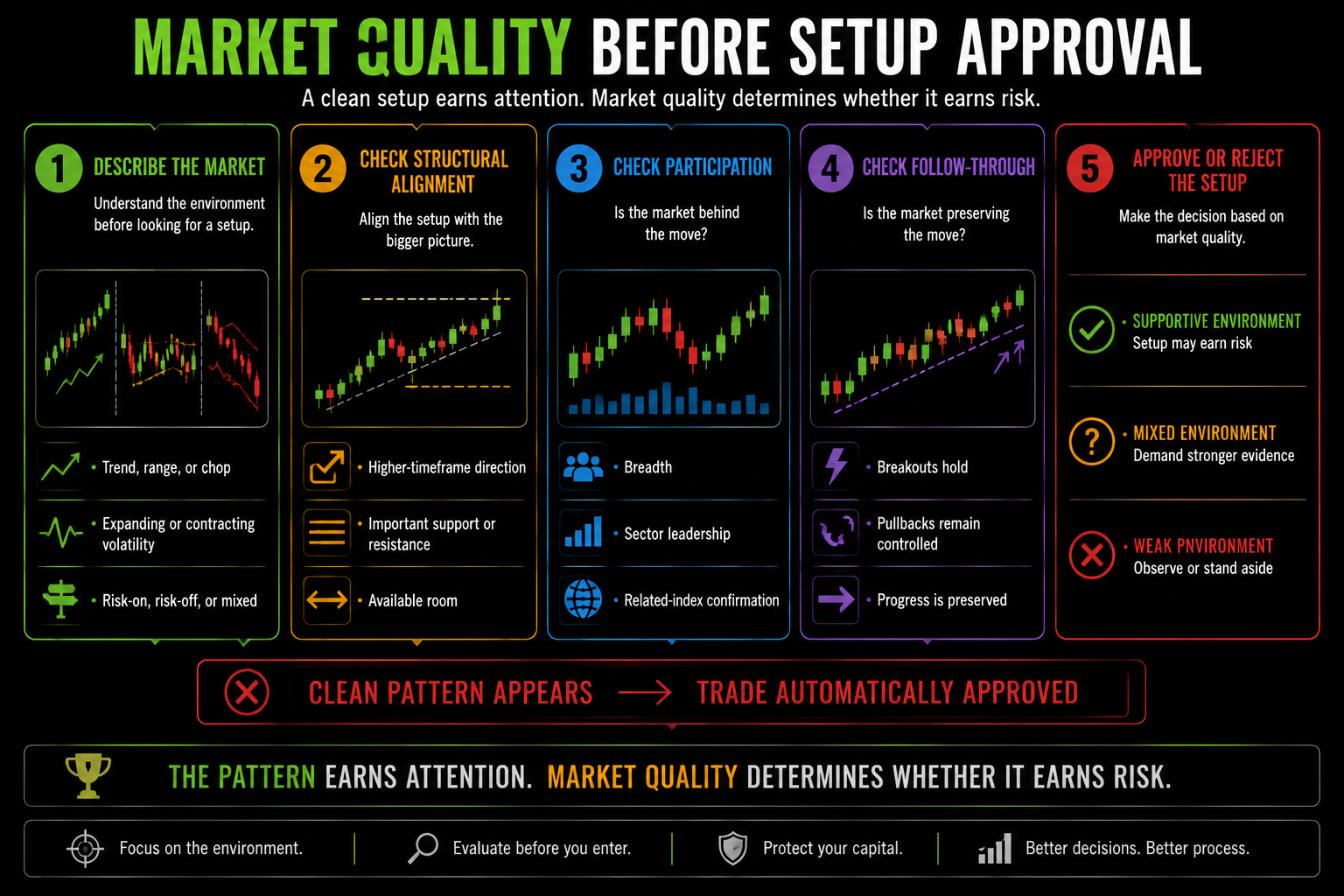
A cleaner process begins before the setup activates. The trader first describes the market environment: trending, ranging, chopping, expanding, contracting, risk-on, risk-off, or mixed. That description establishes what kinds of movement the market has been producing. The setup is then judged according to whether it fits that behavior.
The next step is to evaluate participation and follow-through. The trader should observe whether related indexes and sectors are confirming, whether moves are preserving progress, and whether breakouts are receiving acceptance. A market that repeatedly rejects every extension deserves a different expectation from one that continues building directional structure. The pattern should not be evaluated as though those environments are equal.
The principle that context comes before the candle applies directly to setup approval. The trigger candle is the final piece of evidence, not the entire reason for taking the trade. If the broader context is weak, the candle may earn observation without earning participation. Waiting for stronger conditions is an active decision based on market quality, not a passive refusal to trade.
Use a Market-Quality Filter
Before approving a technically clean setup, the trader can apply a short market-quality filter. The questions should be answered before the entry creates urgency or emotional commitment. A setup does not need ideal conditions in every category, but several weak answers should reduce confidence. The goal is to determine whether the pattern has a supportive environment in which to develop:
- Is the broader market trending, ranging, or chopping?
- Is the setup aligned with or fighting the higher-timeframe structure?
- Are related indexes, sectors, or instruments confirming the move?
- Is participation broad enough for the expected continuation?
- Are recent breakouts receiving follow-through or failing quickly?
- Is price preserving progress after directional pushes?
- Does the setup begin from a meaningful location with available room?
- Is volatility helping price travel or producing unstable reversals?
- Is the market showing conviction, rotation, or conflict?
- Would I still approve this setup if the pattern looked less visually perfect?
The better question is not, “Is this a clean setup?” It is, “Is this a clean setup inside a market strong enough to support what the trade requires?” That distinction prevents technical recognition from becoming automatic permission. It also gives the trader a reason to pass without claiming the pattern itself was wrong.
When the broader market is repeatedly producing failed breaks, weak follow-through, and heavy overlap, traders should review the problem of trading the chop. The answer may involve reducing activity, demanding better location, or waiting until participation improves. Patience is not the absence of a process in this environment. It is the process responding honestly to the quality of the market.
Review the Market Separately From the Setup
Post-trade review should separate setup quality from market quality. The trader may have identified the pattern correctly while overestimating the environment’s ability to support it. That distinction prevents every failed trade from becoming an unnecessary change to the setup rules. It also prevents the trader from defending a weak decision merely because the pattern was technically present.
The review should record participation, follow-through, higher-timeframe alignment, volatility, and the behavior of related markets. Comparing VIX and VVIX during that review can reveal whether the weak conditions came with rising uncertainty about volatility itself. If several failed trades share the same weak-market characteristics, the problem may be environmental rather than mechanical. That information can improve future filtering without implying that similar conditions will always produce the same result. The goal is better classification, not certainty.
Final Thought
A clean setup is valuable because it gives the trader structure, timing, and a repeatable way to evaluate an opportunity. It does not create the market conditions required for that opportunity to develop. Weak participation, poor follow-through, conflicting structure, and choppy movement can cause a technically valid setup to fail. A practical test for when market conditions are not worth trading helps qualify the market along with the pattern.
The goal is not to wait for perfect conditions or reject every trade that contains uncertainty. It is to recognize that a setup earns attention before it earns risk. Market quality determines whether the idea has a reasonable environment in which to work. The trader’s job is to evaluate both before deciding that a clean pattern deserves participation.
Educational content only. Trading involves substantial risk and is not suitable for everyone.