
Many traders search for a simple system because complexity feels exhausting. They want fewer indicators, clearer entries, and a process they can explain without pages of conditions. That goal is reasonable because a simpler framework can improve clarity and reduce unnecessary decisions. The mistake is assuming that a simple framework will also feel easy to follow when money, movement, and uncertainty are involved.
The lessons in The Trader category focus on the person applying the method because rules do not execute themselves. A trader can understand the setup, recognize the location, and know the risk while still acting too early, too late, or outside the plan. The market does not test whether the trader can repeat the rules in calm conditions. It tests whether the trader can respect them when the outcome is unknown and emotion offers a faster answer.
Simple Does Not Mean Shallow
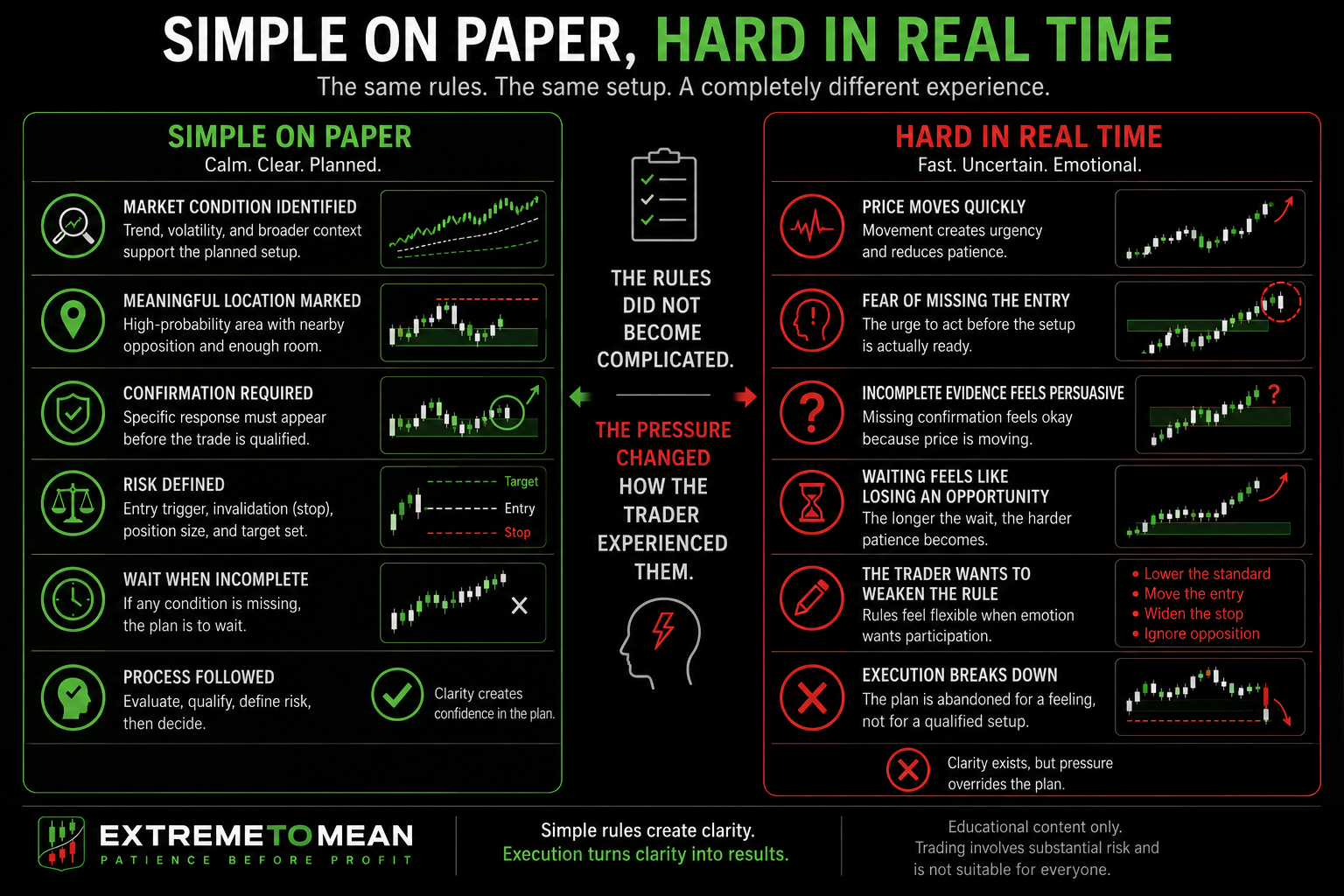
A simple trading process usually reduces the decision to a small number of important questions. The trader may evaluate market condition, location, structure, confirmation, and risk without adding layers that do not change the decision. Each part still requires judgment, and each answer must be connected to current evidence. Simplicity removes unnecessary steps, but it does not remove the need to think.
This is why understanding what an edge actually is matters. An edge is not made stronger merely by adding more indicators, exceptions, or entry patterns. It comes from a repeatable idea with defined conditions and a clear way to manage uncertainty. A simple framework can be serious and well developed even when the final decision can be explained in a few sentences.
Why Pressure Changes the Decision
Rules often look obvious when the chart is no longer moving. After the session, it may be easy to see that price was in the middle, the setup lacked room, or confirmation never appeared. During the trade, however, movement creates urgency and uncertainty makes incomplete evidence feel more convincing. The simple rule remains available, but following it now requires the trader to accept that waiting may mean missing the move.
The weaker decision feels reasonable because it promises relief from uncertainty. Entering early ends the debate, widening the rule creates permission, and adding another signal can make the choice feel better supported. The trader may believe the system failed to provide enough guidance when the real problem is discomfort with an incomplete setup. Simplicity exposes that discomfort because there are fewer technical details available to hide it.
Complexity Can Become an Escape
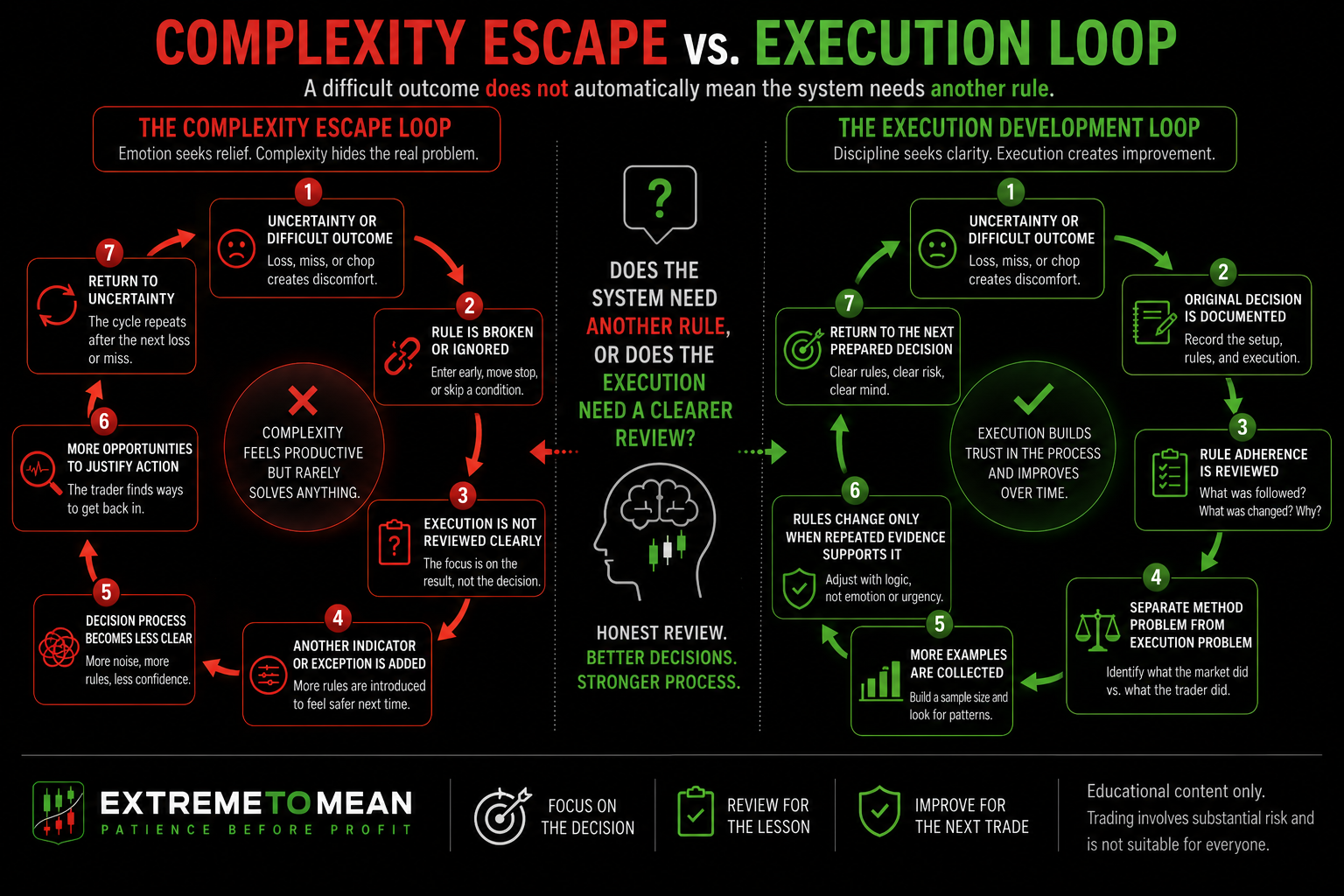
Traders often complicate a method after a loss, a missed trade, or a period of hesitation. They add another indicator, create a new exception, change the entry trigger, or introduce a second setup that seems better suited to recent conditions. Some adjustments are valid, but many are made before the original process has been followed consistently enough to evaluate. Complexity then becomes a response to emotional discomfort rather than a measured improvement to the method.
A more complicated system can temporarily feel safer because every decision appears to have more support. It also creates more opportunities to find permission for the trade the trader already wants to take. When one rule says wait, another indicator may say enter, and the trader can choose whichever answer reduces the current tension. The additional information does not necessarily improve decision quality; it may only make rule-breaking harder to recognize.
Execution Is Where the Work Lives
Execution means applying the same decision standard when the market is quiet, fast, favorable, or frustrating. It includes waiting when the setup is incomplete, passing when risk is unclear, and accepting that a valid process can still lead to an unfavorable result. These actions are not difficult because the instructions are complicated. They are difficult because the trader must follow them without knowing whether patience will be rewarded on that particular trade.
A trading plan made before the open helps because it records the decision standard before live pressure begins changing the story. The plan cannot remove emotion, and it cannot guarantee that the trader will follow every rule. It can make deviations easier to identify by preserving what the trader intended to do. Execution improves when the trader has a stable reference instead of rebuilding the method during each developing setup.
Simple Rules Still Need Context
Simple trading is not the same as applying one signal everywhere. A clean setup can lose quality when it appears in the wrong market state, at a weak location, or without enough room to develop. The rule set may remain compact while still requiring the trader to evaluate context, structure, volatility, and nearby opposition. A simple process organizes these factors instead of pretending they do not matter.
The trader’s job is to evaluate whether the setup earns attention and then whether it earns risk. Recognition is only the first step because a familiar pattern can appear under conditions that do not support the trade. Qualification asks whether the location matters, the response is clear, the invalidation makes sense, and the exposure fits the plan. Simplicity works best when it directs attention toward the few conditions that materially affect the decision — which is really a checklist doing its job inside a larger trading plan rather than replacing it.
Consistency Is Not Blind Repetition
Following simple rules consistently does not mean refusing to respond when market conditions change. A trader can adjust expectations, reduce participation, or stand aside when volatility, structure, or context no longer support the original idea. That is disciplined flexibility because the evidence changed before the trade was taken. It is different from changing the rules after entry or lowering the standard because price began moving without the trader.
The principle behind Patience Before Profit is useful here because patience protects the qualification process. The trader does not need to force the same action in every environment, and simplicity should never become an excuse for ignoring context. The goal is to keep the decision standard clear while allowing the conclusion to change with the evidence. A simple process should make adaptation more understandable, not make the trader rigid.
Review the Rule Break, Not Just the Result
A trading review should ask more than whether the trade won or lost. The trader should identify which rule applied, whether it was followed, what pressure was present, and what explanation was used when the process changed. This separates a method problem from an execution problem. Without that separation, the trader may redesign a sound process to solve a behavior that was never part of the system.
The lesson in protecting your next decision applies directly to this review. One impulsive trade can produce frustration, urgency, or overconfidence that affects the decisions that follow. A clear review helps the trader interrupt that sequence by naming the deviation instead of disguising it as a system adjustment. The purpose is not self-criticism; it is to make the next decision easier to evaluate honestly.
A Better Question Before Changing the System
After a difficult trade, the question “What should I add to the system?” often arrives too early. A better question is, “Did the rules fail to describe the situation, or did I fail to follow the rules that were already clear?” That distinction keeps the trader from solving an execution problem with more complexity. It also leaves room for legitimate improvement when the review shows that the framework truly lacked an important condition.
Before modifying a simple process, the trader can review a short decision filter:
- Was the setup taken under the conditions the method was designed for?
- Did price reach a meaningful location before the entry was considered?
- Were the qualification rules complete, or was one condition treated as optional?
- Was risk defined before the order was placed?
- Did the trader follow the rule and dislike the outcome, or change the rule during the trade?
- Has the same process issue appeared across enough reviewed examples to justify a change?
These questions slow down the urge to redesign the method after one emotional experience. A system change should respond to repeated evidence, not to the discomfort created by a single loss, missed move, or rule violation. The trader may discover that the method needs improvement, but the evidence should show what is missing and why it matters. Otherwise, additional complexity can make the original execution problem even harder to see.
Traders who need a clearer view of how the full framework fits together can study the Extreme to Mean trading system. A defined system provides the structure, but the trader still has to apply it with patience, context, and controlled risk. The purpose of studying the framework is not to collect more rules than can be followed. It is to understand which rules matter enough to guide the decision under pressure.
Final Thought
Simple trading is not easy because clarity does not remove uncertainty. A trader may know exactly what should happen next and still feel tempted to act before the condition appears. The challenge is not remembering the rule but respecting it when the market offers movement without qualification. That is why execution deserves as much attention as setup design.
A simple process gives the trader fewer places to hide from the quality of the decision. It reveals whether the trade matched the market condition, occurred at a meaningful location, carried clear risk, and followed the prepared standard. None of this guarantees an outcome, but it creates a cleaner basis for preparation and review. Simple trading becomes useful when the trader stops asking the rules to remove pressure and starts practicing how to follow them while pressure remains.
Educational content only. Trading involves substantial risk and is not suitable for everyone.