
Reversion trading looks deceptively simple when reduced to a chart screenshot. Price gets far away from its average, turns, and then moves back toward the middle, making the trade appear obvious after the fact. That visual simplicity is one reason traders often enter too early when they see price stretched. They recognize the destination before the market has actually built the setup.
A cleaner approach begins with understanding that reversion belongs inside The Setup, not inside a collection of automatic indicator signals. Distance from the mean creates the possibility of reversion, but price still needs meaningful location, evidence that the stretch is losing force, and enough structure to justify taking risk. The setup develops through a sequence rather than appearing all at once. Learning that sequence helps separate setup recognition from trade qualification.
A Reversion Setup Begins With Distance
Every reversion begins with displacement away from some form of balance. That balance might be represented by a moving average, value area, established mean, prior range, or another reference that describes where price has been accepted. For traders using Volume Profile, the guide to what Point of Control tells traders—and what it does not keeps the busiest price from becoming a guaranteed destination. As price moves farther away, the market becomes increasingly stretched relative to the selected reference.
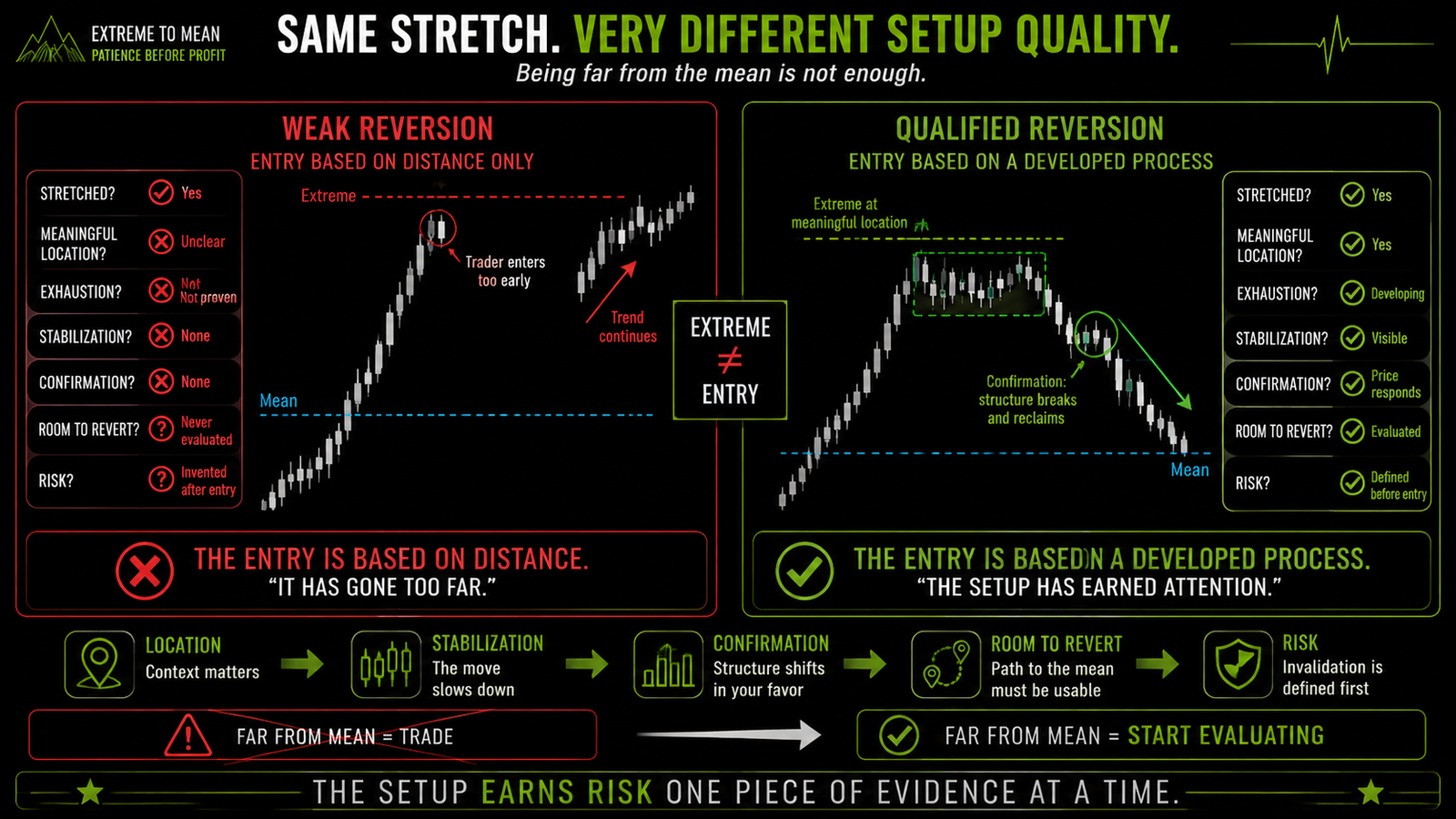
The mistake is assuming that distance automatically creates opportunity. Strong directional markets can remain stretched for far longer than a trader expects, and price can continue extending even when it already looks visually extreme. A market does not owe the trader a return to the mean simply because it has moved far away from it. Distance should therefore create attention, not an automatic entry.
The Extreme Has to Mean Something
A high-quality reversion opportunity requires more than a visually large move. The stretch becomes more useful when it reaches a location that matters: established support or resistance, a higher-timeframe level, an auction extreme, a prior structural reference, or another area where price has a reason to encounter a different balance of buyers and sellers. This is why location is the first filter before traders begin evaluating the rest of the setup. An extreme in the middle of nowhere is still in the middle of nowhere.
Meaningful location also helps define what the trader is actually betting against. A trader fading an extended move at a well-defined structural extreme has a clearer thesis than someone fading price merely because an oscillator looks overbought or oversold. The first trader can identify what should happen if the location begins to hold and what would invalidate that idea. The second trader is often relying on distance alone.
Exhaustion Is a Transition, Not an Entry
Once price reaches a meaningful extreme, the next question is whether the directional move is actually losing force. Exhaustion can appear through slower progress, repeated failure to extend, rejection from the extreme, reduced follow-through, or a shift in the character of candles and swings. None of those observations guarantees that price will reverse. They simply suggest that the one-sided auction may no longer be operating with the same strength.
This is where traders frequently confuse recognition with qualification. Seeing price hesitate after a large move feels like confirmation because the trader is already expecting reversion, so every pause begins to look meaningful. The stronger process is consistent with setup, not signal: several pieces of evidence should begin aligning before risk is justified. Exhaustion earns attention, but the market still needs to show that another side is beginning to participate.
Stabilization Turns an Extreme Into a Developing Setup
Stabilization is the bridge between a stretched market and a possible snap back toward balance. Price may stop making meaningful progress, build a small base, reclaim a nearby reference, reject repeated attempts to continue, or begin forming a more balanced short-term structure. The exact appearance can vary by market and timeframe, so stabilization should not be reduced to one candle pattern. What matters is evidence that extension is no longer occurring as easily as it was before.
Patience matters here because stabilization can fail. Price can pause, attract early countertrend traders, and then break through the extreme with renewed momentum. Entering simply because price stopped moving for a few candles leaves the trader exposed to that continuation without much evidence that control has changed. The setup becomes cleaner when stabilization progresses into actual price confirmation.
The Snap Back Needs Confirmation
Confirmation is the point where the market begins doing something consistent with the reversion thesis rather than merely failing to continue the prior move. That might involve breaking a short-term countertrend structure, reclaiming an important reference, producing a meaningful rejection and follow-through, or otherwise showing that movement toward balance has begun. Confirmation does not mean the trade will work. It means the market has finally contributed evidence to the trader's idea.
This distinction helps solve the classic problem of being right about the destination but wrong about the timing. A trader may correctly believe price is extremely stretched and still lose by entering while the extension remains active. Waiting for confirmation can mean missing the exact turning tick, but catching the exact top or bottom is not the objective. The cleaner goal is participating after the setup has earned more evidence.
There Must Be Room to Revert
A valid turn is not automatically a useful trade. Once price begins moving away from the extreme, the trader still needs to ask whether there is enough unobstructed distance toward the intended mean or balance reference to justify the idea. Nearby structure, congestion, opposing levels, or a poorly positioned entry can remove much of the usable path. This is why room to revert is part of qualification rather than an afterthought.
Imagine price finally confirms a long reversion but the entry occurs just beneath heavy resistance with the mean only a short distance away. The direction of the thesis may be correct while the practical trade offers little room before encountering friction. Another setup can begin from a similar extreme but provide far cleaner space back toward balance. The trader should evaluate the path, not merely celebrate that price finally turned.
Risk Has to Be Clear Before the Trade Is Ready
A reversion setup needs an invalidation point that makes structural sense. If the thesis depends on an extreme holding, continued acceptance beyond that extreme may invalidate the idea, while other setups may use a nearby structural level or confirmation failure. The exact risk model can vary, but it needs to exist before the entry rather than being invented after price moves against the trader. Undefined risk turns an otherwise reasonable setup into an incomplete decision.
This is why the trade is not ready until the risk is clear. Traders often become so focused on the possible move back toward the mean that they spend little time defining what would prove the thesis wrong. A clear invalidation point makes the setup testable before money is committed. If risk cannot be defined cleanly, the market may not have built enough structure yet.
The Full Reversion Sequence
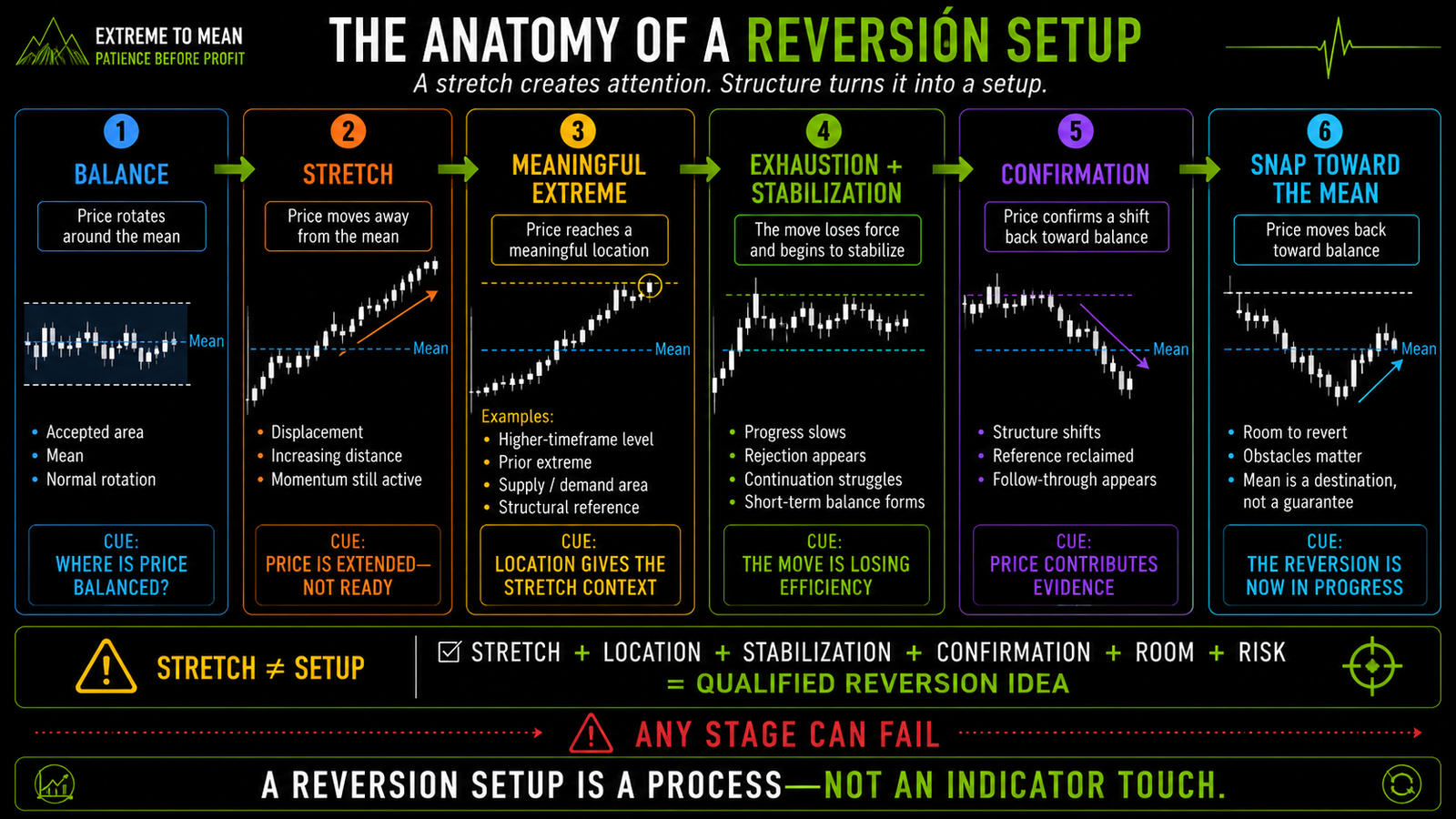
The cleaner reversion process can be summarized as balance → stretch → meaningful extreme → exhaustion → stabilization → confirmation → movement toward the mean. These stages can develop quickly or take considerable time, and some may overlap rather than appearing as perfectly separate events. The point is not to force every chart into an identical template. The point is to stop treating one indicator touch or reversal candle as the whole setup.
The trader should also expect some sequences to fail before completion. Price may stretch and never stabilize, stabilize and never confirm, or confirm briefly before the extreme fails and continuation resumes. Those incomplete sequences are useful because they show why patience is different from passivity. Waiting means allowing the market to complete enough of the process to justify a decision, not assuming every developing reversion eventually becomes a trade.
Better Questions Before Taking a Reversion
A practical mean reversion checklist should move the trader through the sequence instead of asking only whether price looks extended. The most useful question is not, "Is price far enough from the mean?" but, "What evidence has the market actually produced since reaching the extreme?" That shifts attention from prediction toward observable development. It also makes it easier to identify which part of the setup is still missing.
- Has price actually stretched meaningfully away from balance?
- Is the extreme occurring at a location that matters?
- Is the directional move still extending easily?
- Is there evidence of exhaustion or rejection?
- Has price begun stabilizing rather than merely pausing?
- Has structure actually confirmed movement away from the extreme?
- Is there enough room back toward the intended mean?
- What stands between the entry and that target area?
- Is the invalidation point clear before entry?
- Does the risk make sense relative to the available structure?
- Am I entering because the setup developed, or because price simply looks stretched?
- Which stage of the reversion sequence has not yet been proven?
These questions can also improve trade review because they reveal exactly where a poor reversion decision broke down. Instead of writing "entered too early," the trader can identify whether location was weak, stabilization never occurred, confirmation was absent, the path toward the mean was blocked, or risk was undefined. That creates a process that can actually be reviewed and improved. Traders who want to see how location, context, patience, and mean reversion fit together can continue into the Extreme to Mean system.
Final Thought
The anatomy of a reversion setup is not a candle touching an indicator and snapping back. It begins with displacement away from balance, but the extreme must occur somewhere meaningful, the directional move must begin losing effectiveness, and price must show evidence of stabilization and confirmation. Even then, the trader needs usable room toward the mean and a clearly defined invalidation point. Each stage adds information without guaranteeing the outcome.
That sequence is what separates seeing a stretched market from having a qualified reversion opportunity. The trader does not need to predict the exact turning point or capture the first tick of the move back toward balance. Patience means allowing the setup to develop far enough that structure, location, confirmation, and risk can be evaluated together. The trader's job is to recognize the process and let the setup earn risk.
Educational content only. Trading involves substantial risk and is not suitable for everyone.