
A trader can study excellent setups and still wonder why familiar patterns behave differently from one period to the next. The reason is often not that technical analysis stopped working, but that the environment around the setup changed. Rates, liquidity, inflation expectations, currency pressure, debt conditions, and institutional behavior can alter how aggressively capital moves through markets. Bigger-picture monetary context helps explain why the same pattern can carry different quality under different conditions.
The lessons in The Market category are built around that idea. Price structure remains the market a trader actually trades, but structure develops inside a wider financial system. Understanding that system does not replace entries, invalidation, or risk management. It provides another layer of context for judging whether conditions are supportive, restrictive, unstable, or unusually sensitive.
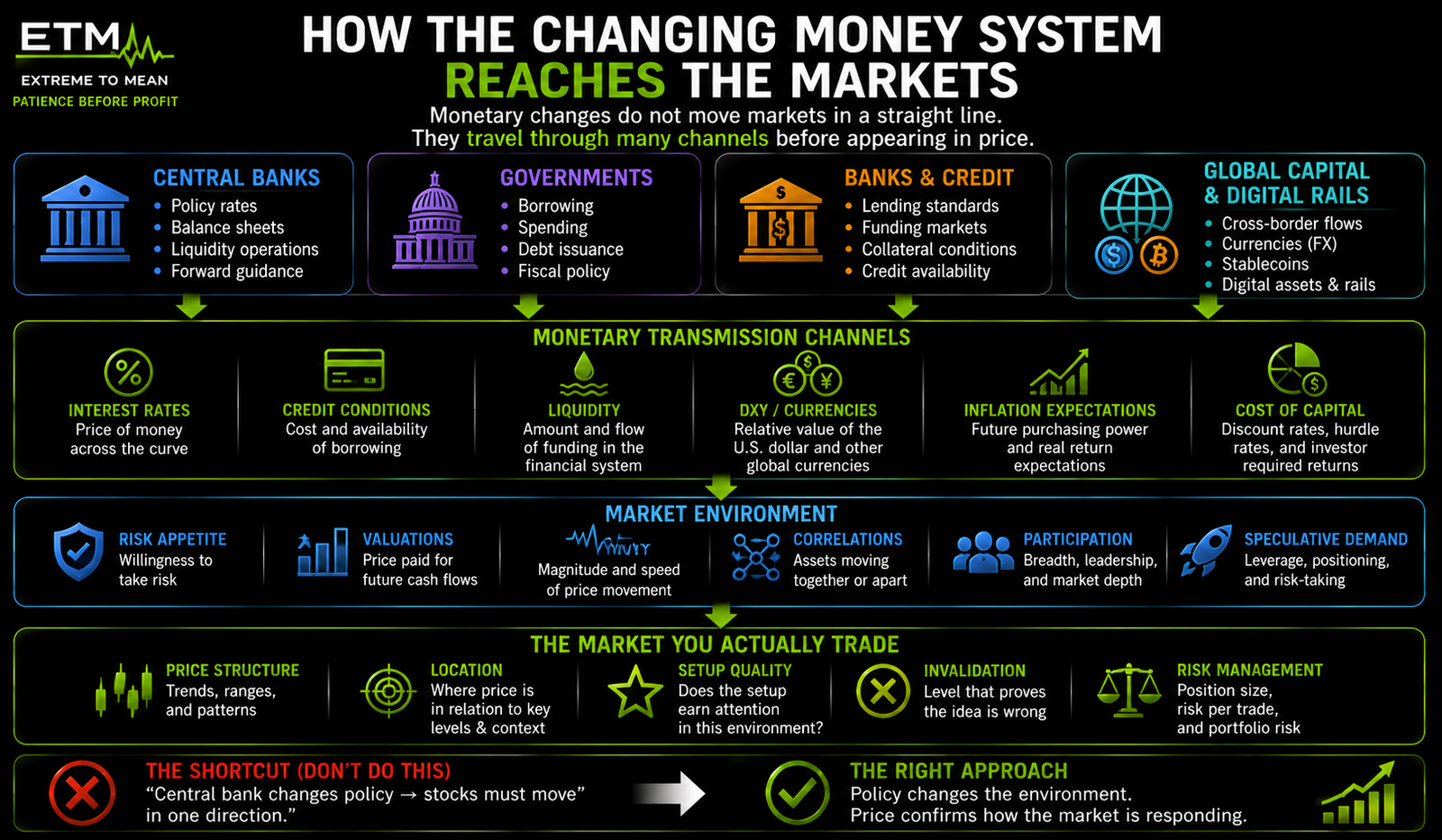
The Money System Reaches Markets Through Several Channels
The monetary system is the network through which money is created, borrowed, priced, transferred, saved, and invested. Central banks influence the price and availability of money, governments borrow and spend, commercial banks extend credit, and investors decide where capital should be held. Those decisions affect interest rates, currencies, liquidity, and the relative attractiveness of different assets. Traders experience the result through changes in volatility, participation, correlations, and price behavior.
This does not mean every market move has one monetary explanation. Earnings, geopolitics, positioning, regulation, supply shocks, and company-specific information can dominate for meaningful periods. Monetary conditions are better treated as background forces that can reinforce or resist the behavior already visible in price. The principle that context comes before the candle remains more useful than trying to explain every move with one macro story.
Central Banks Change the Price of Money
Central banks influence markets most visibly through policy rates, balance-sheet decisions, and communication about future policy. Markets constantly reprice what they expect those institutions to do, so asset prices can move well before an official rate change occurs. The important variable is often the change in expectations rather than the current policy rate by itself. Bonds, currencies, equities, and other assets respond as the expected path of money changes.
Lower expected rates can reduce financing pressure and make longer-duration assets more attractive when other conditions cooperate. Higher expected rates can increase borrowing costs and raise the opportunity cost of holding assets whose expected returns lie far in the future. The relationship is not mechanical because growth and inflation expectations can change at the same time. A falling yield caused by improving inflation can carry a different message from a falling yield caused by fear of economic weakness.
Rates Tell Traders What Money Costs
Interest rates connect monetary policy with actual financing decisions throughout the economy. Corporations issue debt, households borrow, governments refinance obligations, and investors compare risk assets with the returns available from bonds and cash. When those rates change, the relative attractiveness of assets can change with them. The effect can be especially important for markets whose valuations depend heavily on distant future cash flows.
This is why traders benefit from understanding the 10-year Treasury yield without treating it as an equity signal. The yield contains information about growth, inflation, policy expectations, and the compensation investors require for lending over time. A rapid change can help explain why valuation-sensitive markets suddenly behave differently from the previous week or month. Rates provide context for the cost of capital underneath many market decisions.
Liquidity Changes How Much Risk the System Can Absorb
Liquidity is often discussed as though one number determines whether markets should rise or fall. A more practical definition is the availability of funding and the willingness of capital to move through markets without requiring increasingly large concessions. When financing is easy and balance sheets are willing to absorb risk, speculative activity can expand. When funding becomes scarce or expensive, markets can become more fragile.
Central-bank operations are only one part of that process. Commercial-bank lending, Treasury cash flows, collateral conditions, money markets, foreign capital, and investor risk tolerance can reinforce or offset one another. Traders do not need to model every plumbing detail to recognize when several markets begin reflecting easier or tighter conditions. Liquidity provides the backdrop, while price tells the trader whether that backdrop is actually affecting the market.
Debt Makes the System More Sensitive to Rates
Modern financial systems rely heavily on debt. Governments, companies, households, and financial institutions borrow against future tax revenue, earnings, income, or assets. The interest rate and maturity attached to those obligations determine how expensive they are to maintain or refinance. A large change in financing costs can eventually affect spending, investment, valuations, and willingness to take risk.
High debt does not automatically predict a crisis or market decline. A borrower with long-dated fixed-rate obligations faces a different problem from one that must refinance immediately at much higher rates. Currency, cash flow, maturity, and access to credit all matter alongside the headline debt total. The useful lesson for traders is sensitivity, not a countdown clock.
Inflation Changes Policy and Asset Preferences
Inflation changes purchasing power, but markets also care about how inflation changes expected policy and real returns. Persistent inflation can make tighter policy more likely, while declining inflation can give policymakers more flexibility if growth conditions permit it. The market reaction depends heavily on what investors expected before the data arrived. A high inflation number can still produce a favorable reaction if the market had positioned for something worse.
Inflation also changes the competition among assets. Cash, bonds, equities, commodities, real estate, gold, and digital assets can respond differently depending on growth, policy, supply constraints, and investor expectations. No asset functions as a perfect inflation hedge under every set of conditions. Traders should therefore evaluate the regime rather than turn one inflation relationship into a permanent rule.
The Dollar Connects U.S. Markets With the World
The U.S. dollar sits at the center of global trade, reserves, borrowing, and financial markets. Changes in dollar strength can affect international borrowers, commodities, multinational earnings, capital flows, and the relative attractiveness of U.S. assets. A stronger dollar sometimes accompanies tighter global financial conditions, while a weaker dollar can sometimes align with improving risk appetite. The meaning still depends on why the dollar is moving.
The lesson on DXY and the stock market shows why a permanent inverse-correlation rule is too simple. A dollar rally driven by strong U.S. growth may carry a different message from one caused by global stress and demand for safety. The direction is the same, but the underlying driver is different. Traders need the driver before deciding how much weight the dollar deserves in the market thesis.
Digital Assets Are Becoming Part of the Same Financial System
Bitcoin, stablecoins, tokenized assets, and other digital structures have created new ways to hold and transfer value. Their development does not make central banks, commercial banks, government debt, or national currencies irrelevant. Digital assets increasingly interact with the older system through exchanges, custodians, ETFs, payment companies, regulation, and institutional investment. The financial system is becoming more connected rather than splitting into two independent worlds.
Bitcoin demonstrates why monetary design and market behavior should be separated. Its issuance structure differs sharply from sovereign currency, yet its market price can still react to liquidity, regulation, positioning, and broad risk appetite. The lesson on Bitcoin as a risk-on asset shows how the dominant driver can change from one regime to another. Understanding the technology does not remove the need to understand the surrounding market.
Macro Understanding Becomes Dangerous When It Turns Into Prediction
Big-picture explanations feel powerful because they can connect many markets inside one story. That strength becomes a weakness when the story starts to outrank current evidence. A trader may decide that debt must trigger a crisis, liquidity must force a rally, inflation must return, or the dollar must weaken and then interpret every chart through that belief. Monetary education becomes counterproductive when it replaces observation with certainty.
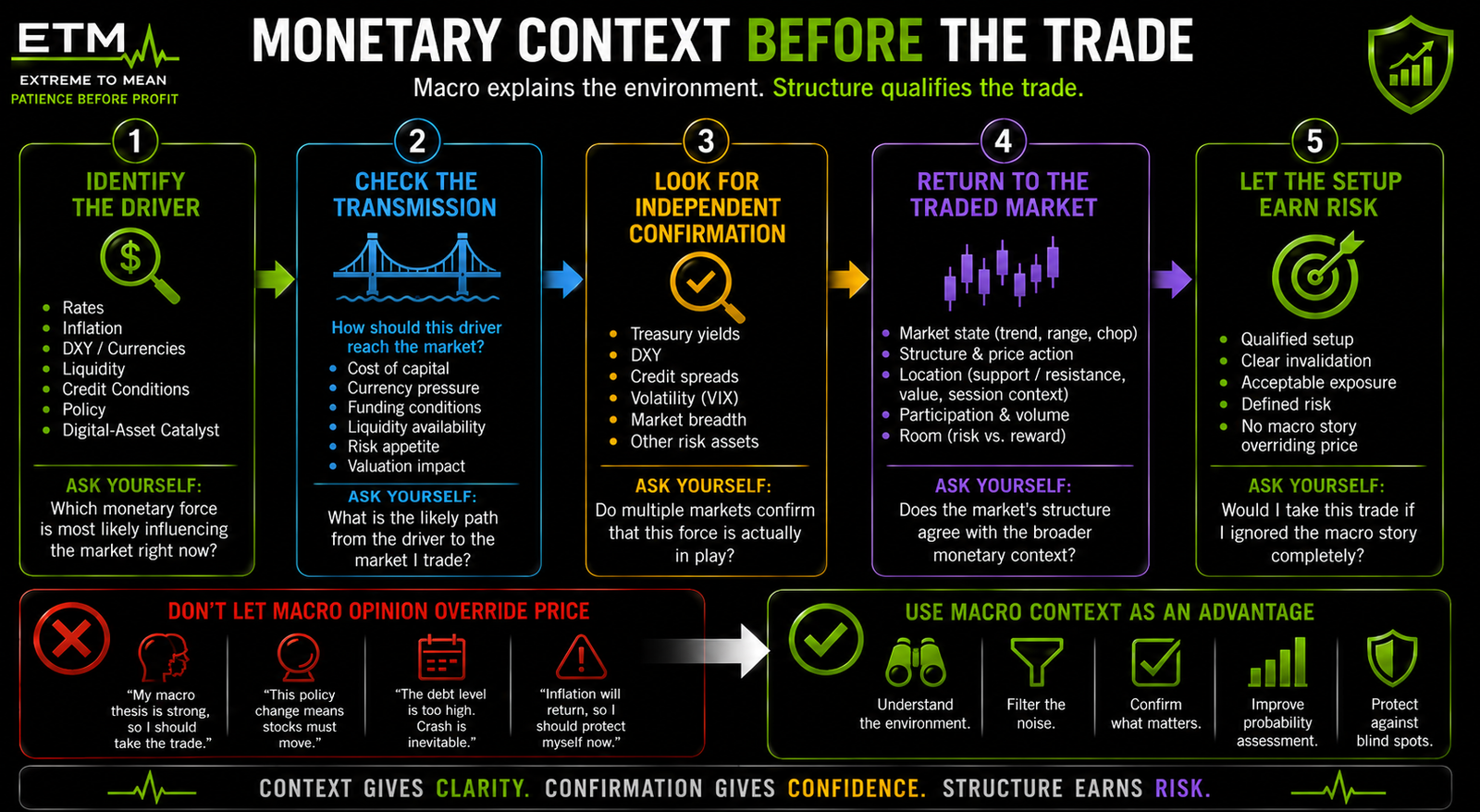
The cleaner hierarchy keeps the market first. Monetary conditions describe the environment, cross-market behavior helps confirm whether those conditions are reaching risk assets, and the traded market determines whether a setup actually exists. No macro thesis creates good location, defines invalidation, or makes poor risk acceptable. The setup still has to earn risk.
A Practical Monetary-Context Review
A trader does not need to forecast the global monetary system before every session. A more useful routine is to identify the few monetary forces important enough to affect the market being traded and then watch whether price confirms their relevance. That keeps macro awareness connected to preparation instead of turning it into endless research. The purpose is context, not a prediction that must be defended.
A practical review can ask:
- What is the market currently expecting from central-bank policy?
- Are Treasury yields rising or falling, and what appears to be driving the move?
- Are financial conditions becoming easier or tighter?
- Is the dollar strengthening or weakening, and why?
- Is inflation changing the expected policy path?
- Are credit and funding conditions supporting the same message?
- Are speculative assets participating in the same environment?
- Is a digital-asset move macro-driven or specific to that market?
- Are several independent markets confirming the same story?
- Does the traded market’s own structure agree with the broader context?
- What evidence would make the current macro interpretation less relevant?
- Am I using monetary context to evaluate conditions or trying to predict the next trade?
The better question is not, “What will the changing money system make the market do next?” It is, “Which monetary forces matter to this market right now, and is price confirming that they deserve weight?” That question allows the trader to ignore developments that are interesting but currently irrelevant. It also creates a reason to reduce the influence of a macro thesis when the traded market refuses to confirm it.
Final Thought
The money system is always changing because policy, debt, inflation, technology, regulation, and global capital flows continue to evolve. Traders benefit from understanding those forces because they influence the environment in which liquidity and risk are priced. The goal is not to forecast the next monetary regime with certainty. It is to recognize when a larger change may be influencing behavior that is already visible across markets.
A trader still enters a specific market, at a specific location, with defined risk. Monetary knowledge should improve context without becoming a reason to override structure, chase headlines, or defend a prediction after the evidence changes. Understand the system, identify the current driver, look for independent confirmation, and then return to the market being traded. Readers who want to build that broader cross-market framework can continue through Decode the Market.
One major part of that transition is examined in the evidence behind de-dollarization and the dollar’s reserve role.
The commercial-bank layer is explained separately in how bank lending creates deposits and money.
Educational content only. Trading involves substantial risk and is not suitable for everyone.