
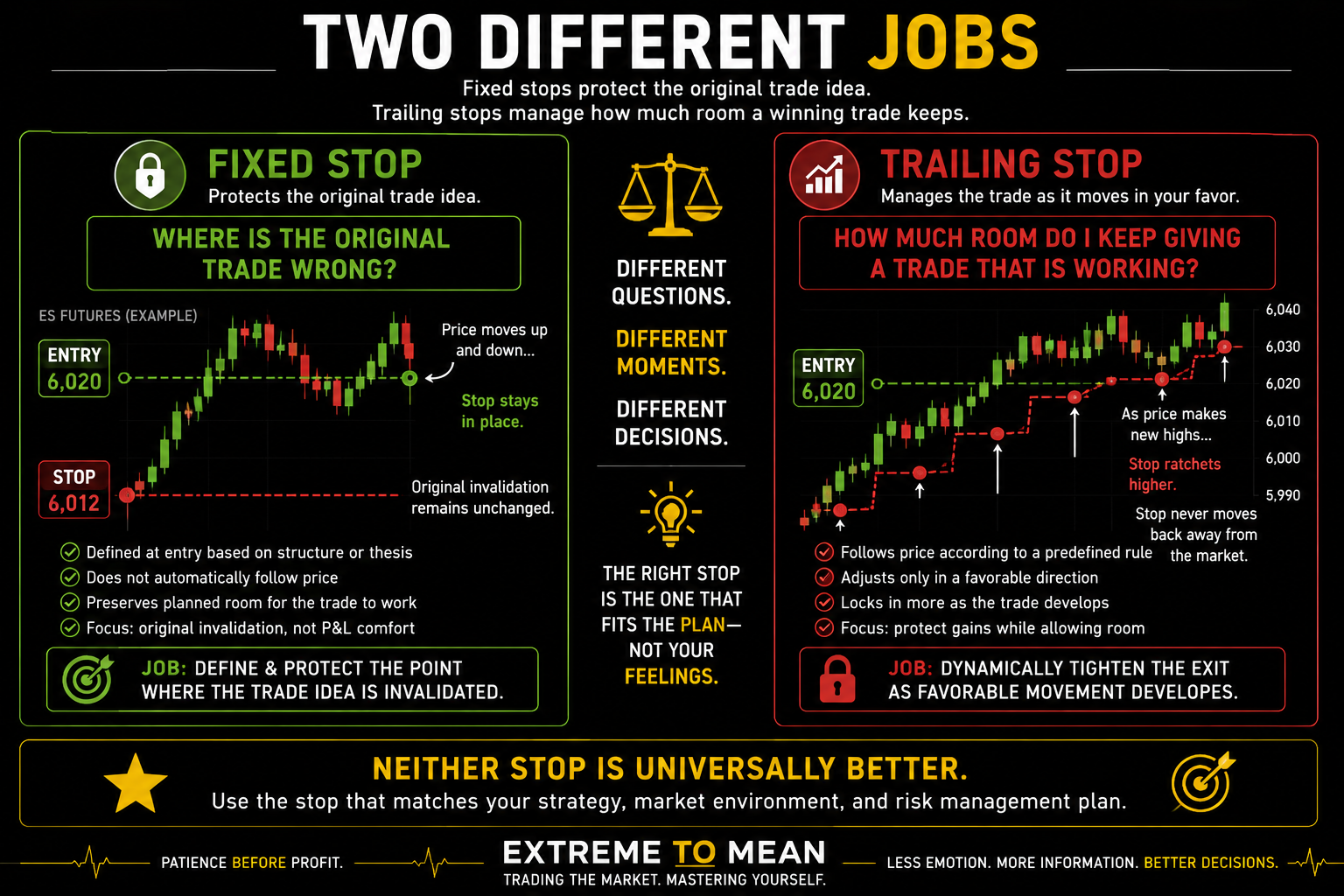
The two are often compared as though one is the upgraded version of the other, but they solve different trade-management problems. A fixed protective stop can preserve the original invalidation point, while a trailing rule changes the exit as favorable movement develops. Inside The Setup, decide which job the stop is doing before P&L changes how the trade feels.
Start With the Job of the Stop
The original stop should begin with the trade thesis rather than an arbitrary dollar amount. If a long setup only makes sense while price holds above a structural area, the stop should be connected to the point where that idea no longer makes sense. Position size can then convert that structural distance into acceptable account risk.
A fixed stop here means a protective stop placed at a predefined price that does not automatically follow every favorable move. It does not mean every ES trade should use the same number of ticks or points. Structure, volatility, or another predefined invalidation method can determine the level.
A Trailing Stop Solves a Different Problem
A trailing stop changes as price moves favorably. In a long trade, the stop generally ratchets upward as the chosen reference rises and does not automatically move back down when price pulls back; in a short trade, the logic is reversed. The strategy decides how that adjustment occurs, so “trailing stop” does not describe one universal algorithm.
Some trailing methods begin immediately, while others activate after a profit trigger, structural event, or other predefined condition. A trail might move continuously, in steps, or when new structure forms. The strategy must define that logic before the trade is open.
The central distinction is simple: the fixed stop asks, “Where is my original thesis invalidated?” A trailing stop asks, “Now that the trade has moved favorably, how much reversal am I willing to tolerate?” Those are different questions and need not use the same rule.
Why Traders Trail Too Early
The emotional pressure often begins as soon as a trade turns green. A trader who accepted the original stop at entry suddenly thinks, “I cannot let this winner turn into a loser,” and moves the stop closer even though nothing meaningful about market structure has changed. That can feel like better risk management because the possible giveback has been reduced.
The tradeoff is that a tighter stop can remove a valid trade during normal rotation and change the payoff structure the strategy was designed around. A stop should tighten because the trade structure changed—not merely because the P&L turned green. The better question is whether new market information justified changing the risk thesis.
Unrealized profit can create the same emotional interference as unrealized loss. At entry the trader fears losing money; after favorable movement the fear shifts to losing profit that now feels owned. The object changed, but fear is still making the decision.
Tighter and Wider Trails Both Cost Something
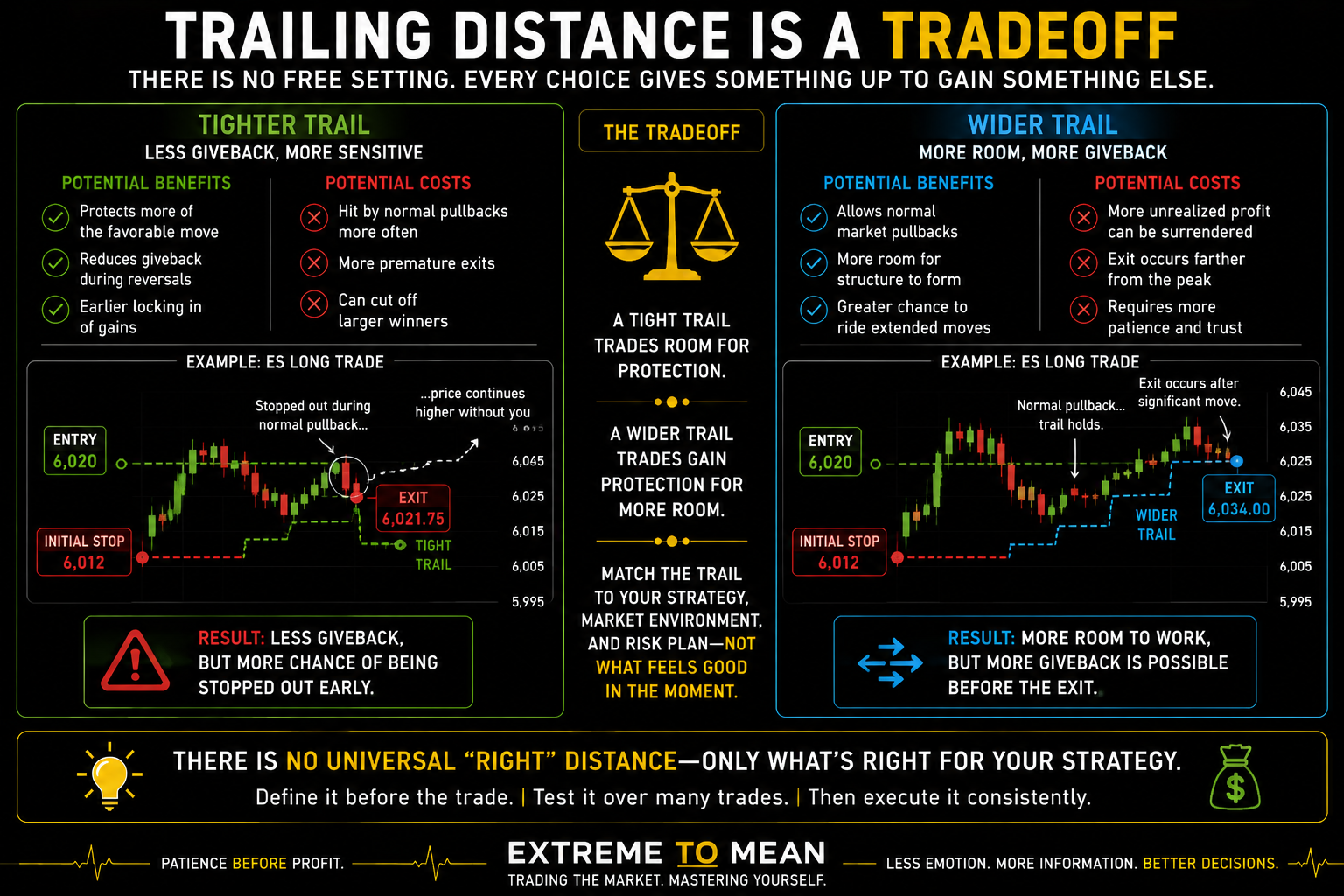
A tighter trail can reduce how much favorable movement is surrendered before exit, but it also becomes more sensitive to routine pullbacks. A wider trail gives the trade more room, but more unrealized profit can disappear before the exit is triggered. There is no free setting.
Suppose an eight-point ES trail feels reasonable on a quiet session. During a volatile CPI-driven session, those same eight points may sit inside ordinary noise. Reviewing the trail alongside the three market states reinforces a broader principle: distance without context is not risk management.
The tightest stop is not automatically the safest strategy. Smaller losses can be offset by more frequent stop-outs, costs, or the removal of larger winners. Less risk on one exit does not automatically mean less risk to the overall process.
Stop Management Changes the Distribution
Imagine a strategy that takes many −1R losses, several +1R winners, and occasionally captures +5R or +8R moves. An aggressive trailing rule may make individual trades look cleaner and may even increase the percentage that finish green. If it repeatedly cuts off the large winners, however, the economics of the strategy can deteriorate.
That is why trading expectancy belongs in the stop-management conversation. Changing when and how the stop moves can change win rate, average winner, average loser, and therefore the average result per trade. Changing the exit changes the distribution.
Profit Factor can change too because trailing affects the aggregate pool of winning and losing dollars. A rule that reduces losing dollars but cuts even more from winners can produce a worse relationship overall. Judge the rule across a meaningful sample rather than because a few recent exits looked emotionally cleaner.
Breakeven and Trailing Are Different Decisions
A stop can begin fixed, move once to approximately breakeven, and then remain there without becoming a continuously trailing stop. A strategy can also move to breakeven after a defined event and later begin trailing. The dedicated lesson on when to move a stop to breakeven owns that specific decision.
Other strategies may trail from entry or use a fixed stop and fixed target throughout. These architectures create different payoff distributions, and none is universally superior. Exit design is part of the strategy rather than an afterthought.
Trailing methods can use fixed points, percentages, volatility, prior bars, or newly formed swings. Each method changes how much normal movement the trade can survive. The ATR lesson for futures traders explains how one volatility measure can inform—not dictate—that decision. The appropriate trail is a characteristic of the strategy, not a universally correct setting.
The Same Trade Can Reward Either Choice
Consider a hypothetical ES long at 6,020 where the setup becomes invalid below 6,012. A fixed structural stop might survive a move from 6,024 back to 6,019 before price later advances to 6,035. The lesson is not that an eight-point stop is correct; it is that the stop remained attached to the original thesis while normal rotation played out.
Now imagine the trader tightens aggressively after price reaches 6,025 and raises the stop to 6,022. Price rotates to 6,021.75, triggers the exit, and later rallies to 6,035. That does not prove trailing stops are bad; it shows that this particular rule gave the trade less room than the movement required.
Trailing can help in another version of the trade. If price advances to 6,050 while building meaningful higher lows, a predefined trail can rise beneath new structure and later exit when the move reverses. In that case the original risk problem genuinely changed because the market created substantial favorable progress.
Stop Mechanics Still Matter
A stop level is an intended trigger, not a guaranteed execution price. Depending on order type and conditions, a stop-market can fill away from the trigger, while a stop-limit can seek more price control at the cost of possible non-execution. Stop placement and order type are separate decisions.
Automated trails can differ in distance, profit triggers, adjustment frequency, and platform logic. A copied rule may behave differently on another platform. Understand the mechanics before assuming “trailing stop” tells you the entire exit rule.
A Practical Fixed-vs.-Trailing Decision Stack
Use Thesis → Initial Risk → Favorable Movement → New Information → Stop Decision → Exit. The goal is to define the architecture before the trade becomes emotionally expensive to manage. Stop changes should come from a rule or market information rather than from discomfort.
- Define the thesis: Why does this trade exist?
- Define initial invalidation: Where is the original trade wrong?
- Size the risk: Convert that structural distance into acceptable account risk.
- Choose the architecture before entry: Fixed throughout, breakeven trigger, trailing, or a hybrid?
- If trailing, define activation: When does trailing begin?
- Define the method: Fixed distance, volatility, structure, bar-by-bar, or another rule?
- Define the update frequency: Continuous, stepped, or structural changes only?
- Define what cannot happen: Does the stop ever widen again?
- Test the rule: What happens to average win, average loss, expectancy, Profit Factor, and drawdown?
- Execute the rule: Do not redesign it because today’s P&L became uncomfortable.
| Question | Fixed Stop | Trailing Stop |
|---|---|---|
| Primary job | Define or maintain an exit boundary | Dynamically tighten the exit as favorable movement occurs |
| Moves automatically? | No | Usually, according to predefined logic |
| Starting point | Predefined stop price | Defined trail or trigger methodology |
| Main advantage | Stable risk logic and planned room | Can reduce giveback as the trade progresses |
| Main tradeoff | Can surrender favorable movement before exit | Can exit on normal pullbacks |
| Best distance | Strategy-dependent | Strategy-dependent |
| Guaranteed fill at stop price? | No | No |
| Automatically safer? | No | No |
| Can change expectancy? | Yes | Yes |
| Universally better? | No | No |
The wrong question is “Which is better: fixed or trailing stops?” The better question is “What exit behavior does this strategy need in order to protect the original thesis while preserving the payoff distribution the strategy depends on?” If you cannot explain exactly why the stop moved, you cannot reliably test whether moving it helped.
Final Thought
Fixed and trailing stops belong to the same risk-management toolbox, but they are not interchangeable. The fixed stop can preserve the original point where the setup is invalidated, while the trailing stop can change the exit as favorable movement creates a different management problem. The decision should come from the strategy rather than from a universal rule.
Both methods involve tradeoffs, and neither guarantees an exact loss, an exact profit, or a better outcome. A fixed stop can give a valid trade room while surrendering favorable movement later, and a trailing stop can protect more of a move while cutting off normal pullbacks. What matters is what each rule does to the full distribution over repeated trades.
When you move a stop after entry, can you explain what changed in the market that justified changing the risk—or are you responding to the emotional difference between seeing a red number and being afraid to lose a green one? A stop-management rule only works if you can execute it consistently enough for its distribution to emerge, which is part of the longer-horizon process behind The Patience Principle.
Educational content only. Trading involves substantial risk and is not suitable for everyone.