Ready to build a better trading process?
Keep learning, grab a free tool, or start with the Extreme to Mean lessons designed to help you trade with more patience, structure, and discipline.

A trader gets stopped out below a recent low, watches price reverse, and sees the original target reached without them. It is easy to conclude that the protective stop—not the trade—was the problem.
A trader gets stopped out below a recent low, watches price reverse, and sees the original target reached without them. It is easy to conclude that the protective stop—not the trade—was the problem.
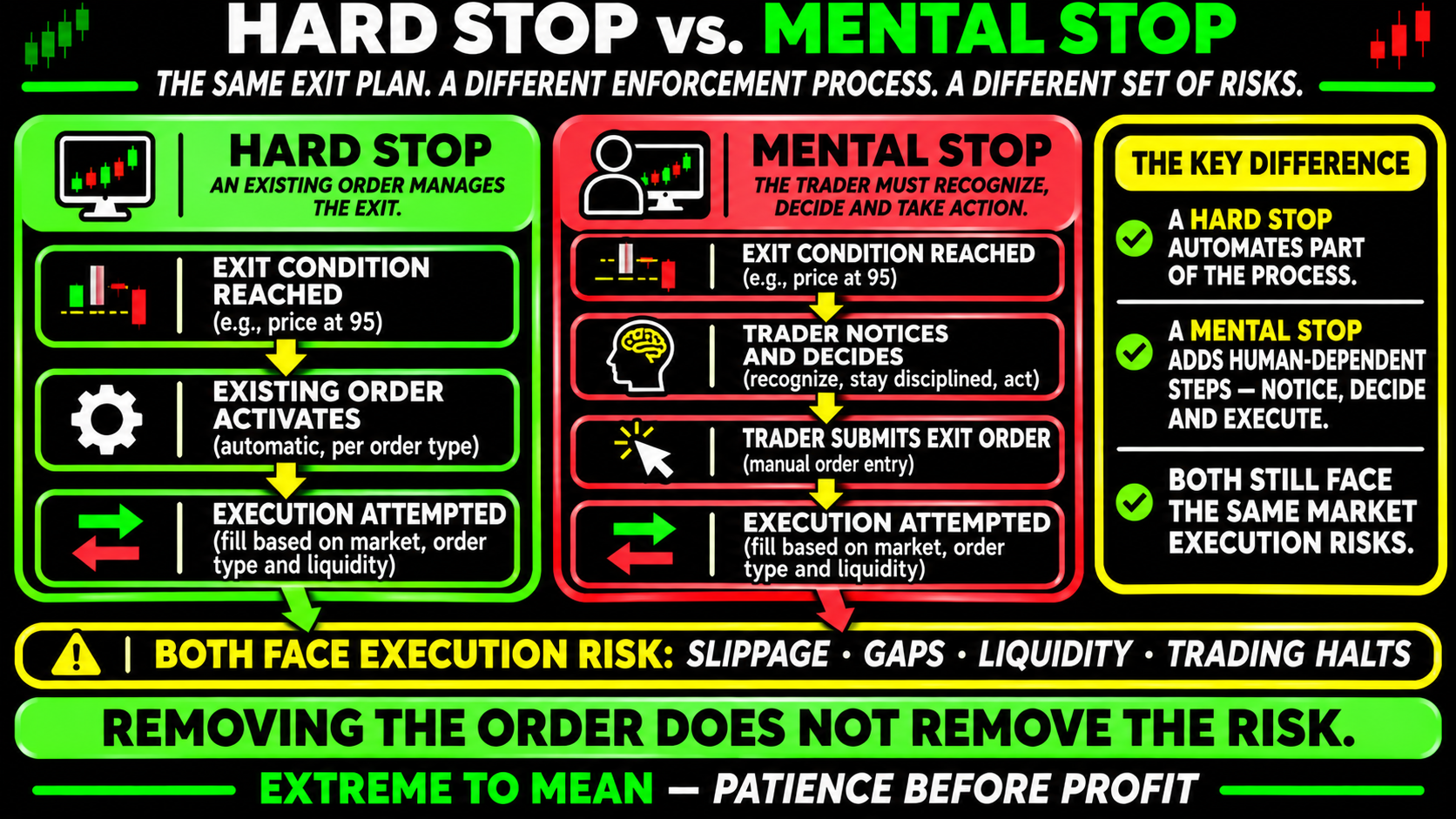
A hard stop is an instruction. A mental stop is a commitment. Both still depend on execution.
A stop-out followed by a reversal makes the protective order look like the problem. Removing it can seem sensible after several such experiences. Yet the next break may never recover, leaving the trader exposed to a much larger loss.
Inside The Setup, separate three jobs: INVALIDATION → EXIT DECISION → EXIT EXECUTION. The first determines when the trade idea fails; the second decides to close; the third actually removes exposure. If we eliminate a protective order, what credible process replaces it?
A stop-loss policy is a predetermined rule for reducing or closing a losing position. A stop order is an instruction submitted to a trading system that is intended to activate when specified conditions occur. A trader can have a defined exit policy without an actual protective order, but the two approaches do not have the same dependencies.
| Approach | What initiates the exit? | Main dependency |
|---|---|---|
| Hard stop | An accepted protective order activates | Order handling and available execution |
| Mental stop | Trader manually acts at a predefined threshold | Recognition, discipline, access, execution |
| Conditional exit | Defined event, such as a confirmed close beyond structure | Detection and execution, manual or automated |
| No defined exit | Trader decides while the loss develops | Improvisation under pressure |
Consider a long trade entered at 100 with a structural reference at 95. One plan exits as soon as price reaches 95; another waits for a completed five-minute candle below 95. These are different exit rules, even before we ask whether a trader or software enforces them. As the basic stop-loss lesson explains, an exit boundary is a risk tool, not a guarantee of the eventual fill.
Markets often probe an obvious high or low and then reverse. A fixed price-triggered stop can exit during that brief excursion even when the trader's broader structural thesis later appears intact. The objection is legitimate: a temporary touch is not necessarily sustained acceptance beyond a level, and different strategies may need different definitions of failure.
Volatility can make a previously sensible stop too close, while a wider stop may make the position unaffordable. Before removing the order, evaluate entry location, invalidation, market conditions, and size. The stop-placement lesson covers that separate decision.
Some traders prefer a close beyond structure, a failed reclaim, or an opposing strategy signal. Such rules can avoid premature exits, but waiting for confirmation can also increase losses as price moves against the position. Flexibility is valuable only when its boundaries and contingency exposure are defined.
A hard stop exists before the unfavorable event, reducing the need for a new manual decision. But its trigger price is not necessarily the transaction price, and an accepted order is not a completed exit. It automates part of the response without guaranteeing the final result.
In CME futures, a stop-limit becomes a limit order after activation and may remain unfilled if the market moves beyond its permitted price. CME's stop with protection instead attempts execution within an exchange-defined protection range, which can also leave unfilled quantity. These are not interchangeable with an unlimited promise to close at any price, as the CME futures order guide explains.
Order location and status matter too. A stop may be exchange-native or simulated elsewhere, with broker-specific trigger hours and expiration; Interactive Brokers' U.S. futures rules illustrate the distinction. We must verify acceptance, quantity, current status, and when the order is active—not just remember clicking “place stop.”
A mental stop adds steps: notice, interpret, decide, submit, and obtain a fill. That can feel manageable in a calm session. In fast conditions, every additional step adds another opportunity for delay or error.
An alert does not close the position unless connected to a working execution system. An accepted protective order maintained independently of the local device may keep functioning through an internet failure, subject to its limitations. A mental stop depends on our ability to regain market access or use another available channel.
Writing an exit rule and enforcing it are psychologically different tasks. Terrance Odean's stock-investor research documented a tendency to realize gains more readily than losses; it does not establish a failure rate for futures mental stops. Not wanting the trade to be wrong is not evidence that it remains valid.
Decision risk is the chance we fail to follow a defined exit rule; execution risk is the chance we cannot close at the expected price or quantity. A functioning hard stop reduces some decision risk without eliminating execution risk. A mental stop retains both, making its added human-dependent steps part of the strategy itself.
Imagine planning a mental exit at 95, then changing it to 94 when price gets close. At 94, the trader spots another support level and decides to wait for 92, only to reconsider again when that level arrives. The price threshold keeps moving, but no new, predefined strategy rule authorized the increased exposure. A mental stop that migrates whenever it is challenged is no longer enforcing the original decision.
A hard stop can also be canceled or widened after entry. A functioning order reduces some real-time decision burden, but cannot prevent someone from disabling it. Any stop adjustment should follow a predefined management rule rather than momentary discomfort; see fixed versus trailing stops.
The economics can overwhelm a high win rate. Suppose our intended 1R risk is $100, five winners each earn +2R, and one unenforced loser reaches −12R. The five wins produce $1,000, the loss removes $1,200, and the total is −$200 before costs. This hypothetical illustrates why loss size matters more than win rate.
Both methods face gaps, deteriorating liquidity, and price limits or halts that may restrict execution. Futures risk disclosures warn of leverage and the difficulty of liquidating positions in certain markets. Planned risk is an estimate—not a guaranteed maximum realized loss.
Margin to open a futures position is not a maximum-loss amount. Smaller size reduces the cost of each adverse point but does not define when to exit. Broker liquidation manages the broker's exposure and is not a substitute for the trader's exit plan.
Institutions may use hedges, portfolio limits, automated controls, and supervision without showing a conventional stop on every position. A retail trader who copies only the absent order has not copied those protections. The visible stop is not the entire risk-management system.
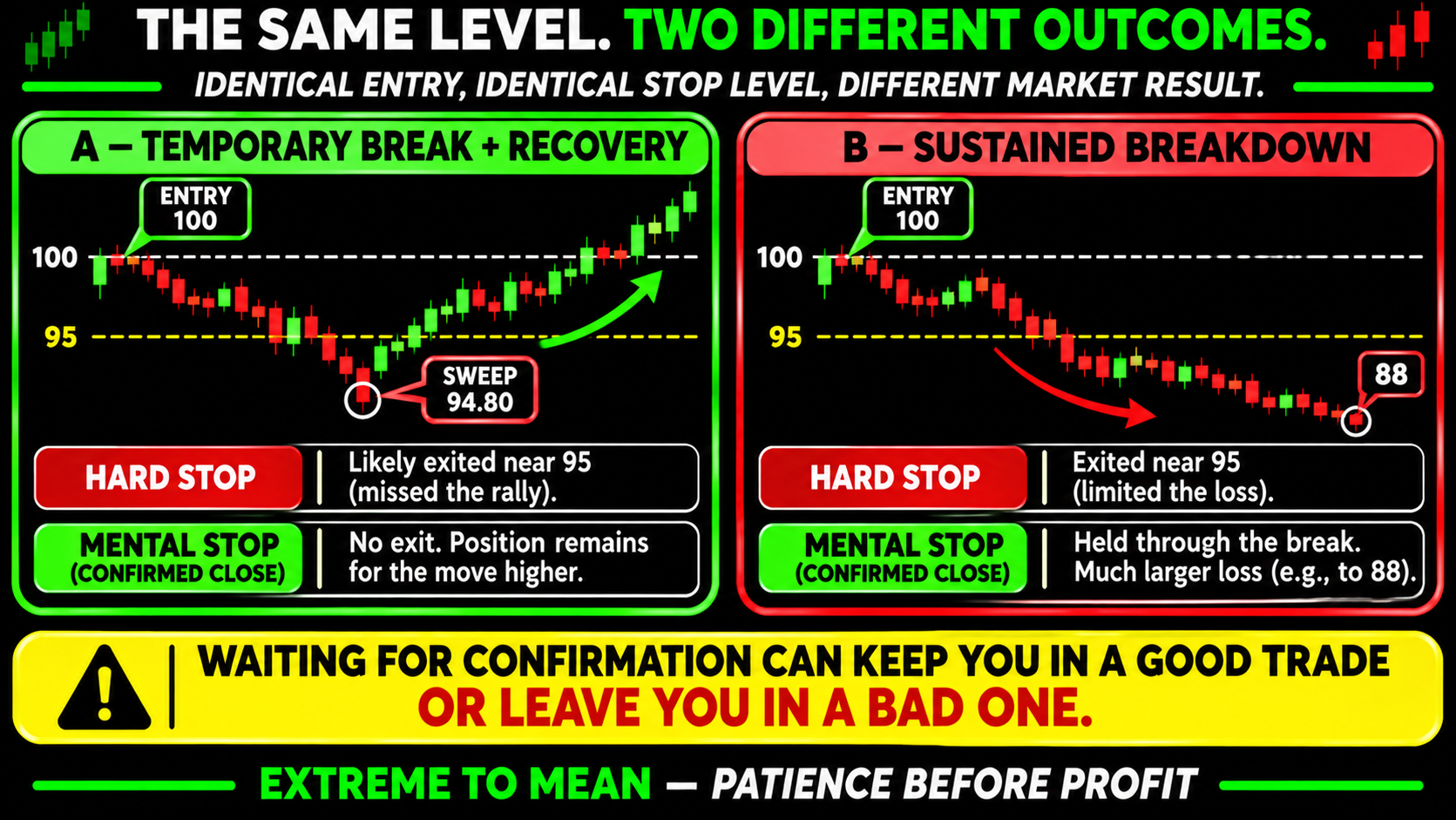
Consider two traders entering at 100 with a reference level at 95. Trader A has a price-touch protective stop, while Trader B has a preplanned exit only after a five-minute close below 95. If price briefly falls to 94.80 and recovers, Trader A's order may activate while Trader B's confirmation condition may never occur; the latter approach could preserve a trade that eventually wins.
Now change only what happens afterward. Price reaches 95 and continues toward 88 before the candle closes. For illustration, assume Trader A exits near the intended level, while Trader B does not close until much lower; the patience that helped in the first scenario now creates a greater loss. Neither example proves which exit policy is superior, and actual fills could differ from these assumed prices.
A hybrid can use a normal condition-based exit with a separate emergency protective order. That preserves some discretion while attempting to reduce the consequences of delayed action. The emergency order still has execution and availability limitations.
The emergency threshold belongs in the original risk budget. If the expected exit implies $100 in loss but the contingency threshold implies $500 before slippage, sizing for only $100 understates exposure. Where the contingency does not fit the account, passing is legitimate; the invalidation lesson explains why the boundary must be decided beforehand.
A useful test separates two questions: When should the strategy exit? and Who or what will enforce that exit? A price-touch rule versus a confirmed-close rule changes the strategy itself; automated versus manual enforcement of the same threshold changes its implementation. That distinction allows researchers to compare the desired market behavior separately from delays, missed exits, and actual fills.
Research by Kathryn Kaminski and Andrew Lo shows that the usefulness of stop-loss policies depends on the strategy and market dynamics studied. Their empirical work uses daily futures observations and a buy-and-hold application; it does not establish that intraday mental stops outperform hard stops. A backtest that assumes perfect manual execution is also not testing the additional human and operational risks of a mental stop.
Record original invalidation, actual order status, exit timing, intended and realized prices, and deviations. Frequent premature exits may reveal a placement or strategy problem rather than proof that protection should disappear. A profitable violation of a risk rule is still a violation.
Before choosing a method, answer the following questions without knowing the outcome. Each question tests the protection actually in place and where it could fail. A vague answer signals an incomplete exit plan.
Use DEFINE → SIZE → ENFORCE → VERIFY → REVIEW. DEFINE what ends the trade, SIZE for intended and contingency exposure, ENFORCE the plan through a specific mechanism, VERIFY the order status and actual exit, and REVIEW every difference between the plan and what occurred. The trade-readiness lesson provides the next practical check before risk is taken.
A hard stop places an instruction before the adverse move; a mental stop leaves enforcement to the trader. A condition-based exit may preserve trades during temporary fluctuations, but it can also increase losses during sustained breakdowns. Neither choice guarantees a loss amount under gaps, poor liquidity, or trading restrictions.
Rather than asking which trading educator dislikes stops, define invalidation, size the contingency exposure, and establish how the exit will actually occur. Ask what happens when the preferred method fails or cannot be executed. Removing the order does not remove the risk; it changes who must enforce the exit.
Educational content only. Trading involves substantial risk and is not suitable for everyone.
Keep learning, grab a free tool, or start with the Extreme to Mean lessons designed to help you trade with more patience, structure, and discipline.