Ready to build a better trading process?
Keep learning, grab a free tool, or start with the Extreme to Mean lessons designed to help you trade with more patience, structure, and discipline.

“I know the setup when I see it” may be enough to recognize a chart in real time. It is not yet enough to measure how the idea performed across historical trades.
“I know the setup when I see it” may be enough to recognize a chart in real time. It is not yet enough to measure how the idea performed across historical trades.
If we cannot describe a setup consistently, we cannot measure its historical performance consistently.
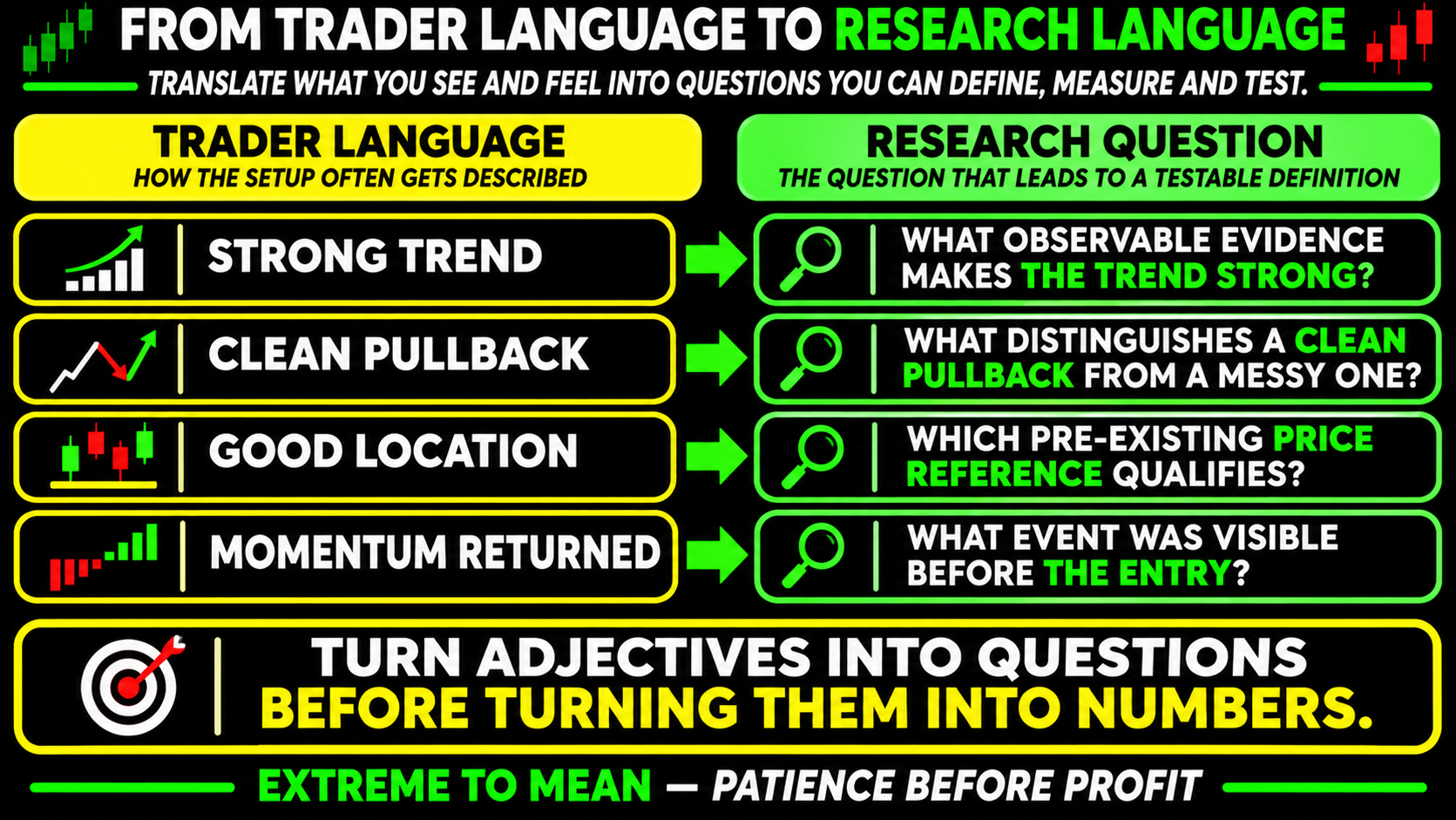
A trader might say, “I buy clean pullbacks in strong uptrends when price reaches a good location and momentum comes back.” That may describe years of meaningful experience, not random guessing. But another person cannot reliably test the statement until we explain what clean, strong, good, and comes back actually mean.
The goal is not to make every trader an algorithm. It is to separate the decisions already inside the setup so we can examine them without relying on the benefit of hindsight. Within The Setup, TESTABLE ≠ FULLY AUTOMATED: a strategy can retain honest judgment while making its rules and exceptions clear.
Discretionary trading can involve real, repeatable observations: trend structure, location, volatility, momentum, and the quality of a pullback. An experienced trader may combine these quickly without saying each step aloud. Recognition can guide a live decision, but measurement requires a definition. The tradable-setup lesson covers live qualification; this lesson makes those qualifications research-ready.
Before translating anything into numbers, write the original setup in plain language and keep that version. For our example, the words clean pullback, strong uptrend, good location, holds, and momentum returns are the places where judgment is hiding. Each adjective becomes a research question rather than an invitation to select whichever indicator makes the old chart look best.
Ask what we were actually observing when we used those descriptions. A “strong trend” might have meant higher highs and higher lows, a rising reference average, or price holding above recently established structure. A “clean pullback” might have meant limited overlap, no break of a particular swing, or an orderly return toward a reference, and those definitions are not interchangeable. The cleanest-setup lesson begins with clear logic; our next task is repeatable classification.
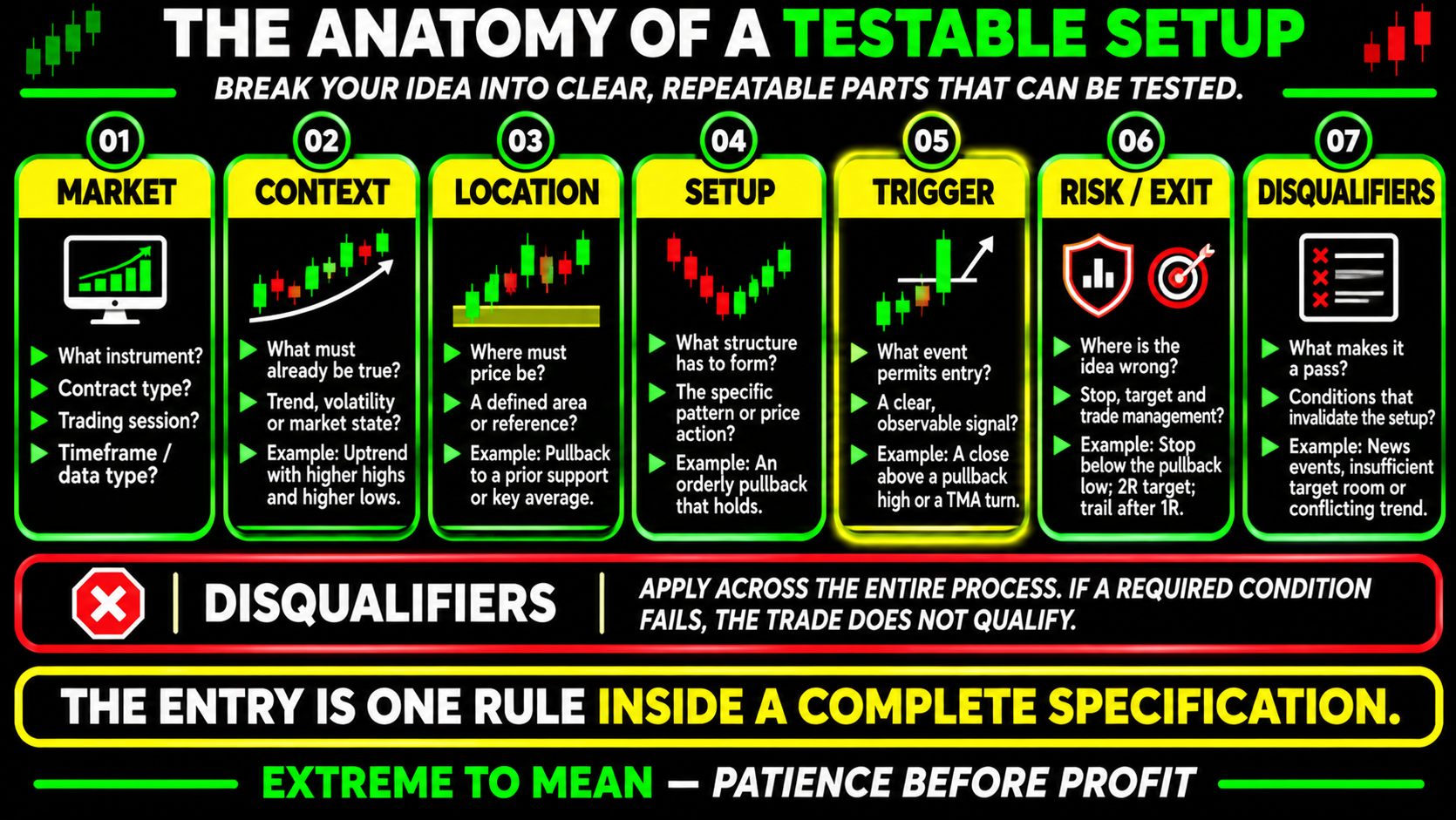
A useful specification separates seven jobs that discretion often blends together: MARKET, CONTEXT, LOCATION, SETUP, TRIGGER, RISK/EXIT, and DISQUALIFIERS. Market defines the instrument, session, and bars—for example, ES regular hours on five-minute candles—while context defines the relevant environment. Location identifies where price must be, while setup describes the structure that must form there.
Trigger identifies the observable event that permits an entry, not merely the background condition that made us interested. Risk and exit specify invalidation, stop logic, target, trade management, and any time-based exit. Disqualifiers describe the otherwise tempting trades we would refuse, such as an incompatible market condition, insufficient target room, or an event window the plan excludes.
Some things we notice are difficult to measure directly, so we may propose a proxy—a measurable substitute. Calling a trend “strong” could become a candidate rule involving price above a rising moving average, while “extended” could become distance from an average in units of volatility. But the proxy is a hypothesis about what our judgment meant, not proof that the indicator captured it.
Suppose we define “strong trend” as price above a rising 20-period average, then notice that many of our originally selected trades did not meet that condition. That disagreement may show a translation problem, rather than evidence that the trader's original observation was worthless. We should document the mismatch, examine what was missing, and treat any revised definition as a new version—not quietly tune the indicator until the historical profits improve.
A trigger must be visible at the decision time, but its signal and its assumed fill price are separate. “The bar closes above a defined level” describes an entry signal; “enter at the next bar's open, allowing for costs” describes one possible execution assumption. If a backtest buys at the signal bar's closing price after using that same close to discover the signal, it may assume a fill that was not realistically available under the stated process.
We also need an invalidation rule before discussing the attractive target. “A little below support” and “exit when the rally looks tired” can produce different answers depending on who reviews the chart. Stops, partial exits, trailing, session cutoffs, and what happens when stop and target appear inside the same historical bar all belong in the written specification.
No-trade conditions matter just as much. When we say, “I would never have taken that one,” we have either found an unwritten rule or uncovered discretion that still needs a defined place. The trades we refuse are part of the strategy too, and omitting them can turn a faithful research test into a different strategy.
Not every useful judgment needs to be replaced by a hard threshold. A trader may retain a structural-clarity rating of zero, one, or two, with written descriptions for each score. The number does not magically remove subjectivity, but it makes the judgment visible and recordable instead of allowing “clean” to change meaning after the result is known.
Reviewers should grade screenshots without future bars or trade outcomes showing. Better still, revisit a sample later without the original labels, or have a second informed reviewer apply the same rubric. Frequent disagreement or many “ambiguous” classifications reveal where the specification still needs attention; perfect agreement is not required. Manual review can work with a fixed rubric; AI may help formalize rules, but should not silently invent subjective definitions.
Once the seven parts are clear, translate them into plain-English if-then instructions: if context qualifies, and location is reached, and setup forms, then wait for the defined trigger unless a disqualifier exists. Next specify entry timing, stop, target, management, and the branch where the trigger never arrives. The separate lesson on if-then trading rules explains scenario-based decisions; here the if-then structure is a research specification.
Real data rarely produces only ideal examples. We need consistent treatment of gaps through entries or stops, partial fills where relevant, missing bars, simultaneous signals, and ambiguous stop/target sequences inside one candle. We must also specify commissions, fees, and plausible slippage so the eventual test describes executable economics rather than just the geometry of a chart.
Call the first complete specification Setup v1.0, save it, and record why each condition belongs. If we remove a rule after a losing trade, tighten a threshold, or add a new filter, that change becomes v1.1 or a separate candidate. An exception log can preserve unexpected cases and proposed explanations without rewriting the rules while their results are being evaluated.
There is a reason to be strict here. Research on backtest overfitting shows how selecting the best-looking variation can reward accidents in the data. Every extra parameter creates another way to fit the past. A losing example should create a research question before it creates a filter, and a rule whose only justification is “the backtest liked it” deserves scrutiny.
Before calculating returns, try the frozen rules on a small diagnostic set of historical situations with the future hidden. For each one, record QUALIFIES, REJECTED, or AMBIGUOUS, along with the reason and any rubric score. If classifications change dramatically between reviewers or across repeated reviews, the research question is still “What was the setup?” rather than “How much did it make?”
After classification becomes reasonably repeatable, a broader backtest can examine trade frequency, expectancy, payoff, drawdown, and costs. This order is also consistent with CFA Institute's backtesting guidance, which begins with the hypothesis and strategy rules before calculating performance. The beginner's guide to backtesting is the natural next lesson once that specification is ready.
A poor result can mean the original trading hypothesis failed, or that our proxy failed to capture the discretionary idea we meant to study. Compare the proxy with blinded examples before deciding, but do not use translation problems to make the idea impossible to challenge. Once a specification has been developed and frozen, it also needs genuinely unseen data and forward validation; results used to rewrite a rule are no longer independent evidence for that version.
Before calling a discretionary setup ready for historical testing, check the following:
OBSERVE the setup in the trader's own words, then DECOMPOSE it into distinct decisions. DEFINE observable conditions or honest judgment rubrics, FREEZE the rule version before reviewing results, and TEST whether situations can be classified consistently before measuring performance. The outcomes are KEEP, REFINE, or REJECT, with any refinement recorded as a new research attempt rather than a free rewrite of history.
Turning discretion into testable rules does not mean removing every judgment or promising to discover a profitable algorithm. It means making the choices inside a familiar setup explicit enough that another person—and eventually historical data—can challenge them. The written rules should preserve the idea we actually intended to study, not a convenient substitute selected because it looked better in hindsight.
A clear definition may reveal an edge, fail to find one, or show that we have not yet defined the concept well enough. Those are different findings, and each is more useful than a beautiful backtest built on rules that change with the answer. Define what the setup means before asking history whether it worked.
Educational content only. Trading involves substantial risk and is not suitable for everyone.
Keep learning, grab a free tool, or start with the Extreme to Mean lessons designed to help you trade with more patience, structure, and discipline.