
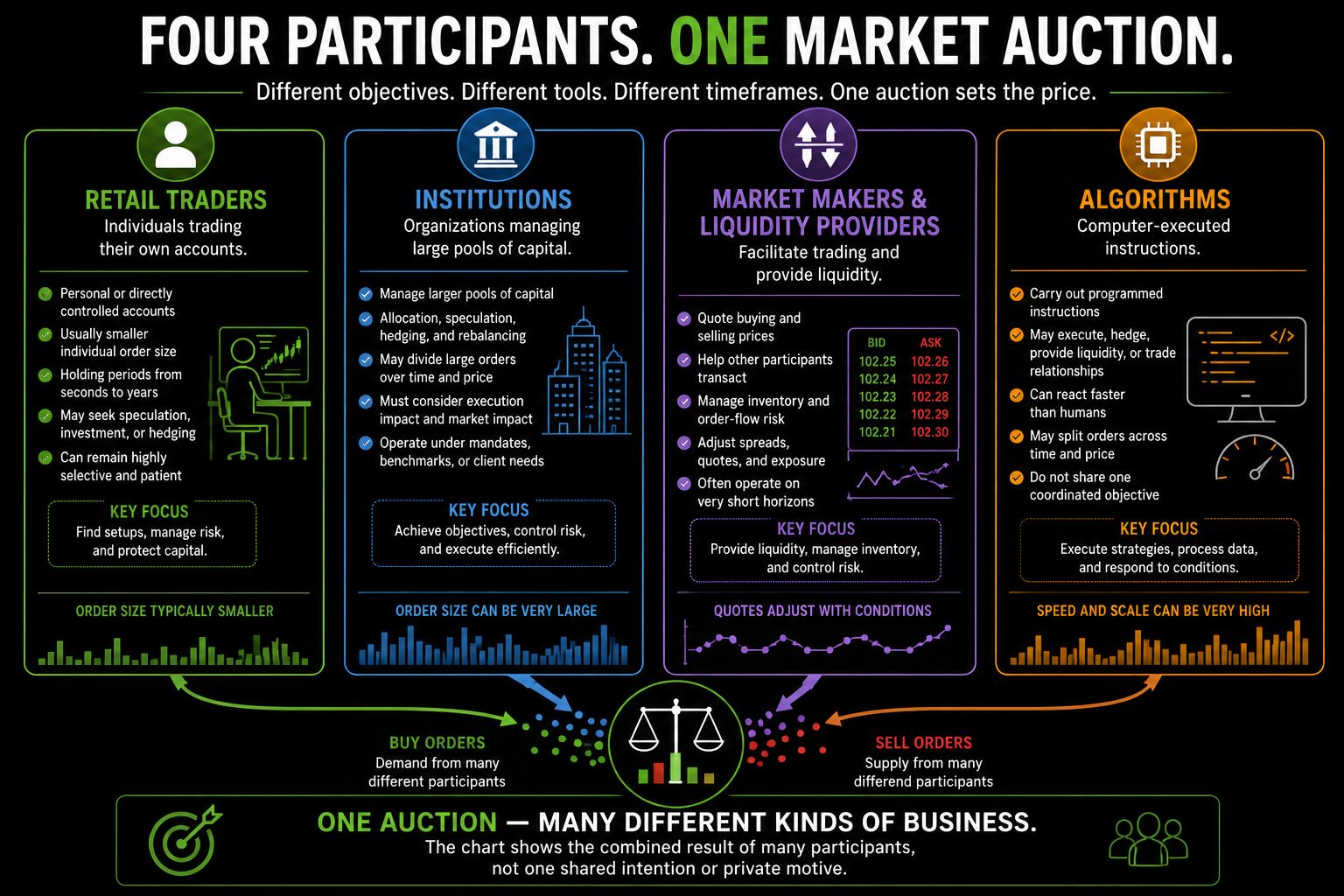
Understanding market participants helps explain why price can look inconsistent. One group may be entering a long-term position while another closes a short-term trade at nearly the same time. A market maker may be managing inventory while an algorithm responds to changing liquidity. The chart shows the combined result, not the private reason behind each order.
The broader lessons in The Market category begin with the idea that price must be read in context. Knowing who may be active does not identify every buyer or seller or reveal a hidden controller behind each candle. It does provide a more realistic way to think about market behavior. The trader can evaluate the auction without turning every move into a story about manipulation.
The Market Is a Meeting Place
A financial market is a place where participants with different needs agree to transact. Some seek short-term movement, some build or reduce large positions, some hedge exposure, and some help orders find counterparties. These objectives can conflict even when the participants are looking at the same price. That conflict is one reason markets move through auctions rather than along a smooth, predictable path.
The lesson in how the stock market actually moves through auction, liquidity, and emotion provides the foundation for this idea. Orders interact at available prices, and price changes when buyers or sellers must reach farther to transact. The participants described below are part of that auction. They help create the demand, supply, urgency, and liquidity visible on the chart.
Retail Traders
Retail traders are individuals trading accounts they control directly. They may hold positions for seconds, days, months, or years, so retail activity is highly varied. Some use charts and technical rules, while others trade news, long-term themes, options, or investment goals. Their orders are usually smaller than major institutional activity, but they still contribute to the auction.
Retail traders often have flexibility that larger organizations do not. They can choose not to trade, change markets, or wait for a specific setup without needing to deploy large capital. They may also be vulnerable to urgency, inconsistent risk, and decisions driven by recent outcomes. Their advantage is not market control; it is the ability to remain selective.
Institutions
Institutions include pension funds, mutual funds, hedge funds, insurers, banks, asset managers, and other organizations managing large pools of capital. Their objectives may include long-term allocation, short-term speculation, hedging, rebalancing, benchmark tracking, or meeting client mandates. Because their orders can be large, they may enter or exit gradually rather than complete a position at one price. Execution quality can matter as much as the directional view.
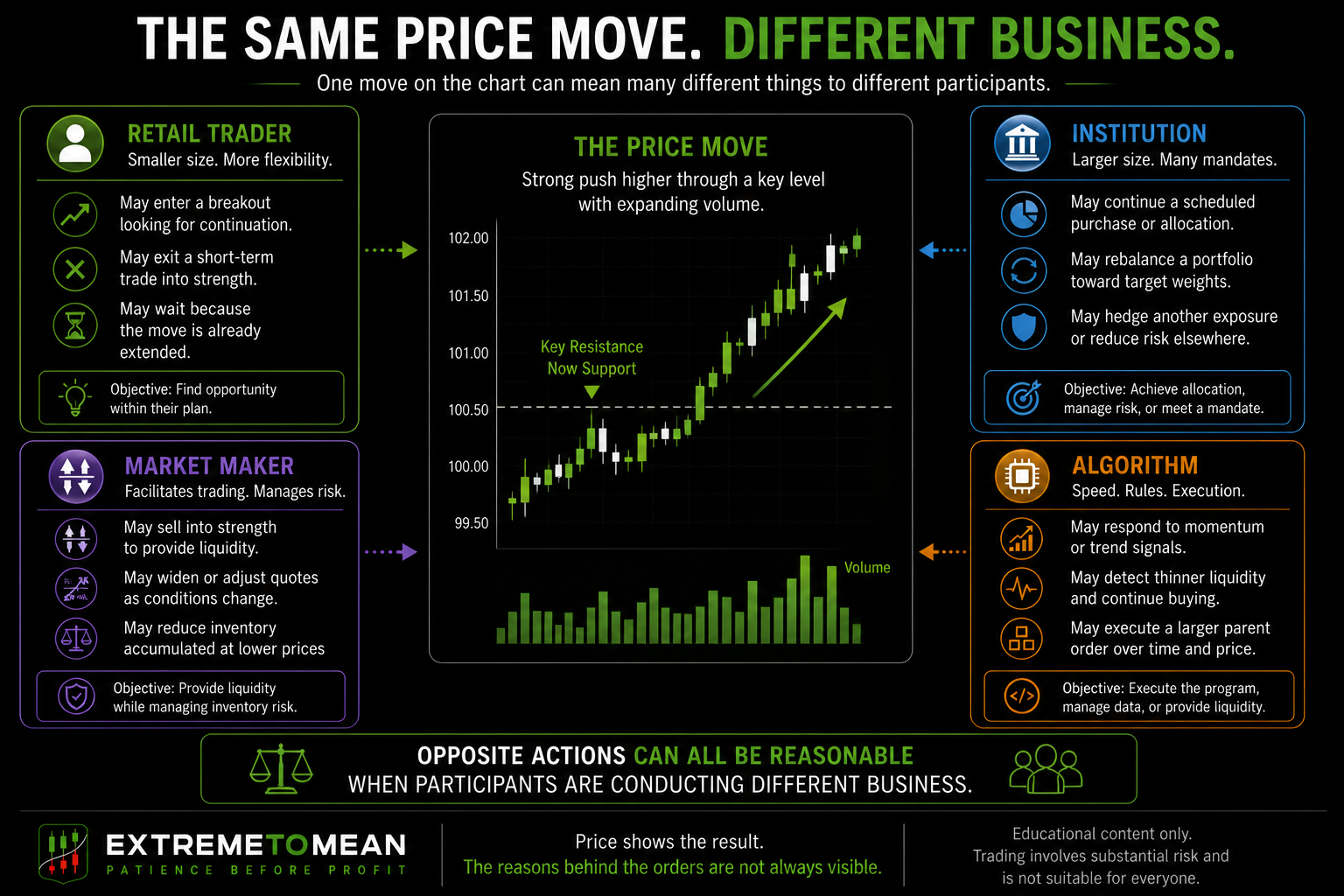
An institution buying does not automatically mean it expects an immediate rally. It may be rebalancing a portfolio, covering another exposure, meeting scheduled inflows, or building a position over time. Likewise, an institutional sale does not always represent a bearish forecast. The business being conducted may reflect risk management or allocation needs that cannot be understood from one candle.
Market Makers and Liquidity Providers
Market makers and other liquidity providers facilitate trading by posting prices at which they will buy or sell. This helps others transact, but it creates inventory risk when one side becomes more active. They may adjust quotes, spreads, and exposure as order flow changes. Their immediate objective is often managing that flow and inventory rather than making a simple long-term prediction.
This does not mean market makers hold price at whatever level they choose. They operate within competition, regulation, available liquidity, and the risk created by other participants. When conditions become uncertain or one-sided, quoted liquidity may become thinner and spreads may widen. Price can then move quickly because less opposing interest is available at nearby levels. That reliance on a regulated intermediary is a useful contrast when comparing how a CBDC and Bitcoin are validated and controlled.
Algorithms
Algorithms are computer-executed instructions, but they do not all perform the same job. Some divide large orders, some provide liquidity, some search for short-term relationships, and others respond to news, volatility, or order-book changes. The speed of an algorithm can be much faster than human reaction, yet the underlying objective still comes from a strategy or business need. “The algorithms” are not one coordinated participant with one shared plan.
Algorithmic execution can make behavior appear sudden or repetitive. Similar conditions may trigger many automated responses, while a large order may be distributed across time and price. These actions can accelerate movement, stabilize it, or shift liquidity quickly. They do not make the next move certain because other systems and people respond at the same time.
Different Timeframes Create Different Decisions
Participants can take opposite actions without either one being irrational. A day trader may sell into strength while a long-term fund continues buying because their holding periods and objectives differ. A market maker may sell to provide liquidity while simultaneously planning to reduce that inventory elsewhere. The same transaction can serve different purposes on each side.
This is why the market comes first before the trader forms a confident story about one participant’s intent. Price behavior should be evaluated through current structure, location, volatility, and market state. A large move may show urgency, but it does not reveal every motive behind the orders. The chart provides evidence of what occurred, not a complete list of who wanted what.
No Single Group Explains Every Move
It is tempting to explain an uncomfortable move by saying institutions hunted a stop, market makers controlled the price, or algorithms targeted retail traders. Those explanations can feel satisfying because they turn uncertainty into a simple story with a clear cause. The problem is that the chart rarely provides enough evidence to prove such a precise motive. A confident story can replace observation before the trader has evaluated what price is actually doing. The same instinct to imagine one controlling actor shows up in monetary discussions too, which is why it helps to understand who actually enforces Bitcoin’s supply rules rather than assuming a single group decides.
Markets can contain manipulation, poor behavior, and temporary distortions, but that does not justify treating every loss or sudden candle as evidence of a coordinated attack. Different participants routinely create sharp moves simply by conducting normal business under changing liquidity. The cleaner approach is to study the response around meaningful areas and avoid claiming knowledge the chart cannot provide. Better context is more useful than a dramatic explanation.
Why Participant Mix Changes Market Behavior
The participant mix can change throughout the day and across market conditions. The open may contain overnight adjustments, fresh information, institutional execution, and short-term speculation together. A quieter period may bring less urgency, while a major announcement can pull many strategies into action. The same visual setup can behave differently because the surrounding auction changed.
The article on three market states helps organize those differences without requiring the trader to identify every participant. A trending market suggests that one side is finding less resistance as price moves, while a rotational market shows more balanced two-way trade. A volatile or conflicted environment may reflect rapid changes in urgency and liquidity. Market state summarizes the combined behavior even when the individual actors remain unknown.
What This Means for the Trader
A retail trader does not need to compete with institutions, market makers, or algorithms on speed or size. The practical job is to recognize that the market contains participants with resources, objectives, and timeframes that differ from their own. That awareness should produce humility, not fear. The trader can wait for locations and conditions where the available evidence becomes clearer.
This is where context comes before the candle. One fast candle may reflect urgency, reduced liquidity, forced execution, news response, or several forces acting together. The trader does not need to choose a dramatic explanation before making a decision. The better process is to evaluate where the move occurred, how price responded, and whether the setup’s risk can be defined.
A Better Question Than “Who Is Controlling This?”
The question “Who is controlling the market?” usually asks for more certainty than the chart can provide. A better question is, “What does the current auction show about urgency, acceptance, rejection, and available liquidity?” That question keeps attention on observable behavior instead of an unverified story. It also helps the trader separate useful context from speculation about hidden motives.
Before acting, the trader can review a short participant-aware filter:
- Is the market behaving directionally, rotationally, or erratically?
- Does price appear accepted at the current area, or is it being rejected?
- Has liquidity become thinner or movement become unusually fast?
- Is the setup forming at a meaningful location or in the middle of noise?
- Am I evaluating observable behavior or inventing a story about who caused it?
- Is the risk clear enough for the setup to earn participation?
The filter does not identify the exact participant behind each order. Its value is that it converts a broad understanding of market participation into a practical reading process. When the answers remain unclear, waiting is not ignorance or weakness. It is recognition that the auction has not provided enough evidence for the trade.
Readers who want to connect participant behavior with broader economic and cross-market context can continue with the Macro Playbook. Macro information can help explain why large groups may be adjusting risk, allocation, or expectations, but it still does not predict each trade. The trader should use that context to improve preparation rather than to create certainty. Participant awareness is useful when it supports better questions, not stronger guesses.
Final Thought
Modern markets are shaped by retail traders, institutions, market makers, algorithms, and many specialized participants operating between those broad groups. They differ in size, speed, holding period, constraints, and purpose. Their combined business creates the auction visible on the chart. No single category explains every movement.
The trader does not need to know the identity behind every order to make a disciplined decision. It is enough to understand that price reflects competing objectives and changing liquidity rather than one simple opinion. That perspective encourages patience, context, and respect for uncertainty. The market becomes easier to evaluate when the trader stops searching for one controller and starts reading the behavior created by many participants.
Educational content only. Trading involves substantial risk and is not suitable for everyone.